Poker Tournament Management App
Run Poker Tournaments Like a Pro!
From First Hand to Final Table
Seat draws, table balancing, the clock, payouts and league standings: Shuffle Up and Deal! runs the whole night from your iPhone or iPad.

Big blind ante explained: players and TDs guide

The big blind ante is a tournament ante collection method in which the player in the big blind posts the entire table’s antes on top of their normal blind. Instead of every player posting a small chip individually, one player covers the whole lot. The WSOP adopted this format to speed play and cut dealer errors, and it has since become standard across large-field events at the WPT and EPT. If you are running a multi-table tournament with 30 or more players, this format will save you time every single orbit. If you are a player stepping into one for the first time, your big blind defence strategy needs an immediate rethink.
Table of Contents
-
How should tournament directors implement the big blind ante?
-
Shuffle Up and Deal! makes big blind ante structures simple to build
How does the big blind ante actually work?
The posting sequence matters more than most players realise, especially when short stacks are involved.
-
Step 1 - Ante posted first: The big blind posts the combined ante for the whole table before posting their blind. This order is deliberate: if the player is all-in and cannot cover both, the blind takes priority.
-
Step 2 - Big blind posted: The normal big blind follows immediately after the ante.
-
Step 3 - Small blind and action: The small blind posts as usual, then action opens from under the gun.
-
Short-stack edge case: When a player cannot cover both blind and ante, the blind is posted first. Any remaining chips go towards the ante and are treated as dead money, which affects side-pot eligibility.
-
Chopped pots: If the hand ends in a chop, the ante is split among eligible winners. Dead-money portions from all-in short stacks are not returned.
Why do tournaments adopt the big blind ante?
The operational case is straightforward. Collecting individual antes from many players takes considerably more time per hand than collecting from just one player. That difference compounds across an entire event, yielding a noticeable increase in hands played per hour in full-ring play.
| Benefit | Impact |
|---|---|
| Faster collection | ~5–10 more hands per hour vs traditional antes |
| Fewer dealer errors | One collection point reduces miscounts and missed antes |
| Cleaner hand flow | No waiting for slow posters around the table |
| Simpler for players | Only the big blind needs to track the ante obligation |
The trade-offs are real, though. The big blind carries a disproportionate cost each orbit, which tightens optimal defence ranges and increases pressure on short stacks. For very small home games of eight players or fewer, the efficiency gain shrinks and the positional tax on the big blind can feel punishing rather than fair. Cash games should avoid this format entirely - it belongs in tournament play.
Adoption context: The big blind ante moved from high-roller events into mainstream festival schedules in the late 2010s and is now standard at large-field events including the WSOP, WPT and EPT.
How does the big blind ante change your strategy?
The increased cost borne by the big blind is the single biggest strategic shift. Because the big blind now pays the entire table’s ante on top of the blind, many calls that were marginally profitable in a traditional ante structure become losing plays. Your defence range tightens, and players who previously called wide from the big blind need to fold more hands.

For small stacks (under 15 big blinds), the ante pressure accelerates the push-fold decision. Getting blinded and anted down is faster than in a traditional structure, so shoving ranges widen slightly to compensate. Medium stacks (15–40 big blinds) should steal more aggressively from the button and cutoff, because the big blind’s tighter defence range means steals succeed at a higher frequency. Deep stacks can play more freely, but even they should expect opponents in the big blind to defend with stronger-than-usual hands.
An illustrative hand: blinds are 2,000/4,000 with a 4,000 ante. The big blind has already committed 4,000. A button open to 9,000 now requires the big blind to call 5,000 more into a pot of roughly 19,000. The pot odds look fine on paper, but the big blind’s range is already weakened by the ante commitment, and a call with a marginal hand like K-7 offsuit is a leak. Folding is correct far more often than in a traditional ante game.
Pro Tip: When defending the big blind in a big blind ante format, use the pot odds as a starting point but weight your decision towards folding marginal hands. The ante you already posted is gone - only the additional call amount matters for your decision.
How should tournament directors implement the big blind ante?

Start with a clear announcement before play begins. Players accustomed to traditional antes will miss the change if you do not flag it explicitly. Table signage stating “Big Blind Ante in Effect” prevents confusion on the first hand of a new level.
Procedural checklist before cards go in the air:
-
Confirm chip denominations match your ante values (no awkward fractions).
-
Verify the ante scales correctly with each blind level in your structure.
-
Brief dealers on the posting order: ante first, then big blind.
-
Confirm the short-stack rule: blind before ante, remainder is dead money.
-
Plan your colour-up schedule around the ante denomination, not just the blinds.
For the structure itself, the Shuffle Up and Deal! Blind Wizard is the fastest way to build an ante-inclusive blind structure that actually fits your event. Tell it your player count, rebuy style, chip denominations and your target finish time, then choose a pace: Turbo, Standard or Deep Stack. The Wizard generates blind levels snapped to your actual chips, schedules breaks and chip races, recommends starting stacks, and adds contingency levels in case the night runs long. A colour-coded indicator shows at a glance whether the structure fits your time window, and WSOP-style presets are built in for organisers who want a proven starting point. Every level stays fully editable afterwards, so you can adjust the ante scaling or add a level without rebuilding from scratch.
Blind Wizard in practice: Input your chip set and finish time, and the Wizard snaps every ante value to a denomination you actually have in play - no awkward chip races, no mid-event scrambles for change. It is the difference between a structure that works on paper and one that works at the table.
Pro Tip: Run the Blind Wizard with your exact chip denominations before the event, not after. A structure that looks clean on a spreadsheet can create chaos if the ante values do not match your chip set.
Key takeaways
The big blind ante is the most efficient ante format for multi-table tournaments, and understanding its mechanics protects both your event and your chip stack.
| Point | Details |
|---|---|
| Core mechanic | The big blind posts the per-player ante multiplied by players seated, plus the normal blind. |
| Short-stack rule | When chips are insufficient, the blind is posted first; the remainder is dead money. |
| Strategic adjustment | Tighten big blind defence ranges and steal more aggressively from late position. |
| TD implementation | Snap ante values to chip denominations and announce the format before play begins. |
| Shuffle Up and Deal! Blind Wizard | Builds a complete, chip-snapped blind structure in seconds with WSOP-style presets and a time-fit indicator. |
Why the big blind ante deserves more credit than it gets
Most of the debate around this format focuses on fairness - specifically, whether it is equitable for one seat to shoulder the whole table’s ante obligation. That framing misses the point. In a rotating blind structure, every player sits in the big blind with equal frequency. The positional tax is not permanent; it is cyclical. What the big blind ante actually does is remove the single most friction-heavy moment in tournament poker: nine players fumbling for chips while the dealer waits.
The real under appreciated benefit is what it does to game pace psychologically. Faster hands mean players reach meaningful decisions sooner, which keeps energy at the table high. Organisers who have switched report fewer complaints about slow play, not more. The format also makes life considerably easier for dealers, who can focus on the deal rather than chasing antes around the table.
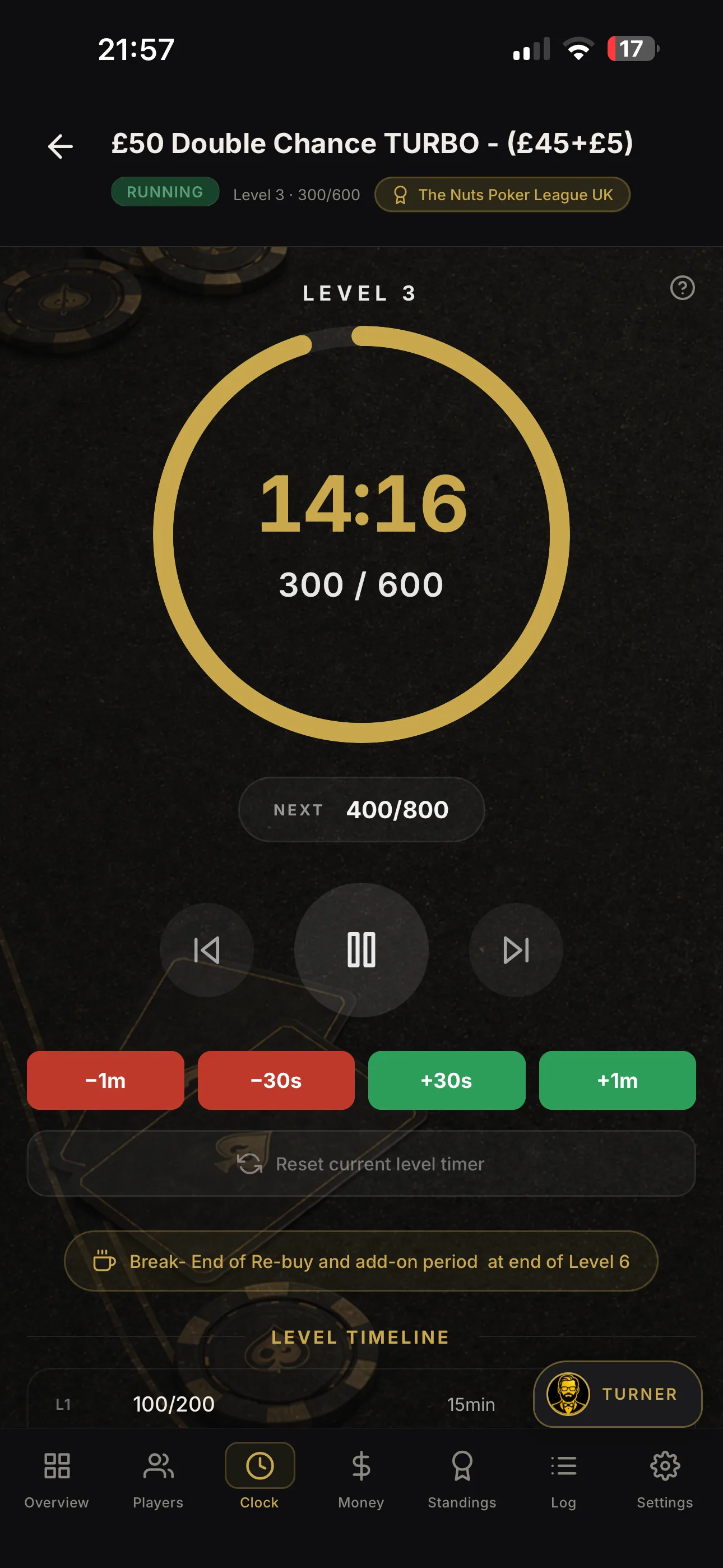
The one genuine concern worth taking seriously is player communication. Regulars who have played traditional antes for years will occasionally post individual chips out of habit. A brief announcement at the start of each new level, combined with clear table signage, handles this almost entirely. Shuffle Up and Deal!’s live tournament clock and level display make that communication automatic - players see the current level, blinds and ante format on the shared display without the TD needing to repeat it.
Shuffle Up and Deal! makes big blind ante structures simple to build
Running a big blind ante event without a proper blind structure is the fastest route to a tournament that runs two hours over schedule. Shuffle Up and Deal! gives tournament directors a purpose-built tool that removes that risk entirely.
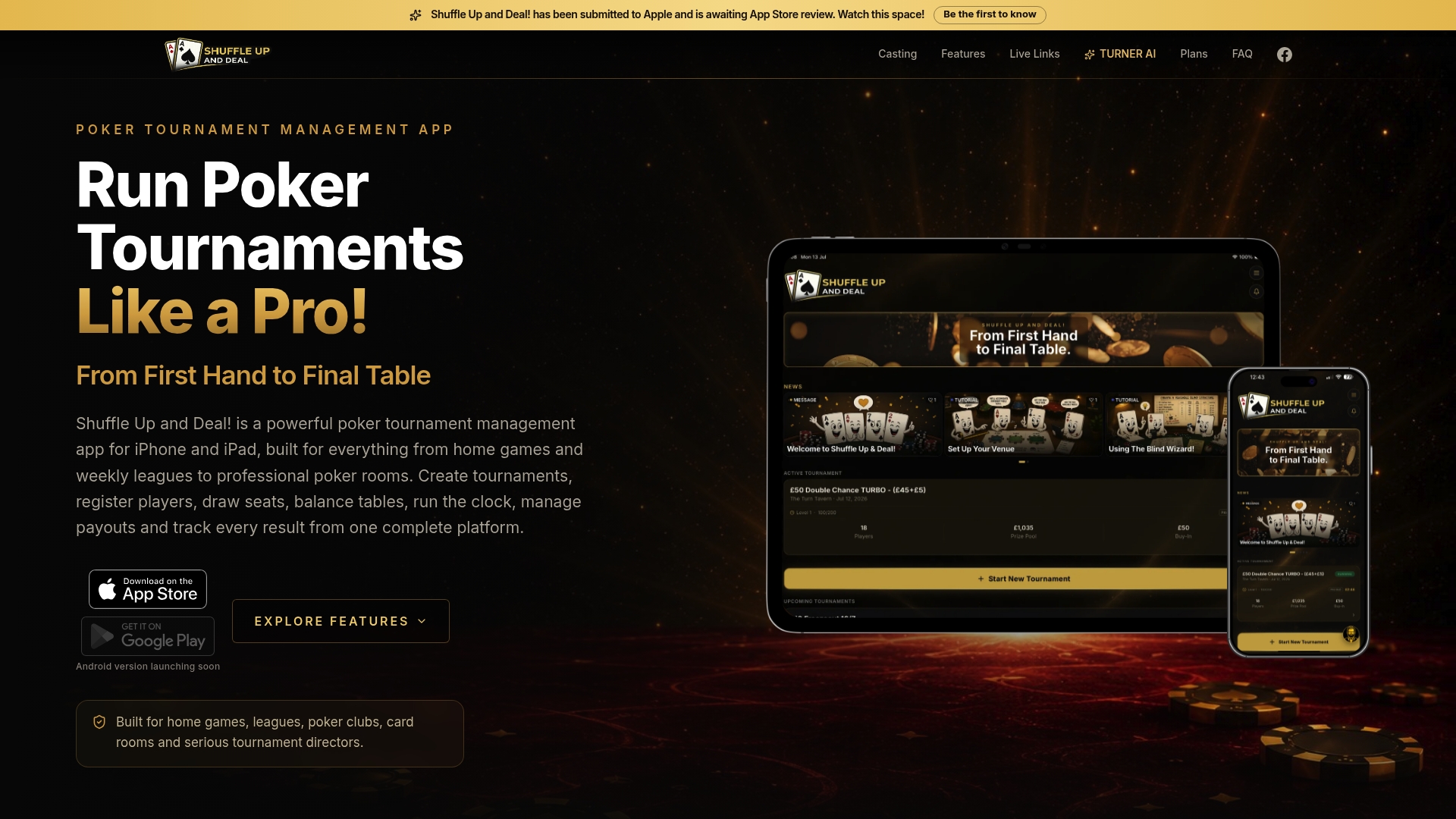
The Blind Wizard in Shuffle Up and Deal! takes your player count, rebuy style, chip denominations and finish time, then generates a complete structure in seconds. Antes are snapped to your actual chip denominations automatically. Breaks, chip races and contingency levels are scheduled without any manual calculation. WSOP-style presets give you a proven starting point, and the colour-coded time-fit indicator tells you immediately whether the structure works for your event. Every level is fully editable, so adjusting the ante scaling for a specific level takes seconds rather than a rebuild. Whether you are running a home game for 20 players or a card room festival for 200, the app keeps your event on time and your players focused on poker. Try the free plan at Shuffle Up and Deal! and build your first ante structure before your next event.
Useful sources and further reading
-
Procedural and rule reference: Big Blind Ante in Poker: Meaning, Rules, and How It Works - covers posting order, short-stack rules and calculation mechanics in detail.
-
Official adoption context: Big blind ante coming to WSOP - the WSOP announcement explaining the operational rationale for switching formats.
-
Ante sizing and terminology: Ante in poker - CardPlayer glossary - defines ante proportions and strategic implications for tournament play.
-
Blind structure planning: Poker Tournament Blind Structure Generator - Home Poker Info - practical guidance on snapping ante values to chip denominations and building workable structures.
-
Community discussion and format comparison: What is the Big Blind Ante? - Poker StackExchange - forum debate covering button-ante alternatives and perceived fairness differences.
-
Tool documentation: Shuffle Up and Deal! - app landing page covering the Blind Wizard, smart seating, live clock and WSOP-style presets for tournament directors.