Poker Tournament Management App
Run Poker Tournaments Like a Pro!
From First Hand to Final Table
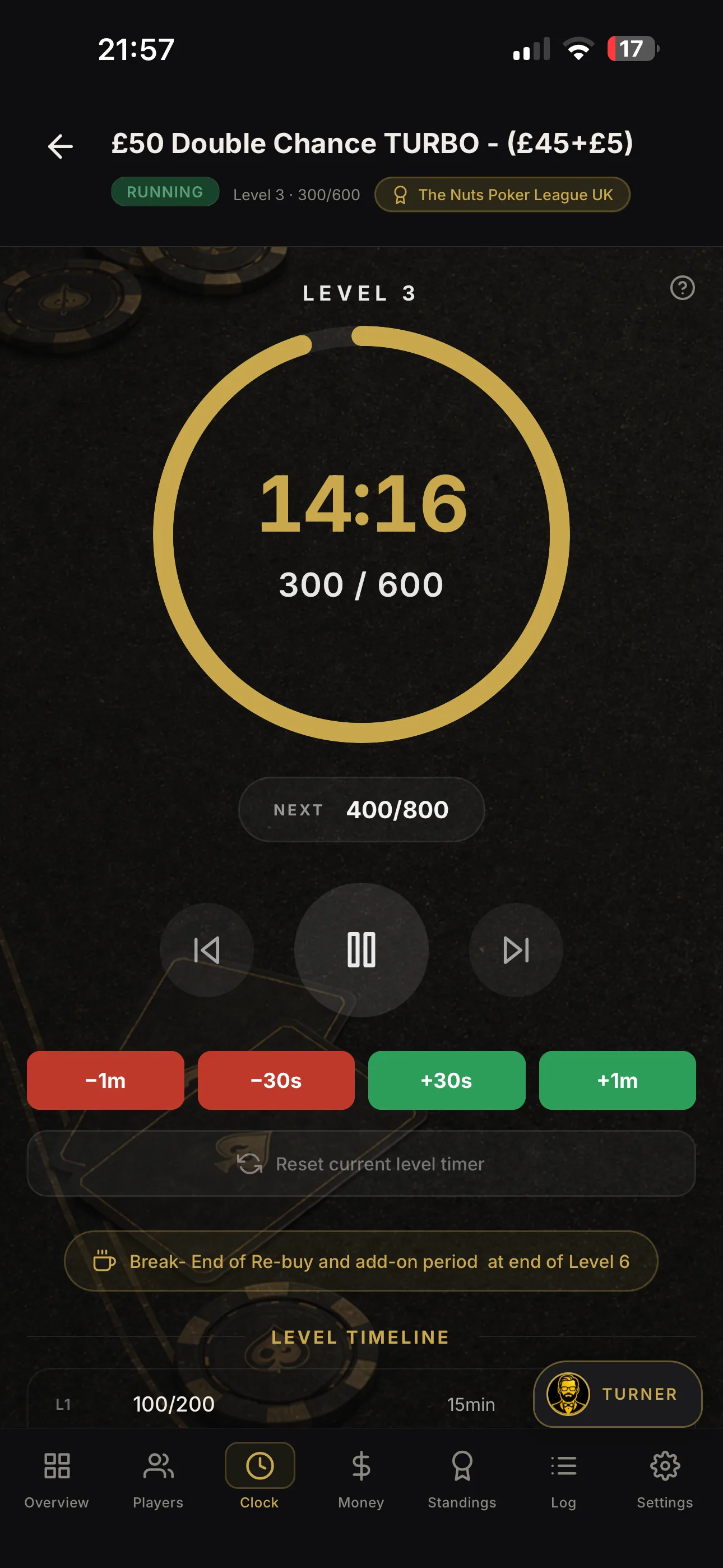
Seat draws, table balancing, the clock, payouts and league standings: Shuffle Up and Deal! runs the whole night from your iPhone or iPad.

Freezeout tournament rules: the complete guide for players and TDs

A freezeout is a poker tournament where each player buys in once, plays until their chips are gone, and leaves. No rebuys. No re-entries. When you’re out, you’re out. The practical implication is immediate: every chip you hold carries genuine tournament equity, and the TD must publish a clear structure sheet before the first card is dealt.
Before you register for any event billed as a freezeout, check the structure sheet. If it mentions “re-entry,” “rebuy,” or “add-on,” the event is not a pure freezeout regardless of how it is marketed.
At a glance:
-
Single entry only; elimination is permanent once chips are lost
-
No rebuys or re-entries permitted in a true freezeout format
-
Prize pool is fixed to unique buy-ins, so the payout table is predictable
-
TDs must publish the full structure sheet, including blind schedule and payout breakdown, before registration opens
-
Always verify the structure sheet wording before you hand over your buy-in
Table of Contents
-
What are the core freezeout rules every player and organiser should know?
-
How should your strategy change at each stage of a freezeout?
-
How do freezeouts differ from rebuy, re-entry and add-on formats?
-
How can organisers enforce freezeout rules reliably with Shuffle Up and Deal!?
-
Shuffle Up and Deal! makes running freezeouts straightforward
What are the core freezeout rules every player and organiser should know?
The WSOP Main Event is the most famous freezeout in the world, and its rules set the template most UK clubs follow. Here is what a proper freezeout structure sheet must establish, and what players should expect when they sit down.
Mandatory clauses for organisers
-
Single-entry rule: Each player registers once. The structure sheet must state this explicitly, e.g. “This is a freezeout event. No rebuys, re-entries, or add-ons are permitted.”
-
Buy-in and fee split: State the total cost, the portion going to the prize pool, and the house fee separately (e.g. £50 + £5). Players have a right to know exactly what enters the pot.
-
Starting stack: Publish the chip count in full (e.g. 10,000 chips). Never describe it vaguely as “a good starting stack.”
-
Late registration window: If late registration is offered, state the cut-off level precisely. Once that level begins, the field freezes and no new entries are accepted.
-
Add-ons: If an add-on is permitted at the first break, say so clearly. An add-on is not a rebuy, but it must be declared on the structure sheet or it cannot be offered.
What elimination means in practice
When a player loses all their chips, their seat is removed from the table immediately. Their cards are dead on any hand in progress at the moment of elimination. If a player is absent from their seat, their hand is dealt and folded automatically; their blinds are posted as normal. Chips are never removed from play or redistributed outside of standard pot mechanics.
Pro Tip: If you are running the event, add a single line to your structure sheet that reads: “This is a freezeout. Re-entry and rebuy are not available at any stage.” That one sentence prevents the most common registration dispute.
Structure sheet checklist for TDs
A complete structure sheet should include:
-
Event name, date, venue, and TD contact details
-
Buy-in amount, house fee, and prize-pool contribution per player
-
Starting chip stack
-
Full blind and ante schedule (level by level)
-
Level length in minutes
-
Late registration cut-off (level number and time)
-
Break schedule (frequency and duration)
-
Payout table (number of places paid and percentage or amount per place)
-
Add-on details, if applicable
-
Dispute escalation procedure
How does a freezeout’s structure sheet work in practice?
The structure sheet is the rulebook for your event. Every number on it shapes how the game plays out, from the first hand to the final showdown.
Key definitions
Starting stack is the number of chips each player receives at registration. Big blind (BB) and small blind are the forced bets that rotate around the table. Antes are additional forced contributions, usually introduced in later levels to accelerate action. Blind levels are the scheduled increases to those forced bets, and level length is how many minutes each level lasts before the blinds go up. Late registration is the window during which new players can still enter; once it closes, the field is frozen.
A worked UK example
Consider a typical Saturday-night club freezeout in the UK:
-
Buy-in: £30 + £5 house fee
-
Starting stack: 10,000 chips
-
Level length: 20 minutes
-
Late registration: Closes at the end of Level 4 (80 minutes in)
-
Antes: Introduced at Level 7
-
Breaks: 10 minutes after every four levels
At Level 1, blinds are 50/100 and a 10,000-chip stack gives you 100 big blinds, plenty of room to play. By Level 8 (blinds 400/800 with a 100 ante), a player who has not grown their stack is down to around 10–12 big blinds and entering push-fold territory.
Estimated duration table
| Levels | Minutes per level | Cumulative time | Stage |
|---|---|---|---|
| 1–4 | 20 | 80 min | Early (late reg open) |
| 5–8 | 20 | 80 min | Middle |
| 9–12 | 20 | 80 min | Late / bubble |
| - | 20 | Variable | Final table / heads-up |
A 30-player event with 20-minute levels typically runs several hours from first hand to final payout. Larger fields should budget proportionally more time for completion.
Before you register, verify:
-
The payout table (how many places are paid and for how much)
-
The exact fee deduction from the prize pool
-
The late-registration cut-off level
-
Whether the word “re-entry” appears anywhere in the rules
How should your strategy change at each stage of a freezeout?
Because there are no second chances, every chip decision carries more weight in a freezeout than in a rebuy event. Strategy must shift with each stage.
Early stage: protect your stack
Play tight and position-focused. Avoid marginal all-ins, particularly against unknown opponents. The goal is to reach the middle stage with at least your starting stack intact. Speculative hands are fine in position with implied odds, but do not commit significant chips to coin-flip situations when the blinds are still small relative to your stack.

Middle stage: apply pressure
As blinds climb and antes kick in, the cost of folding increases. Expand your stealing range from the button and cut-off. Exploit fold equity against players who are short-stacked and desperate to survive. Track your stack-to-blinds ratio (S/BB): below 20 big blinds, your hand-selection options narrow sharply.
Late stage and the bubble
ICM awareness is the defining skill near the bubble. Chips you win are worth less than chips you lose, because losing means elimination. A player with a large stack can apply enormous pressure on medium stacks who are trying to ladder into the money. Short stacks should look for spots to shove rather than bleed out blind by blind.
Push-fold thresholds are worth memorising or calculating in advance. As a rough guide, with fewer than 10 big blinds you are generally in push-or-fold territory with most hands. With 10–15 big blinds, position and opponent tendencies matter more than raw hand strength.
Pro Tip: Near the bubble, use an ICM calculator to model the equity difference between busting now and surviving one more spot. The numbers often justify folding hands that feel strong in a cash game context.
Heads-up play
Heads-up in a freezeout tends to be more deliberate than in re-entry events, because both players have earned their seat through patient survival rather than multiple bullets. Aggression is still rewarded, but the rhythm shifts: position matters on every single hand, and small-ball pressure often outperforms reckless shoves.
What are the standard TD rulings for UK freezeout events?
Consistent floor decisions protect the integrity of the event and keep players confident in the process. Here are the rulings TDs encounter most often.
Common floor calls
-
Misdeal: If the first or second card is exposed during the deal, it is a misdeal and the hand is redealt. Cards exposed later in the deal are handled according to the house rules for exposed cards.
-
Exposed card: A card accidentally flashed before the action is complete is shown to all players and may be replaced at the TD’s discretion, depending on house rules.
-
Chip count dispute: Any player may request a chip count at any time. The TD counts the chips and the result stands. Estimates are not permitted in a disputed count.
-
Seat absence: A player absent from their seat has their hand dealt and folded automatically. Their blinds are posted. If a player misses their big blind repeatedly without notification, the TD may declare their seat dead after a reasonable number of hands, returning chips to the prize pool if applicable.
-
Dead hands: A hand is declared dead if a player acts out of turn, tables cards prematurely, or their cards touch the muck.
Hand-for-hand on the bubble
When one elimination separates the field from the money, the TD calls hand-for-hand play. Every table deals one hand simultaneously, then pauses. This prevents players at one table from stalling while another table plays multiple hands. Hand-for-hand continues until a player is eliminated and the money bubble bursts.
Straddle policy
Straddling is uncommon in UK freezeouts and many clubs prohibit it entirely. If your event permits a straddle, state it explicitly on the structure sheet: “A live straddle of 2x the big blind is permitted from the under-the-gun position only.” If it is not mentioned, the default is no straddle.
TD ruling principle: Every floor decision should be announced clearly to the whole table, not whispered to the player who called the floor. State the ruling, the reason, and whether it is final or subject to appeal. Players who hear the reasoning accept outcomes far more readily than those who receive a verdict with no explanation.
Pro Tip: Log every floor call with the time, the level, the chip counts involved, and the names of any witnesses. A written incident log is your best defence if a dispute resurfaces at payout time.
How do freezeouts differ from rebuy, re-entry and add-on formats?
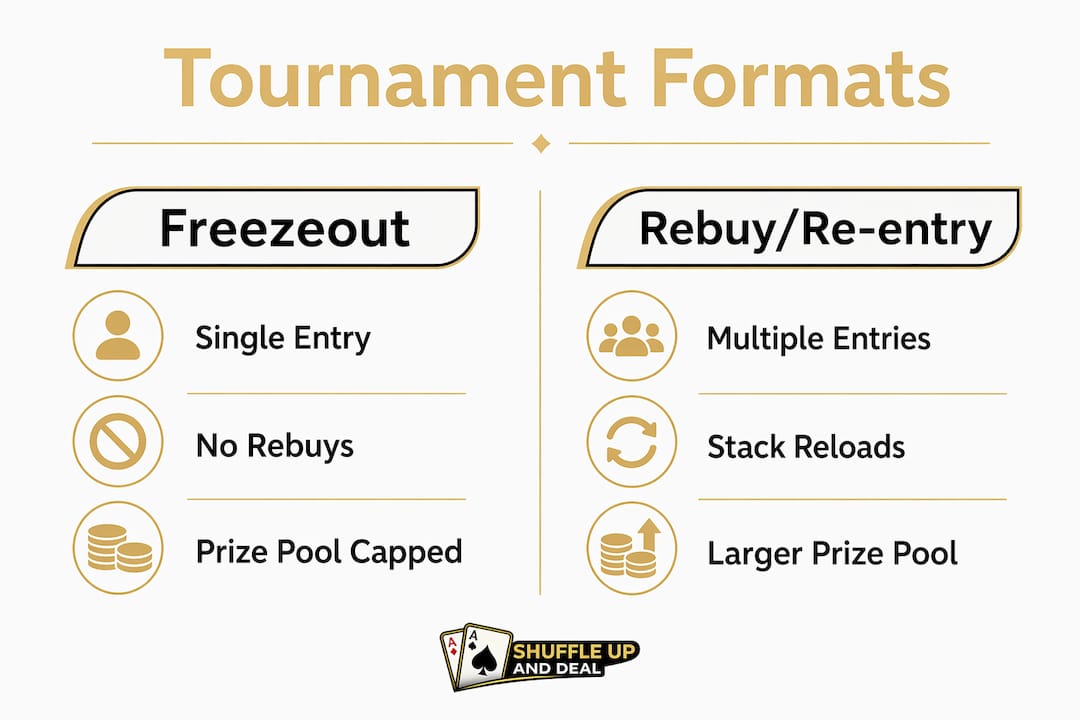
A pure freezeout does not allow re-entry; any event that does is a different format, regardless of the name on the flyer. Understanding the differences helps you choose the right event and adjust your strategy accordingly.
The key distinctions
Rebuy and re-entry formats encourage looser early play because players know they can reload. Prize pools grow larger, variance increases, and the early stages often resemble a cash game more than a tournament. Freezeouts reward patience and precise chip preservation from the very first hand.
Watch for these phrases on structure sheets that signal the event is not a pure freezeout:
-
“Re-entry available until Level X”
-
“One rebuy permitted in the first two levels”
-
“Add-on available at the first break” (add-ons alone do not disqualify a freezeout label, but they must be declared)
-
“Unlimited rebuys in the rebuy period”
Some events marketed with a “freezeout phase” actually permit limited re-entries on Day 1 of a multi-day event. Always confirm the precise re-entry window with the TD before registering.
Payout shape
Freezeouts tend to produce smaller prize pools than rebuy events because the pool is capped at unique buy-ins. The payout structure is typically top-heavy, with the winner taking a disproportionate share. That shape rewards survival and ICM discipline more than it rewards chip accumulation for its own sake.
Format comparison table
| Attribute | Freezeout | Rebuy | Re-entry | Add-on only |
|---|---|---|---|---|
| Entries per player | 1 | Multiple (rebuy period) | Multiple (until cut-off) | 1 |
| Rebuys permitted | No | Yes | No | No |
| Re-entries permitted | No | No | Yes | No |
| Add-on available | Rarely | Often | Sometimes | Yes |
| Prize pool growth | Fixed | Variable (larger) | Variable (larger) | Modest |
| Early-stage strategy | Tight/patient | Often loose | Often loose | Tight/patient |
What does a sample UK freezeout structure sheet look like?
Here is a compact structure sheet a TD can adapt for a typical UK club event, followed by a worked hand scenario near the bubble.
Sample structure sheet
Event: Saturday Night Freezeout Buy-in: £30 + £5 (£30 to prize pool, £5 house fee) Starting stack: 10,000 chips Level length: 20 minutes Late registration: Closes at the end of Level 4 Add-ons: None Re-entries/Rebuys: Not permitted Breaks: 10 minutes after Levels 4, 8, and 12
| Level | Small blind | Big blind | Ante |
|---|---|---|---|
| 1 | 50 | 100 | - |
| 3 | 100 | 200 | - |
| 4 | 150 | 300 | - |
| 5 | 200 | 400 | - |
| 6 | 300 | 600 | - |
| 7 | 400 | 800 | 100 |
| 8 | 500 | 1,000 | 100 |
| 9 | 600 | 1,200 | 150 |
| 10 | 800 | 1,600 | 200 |
| 11 | 1,000 | 2,000 | 300 |
| 12 | 1,500 | 3,000 | 500 |
Payout (30 players, top 4 paid):
-
1st: 45% of prize pool
-
2nd: 25%
-
3rd: 18%
-
4th: 12%
TD contact: [Name], [mobile number], available throughout the event.
Worked bubble scenario
Thirty players entered. The prize pool is £900 (30 × £30). Five players remain; four are paid. Player A has 28,000 chips, Player B has 12,000, Player C has 9,000, Player D has 6,000, and Player E has 5,000.

Player E is in the big blind with 5,000 chips at Level 11 (blinds 1,000/2,000, ante 300). Player A shoves from the button. Player E holds A-J offsuit.
In a cash game, A-J is a clear call. In this freezeout, ICM says otherwise. Player E is the shortest stack; surviving one more elimination means a guaranteed payout. Calling and losing means zero. Folding costs 2,000 chips but preserves 3,000 and keeps Player E alive. Most ICM models recommend folding here unless Player E has a read that Player A is shoving very wide.
Pro Tip: Build your blind schedule so that stacks are between 15 and 25 big blinds at the bubble. That range produces the most interesting push-fold decisions and keeps the game moving without forcing players into pure luck spots.
What should you check before entering a UK freezeout?
A two-minute review of the structure sheet before you register can save you a significant surprise at the table.
-
Format wording: Does the sheet explicitly say “freezeout” and confirm no rebuys or re-entries? If it says “re-entry until Level X,” it is not a freezeout.
-
Starting stack and level length: Calculate your starting stack in big blinds. Fewer than 50 big blinds at Level 1 means the event plays fast and push-fold arrives early.
-
Payout table: How many places are paid? What percentage does first place receive? Is the structure top-heavy or relatively flat?
-
Fee split: What percentage of your buy-in goes to the prize pool versus the house? A £50 buy-in with a £10 house fee means only £40 per player enters the pot.
-
Late registration window: If you arrive late, can you still enter? At what level does registration close?
-
Break schedule: Know when breaks fall so you can plan accordingly.
-
TD contact details: Who do you call if there is a dispute? Is there a floor person on site throughout?
Questions to ask the TD on arrival:
-
Are chip counts verified at registration, and how are discrepancies handled?
-
What happens if a player is absent at their seat for multiple hands?
-
Is an ICM calculator available for deal-making at the final table?
-
Is there a live share link so spectators or absent players can follow the chip counts?
How can organisers enforce freezeout rules reliably with Shuffle Up and Deal!?
Running a clean freezeout manually is possible, but the margin for error is real. Shuffle Up and Deal!’s tournament management app is built specifically to handle the mechanics that cause disputes: single-entry control, blind progression, table balancing, and payout tracking.
Features that matter for freezeout events
-
Single-entry control: The app enforces one registration per player, preventing accidental duplicate entries and removing the need for a manual check at the door.
-
Blind clock: A live, configurable clock advances through your blind schedule automatically, with audio and visual alerts at each level change. No more arguments about when the blinds went up.
-
Smart table balancing: As players are eliminated, the app’s seating algorithm redistributes players across tables evenly, keeping seat counts balanced without manual calculation.
-
Late registration controls: Set the cut-off level in the app and it locks registration automatically when that level begins. The field freezes without any TD intervention.
-
Payout tracking: Enter your prize pool and payout percentages once; the app calculates exact payouts in real time as players are eliminated.
-
ICM calculator: Built-in ICM tools let players and TDs model deal equity at the final table, reducing disputes and speeding up deal negotiations.
-
Live share links: Generate a shareable link so players, spectators, and absent registrants can follow chip counts, blind levels, and eliminations in real time on any device.
-
Multi-device syncing: Multiple TDs can manage the same event simultaneously from different devices, keeping the floor consistent.
Setting up a freezeout event in the app
-
Create a new event and select the freezeout format (single-entry, no rebuys).
-
Enter the starting stack, buy-in amount, house fee, and prize-pool contribution.
-
Input your blind schedule level by level, including antes and level length.
-
Set the late registration cut-off level.
-
Add the payout structure (number of places and percentages).
-
Publish the live share link before registration opens so players can verify the structure sheet on their phones.
Transparent, real-time updates prevent the most common misunderstandings at registration and during the event. When every player can see the current blind level, chip counts, and payout table on their own device, the number of floor calls drops noticeably.
Pro Tip: Use the live share link as your published structure sheet. Send it to players when they register and post it in your club’s WhatsApp group. It updates automatically as the event progresses, so there is never a version-control problem with a printed sheet.
Shuffle Up and Deal! is one implementation option; organisers can run a freezeout with any combination of tools. That said, the app is a genuinely powerful choice for UK clubs and home game organisers who want to run professional, dispute-free events without the overhead of a full card-room team.
Key takeaways
A freezeout is the purest form of poker tournament: one entry, no second chances, and every chip decision matters from the first hand to the last.
| Point | Details |
|---|---|
| Single entry, no exceptions | A true freezeout permits no rebuys or re-entries; verify this on the structure sheet before registering. |
| Chips carry real equity | Because elimination is permanent, ICM awareness near the bubble changes calling and shoving decisions significantly. |
| TDs must publish full structure sheets | The sheet must include blind schedule, level length, payout table, fee split, and late-registration cut-off. |
| Freezeouts produce fixed prize pools | Prize pools are capped at unique buy-ins, making payout calculations predictable and top-heavy structures common. |
| Shuffle Up and Deal! for organisers | The Shuffle Up and Deal! app enforces single-entry rules, automates the blind clock, and publishes live share links so players can verify the structure in real time. |
What running freezeouts actually teaches you
There is a gap between knowing the rules of a freezeout and understanding why they matter. Most disputes at UK club events do not come from players who are trying to cheat; they come from players who genuinely did not read the structure sheet, or from TDs who published one that was ambiguous.
The bubble is where this becomes acute. A hand-for-hand ruling that is announced clearly and consistently, with the reasoning explained to every table, takes thirty seconds. The same ruling delivered quietly to one table while another table keeps playing creates a grievance that outlasts the tournament. The procedural detail is not bureaucracy; it is the difference between a player who accepts a bad beat and one who files a complaint.
The other lesson is about chip preservation. In rebuy events, players who bust early simply reload and adjust. In a freezeout, the player who survives the first two levels with their stack intact has a structural advantage that compounds as the field shrinks. Patience is not passive; it is a deliberate strategy that the format rewards.
One small change that makes an immediate difference: announce the hand-for-hand start loudly, at every table, simultaneously. Players who know the bubble has officially begun adjust their behaviour instantly. Those who find out two hands later feel cheated, even when the ruling was correct.
Shuffle Up and Deal! makes running freezeouts straightforward
Running a freezeout with confidence means having the right tools in place before the first hand is dealt. Shuffle Up and Deal! gives you single-entry controls, an automated blind clock, live share links, and built-in payout tracking, all in one app designed for iPhone and iPad.
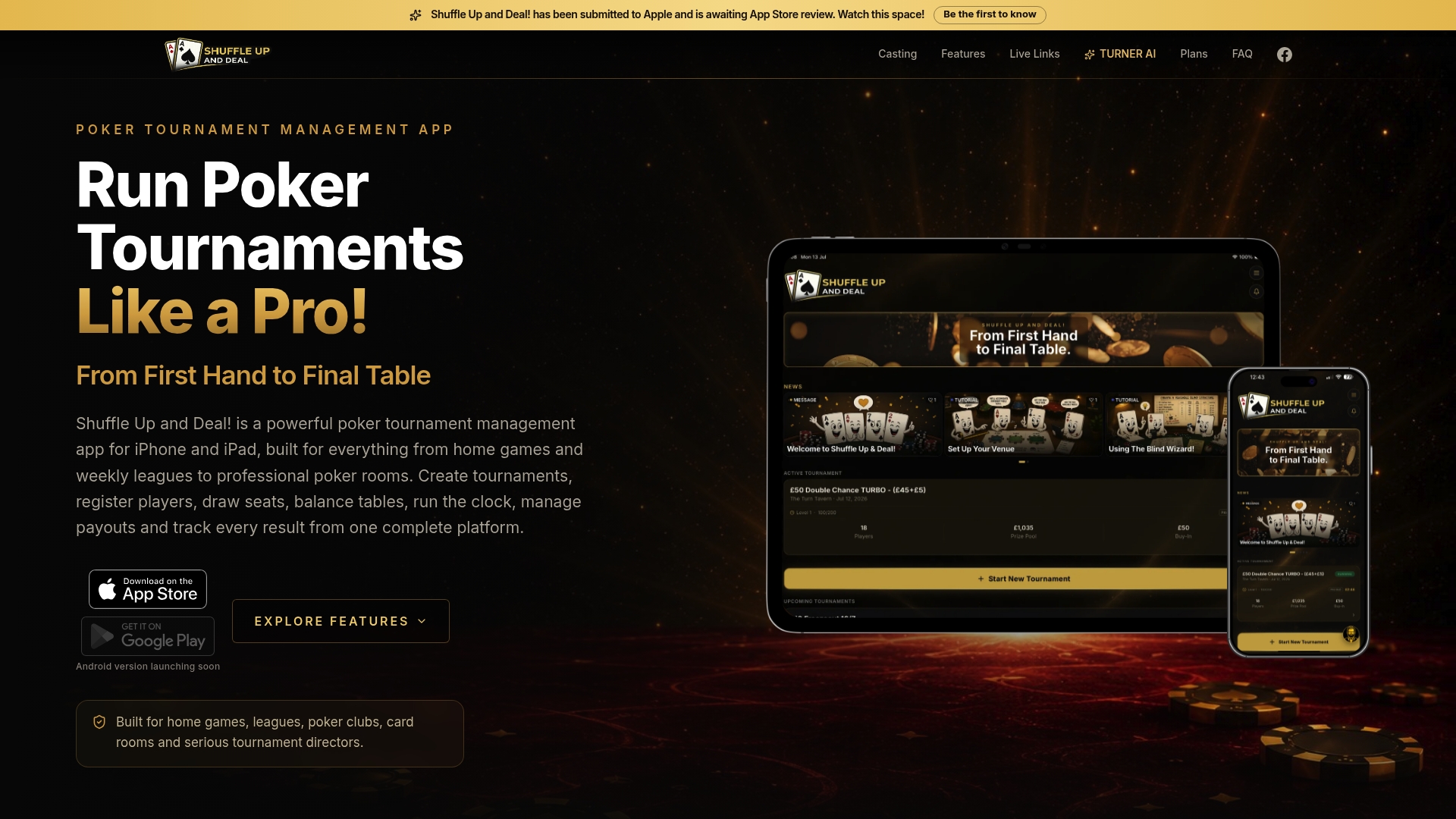
Set up your event in minutes, publish your structure sheet as a live link, and let the app handle the mechanics while you focus on the floor. Whether you are running a 20-player home game or a 100-player club event, the app keeps everything accurate and transparent.
Visit Shuffle Up and Deal! to explore the features and get started with a free plan today.
Useful sources and further reading
-
Freezeout in Poker: One Buy-In, No Rebuys | Poker Skill - clear definition and ICM context for freezeout formats
-
What is a Freezeout in Poker? | PokerNews - covers the WSOP Main Event as a canonical freezeout example
-
Freezeout Poker Tournaments | Pokercode - strategy and prize-pool differences between formats
-
What Is a Freezeout Poker Tournament? | Try Poker - structure sheet guidance and stage-by-stage strategy
-
Freezeout Definition | PokerCoaching - explains why re-entry events are not freezeouts even when marketed as such
-
Poker tournament | Wikipedia - broad overview of tournament formats and structures
-
UK Gambling Commission - for organisers running licensed events in the UK, the Commission’s guidance on gaming and licensing obligations is the primary regulatory reference
-
Shuffle Up and Deal! | Shuffle Up and Deal! - tournament management app for UK organisers running freezeouts and other formats
This article is general information for players and organisers. For licensing obligations, legal compliance, or specific regulatory questions, consult the UK Gambling Commission directly or seek qualified legal advice for your situation.