
Poker Tournament Management App
Run Poker Tournaments Like a Pro!
From First Hand to Final Table
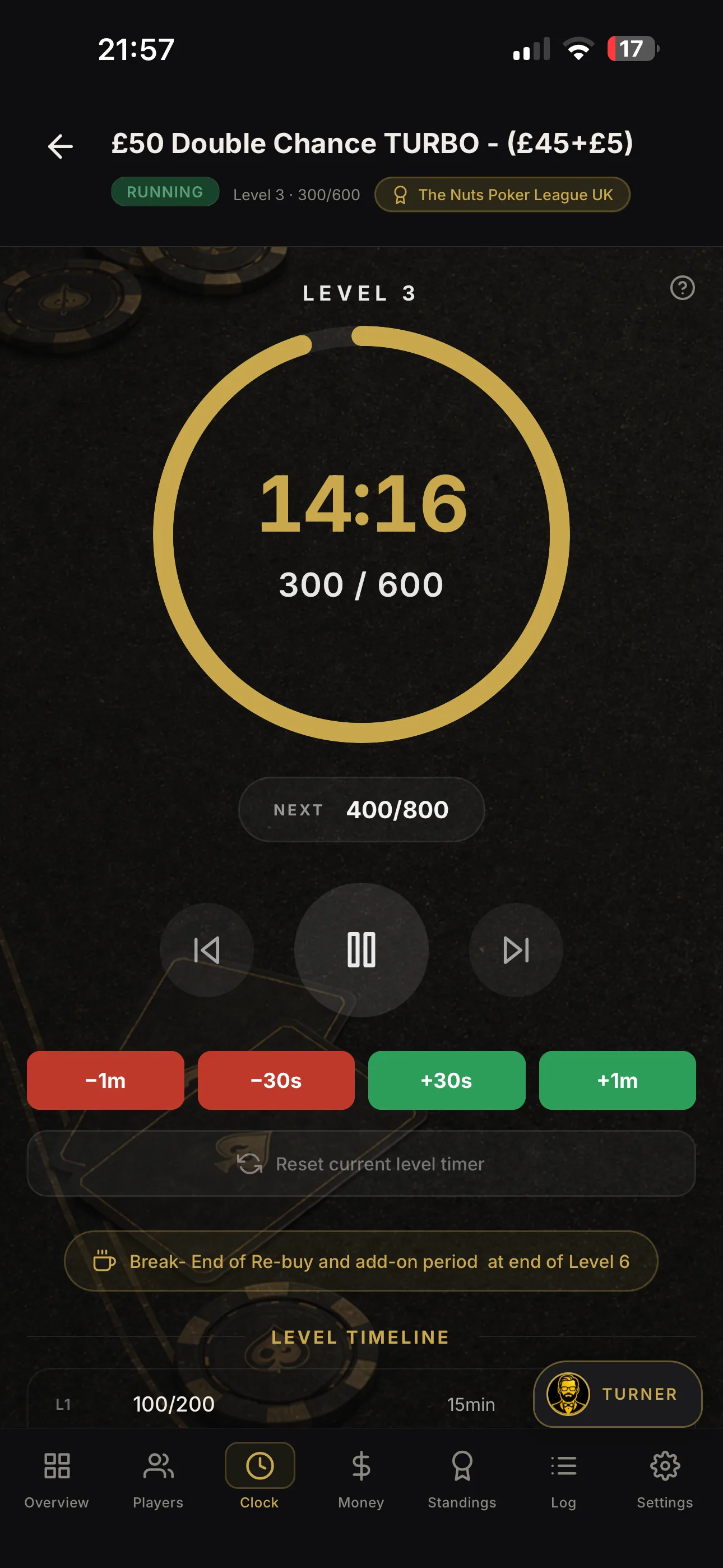
Seat draws, table balancing, the clock, payouts and league standings: Shuffle Up and Deal! runs the whole night from your iPhone or iPad.

Independent chip model poker: your complete guide

The Independent Chip Model (ICM), also known as the Malmuth–Harville method, converts your tournament chip stack into a real-money equity value based on current stack sizes and the payout ladder. It assumes all players have equal skill, so finishing probabilities are determined purely by chip distribution. ICM matters most at three moments: final-table deal negotiations, the bubble and pay-jump pressure, and short-stack push/fold decisions where survival is worth more than an extra pot.
-
Final-table deals: ICM gives you the mathematically fair baseline before anyone starts negotiating.
-
Bubble play: ICM explains why folding a marginal spot near the money can be worth more in £EV than calling.
-
Push/fold decisions: shallow stacks must weigh chip equity against prize equity, and those numbers diverge sharply.
Shuffle Up and Deal! includes an in-app ICM calculator so tournament directors and players in the UK can run these numbers at the table in under two minutes.
Pro Tip: Before any final-table chop conversation starts, pull up the ICM baseline. It anchors the negotiation in maths rather than bluster.
Table of Contents
How does the independent chip model convert chips to prize money?
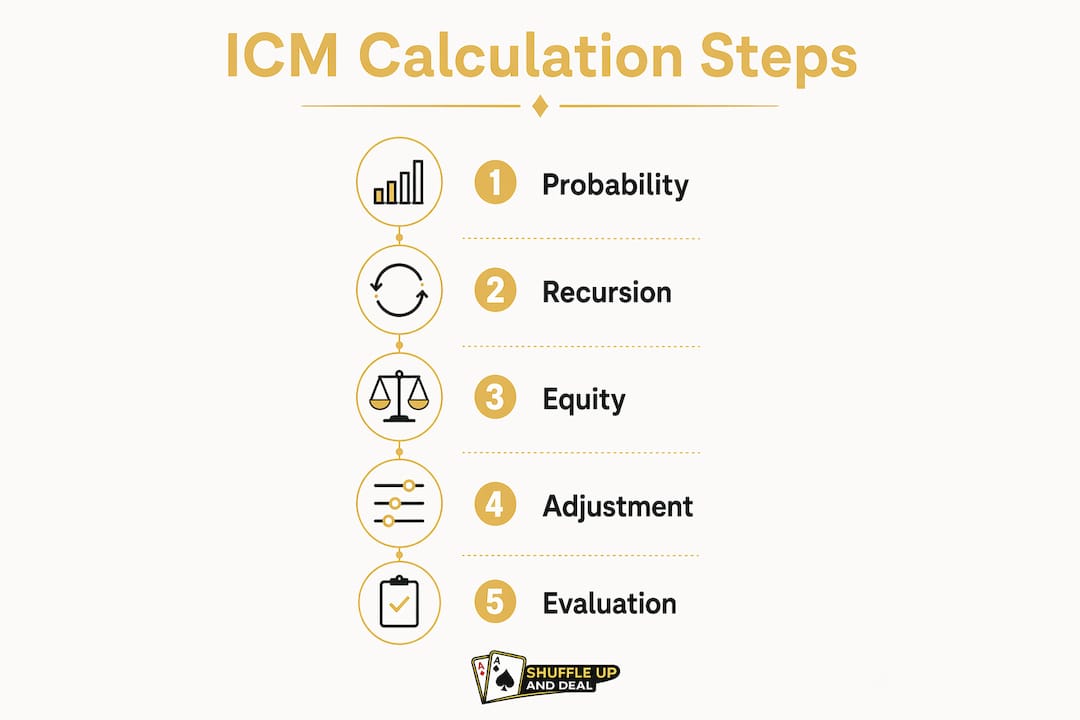
The calculation runs in three steps. First, your probability of finishing first equals your chip share of the total chips in play. Second, your probability of finishing second is calculated by removing each possible first-place finisher in turn, recomputing everyone’s chip share of the remaining field, and averaging across all scenarios. Third, multiply each finishing probability by the corresponding payout and sum the results. That total is your ICM equity.

The recursion in step two is why ICM is impractical by hand for more than two or three players. For four or more, use a calculator.
Chip EV versus £EV: doubling your chips does not double your prize equity under most payout structures. The marginal value of each additional chip diminishes as your stack grows. This is the central intuition behind ICM, and it is why a chip leader cannot simply play for maximum chip accumulation near the money.
Pro Tip: Run the numbers before sitting down to negotiate. Knowing your ICM equity in advance tells you the minimum you should accept in any chop discussion.
Where should you apply ICM in tournament play?
Final-table deal negotiations
ICM is the mathematically fair standard for final-table chops. Short stacks benefit most because ICM assigns them survival value above their chip percentage. Chip leaders, by contrast, give up some upside because ICM does not reward the playability advantage of a big stack. Starting negotiations at the ICM baseline and adjusting only for a demonstrable skill edge is the professional approach.
Bubble and pay-jump pressure
ICM pressure grows as pay-jumps approach, which is why players tighten up near the bubble even with strong hands. A pay-jump from £50 to £150 is worth far more in £EV than winning a single pot. The correct response is not always to fold everything, but to recognise that survival decisions carry a premium that pure chip-EV calculations miss entirely.
Push/fold decisions with shallow stacks
When your stack falls below roughly 15 big blinds, ICM reshapes your push/fold ranges. You may need to tighten calling ranges significantly because a bust-out costs you the survival premium, even when a call is chip-EV positive. Conversely, open-shoving can be correct at wider ranges than chip-EV suggests, because fold equity preserves your stack without a showdown.
Sit-and-go and late-stage MTT play
In a standard three-payout sit-and-go, ICM pressure is extreme on the bubble because the jump from 4th (nothing) to 3rd (min-cash) is enormous relative to stack sizes. In a large MTT, ICM applies differently: the payout ladder is longer, so individual pay-jumps are smaller, and the model’s influence on hand-level decisions is more gradual until the final table.
Pro Tip: In a three-handed sit-and-go bubble, the big stack should apply maximum pressure. ICM punishes the two shorter stacks for calling and losing, so they will fold far more than chip-EV alone would justify.
What are ICM’s real limitations?
ICM is a powerful tool, but treating it as infallible leads to bad decisions. Here are the blind spots you need to know:
-
Equal-skill assumption: ICM ignores skill edges entirely. A weaker player with a big stack gets the same ICM equity as a world-class professional. In reality, the professional’s edge compounds over future hands.
-
Static snapshot: ICM models the current chip distribution as fixed. It does not account for antes, blind growth, re-entries, or the changing player pool as the tournament progresses.
-
Undervaluing chip-leader playability: A deep stack gives you positional leverage, the ability to apply ICM pressure on others, and more post-flop options. ICM does not price any of that in, which means it can undervalue a strong player’s practical advantage.
-
Misapplying it to hand-level decisions: ICM is a deal-making and strategic framework, not a hand-history solver. Using it as the sole input for every in-hand decision ignores board texture, opponent tendencies, and real-time reads.
-
Chip-chop confusion: Some players accept a chip-chop thinking it is equivalent to an ICM deal. It is not. Chip-chop systematically overpays chip leaders and underpays short stacks.
-
Misreading pay-jump incentives: Players sometimes over-tighten because they misread ICM pressure, folding spots that are still clearly profitable even after accounting for prize equity.
A practical guideline: use ICM as your baseline, then blend in honest appraisal of skill edges and variance tolerance. Experts advise requiring a demonstrable skill edge of a clear margin before deviating meaningfully from the ICM split.
ICM versus chip chop: which deal method benefits you?
Chip-chop divides the prize pool proportionally to chip counts, which sounds fair but systematically favors whoever holds the most chips. ICM calculates expected prize money using finishing probabilities, which gives short stacks a fairer share of the remaining pool.
| Stack position | Chip chop | ICM deal | Who benefits |
|---|---|---|---|
| Chip leader | Receives the highest share, potentially exceeding realistic first-place value | Receives less than chip-chop; capped by payout structure | Chip leader prefers chip chop |
| Short stack | Receives only their chip percentage, often close to min-cash value | Receives survival premium above chip percentage | Short stack prefers ICM |
| Balanced stacks | Outcomes are similar under both methods | Outcomes are similar under both methods | Roughly neutral |
Blended deals, which sit between pure ICM and pure chip-chop, are a common compromise. Some calculators offer a blend slider so you can visualise the negotiation space and find a number both sides can accept. If you are the chip leader, you may prefer to push toward chip-chop. If you are short-stacked, anchor firmly to ICM.
Quick heuristics you can use at the table
Full ICM calculations are impractical mid-hand. These shortcuts give you a fast read on your situation:
-
The 72 rule: a rough guide used by some players to estimate push/fold thresholds. With around 7–12 big blinds, open-shoving is often correct from most positions, though the exact threshold shifts with stack sizes, payout structure, and position. Treat it as a starting point, not a formula.
-
The 80/20 rule: in ICM-heavy spots, roughly 80% of your decision-making should account for survival value and only 20% for chip accumulation. The ratio is a mental anchor, not a precise calculation, but it keeps you from over-prioritising chip-EV near the money.
-
Push/fold quick checks: count your big blinds. Below 10 BBs, your decision tree simplifies to push or fold. Between 10 and 20 BBs, factor in fold equity, your position, and the ICM cost of busting before the next pay-jump. Above 20 BBs, post-flop play and ICM pressure interact more subtly.
-
Caution: heuristics are approximations. For final-table chops or any close decision involving significant money, revert to a proper ICM calculator rather than relying on a mental shortcut.
Which ICM calculators work best for UK players and TDs?
Several reputable tools are available to UK players and tournament directors:
-
PokerCharts ICM calculator: a clean, browser-based tool that computes standard Malmuth–Harville ICM and supports blended splits. Useful for quick deal checks before or during a final table.
-
ThinkGTO deal calculator: strong for deal-making workflows, with guidance on when to accept or reject a chop based on skill-edge thresholds.
-
MIT OpenCourseWare (Lecture 6): not a calculator, but the MIT lecture on ICM is one of the most rigorous free resources for understanding the underlying maths.
How Shuffle Up and Deal! fits into live UK tournaments
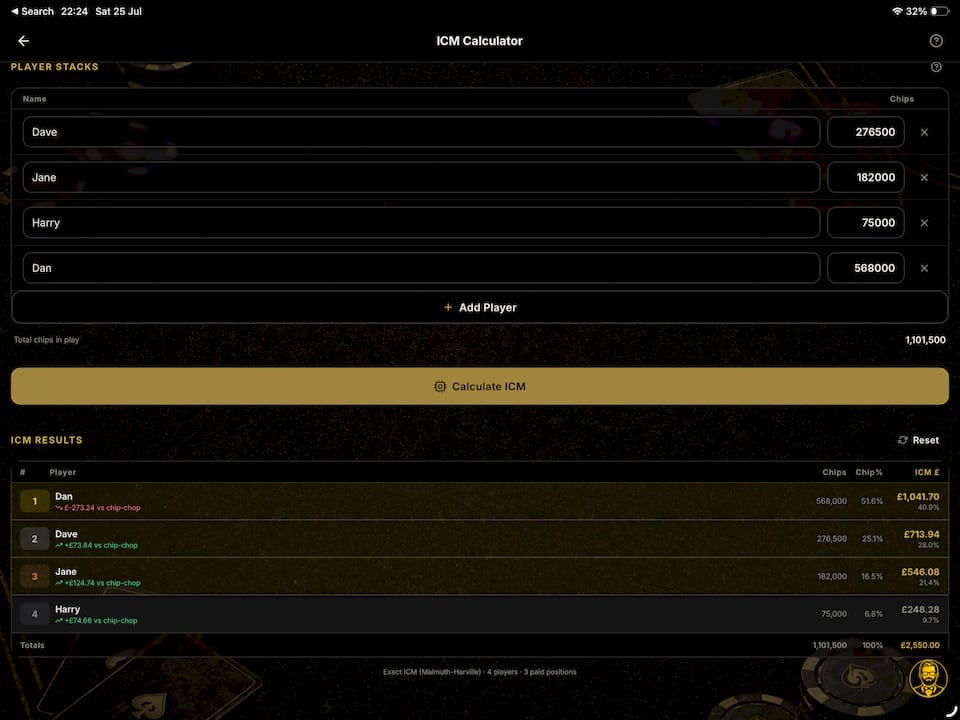
Shuffle Up and Deal! is built for exactly this moment. The app’s in-app ICM calculator lets you enter live stack sizes and payout structures directly, with GBP support for UK events. You can run the calculation, share the ICM baseline with players via a live share link, and record the agreed split, all without leaving the app. That transparency matters: presenting ICM numbers via a shared app link reduces negotiation friction and helps recreational players trust the process.
The workflow takes under 90 seconds: collect stacks, confirm payouts, run the ICM calculation, present the baseline, and publish the agreed deal via the share link. Players receive the numbers on their own devices. No disputes about who said what.
Pro Tip: Print or share the ICM baseline before opening the floor to negotiation. A neutral number presented transparently is far harder to argue with than a verbal estimate.
A quick checklist for players and tournament directors
For players
-
Ask for the ICM number before agreeing to any deal.
-
Confirm the payout structure and whether any rebuys or late registrations have been accounted for.
-
State any demonstrable skill edge clearly and early, before the ICM baseline is set.
-
Never accept a chip-chop without checking how it compares to the ICM split.
For tournament directors: running an ICM chop step by step
-
Pause the clock and collect accurate chip counts from all remaining players.
-
Confirm the remaining prize pool and payout structure in the app.
-
Run the ICM calculation using Shuffle Up and Deal! or a reputable calculator.
-
Present the ICM baseline to all players simultaneously, using the live share link so everyone sees the same numbers.
-
Open the floor to adjustments only for agreed, demonstrable skill edges.
-
Record the final agreed split in the app.
-
Restart the clock once all players have confirmed the deal.
Table-side etiquette: announce all numbers publicly, use a neutral calculator, avoid private side conversations, and document the agreement via the app’s share link. A transparent process protects everyone.
Key takeaways
The Independent Chip Model is the mathematically fair baseline for tournament deals: use it first, adjust second, and never skip it entirely.
| Point | Details |
|---|---|
| ICM converts chips to prize equity | Your chip share determines finishing probabilities; multiply by payouts to get your £EV. |
| Short stacks gain most from ICM deals | ICM assigns a survival premium above chip percentage; chip leaders give up some upside. |
| Chip chop favours chip leaders | Chip-chop divides proportionally to chips and can overpay leaders relative to ICM. |
| Use calculators for chops, heuristics in-play | For final-table deals, use a proper ICM tool; for quick in-hand reads, use the 72 or 80/20 rule. |
| Shuffle Up and Deal! handles ICM at the table | Shuffle Up and Deal! runs ICM calculations, shares results via live link, and records agreed splits in-app. |
Why ICM is the most underused edge in tournament poker
Most players know ICM exists. Far fewer use it correctly, and almost none bring a neutral, verified number to the table when a deal is proposed. That gap is where value leaks.
The conventional wisdom treats ICM as a final-table formality, something you calculate once and then negotiate away from. The smarter view is that ICM is a floor. Accepting less than your ICM equity requires a compelling reason: a clear skill edge, a cashflow preference, or a genuine read that the remaining players are stronger than the model assumes. Without one of those, you are giving money away.
The other underappreciated point is what large-scale empirical research confirms: ICM tends to underestimate the value of larger stacks and overestimate the performance of short stacks in real-world tournaments. That does not mean ICM is wrong for deal-making purposes. It means chip leaders have a legitimate argument for a modest upward adjustment, and short stacks should not assume ICM is automatically generous to them. The model is the starting point, not the final word.
Bring the number. Present it transparently. Then negotiate from there.
Shuffle Up and Deal! makes ICM deals fast and dispute-free
Running a fair ICM chop used to mean scribbling on a napkin or trusting someone’s phone calculator. Shuffle Up and Deal! changes that entirely. The app’s built-in ICM calculator handles stack entry, payout structures, and deal computation in one place.
Beyond ICM, the app manages your full tournament: blind clock and level controls, smart seating and table balancing, prize-pool tracking, rebuys and late registration, league management, and multi-device syncing for larger UK events. Tournament directors get a complete, professional toolkit. Players get transparency and speed at the deal table.
The free-forever plan covers smaller events. Paid tiers unlock higher usage limits, advanced features, and multi-event management for card rooms and league organisers running regular competitions. Visit Shuffle Up and Deal! to explore plans and get your first tournament running today.
Further reading and calculators
-
Independent Chip Model - Wikipedia: formal definition, the Malmuth–Harville method, and historical context.
-
ICM calculator - PokerCharts: browser-based tool with blend slider for deal negotiations.
-
ICM deal calculator - ThinkGTO: deal-making workflow with skill-edge guidance.
-
ICM deal-making: when to chop and when to gamble - ThinkGTO: practical advice on negotiation strategy and when to deviate from ICM.
-
What is ICM? - PokerNews: accessible explainer covering bubble, pay-jump, and push/fold applications.
-
Poker basics: ICM final-table deals - PokerStrategy: overview of ICM’s origins as a deal-making method.
-
Lecture 6: Independent Chip Model - MIT OpenCourseWare: rigorous academic treatment of the underlying mathematics.
-
Empirical Validation of the Independent Chip Model - arXiv: large-scale real-world validation across thousands of tournament events.
-
Shuffle Up and Deal! in-app ICM calculator: the fastest route to a verified, shareable ICM baseline at a live UK event.