
Poker Tournament Management App
Run Poker Tournaments Like a Pro!
From First Hand to Final Table
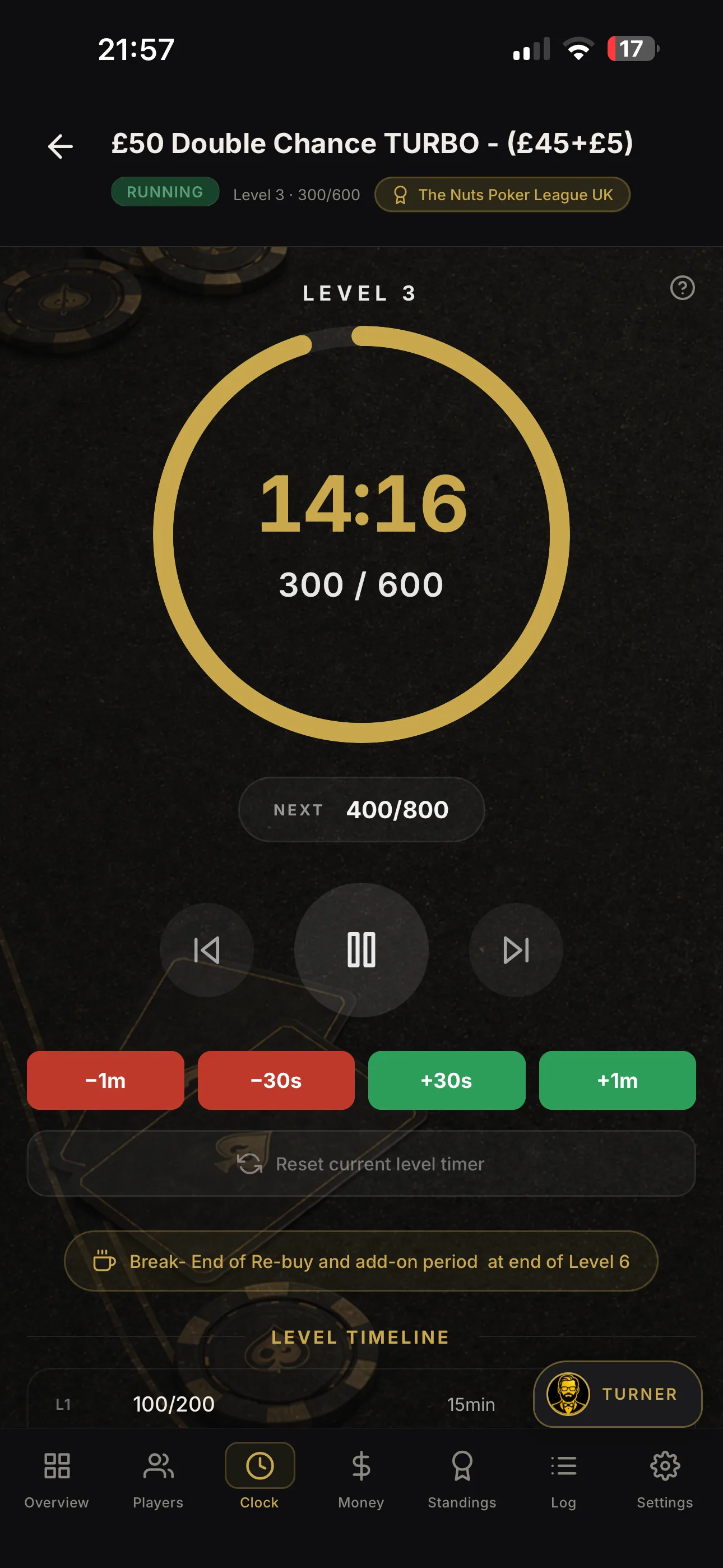
Seat draws, table balancing, the clock, payouts and league standings: Shuffle Up and Deal! runs the whole night from your phone or tablet.



Start With Target Finish Time: Large Field Structure for Tournament Directors
A large field structure has one job: get you from Level 1 to the money bubble to a champion at a time you chose, not one you stumbled into. Design it backwards from your target finish time, then tune blind levels, starting stacks and rebuy rules to hit that mark. The main levers are the blind schedule, stack depth in big blinds, your rebuy and late-registration windows, table balancing, and payout percentage. Tools like Shuffle Up and Deal! handle the registration, live clock and seating side of that equation for you.
TL;DR:
- Confirm your target finish time and level length to build a schedule that keeps the event within your desired duration without overrunning.
- Model attrition, rebuy, and late-registration volume carefully to prevent unpredictable delays and ensure smooth progression near the money bubble.
- Use automated seat-balancing and clear communication methods, including live updates and visible clocks, to maintain fairness and efficiency across hundreds of players.
- Prepare a conservative reserve of chips for rebuys and trigger colour-ups during breaks to avoid disruptions caused by physical chip shortages or long colour-up times.
- Rehearse all staff roles and test technology solutions a day before the event to identify issues early and avoid technical failures that derail a large-field tournament.
Table of Contents
- What does a large-field structure need to get right?
- How do you design a blind schedule to finish on time?
- Starting stacks, chip breakdown and colour-up plans
- Setting rebuy, add-on and late-registration rules
- Table balancing and seating for a big field
- Building a payout structure players trust
- Running the floor: staff, communication and software
- How do you physically set up a large field structure?
- What goes wrong in large fields, and how do you fix it?
- What do successful large-field events actually do differently?
- Lessons from running large events
- Run your large field on Shuffle Up and Deal!
- Sources
What does a large-field structure need to get right?
Before you touch a spreadsheet, confirm you have the fundamentals nailed down. Miss one of these and you’ll be firefighting by Level 5.
- Pick a target duration and a level-length template, then express every stack size in big blinds so it scales across buy-ins.
- Decide your rebuy and late-registration policy, and fix the level when antes kick in.
- Pre-calculate the payout table, aiming to pay roughly 10 to 20% of the field, and publish the structure before Day 1 starts.
- Prepare a chip set with spares for rebuys and lock in a colour-up schedule.
- Assign staff roles and confirm your tech, including the live clock and seat manager, works before players sit down.
Get these five right and the rest of the day runs on rails. Get one wrong, and you’ll be explaining a payout change to 400 annoyed players at 11pm.
How do you design a blind schedule to finish on time?
Work backwards. Decide how long you want the event to run, then divide that by your preferred level length to get the number of levels you have to play with. A ten-hour Day 1 with 30-minute levels gives you 20 levels to build a structure around, not the other way round.
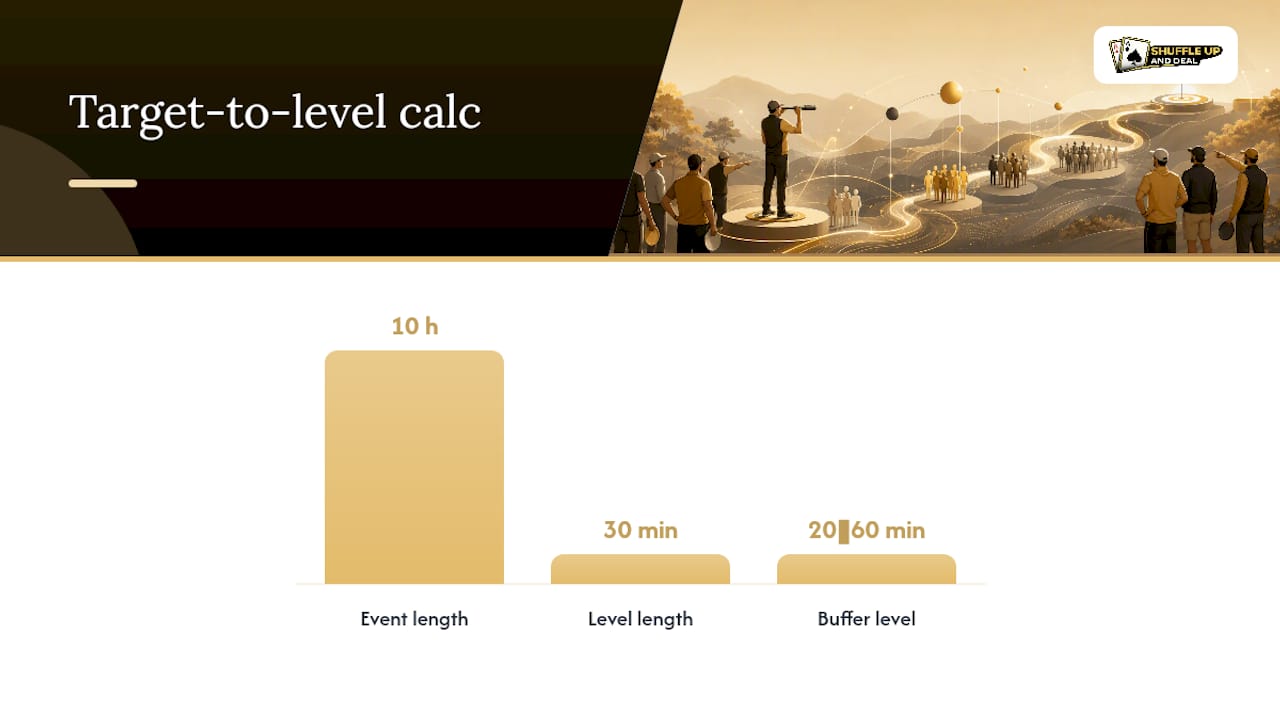
This is the approach Justin Hammer recommends: start with the desired event length and choose level lengths and stack sizes to fit that target, rather than padding levels or piling on extra chips because it feels generous. A structure built the other way round almost always runs long, and a structure that runs long is the single biggest source of player complaints you’ll ever field.
Here’s a practical sequence for building the schedule:
- Fix your target finish time and level length, then calculate total levels available.
- Set your starting stack in big blinds rather than a raw chip count, so the structure works whether your buy-in is £50 or £500.
- Decide whether antes start early or use a big blind ante from a set level, since that single choice changes how aggressively players can play late levels.
- Model attrition and rebuy volume conservatively when forecasting how many levels it will take to reach the money.
- Adjust early-level pace: faster early blinds thin the field quickly and shift the weight of the tournament towards the middle and bubble stages, while deeper starting stacks push more decisions into the late levels.
Large fields behave differently from small ones. Expect the field to thin naturally through the early levels, then watch stack building intensify through the middle before players sharpen up around the bubble, a pattern that shapes strategy at scale and one your structure should accommodate rather than fight.
Pro Tip: Build in one buffer level near the projected bubble. Bubbles run long almost every time, and a spare 20 to 30 minute level in your plan absorbs that delay without pushing your final table into the small hours.
For ready-made schedules rather than building from scratch, a detailed blind structure guide gives you tested level progressions you can adapt to your own target time.
Starting stacks, chip breakdown and colour-up plans
Starting stack depth, measured in big blinds rather than raw chips, is what makes a structure portable across buy-in levels. A 100 to 200 BB starting stack is the common range for high-entry events: deep enough to reward skill in the early levels, shallow enough that the tournament still moves.
Chip logistics matter more than most new directors expect. Practical formulas built around common denominations, such as the T1000 and T2000 chip sets used in large club tournament templates, give you a starting point for how many chips of each colour you actually need on the felt, plus spares.
- Keep a stock of high-denomination chips in reserve specifically for rebuy periods, so a rush of re-entries doesn’t leave a table short.
- Trigger a colour-up whenever a denomination makes up more than roughly 25% of chips in play. That’s the point where stacks become unwieldy to count and pots take too long to push.
- Schedule colour-ups during breaks wherever possible, never mid-level, so play doesn’t stall while dealers swap chips.
- Use chip trays and clear signage at each table so colour-up runs quickly and dealers aren’t hunting for the right stack.
A detailed chip breakdown guide walks through denomination ratios if you want the exact maths rather than rules of thumb.
Setting rebuy, add-on and late-registration rules
Rebuys and late registration exist to grow the prize pool, but loose rules turn a structure into chaos. Decide your format early: straight freezeout, re-entry, or rebuy plus add-on, since each affects how long the early levels realistically take.
- Set a clear cut-off, whether it’s a specific level number or a fixed clock time, and publish it well before Day 1.
- Estimate rebuy volume conservatively when planning chips and payouts. It’s easier to add capacity than claw back an overpromised guarantee.
- Require receipts and a name-match check at the registration desk to stop duplicate or fraudulent entries slipping through.
- Communicate rebuy cut-offs on the same display players use to track blinds and payouts, not just verbally at the table.
Rebuys also affect ICM once you’re near the bubble, since a late surge of entries changes the effective field size your payout percentages are working against. Keep late-reg and rebuy numbers visible in real time so players aren’t guessing at how the field, and the money, is shifting under them.
Table balancing and seating for a big field
Fairness and minimal disruption are the two principles behind every good balancing decision. Move the fewest players possible, and where you can, preserve seat position rather than scrambling a table completely.
Consolidation happens on a schedule, not on a whim. A common rule of thumb takes a field running 10 tables of 10 down to 6 tables around 60 players remaining, then to 4 tables near 40, 3 around 30, 2 near 20, and a final table at 10. Time these major consolidations around scheduled breaks wherever you can, so players aren’t pulled mid-hand to shuffle seats.
- Run hand-for-hand play once you’re within a few spots of the money bubble, to keep every table finishing hands at roughly the same pace.
- Assign a dedicated move team for large consolidations rather than relying on table dealers to self-organise.
- Publish table moves on the same display or share link players already check, cutting down on floor staff being flagged for directions.
- Let automated seat-balancing tools flag the exact players to move, removing the manual headcount errors that creep in at scale.
Pro Tip: Announce a consolidation two hands before it happens, not after. Players finish their current hand calmly instead of scrambling mid-deal, and your floor staff get a clean window to move chairs.
Live syncing between devices matters here too. When every staff member’s seating chart updates in real time, you stop the classic large-event problem of one dealer moving a player who’s already been reassigned by someone else.
Building a payout structure players trust
Paying roughly 10 to 20% of the field is the industry standard, and it exists for a reason: pay too few places and you lose the recreational players who keep the field big; pay too many and min-cashes stop feeling like a result. Whatever percentage you land on, pre-calculate the full table and publish it before Day 1. Nothing damages trust faster than adjusting payouts on the fly.
- Choose a top-heavy structure when you’re marketing a headline prize or chasing a guaranteed pool figure; choose a flatter structure when player expectations lean towards rewarding a deeper run.
- Decide in advance whether ICM-based deals are permitted at the final table, and say so publicly, since players will ask the moment it’s three-handed.
- For a 200-player field, a payout table typically runs into the low twenties of paid places; a 500-player field pays out to dozens of places; a 1,000-player field can extend beyond one hundred, always scaled to stay within the approximate 10 to 20% band.
Whatever numbers you land on, get them in front of players early. A payout table nobody has seen until the money bubble bursts is a payout table people will argue with.
Running the floor: staff, communication and software
A large field lives or dies on communication. Players need to know their table, their stack, the current blinds and the payout structure without hunting a staff member down every ten minutes.
- Staff the essential roles clearly: a tournament director running the clock and rulings, floor staff handling moves and disputes, a registration desk managing entries and rebuys, and dealers rotated on a fixed schedule.
- Use multiple communication channels simultaneously: external displays for blinds and chip counts, a share link for players checking from their phones, staff radios for the floor team, and printed structure sheets as a backup.
- Match your software to each operational need. A registration engine handles entries and rebuys, a live clock keeps every table synced on blinds, a seat manager runs the balancing automatically, and a payout engine keeps the prize table visible and current, all functions purpose-built tournament software is designed to automate.
- Confirm tech readiness the day before: charged devices, backup connectivity, a spare display, and enough chips in reserve to cover an unexpectedly heavy rebuy period.
Shuffle Up and Deal! covers this ground directly, with a registration flow, smart seating, a live tournament clock and payout tracking built for exactly this kind of high-entry event, alongside in-app ICM and pot odds calculators for final-table decisions.
Pro Tip: Run a full tech rehearsal 24 hours out, clock, displays and seating software included. The failures that ruin a Day 1 almost always show up in rehearsal first, when they’re cheap to fix.
How do you physically set up a large field structure?
Physical setup starts with table density and traffic flow, not chip counts. Space tables so a floor member can walk a full lap without weaving through spectator crowds, and leave clear paths to the registration desk, cashier, and toilets, since bottlenecks there ripple straight into late blind levels.
Position your external display or clock screen where every table has a sightline. If players can’t see the blinds without asking, you’ll spend the day fielding the same question a hundred times over. Group tables by section with visible numbering, and keep a printed or digitally shared seating chart at the registration desk so late-registering players can find their seat without floor assistance.
Dealer stations need consistent kit: identical chip trays, a working timer or shared clock feed, and enough card decks in rotation that a shuffle machine or dealer break never holds up a table. For multi-day events, plan bag-and-tag stations near the exit, not buried in a back room, so end-of-day storage doesn’t become its own queue.
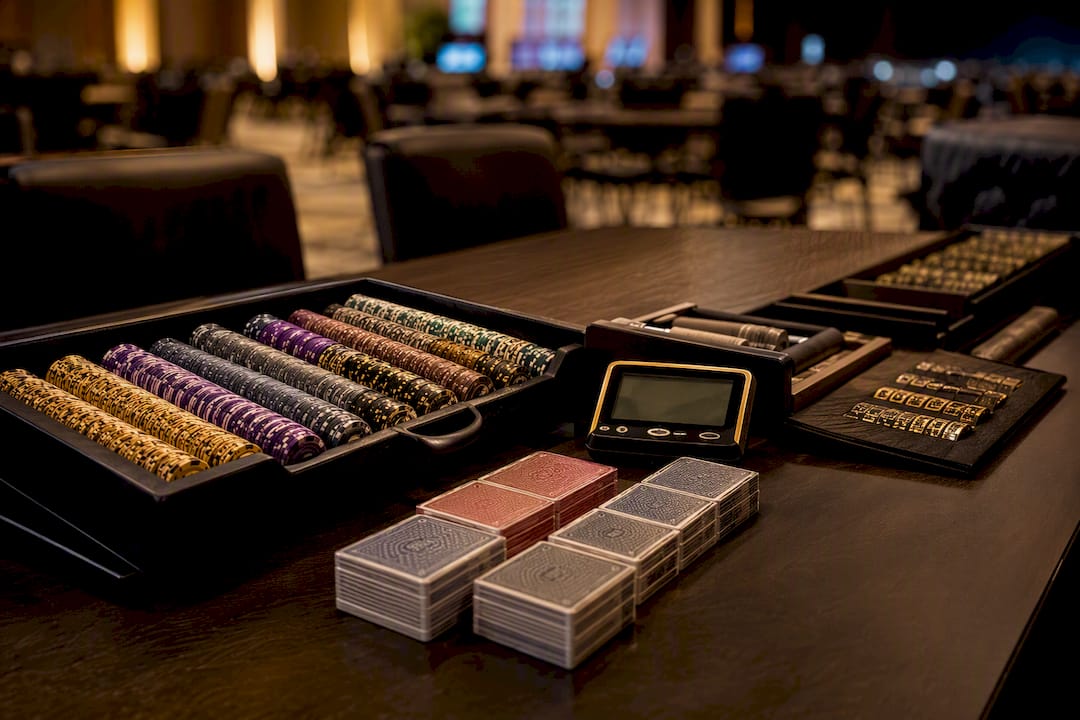
Build in a staging area near the tournament floor for rebuy chip stock and spare decks, restocked at every break rather than mid-level. The construction detail that gets skipped most often is cable management for displays and clock feeds. A trailing cable across a walkway between tables is a hazard you don’t want on your incident log, and it’s one of the easiest things to fix before doors open.
What goes wrong in large fields, and how do you fix it?
Most large-field problems trace back to one of three causes: undercounted rebuy volume, uneven table balancing, and communication gaps between staff and players.
Undercounted rebuys catch directors out because the volume rarely arrives evenly. A rush in the final ten minutes before the late-registration cut-off can leave chip runners scrambling and tables temporarily short-stacked on physical chips. The fix is holding a genuinely conservative reserve, built from your rebuy estimate plus a margin, rather than ordering exactly what the median scenario suggests.
Uneven balancing shows up when a manual seat manager falls behind during a busy stretch, leaving one table playing six-handed while another sits at nine. That gap skews the game for both tables and invites complaints about fairness. Automated seat-balancing tools flag the move the moment a table falls out of balance, which is precisely why automated systems reduce errors compared with a floor member eyeballing headcounts across a room.
Communication gaps are the quietest problem but the most corrosive. Players who don’t know the current blind level, their table move, or the payout structure lose trust in the event, even when the underlying operations are running fine. Redundant channels, a visible clock, a share link, printed sheets, close that gap without adding staff.
Bubble play brings its own challenge: pacing slows dramatically as players nurse short stacks. Hand-for-hand procedure exists specifically to stop one table racing ahead of another during this phase, keeping the money finish fair across every table still in play.
What do successful large-field events actually do differently?
The events that run smoothly share a pattern: they treat the structure as a fixed plan communicated early, not a live negotiation. Directors who publish blind schedules, payout tables and rebuy cut-offs before Day 1 report far fewer disputes than those who adjust on the fly, because players know exactly what they signed up for.
Events that scale well also lean on staged consolidation rather than reactive table breaks. Following a structured sequence, such as stepping down through table counts at set player thresholds and timing the moves around breaks, keeps disruption predictable instead of chaotic. Directors running fields well into the hundreds consistently report that scheduling consolidation around breaks, rather than the moment a table technically qualifies for breaking, is what keeps players calm through the middle stages of the day.
Live results and structure visibility also separate the smooth events from the rocky ones. Platforms built for publishing live tournament information, the kind of transparency Democratic Chess uses for its own event listings, show the same principle at work across a different game entirely: players who can check standings and structure themselves generate far fewer floor enquiries than those relying on staff to relay information.
The common thread across every well-run large field is preparation that happens before the doors open, not during the event itself. A pre-published structure, a rehearsed staff team and software that’s been tested rather than trusted on faith are what separate a smooth ten-hour day from a chaotic one.
Lessons from running large events
Starting from finish time beats bolting together a structure level by level. It forces discipline you won’t get any other way.
Three instincts separate smooth events from chaotic ones: patience through the early levels, rebuy numbers planned conservatively rather than hoped for, and consolidations scheduled around breaks instead of forced mid-level. None of these are complicated. All three get skipped under pressure.
Rehearse your tech and staff roles before doors open. The clock, the seating software, the payout display, test every one of them the day before, because the failures that wreck a Day 1 almost always show up first in a rehearsal, when they’re still cheap to fix.
*- Jason
Run your large field on Shuffle Up and Deal!
Shuffle Up and Deal! is the tool that turns everything in this guide into a working event instead of a spreadsheet. Where a traditional whiteboard-and-clipboard setup means someone manually tracking blinds, seating charts and payouts across a hundred-plus players, Shuffle Up and Deal! runs registration, the live tournament clock, smart seating and your payout engine from a single app on iPhone or iPad.

The workflow is straightforward: import a blind template that matches your target finish time, start the live clock, let smart seating auto-balance tables as the field thins, and publish your payout structure the moment it’s set. Built-in ICM and pot odds calculators support final-table decisions, and a live share link keeps players checking their phones instead of the floor staff. League management and player statistics carry the same structure across your entire season, not just one event.
Start on the free plan and browse the ready-to-use blind and payout templates before your next high-entry event, and see which parts of this guide you can hand straight to the app.
Sources
- Pokerstrategy
- Poker
- Large-field tournament strategy - BeatTheFish
- How to host a large poker tournament - HomePokerTourney