
Poker Tournament Management App
Run Poker Tournaments Like a Pro!
From First Hand to Final Table
Seat draws, table balancing, the clock, payouts and league standings: Shuffle Up and Deal! runs the whole night from your iPhone or iPad.


League tiebreakers explained: the Premier League order and beyond

When two Premier League clubs finish level on points, the order fans should check is fixed: points, then goal difference, then goals scored, then further criteria if the deadlock still isn’t broken. Head-to-head results aren’t automatically the next step in English football, which surprises a lot of supporters who assume it works the way fantasy leagues or American sports do. If every one of those measures still ties, the league moves to the rarest outcomes of all: a play-off match, or, historically, the drawing of lots.
Here’s the checklist to run through when you’re staring at a congested table in April:
- Points - the primary and only starting measure.
- Goal difference - goals scored minus goals conceded, across the whole season.
- Goals scored - the raw attacking tally, regardless of what’s been conceded.
- Further criteria - competition regulations for that specific season, which can include head-to-head form.
- Play-off or lots - used only when every statistical measure fails to separate the sides.
Key Takeaways
The Premier League separates tied teams using points, then goal difference, then goals scored, before turning to further published criteria or a play-off.
| Point | Details |
|---|---|
| Check the right order | Points decide first, then goal difference, then goals scored, before any further criteria apply. |
| Head-to-head isn’t automatic | English top-flight football treats head-to-head as a further criterion, not a guaranteed second step. |
| Multi-team ties reset each round | Separate one team at a time, then restart the comparison for the teams still tied. |
| Play-offs and lots are last resorts | Statistical criteria almost always resolve ties before a decisive match or drawing of lots is needed. |
| Publish your rules early | League organisers reduce disputes by displaying the tiebreaker hierarchy before the season begins. |
Table of Contents
- What are the Premier League tiebreaker rules?
- How do the common tiebreaking criteria actually work?
- How are ties between three or more teams resolved?
- How do other leagues and sports handle ties?
- Publishing tiebreaker rules the right way
- The bottom line for anyone checking a table
- Why the “just look at head-to-head” instinct misleads fans
- Sources
What are the Premier League tiebreaker rules?
The Premier League’s own handbook sets out a clean hierarchy, and it’s worth memorising because it applies whether you’re checking a title race, a European qualification scrap, or a relegation dogfight in the same afternoon.
- Points total - the number of match points earned across a full season of matches.
- Goal difference - total goals scored minus total goals conceded for the season.
- Goals scored - the total number of goals a team has put in the net, win, lose, or draw.
- Head-to-head and other published criteria - applied only if points, goal difference, and goals scored are all identical, which is exceptionally rare across a a standard league season.
- Play-off - a one off match, historically used to settle major positions such as league titles or relegation slots.
Goal difference does most of the heavy lifting here. If Team A has scored 70 and conceded 40, their goal difference is +30. If Team B has also scored 70 but conceded only 35, Team B sits above them on +35, even though both teams found the net exactly the same number of times. That’s why manager’s post match interviews so often mention “protecting the goal difference” in a game that’s already won. A 4-0 win matters more for separating ties than a 1-0 win, even though both deliver three points.
In the entire history of the Premier League, only one season has been decided on goal difference at the very top: 1988/89, when Arsenal beat Liverpool 2-0 at Anfield in the final match, finishing level on points but overtaking Liverpool on goals scored after both had identical goal difference. It remains one of English football’s most replayed finishes precisely because it happened in the last minute of the last game, with the tiebreaker math changing in real time as Michael Thomas scored.
More recently, relegation and European qualification battles have been settled by goals scored rather than dramatic late goals. Whenever three or four clubs cluster on the same points total in mid-May, the away goals column and the goals-scored column become just as important as the result on the pitch that day. If you’re following a tight relegation battle, don’t just watch the scoreline. Check whether a rival’s match is producing goals at either end, because that shifts the tiebreaker order even if the final placing looks unchanged from full time.
How do the common tiebreaking criteria actually work?
Every competition draws from the same toolbox of criteria, but the order and the fine print change depending on who’s writing the rules. Understanding each one properly means you can read any league table, in any sport, without needing to look up the regulations first.
Goal difference is simply goals scored minus goals conceded. Imagine two teams level on 60 points. Team X has scored 55 and conceded 30 (goal difference +25). Team Y has scored 48 and conceded 25 (goal difference +23). Team X finishes above Team Y, despite Team Y having the tighter, more efficient defence. This is why manager’s chase big scorelines even in matches that are already safely won.
Goals scored kicks in only when goal difference is also tied. It rewards attacking output specifically, which is one reason leagues favour it over other measures: a team that wins 3-2 five times contributes more to this column than one that grinds out 1-0 wins, even if both records are otherwise identical.
Head-to-head comparisons sound simple but carry a real limitation: they only work cleanly when every tied team has played the same opponents the same number of times. In a standard league season, that’s usually true for two teams. It breaks down fast in three or four team ties, where a “head-to-head mini-league” table can itself finish tied, forcing organisers back to goals scored or goal difference anyway.
Other criteria exist for good reason:
- Most wins rewards teams that finish games rather than settling for draws.
- Away goals, once common in UEFA competitions and many domestic knockout formats, has been phased out of most European club competitions since 2021, though some leagues still reference it in older regulations.
- Disciplinary record (fewer red and yellow cards) occasionally appears as a final tiebreaker in leagues that want to reward clean play.
- Fewer goals conceded sometimes replaces goals scored as a defensive counterpart in cup formats.
Pro Tip: Don’t assume head-to-head is universal. If you’re running or following a smaller league, check the published rules before the final round, because plenty of grassroots and amateur competitions skip head-to-head entirely and go straight from goal difference to goals scored, just like the Premier League does.
How are ties between three or more teams resolved?
Three way and four way ties look chaotic on paper, but organisers resolve them with a method that’s more logical than it first appears: one team at a time, from the top down.
- Rank the whole group by the standard criteria first. Apply points, then goal difference, then goals scored across all tied teams simultaneously, not just pairs.
- Seed the top team once separated, then reapply the process to those still tied. If three clubs are level and the process separates one, the remaining two teams are compared again from the start of the hierarchy, not carried over from wherever the three team comparison left off.
- Fall back when head-to-head mini-leagues fail. If a competition permits head-to-head among the tied group, but two of the three teams drew both their matches against each other while the third won both of theirs, the mini-league itself can finish level. At that point, the competition drops back to goals scored or another published criterion rather than trying to force a head-to-head answer that doesn’t exist.
- Use the rare final steps only when statistics are exhausted. A single play-off match remains the most common “nuclear option” in football, historically used for title deciders and relegation places. Drawing of lots is even rarer, but it is written into a number of competition regulations worldwide as the absolute last resort, as general tiebreaker precedent across sports confirms.
This staged approach matters because it stops one bad tiebreaker rule from corrupting the whole group. Separating one team, then restarting the comparison for the rest, keeps every remaining team’s fate tied to the full hierarchy rather than a partial, contaminated calculation.
How do other leagues and sports handle ties?
Football isn’t alone in wrestling with dead heats, and comparing approaches shows how much a sport’s priorities shape its rulebook.
- MLB prioritises head-to-head record first, then moves through intradivision and intraleague records if the tied teams didn’t meet enough times to settle it directly, according to MLB’s own published tiebreaker rules. Baseball’s long, imbalanced schedule makes head-to-head a much more reliable first step than it would be in a 38 game football season where every team meets every other team exactly twice.
- The NFL runs through a strict, published stepwise hierarchy that includes strength of schedule and strength of victory, metrics that essentially ask “how hard was your route to these results?” rather than just counting goals or points.
- MLS and UEFA competitions vary in exactly where head-to-head sits in the order, and many have moved away from extra fixtures altogether, preferring statistical resolution to avoid the logistical cost of scheduling a decisive rematch.
- Drawing of lots survives in various rulebooks as the genuine last resort, precisely because leagues would rather have a documented, published fallback than an ad hoc decision under pressure.
The pattern across every sport is the same: nobody wants extra fixtures if they can avoid them, so tiebreaker lists get longer and more specific over time, not shorter.
Publishing tiebreaker rules the right way
The single biggest driver of tiebreaker disputes isn’t a confusing rule. It’s a rule nobody bothered to publish clearly before the season started. Practitioners consistently recommend making the hierarchy visible and accessible from day one, not buried in a PDF nobody reads until a dispute erupts in week 30.
For anyone running a home game, a card room league, or a regular poker series where standings matter, the same logic applies directly. Shuffle Up and Deal!'s league management and leaderboard tools let you publish your points system and tiebreaker order before a single card is dealt, so players see exactly how a tie gets broken rather than discovering the rule after the fact. The app’s leaderboards display live standings throughout your season, and its published rules templates mean your players are checking the same hierarchy you are.
- Publish the order before the season starts, not after the first dispute.
- Show live standings so ties are visible as they develop, not just at the finish.
- Use pop-up clarifiers or rule pages so nobody has to guess how a tie gets separated.
Pro Tip: If you organise a poker league, borrow the football model directly: decide your order (points, then a secondary metric like cashes or final tables, then head-to-head results) and publish it in your league settings before round one. Shuffle Up and Deal!'s league features make this a five minute job rather than a season long headache.
The bottom line for anyone checking a table
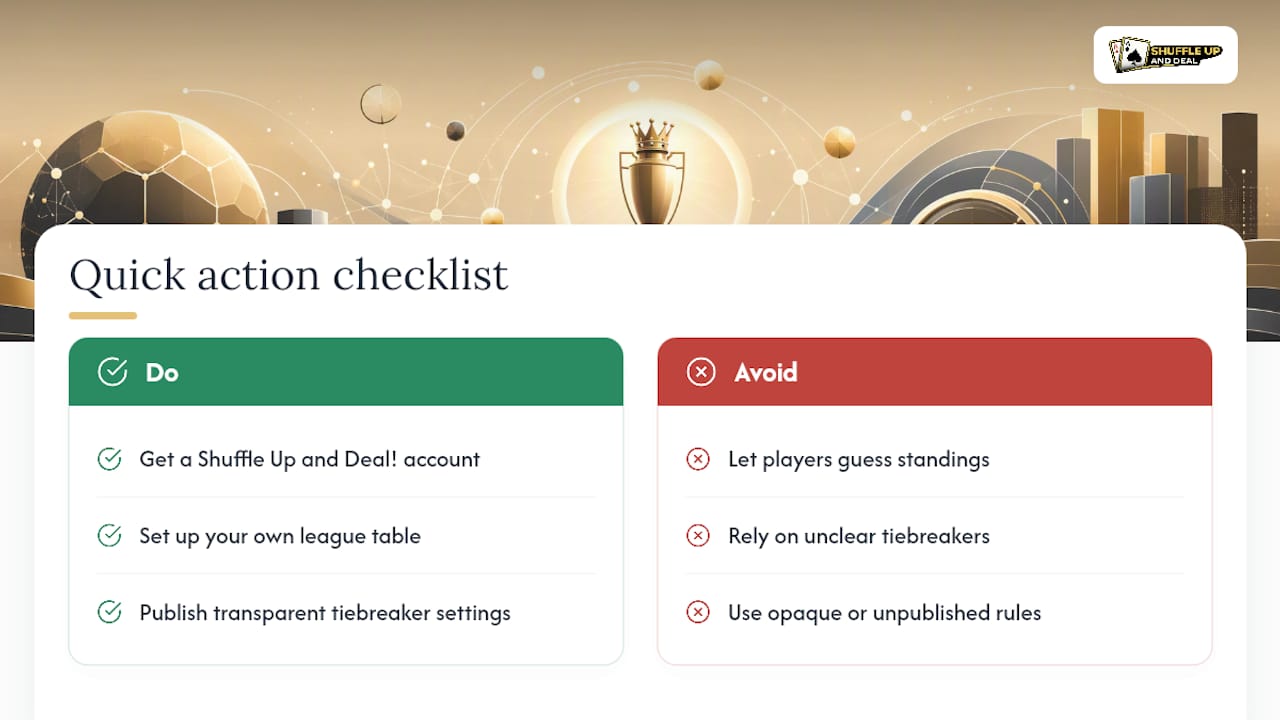
Learning the exact tiebreaker order is worth doing because there’s a real chance you’ll need it. Get a Shuffle Up and Deal! account and set up your own league table using the app’s transparent, published tiebreaker settings so your players never have to guess where they stand. Explore Shuffle Up and Deal! to see how tournament management and league leaderboards work together on iPhone and iPad.
Why the “just look at head-to-head” instinct misleads fans
The most common mistake supporters make is assuming head-to-head results settle Premier League ties automatically, probably because it’s how fantasy football, five-a-side leagues, and plenty of foreign competitions do it. That instinct is wrong for the competition most English fans actually follow, and it leads to a lot of confidently incorrect predictions in April and May.

What the evidence in this piece actually supports is that goal difference, not head-to-head, does the real separating work in the Premier League, and it does so far more often than most fans realise. Conventional football chat underrates how often a team’s late-season “greedy” scoreline (running up a 4-0 rather than settling for 1-0) is a deliberate insurance policy against exactly this scenario.
If you take one thing from this explainer, prioritise checking goal difference and goals scored over head-to-head when you’re reading a congested table. For organisers running your own league, whether that’s a pub quiz, a five-a-side circuit, or a poker series, publish your hierarchy before anyone needs it. Rules read calmly in August prevent arguments read angrily in May.
- Jason
Sources
- MLB - playoff tiebreaker rules
- H2H Points league playoff seeding: How tiebreakers work – ESPN Fan Support
- Tiebreaker - Wikipedia