
Poker Tournament Management App
Run Poker Tournaments Like a Pro!
From First Hand to Final Table
Seat draws, table balancing, the clock, payouts and league standings: Shuffle Up and Deal! runs the whole night from your iPhone or iPad.

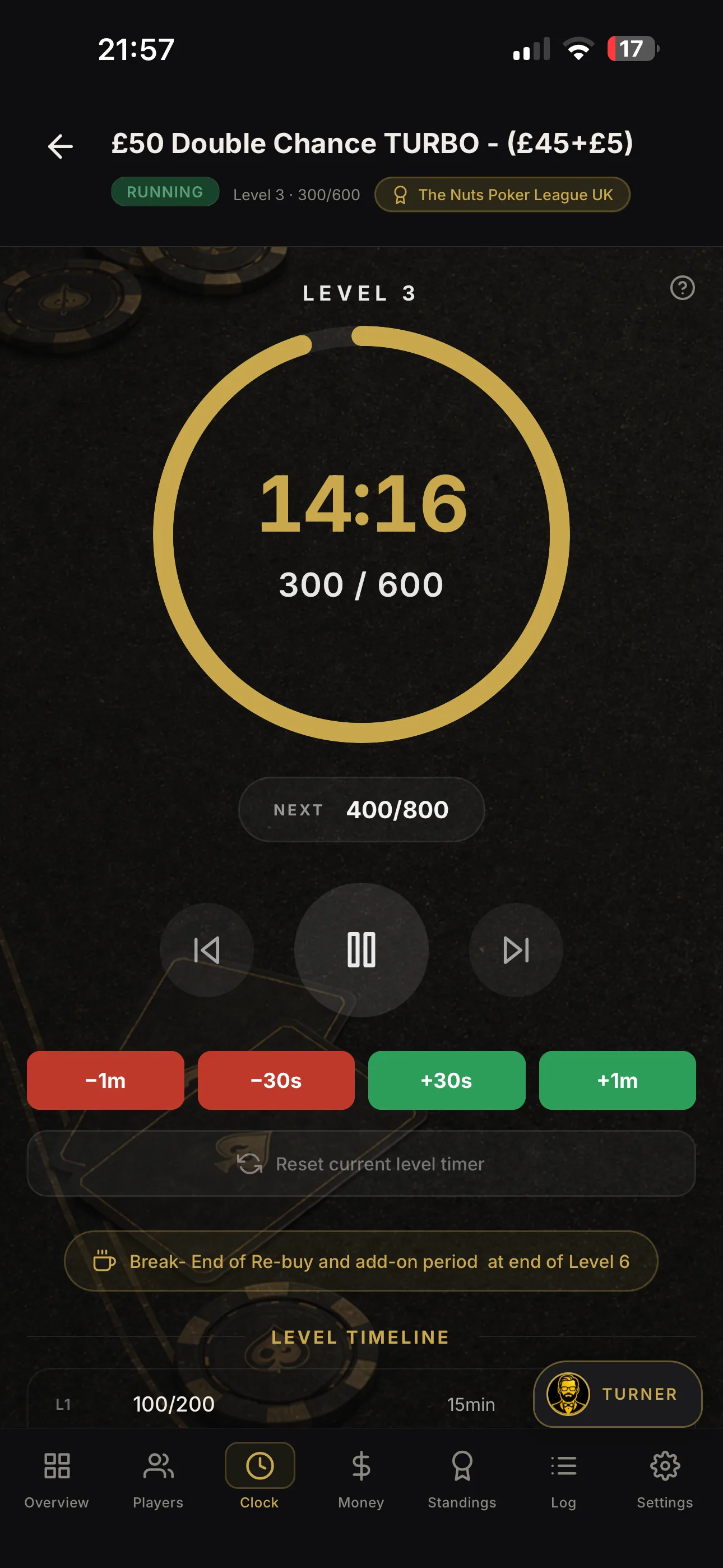
Poker blind structure: build the perfect schedule

The fastest way to get a working blind schedule is to use Shuffle Up and Deal!’s Blind Wizard. Tell it your player count, chip denominations, start and finish time, playing style, and whether you want rebuys or antes, and it generates a complete, constraint-driven structure in minutes. If you prefer to build one manually, follow these steps: set your target duration, choose a starting stack of approximately seventy-five to one hundred big blinds for a standard home game, pick a level length between twelve and twenty minutes, decide on rebuys and ante style, then apply a multiplier around 1.4× per level. The sections below give you the formulas, templates, and theory to do exactly that.
Table of Contents
-
How Shuffle Up and Deal!’s Blind Wizard generates and runs your schedule
-
Run your next tournament with Shuffle Up and Deal!’s Blind Wizard
Three ready-to-use blind schedule templates
These three templates cover the most common UK home and club formats. Print one out, or load it into Shuffle Up and Deal! as a starting point and tune from there.
Short/turbo (1–2 hours, 6–10 players)
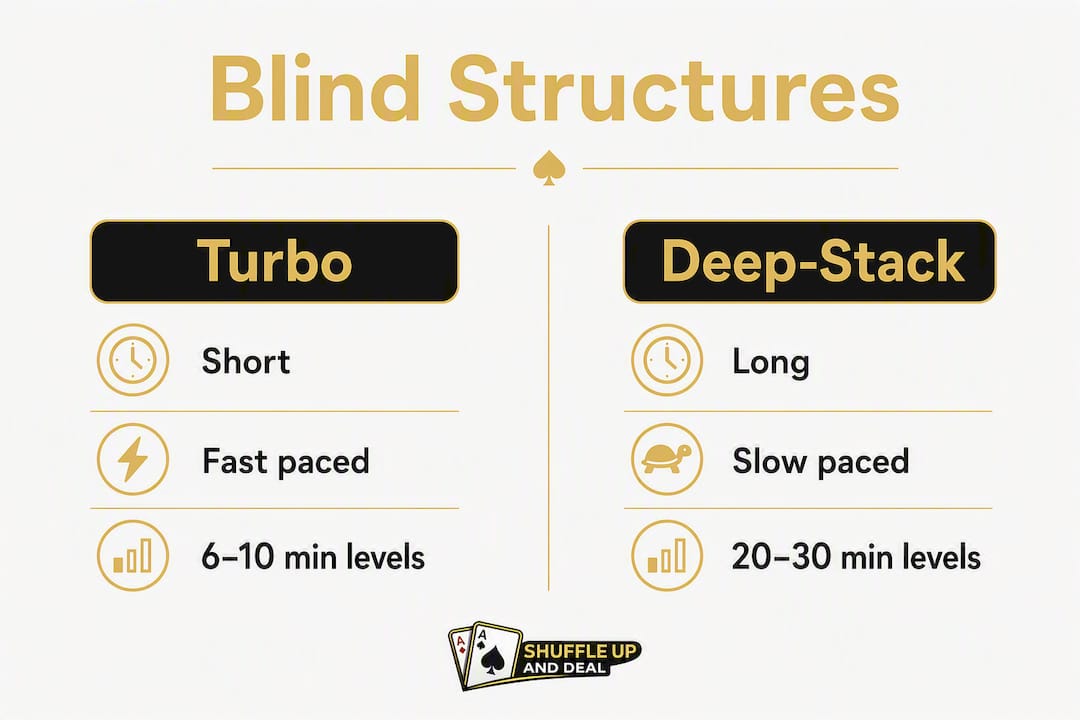
Start with 40–60 big blinds and 6–10 minute levels. Expect the tournament to finish around level 8–10.

| Level | Small blind | Big blind | Ante (BB ante) | Duration |
|---|---|---|---|---|
| 1 | 25 | 50 | - | 8 min |
| 2 | 50 | 100 | - | 8 min |
| 3 | 75 | 150 | - | 8 min |
| 4 | 100 | 200 | 25 | 8 min |
| 5 | 150 | 300 | 25 | 8 min |
| 6 | 200 | 400 | 50 | 8 min |
| 7 | 300 | 600 | 75 | 8 min |
| 8 | 400 | 800 | 100 | 8 min |
| 9 | 600 | 1200 | 150 | 8 min |
| 10 | 800 | 1600 | 200 | 8 min |
Starting stack: 5,000 chips. Denominations: 25, 100, 500.
Standard home game (2–3 hours, 8–10 players)
75–100 big blinds at the start, 15 minute levels. Most games finish around level 10–12.
| Level | Small blind | Big blind | Ante (BB ante) | Duration |
|---|---|---|---|---|
| 1 | 25 | 50 | - | 15 min |
| 2 | 50 | 100 | - | 15 min |
| 3 | 75 | 150 | - | 15 min |
| 4 | 100 | 200 | 25 | 15 min |
| 5 | 150 | 300 | 25 | 15 min |
| 6 | 200 | 400 | 50 | 15 min |
| 7 | 300 | 600 | 75 | 15 min |
| 8 | 500 | 1,000 | 100 | 15 min |
| 9 | 800 | 1600 | 150 | 15 min |
| 10 | 1,000 | 2,000 | 200 | 15 min |
| 10–12 | 1,500 | 3,000 | 300 | 15 min |
| 12 | 2,000 | 4,000 | 500 | 15 min |
Starting stack: 10,000 chips. Denominations: 25, 100, 500, 1,000.
Deep-stack evening (4+ hours, 10–20 players)
150–300 big blinds at the start, 20–30 minute levels. Expect a finish around level 12–15, with a break at level 6.

| Level | Small blind | Big blind | Ante (BB ante) | Duration |
|---|---|---|---|---|
| 1 | 100 | 200 | - | 25 min |
| 2 | 150 | 300 | - | 25 min |
| 3 | 200 | 400 | - | 25 min |
| 4 | 300 | 600 | 75 | 25 min |
| 5 | 400 | 800 | 100 | 25 min |
| 6 | 500 | 1,000 | 100 | BREAK |
| 7 | 8 | 1600 | 150 | 25 min |
| 8 | 1,000 | 2,000 | 200 | 25 min |
| 9 | 1,500 | 3,000 | 300 | 25 min |
| 10 | 2,000 | 4,000 | 500 | 25 min |
| 11 | 3,000 | 6,000 | 600 | 25 min |
| 12 | 4,000 | 8,000 | 1,000 | 25 min |
Starting stack: 30,000 chips. Denominations: 100, 500, 1,000, 5,000.
Pro Tip: For multi-table events with 20+ players, add two or three contingency levels at the end of your schedule. If the field runs deeper than expected, you have room to extend without improvising blind amounts on the fly.
What does a blind-structure calculator actually need?
A calculator needs surprisingly few inputs to produce a usable schedule. Get these right and the rest follows automatically.
-
Number of players. Drives the total chip pool and the estimated number of hands before a winner emerges. More players means more levels needed, so either extend level length or add contingency levels.
-
Starting chips (or starting big blinds). A 50:1 or 100:1 chip-to-BB ratio is the standard convention. 10,000 chips with a 100/200 starting blind gives you 50 BB, which is on the shallow side; 10,000 with 75/150 or 100/100 gives 75 or 100 BB and much more play.
-
Target duration. The single most important constraint. Everything else bends to fit this.
-
Level length. Live, self-dealt home games deal roughly 25–30 hands per hour, compared with 60–100 online. Use longer levels for live events to give players a similar number of hands per level.
-
Smallest chip denomination. Blinds must be divisible by your smallest chip. A 75-chip blind is unplayable if your smallest chip is 100.
-
Rebuys and add-ons. Each rebuy adds chips to the pool, pushing the effective finish blind higher. Declare the rebuy period upfront so the calculator can adjust.
-
Ante style. Traditional per-player antes slow the game down. Big-blind ante is faster and reduces small-chip clutter.
-
Playing style. Turbo, standard, or deep-stack. This sets the default multiplier and level length before you fine-tune.
Pro Tip: Delay antes until level 4 or 5. Introducing them too early, when stacks are still deep, adds complexity without meaningfully changing the dynamic. Antes work best once average stacks drop to around 30–40 BB, where they genuinely accelerate play.
How tournament theory shapes your blind design
A poker blind structure is not just a list of numbers. It is a pacing engine, and understanding its three phases helps you design one that feels fair and fun rather than rushed or endless.
Starting depth is measured in big blinds. Standard home games start at 75–100 BB, deep-stack events at 150–300 BB, and turbo formats at 40–60 BB. Starting depth determines how much skill-based play happens before the game becomes a push-fold exercise.
The three phases break down like this:
-
Early phase (>100 BB). Players have room to manoeuvre. Post-flop play, position, and reads all matter. Blinds should increase slowly here.
-
Middle phase (30–40 BB). Antes are introduced and pressure builds. Three-bet shoves and squeeze plays become common. This is where the tournament really takes shape.
-
Late phase (<20 BB). Push-fold poker. Stack sizes dictate decisions more than reads. Blind increases here should be measured, not dramatic, or you risk eliminating multiple players on the same hand through bad luck rather than skill.
A useful rule of thumb: a home tournament typically ends when the big blind reaches 5–10% of the total chips in play, usually around levels 8–12. For a 10-player game with 10,000 chips each (100,000 total), that means the game concludes when the BB is somewhere between 5,000 and 10,000.
This target gives you a concrete finish blind to aim for when you build your schedule from scratch.
The formula for calculating blind levels
The exponential growth formula is the engine behind every well-designed blind increase schedule:
finalBB = startBB × r^n
Where:
-
startBB = your opening big blind
-
r = the multiplier applied each level
-
n = the number of blind increases (levels)
-
finalBB = your target finish big blind
To find the multiplier r when you know your start and finish blinds and the number of levels, rearrange:
r = (finalBB ÷ startBB)^(1/n)
Worked calculation
Say you are running a standard home game. Starting BB is 100, target finish BB is 4,000, and you plan 10 blind increases:
-
r = (4,000 ÷ 100)^(1/10)
-
r = (40)^(0.1)
-
r = approximately 1.45
That is comfortably inside the recommended 1.3×–1.6× range, so the schedule will feel smooth rather than punishing.
Rounding rules
-
Always round blind amounts to denominations you actually have. A 145-chip blind is unplayable.
-
Keep multipliers between 1.3× and 1.6× for most formats. Below 1.3× and the game drags; above 1.6× and players face sudden all-in pressure.
-
If a calculated jump exceeds 2× between any two consecutive levels, extend your level durations or reduce your starting chip count rather than forcing the jump.
-
Use round numbers that feel natural at a poker table: 25, 50, 75, 100, 150, 200, 300, 400, 500, 600, 800, 1,000, 1,500, 2,000, 3,000, 4,000, 5,000.
Worked examples for typical UK tournaments
Example 1: single-table home game, 9 players
Assumptions: 9 players, 10,000 starting chips, 100/200 starting blinds (50 BB), 2.5-hour target, 15-minute levels, no rebuys, BB ante from level 4, chip denominations: 25, 100, 500, 1,000.
Target finish BB: approximately 3,000–4,000 (3–4% of 90,000 total chips, slightly below the 5–10% threshold because a 9-player single table finishes faster than a multi-table field).
| Level | Small blind | Big blind | Ante | Duration |
|---|---|---|---|---|
| 1 | 100 | 200 | - | 15 min |
| 2 | 150 | 300 | - | 15 min |
| 3 | 200 | 400 | - | 15 min |
| 4 | 300 | 600 | 75 | 15 min |
| 5 | 400 | 800 | 100 | 15 min |
| 6 | 600 | 1200 | 150 | 15 min |
| 7 | 800 | 1600 | 200 | 15 min |
| 8 | 1000 | 2,000 | 300 | 15 min |
| 9 | 1500 | 3,000 | 400 | 15 min |
| 10 | 2,000 | 4,000 | 500 | 15 min |
Estimated finish: level 8–10, approximately 2–2.5 hours.
Example 2: club game, 20–30 players
Assumptions: 25 players, 15,000 starting chips, 100/200 starting blinds (75 BB), 3.5-hour target, 20-minute levels, one rebuy allowed in first 3 levels, BB ante from level 5, chip denominations: 100, 500, 1,000, 5,000.
With rebuys, assume 60% of players rebuy once. Total chips in play: 25 × 15,000 + 15 × 15,000 = 600,000. Target finish BB: 30,000–60,000.
| Level | Small blind | Big blind | Ante | Duration |
|---|---|---|---|---|
| 1 | 100 | 200 | - | 20 min |
| 2 | 200 | 400 | - | 20 min |
| 3 | 300 | 600 | - | 20 min |
| 4 | 400 | 800 | - | 20 min |
| 5 | 600 | 1200 | 150 | 20 min |
| 6 | 800 | 1600 | 200 | 20 min |
| 7 | 1000 | 2,000 | 300 | 20 min |
| 8 | 2,000 | 4,000 | 500 | 20 min |
| 9 | 3,000 | 6,000 | 600 | 20 min |
| 10 | 4,000 | 8,000 | 1,000 | 20 min |
| 11 | 6,000 | 12,000 | 1,500 | 20 min |
| 12 | 10,000 | 20,000 | 2,000 | 20 min |
Estimated finish: level 10–12, approximately 3–3.5 hours.
Mid-tournament adjustments: if the game is running fast (many early eliminations), extend level length by 5 minutes from the next break. If it is running slow, introduce antes one level earlier than planned, or skip a contingency level. Announce any change at a break, never mid-hand.
Example 3: deep-stack evening, 10–12 players
Assumptions: 12 players, 30,000 starting chips, 100/200 starting blinds (150 BB), 4.5-hour target, 25-minute levels, no rebuys, BB ante from level 5, break at level 6 with chip race for 100-chips. Denominations: 100, 500, 1,000, 5,000.
This matches the deep-stack template above. The key difference from the standard game is the slower multiplier (approximately 1.35×) and the longer levels, which give players more hands per level and keep post-flop play alive well into the middle phase.
How rebuys, add-ons and antes change your schedule
Rebuys and add-ons are the most common reason a tournament runs longer than planned. Here is how to account for them properly.
-
Rebuys increase total chips in play. More chips means the finish blind must be higher for the BB to represent a meaningful percentage of the pool. If you expect 50% of players to rebuy once, multiply your original total chip count by 1.5 and recalculate your target finish BB.
-
Add-ons at the first break are cleaner to manage than mid-level rebuys. Schedule them to coincide with a break so the chip count is stable before you enter the middle phase.
-
Unlimited rebuys can extend a 2-hour game by an hour or more. If your finish time matters, cap rebuys at one per player or restrict the rebuy period to the first three levels.
-
Antes accelerate the game. Introducing antes earlier than planned is the quickest way to speed up a slow tournament. Moving antes from level 5 to level 3 can shave 20–30 minutes off the runtime.
-
Big-blind ante is the right default for live home games. It is faster to deal, easier to track, and reduces the need for small-denomination chips. It is also the format now standard in most major live events.
-
Compensating for a heavy rebuy period: if the rebuy period was busier than expected, shorten future levels by 3–5 minutes or introduce antes one level earlier. Do not try to compensate by doubling blind amounts.
Common blind structures and chip denomination guidance
Turbo structure
Starting depth: 40–60 BB. Level length: 6–10 minutes. Multiplier: approximately 1.5× per level. Best for: knockout bounty games, late-night add-on events, or when you need a definite finish time. Chip denominations: keep it simple with three colours (e.g. 25, 100, 500). Colour-up the 25-chips at the first break.
Standard structure
Starting depth: 75–100 BB. Level length: 12–20 minutes. Multiplier: approximately 1.4×. Best for: most UK home games and single-table club events. Chip denominations: four colours work well (25, 100, 500, 1,000). Colour-up 25-chips after level 4–5.
Deep-stack structure
Starting depth: 150–300 BB. Level length: 20–30 minutes. Multiplier: approximately 1.3×. Best for: serious club nights, poker holidays and events where skill-based play is the priority. Chip denominations: five colours (100, 500, 1,000, 5,000, and optionally 25,000 for very large stacks). Plan a chip race for the 100-chips at the first break.
Adapting for player count and skill mix
For mixed-skill groups, lean towards a standard or deep-stack structure regardless of player count. Shallow stacks punish beginners disproportionately and reduce the fun for everyone. For single-table events (6–10 players), you can use slightly shorter levels than a multi-table equivalent because fewer players means faster eliminations. For multi-table events (20+ players), add 5 minutes per level and build in at least two breaks with colour-ups planned around your denomination ladder.
How Shuffle Up and Deal!’s Blind Wizard generates and runs your schedule
Shuffle Up and Deal! removes every manual calculation from the process. Here is what the Blind Wizard does, step by step:
-
Input your constraints. Enter player count, chip denominations, start and finish time, playing style (turbo/standard/deep), and whether you want rebuys, add-ons, or antes (traditional or big-blind ante).
-
Generate a constraint-driven structure. The Blind Wizard produces level durations, smooth blind growth, a recommended starting stack, main levels sized to hit your target finish time, and contingency levels in case the game runs long.
-
Auto-schedule breaks and chip races. Breaks and colour-ups are placed automatically around your denomination ladder. No manual planning needed.
-
Fine-tune level by level. Every generated structure is editable. Adjust individual blind amounts, swap level lengths, or add a custom level without rebuilding from scratch.
-
Save as a reusable template. Once you are happy with a structure, save it. Apply it to future events with a single tap, or use it as the starting point for a new variation.
-
Run the tournament clock on the night. Levels auto-advance. Pause, skip, and jump-to-level controls give you full flexibility. Professional voice packs announce “blinds are up” and the new blind amounts so you never have to shout across the room.
-
Chip-race auto-pause. When a colour-up break arrives, the clock pauses automatically so you can complete the race before the next level starts.
-
Casting mode for TV display. Put the clock on a TV or external screen so every player can see the current level, blinds, and time remaining without asking the TD.
Tournament directors commonly rely on software to automate level transitions, manage breaks and track payouts, because automation reduces human error and keeps events on schedule. Shuffle Up and Deal! is built around exactly that principle.
Key takeaways
A well-designed poker blind structure starts with the right depth in big blinds, applies a consistent multiplier of 1.3×–1.6× per level, and targets a finish blind of 5–10% of total chips in play.
| Point | Details |
|---|---|
| Starting depth matters most | Use 75–100 BB for standard home games, 150–300 BB for deep-stack, 40–60 BB for turbo. |
| Keep multipliers in range | A 1.3×–1.6× multiplier per level produces smooth blind growth; never exceed a 2× jump between levels. |
| Antes change the pace | Introduce antes at level 4–5 and use big-blind ante for speed; moving them earlier is the fastest way to accelerate a slow game. |
| Rebuys push the finish blind higher | Estimate your rebuy rate, recalculate total chips in play, and adjust your target finish BB before the event starts. |
| Shuffle Up and Deal! builds it in minutes | The Blind Wizard generates a complete, editable schedule from your inputs and runs the clock on the night. |
Why most home games get the blind structure wrong
The most common mistake is not starting too shallow or running levels too short. It is failing to state assumptions before the night begins. A tournament director who has not decided whether rebuys are allowed, what the chip denominations are, or when the game needs to finish cannot build a coherent schedule, regardless of which formula they use.
The second mistake is treating the blind schedule as fixed. A good structure is a plan, not a contract. If six players bust in the first two levels and the game is running 40 minutes ahead of schedule, the right response is to extend level length at the next break, not to stick rigidly to a schedule that will produce a 90-minute game when you promised three hours.
There is also a widespread confusion between betting structure and blind structure. No-Limit, Pot-Limit, and Fixed-Limit are betting rules that govern variance and hand dynamics. The blind schedule governs pace and finish time. Conflating the two leads to misdesigned events where a No-Limit game is given a Fixed-Limit-style shallow structure, or a deep-stack game is given turbo-length levels.
The practical fix for all three mistakes is to write your assumptions down before you generate a schedule: player count, starting chips, target finish time, level length, rebuy rules, and chip denominations. Hand that list to every player at the start. If something changes mid-tournament, announce it at a break and explain why. Players accept adjustments far more readily when they understand the reasoning.
For events that run across multiple sessions or venues, including poker cruise holidays where scheduling constraints are tighter, having a saved template you can adapt quickly is worth more than any formula.
Run your next tournament with Shuffle Up and Deal!’s Blind Wizard
Building a blind schedule by hand takes time you could spend running a better event. Shuffle Up and Deal! gives you a complete tournament management platform where the Blind Wizard handles the maths, the clock handles the night, and you handle the poker.

Enter your player count, chip denominations, start and finish time, and playing style, and the Blind Wizard generates a full schedule with breaks, colour-ups, and contingency levels built in. The tournament clock auto-advances levels, voice packs announce new blinds, and casting mode puts everything on a TV. Every structure saves as a reusable template, so your second event takes a fraction of the time your first one did.
There is a free-forever plan for smaller events, with paid tiers that unlock higher player counts and advanced features for club TDs running regular nights. To get started, download Shuffle Up and Deal! and load the standard 2–3 hour template as your first schedule. Tune it to your chip denominations, set your finish time, and you are ready to deal.
Useful sources and further reading
-
Home Poker Tourney - blind rules and finish estimates: practical guidance on when home tournaments typically end and how to estimate finish time from blind levels.
-
Pokerology - poker tournament rules and guidance: solid overview of starting stack recommendations and level length guidance for different formats.
-
SoMuchPoker - guide to poker tournaments: explains the difference in hands-per-hour between live and online play, which directly affects level length decisions.
-
PokerNews - big blind antes: a thorough discussion of the practical advantages of big-blind ante for live events.