
Poker Tournament Management App
Run Poker Tournaments Like a Pro!
From First Hand to Final Table
Seat draws, table balancing, the clock, payouts and league standings: Shuffle Up and Deal! runs the whole night from your iPhone or iPad.

Poker Blind Timer FAQ: Every Question Your Players Ask
Poker Blind Timer FAQ: Every Question Your Players Ask
Every tournament director ends up answering the same handful of questions once the cards are in the air. How long is the level? When's the break? What are the blinds next? How many players are left? How close am I to the money? Almost all of them come back to the clock. This is the FAQ we wish every player had read before they sat down - the answers real directors give, in the order they get asked.
What is a poker blind timer?
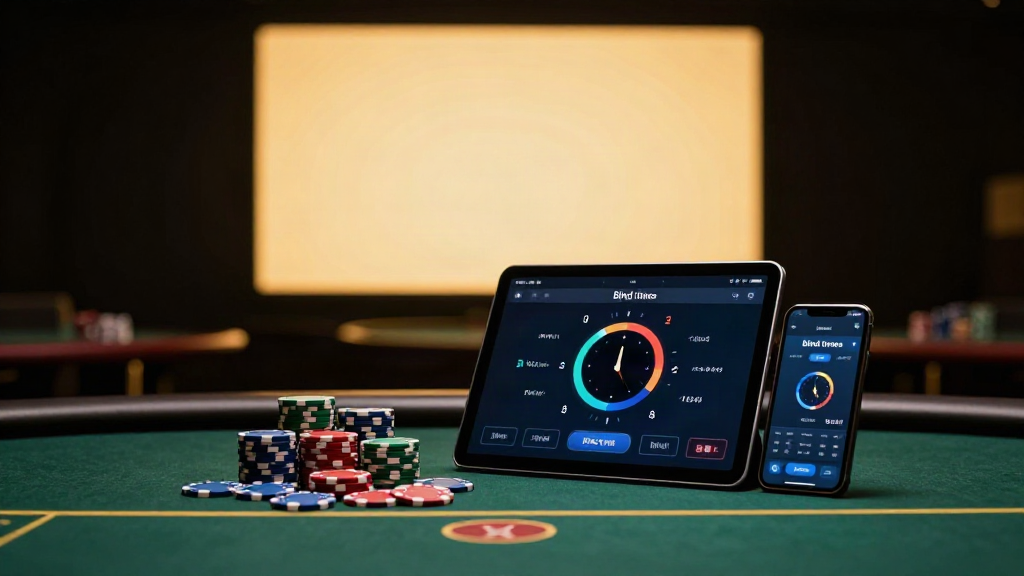
A poker blind timer is the clock that runs your tournament. It counts down each level, shows the current blinds and antes, and tells the room what is coming next. In a home game it is often a phone propped against a chip case; in a card room it is a dedicated tournament clock cast to a screen, so every table sees the same numbers at the same second. The job is the same either way: keep the whole field on one clock, so nobody has to ask how long is left.
How do blind levels work?
Every tournament is split into levels. Each level carries a set of blinds and a matching ante, and both increase when the level ends. A structure written as "20-minute levels" means exactly that - twenty minutes of play, then the blinds go up. Because the length is fixed, players can work out roughly how many hands they will see before the cost of playing rises. The structure is the schedule; the timer is what enforces it.
How long should each blind level last?
As a starting point:
- Home games and league nights: 20-30 minute levels while stacks are deep
- Standard club tournaments: 15-20 minutes
- Turbo, charity and one-night events: 8-12 minutes
Shorter levels make the blinds climb faster relative to stack depth, which gets the tournament finished sooner. If players moan that the structure feels like a lottery by level six, the levels are too short or the starting stack is too small - usually both.
When should antes kick in?
Most live tournaments now use a big blind ante, introduced once the field has thinned or straight from level one. It is faster to administer than individual antes and far easier to police at the table. If you run antes from the first level, expect a bit more friction and a bit more time per hand early on. Leave them out until later and players get a gentler start, with the money going in faster when it matters.
How should breaks be scheduled?
The common pattern is a 15-minute break every two hours of play, usually every four to six levels. The clock should announce the break the same way it announces a level change, and count down to it visibly. A "next break" indicator on screen kills the "when's the break?" question before it is asked. Keep the break long enough for players to get a drink and for you to colour up chips or balance tables.
What should a tournament clock actually display?
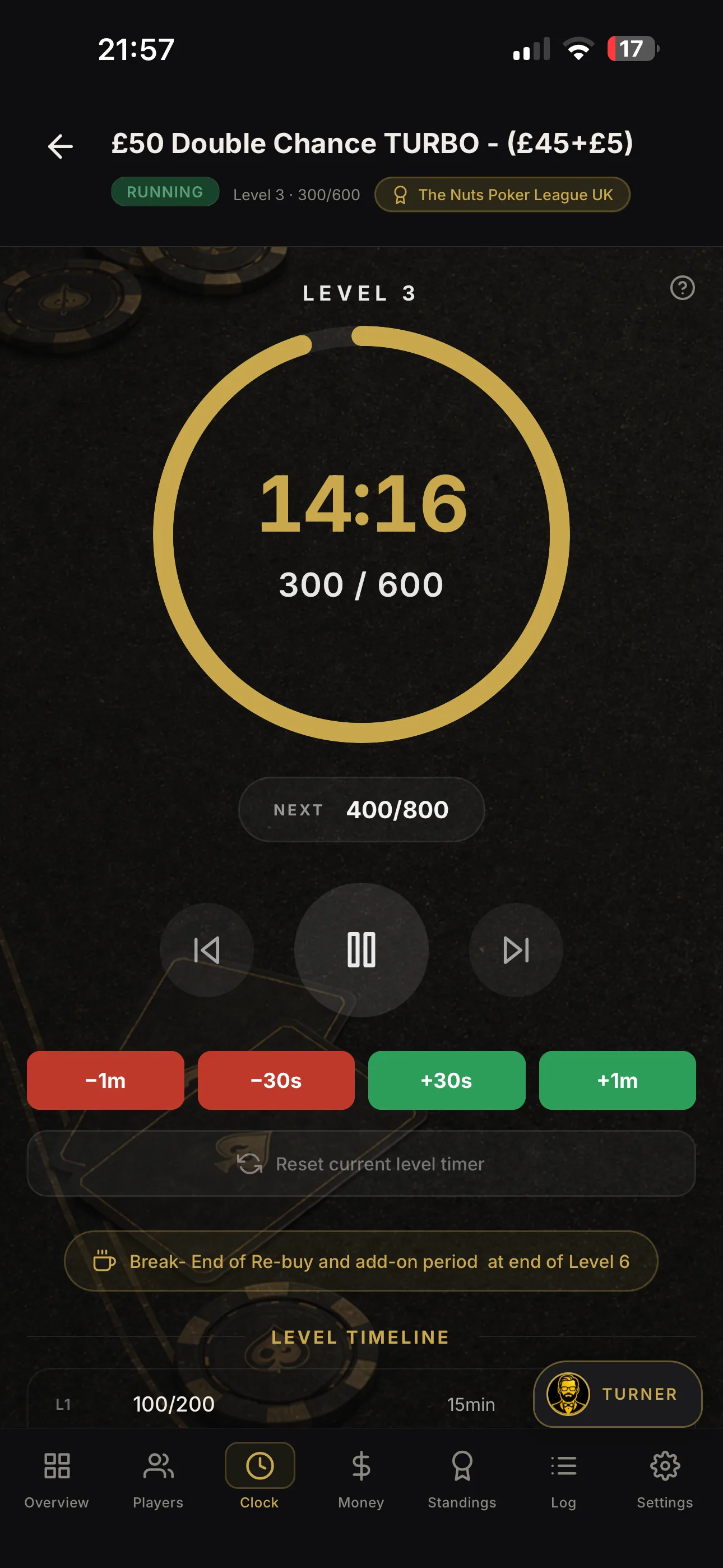
At a minimum: the current level and time remaining, the small blind, big blind and ante, and the blinds for the next level. Beyond that, directors want players remaining, average stack, total entries, re-entries and rebuys, and time to the next break. The strongest clocks add prizes and payouts, the seat draw and table assignments, plus clear animations for the level change, the break, the bubble and going ITM. Everything players currently ask you out loud is something the screen should already be showing.
What is the difference between a blind timer and tournament software?
A blind timer does one job: it counts the levels. Tournament software runs the whole event - registration, seat draws, table balancing, eliminations, payouts and league standings - with the clock as one part of it. A timer tells you the blinds. A tournament system tells you who is still in, which table is short, what the next payout is and where every player is sitting, all from the same screen.
How does late registration work with the clock?
Late registration normally stays open until a set level - often the first break, or somewhere around levels four to six. The clock should show that deadline plainly, so latecomers know exactly how long they have. Once registration closes, the payouts and the average stack can be finalised and the tournament runs to the money. Directors running re-entries and rebuys want the same clarity: a visible cut-off, not a judgement call at the desk.
What happens at the bubble?
The bubble is the last player out before the money. It is the most watched moment of the night, and a professional clock makes it obvious - a bubble animation or on-screen marker so every table knows a payday is one elimination away. When the bubble bursts, the clock flips to ITM and shows the payouts. It sounds like presentation, but it reduces stress: players stop asking you whether they are in the money.
Can players follow the clock on their own phones?
Yes, and it saves you a lot of walking. A live tracker linked to the tournament lets players open a browser page or scan a QR code and see the blinds, the clock, the key metrics, their table and seat, and the knockouts as they happen. Venue pages can show upcoming games, results and league standings between events. The screen on the wall serves the room; the tracker serves the player who has just been moved to table nine.
Do I need a TV, or is a laptop enough?
Either works. A laptop is fine for a single table. For a club or a multi-table league, a TV or second screen gives you the display the room deserves - blinds, clock, payouts, seating and ticker messages, readable from the far end of the room. Whatever you cast to, the point is that everyone is reading the same numbers at the same time.
Is a phone timer good enough for a real tournament?
For one table at home, a phone timer is fine. The moment you are balancing tables, handling re-entries, tracking eliminations and calculating payouts, a plain timer starts costing you time and mistakes - the spreadsheet, the paper seat draw and the stopwatch stop agreeing with each other. That is the point at which a proper poker blind timer inside a full tournament system pays for itself.
The clock is the one thing everyone watches
Players will forgive a lot, but they will not forgive an unclear clock. Get the structure right, put the blinds somewhere everyone can see them, and let the timer absorb the questions for you. That is exactly what Shuffle Up and Deal! is built to do: a poker blind timer that runs the levels, antes and breaks, sitting inside a full tournament system that handles registration, seating, table balancing, eliminations, payouts and league standings - on the iPhone or iPad you already carry.