
Poker Tournament Management App
Run Poker Tournaments Like a Pro!
From First Hand to Final Table
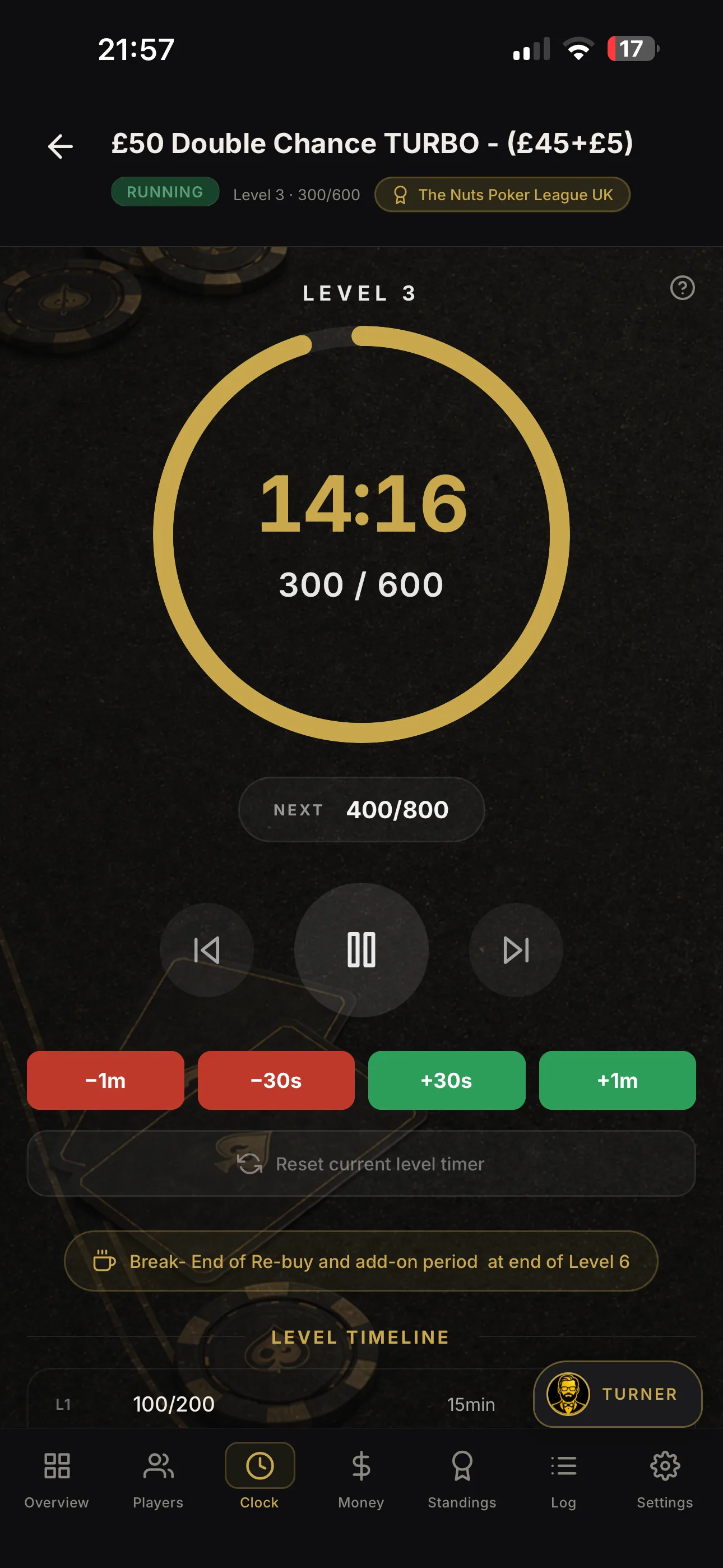
Seat draws, table balancing, the clock, payouts and league standings: Shuffle Up and Deal! runs the whole night from your iPhone or iPad.


Poker chip breakdown: the UK tournament director's guide

What every UK organiser needs to know about chip breakdown
Get your poker chip breakdown right and the whole tournament runs itself. Get it wrong and you’ll spend the night fielding “what’s the green worth?” questions while blinds stack up and players lose patience.
The core principles are straightforward:
-
Stick to 4–5 chip colours. More than five colours triggers constant chip exchange requests and slows the game noticeably.
-
Print denominations on every chip. Value-printed chips eliminate “what’s the green?” queries entirely, freeing you to run the event.
-
Follow the 4x/5x progression rule. Casinos skip close values like 10 and 50 for good reason: denominations of 1, 5, 25, 100 minimise change-making and keep pace brisk.
-
Weight stacks toward small chips. A standard starting stack distributes about 40% in the smallest chip denomination, 30% in the second lowest, 20% in the third, and 10% in the highest.
-
Reserve 20–30% as a bank. Without this buffer, tournaments stall when blinds rise and colour-ups are needed.
-
Use a digital tool. Professional apps automate chip distribution, track rebuys in real time, and flag shortages before they become problems.
Table of Contents
Chip breakdown models for different tournament sizes
Small home game (8 players): Give each player 8×25, 8×100, 2×500, 8×1,000, and 1×5,000 - 27 chips totalling 15,000 points. A 500-chip set covers eight players comfortably, including a rebuy buffer.

Mid-size event (8–24 players): Scale to roughly 500–750 chips total. A 750-chip set handles up to 24 players; a tournament with rebuys warrants stepping up to a 1,000-chip set. Front-load the 25s and 100s; hold the 5,000s back for colour-ups.
Multi-table tournament: Plan on 1,000–2,500 chips across two to five 500-chip sets. Each table needs its own bank of spare chips for colour-ups and rebuys independently.
How chip breakdown shifts through tournament stages
Early levels demand plenty of small chips. Players post blinds constantly and need change without pausing play. Mid-tournament, colour-ups remove the smallest denomination as blinds rise past its useful range - trading four 25-point chips for a single 100-point chip, for example. Late stages run almost entirely on high-value chips, so your bank needs enough 5,000s and 25,000s to keep stacks manageable. Plan each colour-up in advance; doing it reactively mid-hand is where tournaments lose 20 minutes.
Chip quantities per denomination by player count
| Players | 25s | 100s | 500s | 1,000s | 5,000s | Total |
|---|---|---|---|---|---|---|
| 6 | several | several | some | several | some | a few hundred |
| 8 | several | more | more | more | more | around 500 |
| 10 | somewhat more | even more | more | more | more | in the hundreds |
| These totals include the recommended 20–30% bank reserve for rebuys and colour-ups. |
Budgeting for chip procurement
Clay composite chips cost more than ABS plastic but hold up across hundreds of events. For a regular UK home league running monthly, a quality 500-chip set pays for itself quickly. Buy sets weighted toward small denominations - most retail sets ship with too many high-value chips and too few low ones, which is the first thing to correct. If your event grows beyond 10 players, purchasing a second 500-chip set is cheaper than sourcing mismatched chips later.
Aligning chip breakdown with blind structure and payouts
Your chip breakdown and your blind structure must be designed together, not separately. If your smallest chip is a 25 and your starting blinds are 25/50, players need at least 10–15 of those chips to post blinds comfortably through the first few levels. As blinds climb, colour-ups should coincide with scheduled break periods so play never stops mid-hand. Payout calculations also depend on chip counts: knowing your total chips in play lets you calculate prize pool splits and ICM deals accurately.
Shuffle Up and Deal! makes chip breakdown genuinely effortless
Running chip calculations manually across multiple denominations, player counts, and rebuy scenarios is where errors creep in. Shuffle Up and Deal! handles all of it automatically.
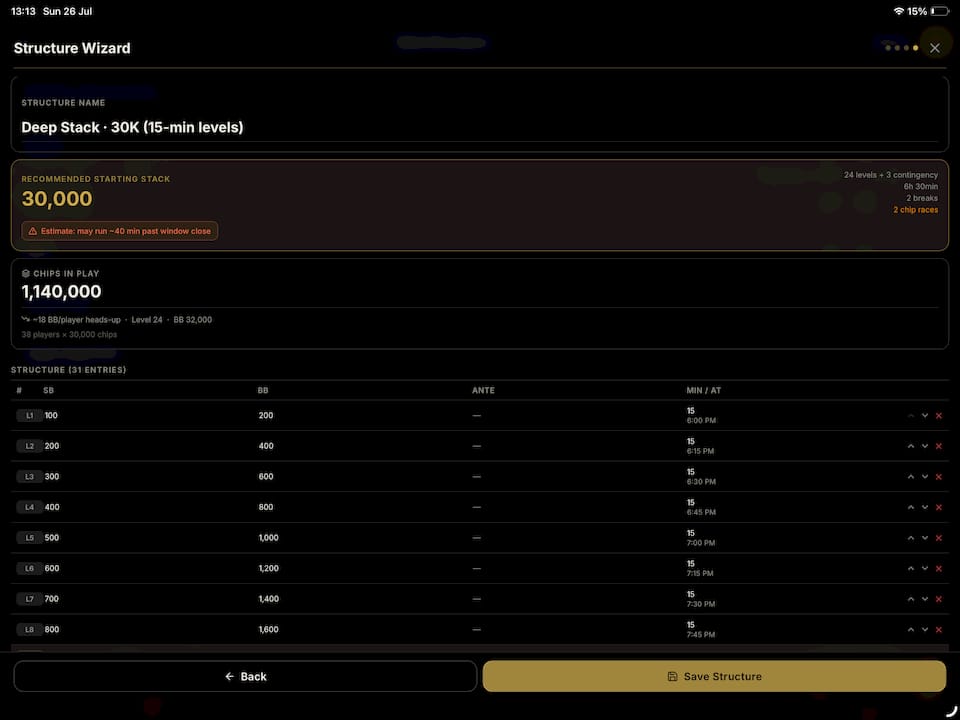
The Shuffle Up and Deal! app calculates chip distribution aligned with your blind structure and player count, tracks rebuys and add-ons in real time, and manages colour-ups without you lifting a calculator. Its live tournament clock keeps blind levels on schedule, while smart table balancing ensures chip distribution stays fair as players bust out. You can cast the tournament display to any screen, share live updates with players via a link, and run ICM deal calculations the moment the final table needs them. Whether you’re running a six-player home game or a 30-player multi-table event, Shuffle Up and Deal! keeps everything accurate and professional. Start your free plan at shuffleup.co.uk and see how much smoother your next event runs.
Key takeaways
A well-planned poker chip breakdown, built around the 4x/5x denomination rule and a 20–30% bank reserve, is the single biggest factor in keeping a tournament running on time.
| Point | Details |
|---|---|
| Limit chip colours | Use 4–5 colours maximum to prevent player confusion and keep pace fast. |
| Weight small denominations | About 40% of each starting stack should be the smallest chip for early blind posting. |
| Reserve a bank | Keep 20–30% of total chips back to cover rebuys and colour-ups without stalling play. |
| Plan colour-ups in advance | Schedule each colour-up at a break; reactive mid-hand colour-ups cost significant time. |
| Use Shuffle Up and Deal! | Shuffle Up and Deal! automates chip distribution, rebuy tracking, and colour-up management for UK tournament directors. |