
Poker Tournament Management App
Run Poker Tournaments Like a Pro!
From First Hand to Final Table
Seat draws, table balancing, the clock, payouts and league standings: Shuffle Up and Deal! runs the whole night from your iPhone or iPad.


Poker league points system for organisers: ready-to-use templates

The best default for most home and casual leagues is a formula-based points matrix, scaled to field size, topped up with a fixed attendance bonus. This single combination handles the two things organisers argue about most: whether a 30-runner Tuesday should outweigh an 8-runner Thursday, and whether showing up should count for something even on a bad night.
Here’s a copyable starting point for a league running 10 to 30 players a night:
- 1st place: a high fixed number of points plus attendance bonus
- 2nd place: somewhat fewer points plus attendance bonus
- 3rd place: moderately fewer points plus attendance bonus
- 4th place: fewer points plus attendance bonus
- Attendance bonus: a fixed number of points awarded to every registered player, regardless of finish
Publish three rules alongside this table: how attendance points are earned, whether rebuys affect scoring, and the minimum number of events a player needs to qualify for the season standings.
Key Takeaways
A field-size-scaled points matrix with a fixed attendance bonus and a minimum-games requirement produces the fairest, least disputed season rankings for most leagues.
| Point | Details |
|---|---|
| Default system | Use a formula-based or tiered points matrix that scales with field size, plus a flat attendance bonus. |
| Separate money from points | Award points by finishing position only; never let rebuys or buy-in size inflate a player’s score. |
| Guard against cherry-picking | Pair points-per-game ranking with a published minimum-games threshold, typically 50 to 60% of events. |
| Fix tiebreakers before season start | Split points evenly for tied finishes, then rank by wins, best finish, and head-to-head. |
| Automate the workload | Shuffle Up and Deal! calculates points, attendance credits, and rebuy handling automatically and publishes a live leaderboard. |
Table of Contents
- What is a poker league points system and which type suits you?
- How do you scale points for different field sizes?
- Total points or points per game: which ranks your season fairly?
- Should buy-ins and rebuys affect your league points?
- How do you handle tiebreakers, split pots and no-shows?
- Ready-to-use points matrices for 8, 12, 20 and 30+ player fields
- How do you choose the right points system for your league?
- Running your points system inside Shuffle Up and Deal!
- Sources
What is a poker league points system and which type suits you?
A poker league points system is the method you use to convert individual tournament results into a season-long ranking. Four families dominate active leagues, and each rewards a slightly different kind of player.
Payout-structure systems mirror the prize pool: whatever percentage of the pot a player wins in cash, they earn as points. This sounds fair on paper because it matches money already, but it collapses when field sizes vary. A £300 pot with 10 runners pays differently than a £900 pot with 30, so points earned for finishing 1st are not comparable week to week.
Linear systems award one point per opponent you outlast, plus your own survival point. Simple to explain, easy to calculate by hand, and it rewards grinding through a big field. Its weakness is that a min-cash in a 40-player field can outscore an outright win in an 8-player field, which frustrates players who show up consistently and win small events.
Proportional systems use tiers keyed to field size: bigger fields get bigger point pools at the top, smaller fields get compressed scales. 607 Poker League runs exactly this model, with first-place points ranging roughly from 250 to 600 depending on how many players registered, plus a flat attendance credit for everyone who shows up.
Formula-based systems calculate points from a mathematical function that factors in field size, buy-in, and finishing position simultaneously, rather than relying on a fixed lookup table. Home Poker Tourney recommends Dr Neau’s Tournament Formula for exactly this reason: score = SQRT(n * b * b / e) / (f + 1.0), where n is the number of players, b is the buy-in, e is total event expenses, and f is your finishing position. Sharp’s Poker League uses a close variant, points = sqrt(((a*b)*(b/c))) / (d + 1.0), swapping in slightly different variables for players, buy-in, and expense.
| System | Best for | Field-size fairness | Calculation effort |
|---|---|---|---|
| Payout-structure | Cash-focused leagues | Poor | Low |
| Linear | Small, stable fields | Moderate | Very low |
| Proportional (tiered) | Leagues with variable turnout | Good | Moderate |
| Formula-based | Multi-venue or high-variance leagues | Best | High (needs a spreadsheet) |
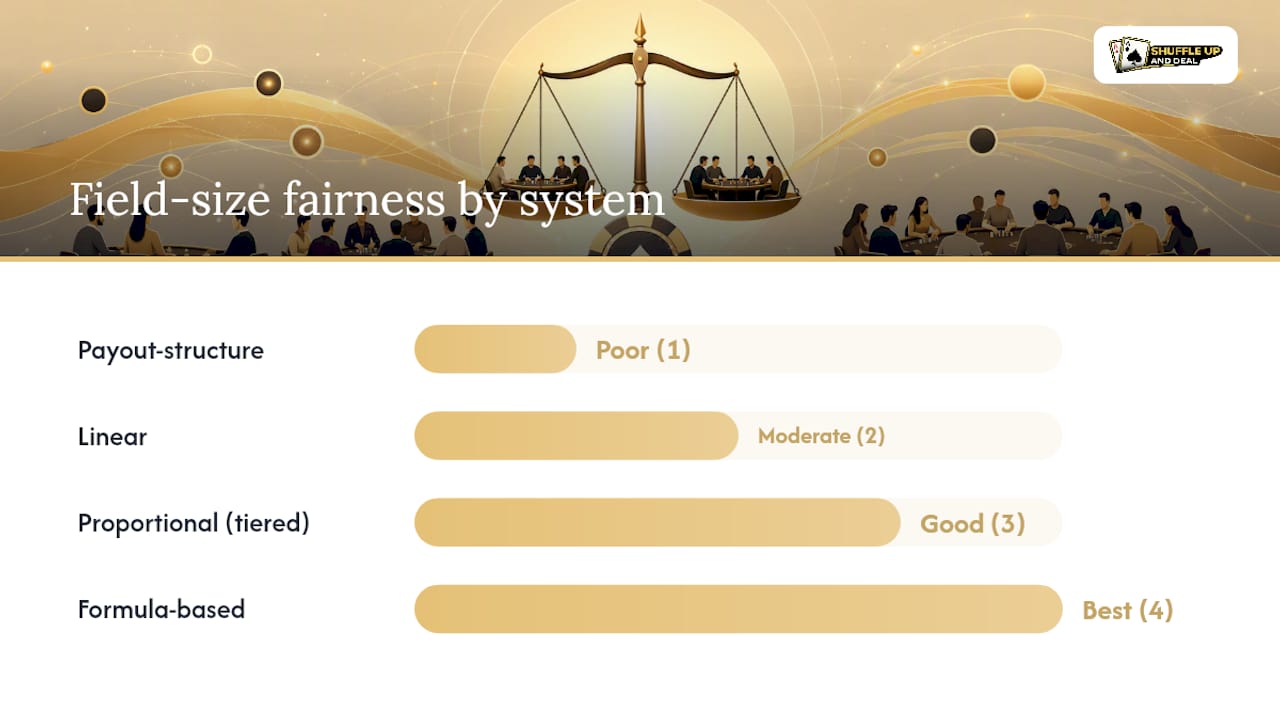
Most organisers running a single weekly game with a stable 12 to 20 players do fine with a proportional table. Leagues that jump between an 8-player Tuesday and a 35-player monthly final need the formula, because only a formula naturally compresses or stretches the point spread to match who actually turned up.
How do you scale points for different field sizes?
A fixed points table punishes small fields and inflates large ones. If 1st place always earns 50 points, a player who beats 7 opponents gets the same reward as one who beats 27, and that mismatch becomes obvious the moment your league mixes big and small nights.
The fix is a matrix that grows with the field, not a single row of numbers reused every week. Here’s how three common field sizes might scale under a proportional model:

8-player field
| Place | Points |
|---|---|
| 1st | a moderate value |
| 2nd | fewer points |
| 3rd | fewer points |
| 4th | fewer points |
12-player field
20+ player field
For leagues that regularly swing between these extremes, Great Lakes Poker League publishes a full place-to-points table running from 54 points for 1st down to 0 at 40th, built for high-entry seasonal events where dozens of finishing positions all need a defined value.
Pro Tip: If your field size bounces around unpredictably, skip fixed tables entirely and plug Dr Neau’s formula into a spreadsheet. It self-adjusts for every event automatically, so you never have to guess which matrix row applies.
Total points or points per game: which ranks your season fairly?
Total points rewards volume. Whoever plays the most events and finishes reasonably well tends to top the table, which suits leagues built around consistent attendance.
Points per game (PPG) rewards efficiency. It divides a player’s total points by the number of events they entered, so someone who plays 6 nights and wins 4 can outrank someone who grinds all 20 nights with modest results. The catch, as Felt King points out, is that PPG without safeguards lets a player enter two events, win both, and sit atop the leaderboard having barely shown up.
The safeguard is a minimum-games requirement. A common threshold is 50 to 60% of total events played, or a flat number such as “must play at least 8 of the season’s 15 events to qualify for the championship.” Home Poker Tourney recommends exactly this pairing: PPG for fairness, minimum games to stop cherry-picking.
Publish it plainly in your rules: “Players must complete a minimum of [X] events to qualify for season standings. Rankings below this threshold are calculated but excluded from prizes and the championship seat.” That single sentence prevents most end-of-season disputes before they start.
Should buy-ins and rebuys affect your league points?
Keep money and points on separate ledgers. Your prize pool exists to pay out cash on the night; your points system exists to rank players across the whole season. Felt King makes this distinction explicit, recommending finish-position points with optional bonuses rather than anything tied to the cash a player actually won.
Rebuys need their own rule, stated up front:
- Award attendance and finish points based on a player’s final stack and placement, not how many times they rebought.
- Do not award extra points per rebuy. Points should reflect where a player finished, not how much they spent getting there.
- For late registration, treat a player as present if they registered before a fixed cutoff (commonly the end of level 3 or 4), and award full attendance credit from that point onward.
- Add-ons follow the same logic as rebuys: they buy chips, not points.
This keeps a wealthy player who rebuys five times from outscoring a disciplined player who rebought once and finished higher, which is the single most common source of resentment in mismanaged leagues.
How do you handle tiebreakers, split pots and no-shows?
Split pots need a points rule that mirrors the chip rule. When two players hold identical five-card hands, PokerNews confirms the pot splits evenly and suits never break the tie. Apply the same logic to points: if two players are eliminated simultaneously and share a finishing position, they should split the combined points for that position and the one below it, then round.
For season-end ties on total points or PPG, apply tiebreakers in this order:
- Most tournament wins during the season.
- Best single finishing position across the season.
- Head-to-head results where both players entered the same events.
No-shows and disconnections should score zero for that event but still count toward the minimum-games denominator if the player registered and paid.
Pro Tip: When splitting an odd leftover point, BCPoker’s guide to tied hands notes that tournament software typically assigns odd chips by house rule rather than leaving it to argument. Do the same with points: decide in advance whether the odd point goes to the player with better position, and write it into your rules so nobody has to negotiate it live.
Ready-to-use points matrices for 8, 12, 20 and 30+ player fields
The tables above cover 8, 12, and 20+ players. For seasons that regularly draw 30 or more, extend the top-heavy structure further down the field rather than flattening it, since a 30-runner field has meaningfully more “mid-table” finishers worth differentiating.
30+ player field (extended)
| Place | Points |
|---|---|
| 1st | a very high value |
| 2nd | somewhat fewer points |
| 3rd | fewer points |
| 4th | fewer points |
| 5th | fewer points |
| 6th–8th | moderate points |
| 9th | lower points |
If you’d rather not maintain four separate tables, use Dr Neau’s formula directly in a spreadsheet. In Google Sheets or Excel, a working cell formula looks like:
=SQRT(n * b^2 / e) / (finish + 1)
with n, b, and e pulled from named cells for player count, buy-in, and total expenses, and finish referencing that player’s placement in your results column. Drag it down a column of finishing positions and every player’s score recalculates instantly, no matter how many people show up.
Build attendance bonuses in as a flat addition after the formula column, and reserve a separate “championship seat” column that flags anyone in your top 5 to 8 season standings once your minimum-games threshold is met.
For a live version players can check between events, export your results sheet to CSV and drop it into Google Sheets with sharing turned on, or use a dedicated leaderboard feature that updates automatically the moment you enter results, which removes the manual re-upload step entirely.
How do you choose the right points system for your league?
Run through this checklist before locking in a system for the season:
- Estimate your typical field size range. If it barely moves week to week, a fixed proportional table works fine. If it swings by more than roughly 15 players, lean towards a formula.
- Decide what you’re rewarding. Consistent attendance favours total points; sharp, occasional play favours PPG with a minimum-games floor.
- Check your prize distribution goals. If you already pay out proportionally to the pot, don’t also tie points to that same pot. Keep the systems separate.
- Survey your players before switching mid-season. Ask two questions: “Should attendance alone earn points?” and “Should a big win in a small field outscore a min-cash in a big one?” The answers usually reveal which model your group actually wants.
Red flag: if your current system is pure payout-percentage or pure linear-survival, and players are already grumbling about small-field wins feeling worthless, that’s your signal to move to a proportional or formula-based table before the complaints escalate into a season-ending argument.
Running your points system inside Shuffle Up and Deal!
Manually maintaining a spreadsheet across a 20-event season is where most organisers lose an evening every month. Shuffle Up and Deal! folds the whole workflow into the app you’re already using to run the tournament itself.
- League leaderboards update automatically as results are entered, showing total points and PPG side by side.
- Custom points matrices let you configure your own field-size scaling instead of relying on one fixed table.
- Attendance credits apply per-event without manual entry, matching the flat-bonus approach recommended throughout this guide.
- Rebuy controls keep rebuy activity separate from the points calculation, so spending more never inflates a player’s season ranking.
- Live display and casting turn any iPad into a running leaderboard players can check between hands.
To set it up: create your league, configure your points matrix or plug in a formula, enter results after each event, and publish the leaderboard. Player statistics carry over automatically, which keeps regulars engaged even in weeks they finish outside the money.
Pro Tip: Publish your league’s points rules as a pinned share link before the first event, not after week three. Players forgive a strict minimum-games rule far more easily when they knew about it from day one.
A short note on getting this right the first time
Most disputes over a poker league points system don’t come from the maths, they come from timing. Organisers tweak the rules mid-season after someone complains, and that single change undoes months of trust even when the new system is objectively fairer.
Pro Tip: Lock your points table and minimum-games rule before your first event, print it, and treat it as fixed for the entire season. Save changes for the off-season, however tempting a mid-season fix feels.
Let Shuffle Up and Deal! run the numbers while you run the room
Shuffle Up and Deal! is the alternative to a shared spreadsheet nobody trusts by August, sold for one honest reason: it calculates every player’s points the moment you enter a result, rather than leaving you to reconcile formulas at midnight after league night ends.

Every system in this guide, from a fixed 8-player table to Dr Neau’s formula, can be configured directly inside the app’s league management tools, alongside attendance credits, rebuy handling, and live leaderboards that publish automatically to a share link your players can bookmark. Organisers running qualifiers into a season finale also get smart seating and table balancing built in, so championship night runs as smoothly as week one. If prize distribution is part of your season alongside points, the app’s chip and payout tools sit right next to the leaderboard, and leagues focused on fairness principles more broadly may also appreciate Railbird’s work on promoting poker as a skill game.
Start on the free plan, build your first league, and import one of the templates from this guide directly into your points matrix. Head to Shuffle Up and Deal! to create your league and enter your first event today.
Sources
- Poker League Points Systems - Home Poker Tourney
- Poker League Scoring System | Felt King
- Scoring - 607 Poker League
- Sharp’s Poker League - SPLeague game scoring formula
- Point structure | Great Lakes Poker League