
Poker Tournament Management App
Run Poker Tournaments Like a Pro!
From First Hand to Final Table
Seat draws, table balancing, the clock, payouts and league standings: Shuffle Up and Deal! runs the whole night from your phone or tablet.



12 Tournament Director Mistakes That Slow Your Poker Night

Every tournament director has had that night. The cards are flying, the room is full, and somewhere in the middle of level six you realise you have become the bottleneck. Players are waving at you, the blinds are drifting, and the seat draw you ran twenty minutes ago no longer matches what is actually on the felt.
None of that is bad luck. It is process. The mistakes below are the ones that quietly turn a smooth game into chaos, and each one has a fix you can put in place before the next shuffle up.
1. Running the clock on a stopwatch and mental maths
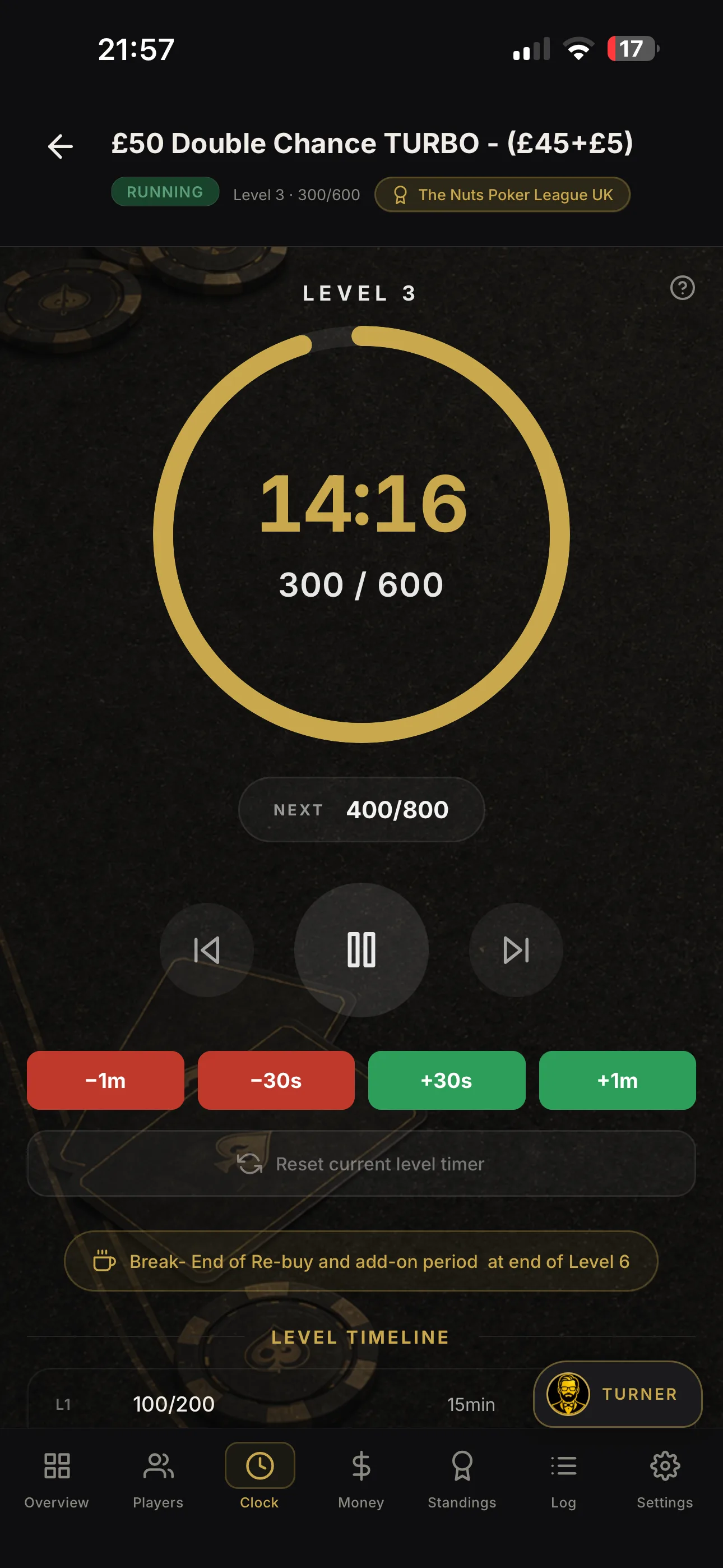
If your blind clock lives in your head, on a phone stopwatch, or on a whiteboard you have to keep rewriting, it will drift. Levels run long, breaks run short, and nobody in the room is quite sure whether it is 100/200 or 200/400.
The fix: save your blind structure once, then let a dedicated poker blind timer run it. Levels, antes, breaks and late-registration cut-offs all advance on their own, so the room follows the clock instead of the clock following you.
2. Drawing seats by hand
Paper seat draws are fine right up until you have sixty runners and a re-entry walking in at the last second. Hand-drawn seating is slow, hard to read and impossible to re-run fairly when a player complains.
The fix: automatic seat draws. Registration generates seats, tables and balances in seconds, and you can re-draw or re-seat a late arrival without tearing up the sheet.
3. Waiting for a complaint before you balance tables
By the time someone says "table four is down to three players", you have already lost half a level. Table balancing done late means short-handed tables bleed chips and the tournament loses its shape.
The fix: table balancing and breaking that happens as players bust. The app moves players down, breaks tables at the right moment and tracks who is sitting where, so you are not the one doing algebra with a dealer button in your hand.
4. Letting registration paperwork pile up
Late registration, rebuys, re-entries and add-ons are where running a tournament gets messy. Cash in a tin, names on a scrap of paper, and a stack of numbers you have to reconcile at the break.
The fix: player registration that records buy-ins, fees, rebuys and re-entries as they happen. Your numbers are always current, and you can close late registration with a tap.
5. Shouting the blinds across the room
"Blinds are 300/600, ante 600." Repeat that forty times a night and you have spent more time announcing than directing. It also means players only ever hear the blinds if they are listening to you.
The fix: an external display. A TV or second screen becomes a professional poker room board showing blinds, the clock, player counts, average stack and prizes, with level, break, bubble and ITM animations. The room reads the board, not your voice.
6. Tracking eliminations and chip counts on paper
Paper elimination lists get lost, crossed out and disputed. Worse, they make it almost impossible to answer the two questions players ask most: how many are left, and what is the average stack.
The fix: eliminations recorded live, with undo for the mistaken bust-out. Finishing positions build themselves, and average stack and player counts update on the board the moment someone leaves.
7. Working out payouts at the last minute
Every director has watched a final table sit in silence while someone taps a calculator. It is the worst possible moment to look disorganised, and it is entirely avoidable.
The fix: payout structures saved and applied automatically. The app works out the prizes from the entry count, and the board shows the payouts before the final table is even dealt.
8. Having no visible standings
If your league only exists in a notebook, your regulars cannot see how they are doing. Players who cannot see the race stop turning up to defend a position they cannot name.
The fix: league standings that update from results. Points, finishing positions and season tables are there for everyone to see, which is exactly what keeps a weekly league alive.
9. Losing the room to a hundred small questions
Where am I sitting? What are the blinds? What is the prize? When is the next break? Answer each one ten times and you have no attention left for the tournament itself.
The fix: a Live Tracker players open on their own phones by scanning a QR code. Live blinds, clock, tables, seats, knockouts and standings, all in the player's hand, so they stop asking you.
10. Trusting the room on knockouts
Bounty and knockout tournaments run on trust when nobody is writing anything down. That trust gets tested the moment two players disagree about who did the busting.
The fix: knockouts recorded as they happen, tied to the player and the table. The count is public and settled, which removes the argument before it starts.
11. Rebuilding the same tournament from scratch every week
Setting up a structure, payouts, seats and late reg from a blank sheet every single time is an hour of unpaid admin you will never get back.
The fix: save the whole setup - blind structure, buy-ins, fees, table sizes, payout structures and venue - and reload it. Your Tuesday night league starts from a template, not a blank page.
12. Ending the night with nothing to build on
You run a great tournament, the players love it, and then it all disappears into a notebook nobody reads again. No numbers, no history, no idea what is actually working.
The fix: results, statistics and financial reporting kept automatically. Venue ledgers, player histories and season stats are there when you need them, so the next event starts from what you learned rather than from scratch.
The common thread
Look back at that list and one pattern stands out: every mistake comes from holding the tournament together with your own attention. The clock, the seating, the balancing, the payouts and the standings all run through you, and there is only one of you.
Shuffle Up and Deal! moves that work onto the system. It handles the tournament clock, registration, seat draws, table balancing, eliminations, payouts and league standings in one place, casts a professional display to any spare screen, and puts live updates in your players' pockets. You still direct the room. You just stop being the software.
Book your next game in, save the structure, and let the board do the shouting. Then shuffle up and deal.