
Poker Tournament Management App
Run Poker Tournaments Like a Pro!
From First Hand to Final Table
Seat draws, table balancing, the clock, payouts and league standings: Shuffle Up and Deal! runs the whole night from your phone or tablet.



Spreadsheets vs Paper Seat Draws vs a Tournament App

Every tournament director starts the same way. A spreadsheet for registration, a sheet of paper for the seat draw, a stopwatch for the blinds, and a calculator for the payouts. It works fine on a quiet Tuesday. Then 40 players turn up for a Friday night league game, three tables need balancing, the bubble is about to burst, and suddenly you are the busiest person in the room.
This is an honest comparison of the three ways people run live poker tournaments today - spreadsheets, paper and stopwatches, or a dedicated poker tournament management app - and where each one breaks down once the room gets busy.
The spreadsheet-and-paper workflow
Most home game hosts, pub organisers and small clubs run on a mix of Excel or Google Sheets and paper. There is nothing wrong with the theory. A spreadsheet is flexible, free, and everyone already knows how to use one. You can track buy-ins, re-entries and a running player list without spending a penny.
The problems start when the clock is running.
- The blind structure lives in a different tab (or in your head), so you are manually watching a stopwatch and calling levels across the room.
- The seat draw is done by hand, which is slow for a big field and impossible to keep fair if you are also the one playing.
- Balancing tables means counting players at each table, working out who moves, and writing it down - all while a level ticks down.
- Eliminations and finishing positions get scribbled somewhere, and payouts are worked out on a calculator at the end.
- Nobody but you knows what is going on, so every question comes to the same person: you.
Spreadsheets scale with effort, not with automation. Every extra table, every late registration and every rebuy adds work rather than removing it.
Paper seat draws and a wall clock
The purest version of the manual approach is the one most clubs grew up with: names drawn out of a hat, a list pinned to the wall, and a clock on the wall for the blinds. It has a certain charm, and for a single-table home game with eight mates it does the job.
The cracks appear the moment scale enters the room:
- Drawn seat cards cannot cope with late registration or re-entries cleanly.
- Breaking a short table means re-drawing by hand, which feels unfair and takes real time.
- Average stack, total chips in play and payouts are all mental arithmetic.
- There is no display for players, so the tournament lives in the TD's notebook.
The paper workflow is reliable right up until it is not - and it only ever works while one person is free to run it.
What a dedicated poker tournament management app does differently
A dedicated management app takes the jobs that currently sit in separate tools and puts them in one place, structured around how a live tournament actually runs.
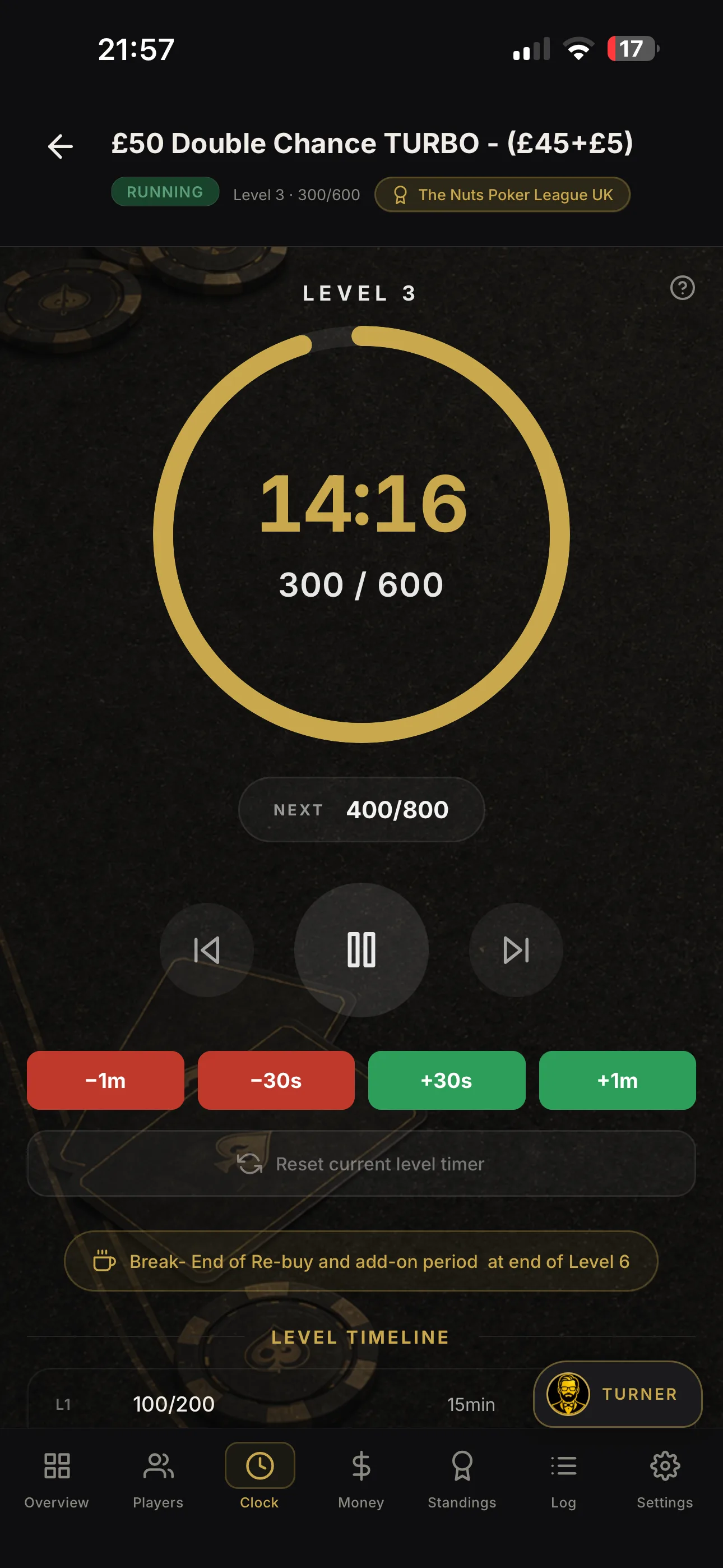
The clock and blind structure. You build and save blind levels, antes, breaks and level times once, then run them every week. The clock drives the room and calls the levels for you.
Registration, rebuys and re-entries. Buy-ins, fees, late registration and add-ons are recorded as they happen, so your prize pool and player count are always current - not reconstructed at the end.
Seat draws and table balancing. The app handles automatic seat draws, table balancing and table breaking, plus manual reseating when you need it. Moving a player no longer means a fresh sheet of paper.
Eliminations and finishing positions. Knockouts are recorded as players bust, which gives you accurate finishing positions, the bubble and ITM cut-off without a separate list.
Payouts and results. Payout structures are calculated from the live field, so you are not running a calculator in the car park at the end of the night.
Displays and player information. A TV or second screen can show blinds, the clock, player counts, average stack, prizes and seating, alongside your venue's branding. Players can follow along on their phones through browser-based live tracking and QR codes.
The difference is not really about features. It is about removing the manual steps that eat your attention during a live event.
Where each approach actually breaks down
| Job | Spreadsheet + paper | Dedicated app |
|---|---|---|
| Blind clock | Stopwatch, manual calls | Saved structure, automatic levels |
| Seat draw | Hand-drawn, slow to change | Automatic, instant reseating |
| Table balancing | Counting and re-writing | Automated balancing and breaking |
| Eliminations | Scribbled notes | Recorded, with undo |
| Payouts | Calculator at the end | Calculated live from the field |
| Player info | They ask you | TV display and phone tracker |
| League standings | Another spreadsheet | Tracked and published |
Spreadsheets and paper are not stupid choices. They are the cheapest way to start, and for a single small home game they are genuinely fine. The point is to know where the trade-off sits. The manual approach converts your evening into admin, keeps every answer in your head, and gets slower as the field grows. A dedicated app is built to get faster as the room fills up.
How to choose
Ask yourself three questions.
If you run one table for friends a few times a year and enjoy the DIY side, a spreadsheet and paper will keep you going - you do not need software for that.
If you run recurring games, weekly leagues or a pub tournament where the same players come back and expect standings, the manual workload compounds every week. That is where a management app stops being a luxury and starts being a time-saver.
If you run anything approaching a real card room - multiple tables, late registration, re-entries, prizes and a display for players - manual tools will eventually cost you either accuracy or your enjoyment of the night. Usually both.
The bottom line
Spreadsheets, paper seat draws and stopwatches are not wrong. They are just doing a job they were never built for. A dedicated poker tournament management app turns the tournament clock, registration, seating, table balancing, eliminations, payouts and league standings into one reliable system - so the tournament runs on rails and you get to actually watch it.
If your current setup works, keep it. If it is costing you every Friday night, it is worth seeing what a proper tool does differently.