
Poker Tournament Management App
Run Poker Tournaments Like a Pro!
From First Hand to Final Table
Seat draws, table balancing, the clock, payouts and league standings: Shuffle Up and Deal! runs the whole night from your iPhone or iPad.

Poker Tournament Software vs Spreadsheets: What Manual Logs Really Cost Your Room
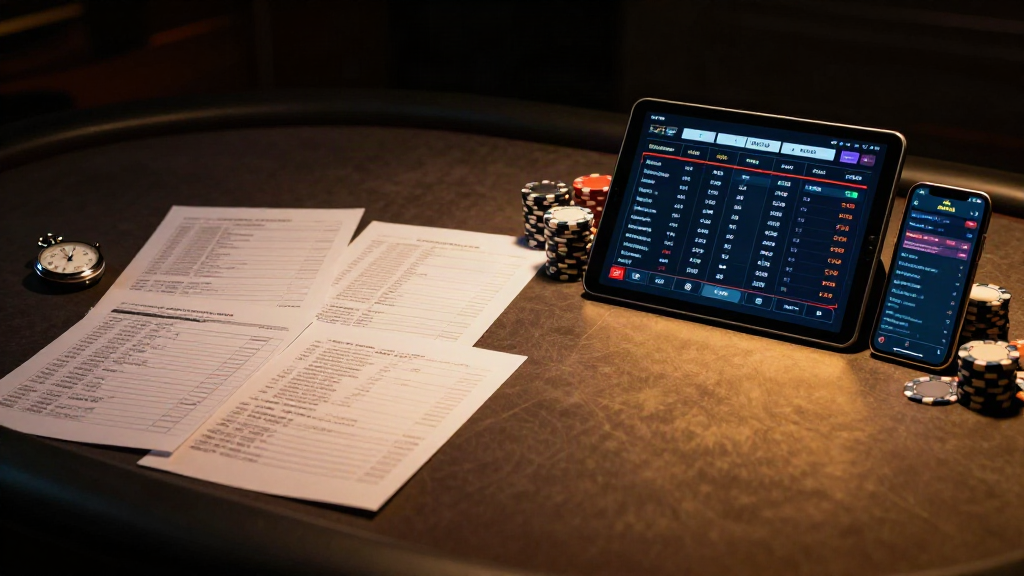
Every tournament director knows the drill. A laptop with three tabs open, a printed seat draw that's already out of date, a stopwatch balanced on the rail, and a player at table four asking - politely, for now - why he's been sitting short-handed for twenty minutes.
You've run the room this way because it works. Sort of. But "sort of" has a cost, and it's bigger than most directors realise. This is an honest, head-to-head look at managing a tournament with spreadsheets, paper and stopwatches versus a purpose-built poker tournament management app - fairness, table balance, payout accuracy, and the experience your players actually feel.
The manual way: spreadsheets, paper, and stopwatches
The classic tournament kit hasn't changed in decades. You register players on a paper list or a spreadsheet. You hand-draw seats. You run the blind clock on a stopwatch or an old timer app, and you update the levels by voice. Standings live in a notebook, or in your head, and only make it to a screen if someone volunteers to type them up.
It's cheap, it's familiar, and for a casual game among friends it's fine. The problems start the moment the field grows, the bust-outs pile up, and the night stretches past the point where anyone can hold six moving pieces in their head.
Where the manual method quietly costs you
1. Fairness you can't prove
The second your seat draw is drawn by hand, someone will question it. Was the draw random? Did that player really get that seat, or did the host's mate? Paper draw slips get lost, redrawn, or "adjusted" to balance tables, and every adjustment is a small hit to your authority. A director who can't prove fairness spends the night defending decisions instead of running the room.
2. Table balance and bust-outs
Balancing tables late in a tournament is where spreadsheets fall apart. When Table 2 breaks, you need to know which players move, which seats are open, and where the short stacks should land - fast, and fairly. Do it by hand and you're shuffling names on a printout while the blind level runs down and the players at the receiving table wait. Manual seat moves are also the number-one source of "that's not fair" arguments at the final table.
3. Payout accuracy and the money
Hand-calculated payouts and chip counts are where real money gets lost. One misread stack, one payout structure applied slightly wrong, and you've either short-changed a player or eaten the difference yourself. Cash games and side pools only add more figures to track. And if a payout dispute can't be settled by a clear, shared record, it's your reputation on the line.
4. The player experience
Players judge your room by what they can see. A written standings sheet no one can read, a blind clock that only you can see, and a payout announcement you had to calculate twice - that's an amateur night, whatever the buy-in. The rail wants to know the chip average, the money bubble, and how close they are to the final table. If they can't, they disengage.
5. Your night, gone
Add it up: eight hours of running, plus the admin. Late-night uploads, disputes over stacks, next-day results to type up. You're doing data entry in the middle of a poker game, and it never quite balances.
What a purpose-built poker tournament management app does differently
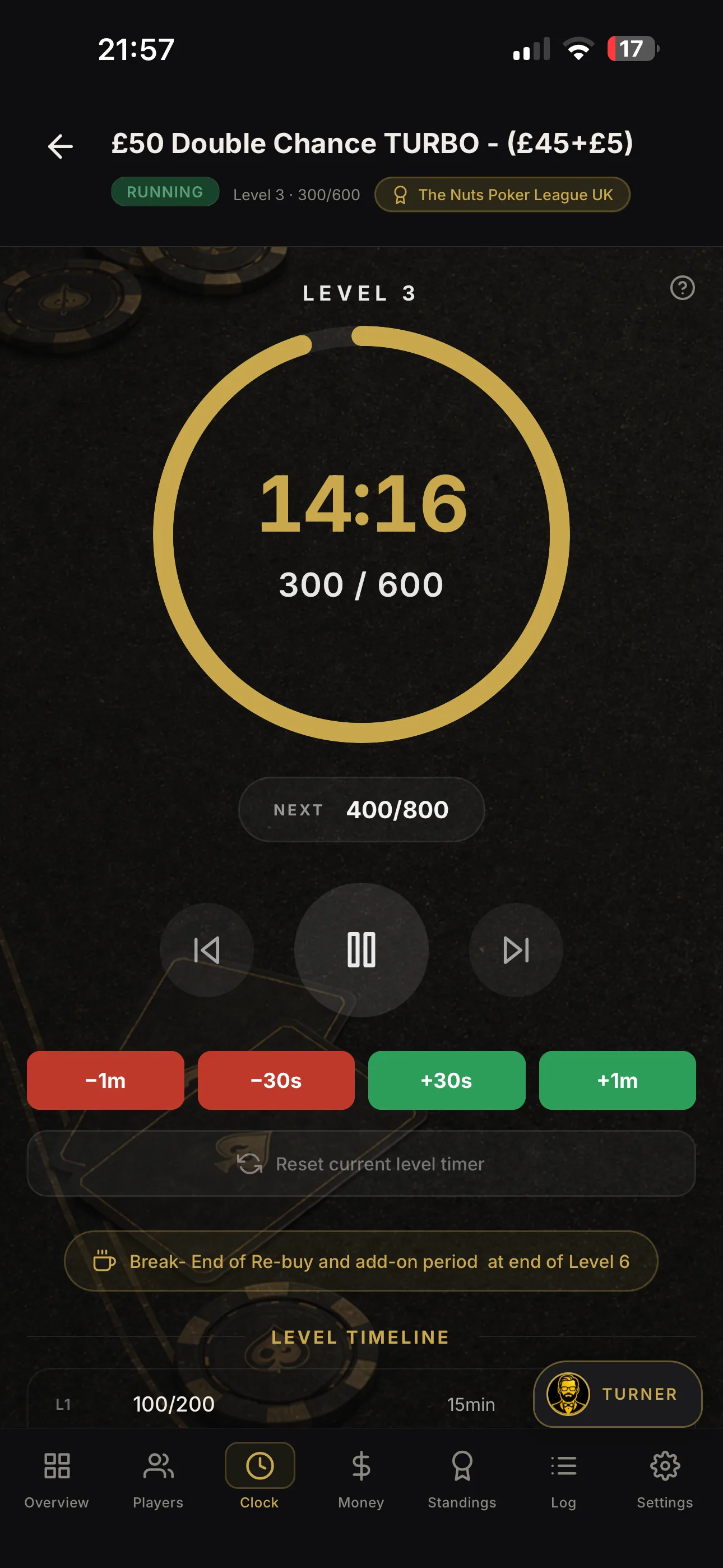
Now run the same night on a poker tournament management app - Shuffle Up and Deal! - on the iPhone or iPad that's already in your pocket.
Seats are drawn by the app and shown on screen, so every player sees the same fair, random result. Tables balance automatically: when one breaks, the app tells you who moves and where, and the standings update instantly. The blind clock runs itself, level after level, on cast screens your players can read from the rail. Stack sizes and payouts are calculated from clean data, and results are tracked from the first hand to the last, with a record everyone can trust.
You stop being a bookkeeper and go back to being a tournament director.
Head-to-head: manual vs the app
| Task | Spreadsheets, paper, stopwatch | Poker tournament management app |
|---|---|---|
| Seat draw | Hand-drawn, disputes over fairness | Random, on-screen, provable |
| Table balance | Manual, slow, error-prone | Automatic with clear moves |
| Blind clock | Stopwatch, called out by voice | Runs itself, cast to a TV |
| Live standings | Notebook or head, invisible | Live on screen for players and rail |
| Payouts | Hand-calculated, disputed | Accurate, from tracked data |
| Results | Typed up after the event | Recorded as you go |
| Your night | Running + admin | Running the room |
The real cost of manual logs
The manual way doesn't look expensive because the costs are spread out and invisible. A disputed seat draw. A wrong payout. A player who leaves early because the standings were unreadable. A results file you never finished. Individually they're small. Over a season, they're the difference between a room players trust and a room they tolerate.
A purpose-built app removes most of that cost for the price of a mid-range subscription - and it runs on hardware you already own, so there's nothing to install, wire up, or train your regulars on.
Why directors make the switch
Directors don't move to a poker tournament management app because they love software. They move because they want to stop juggling, stop arguing, and stop losing their own night to admin. They want the draw to be fair without question, tables to balance themselves, the clock to run itself, and standings their players can see and believe.
That's the whole trade. Manual methods ask you to trust your memory and your pen. A tournament management app gives you a fair, professional, stress-free room - and gives you your night back.
Tournament chaos, finally under control. See how the clock, the draw, and the standings run themselves on the iPhone or iPad you already own.