
Poker Tournament Management App
Run Poker Tournaments Like a Pro!
From First Hand to Final Table
Seat draws, table balancing, the clock, payouts and league standings: Shuffle Up and Deal! runs the whole night from your phone or tablet.



Poker Tournament Terms Explained: Shuffle Up to Bubble

Poker tournament terms, explained like a tournament director
Every live tournament runs on its own language. Listen across a card room for a minute and you will hear it: shuffle up, late reg, the bubble, on the stone. For the people sat at the table, those words are half the fun. For the person running the event, they are the working vocabulary of the whole night.
If you organise tournaments - a home game, a weekly league, a busy club or a card room - you need every player, from the first-timer to the seasoned reg, to understand what you are saying. This guide covers the poker and tournament terms you actually use, defined the way an experienced tournament director would explain them over the microphone.
What does "shuffle up and deal" mean?
"Shuffle up and deal" is the traditional call that starts a poker tournament. It is the moment the director tells the dealers to shuffle the cards and begin the first hand. On a proper tournament clock, it is the last thing you say before the button moves and the blinds start to bite.
It is more than a phrase - it is a signal. When you call shuffle up and deal, everyone in the room knows registration is closed, the seat draw is finished and the tournament is officially under way. It is the cleanest way to bring a noisy room to order and get cards in the air.
Blinds and levels
Blinds are the forced bets the two players to the left of the button must post before each hand. They exist to keep the action moving and to stop a tournament dragging on forever.
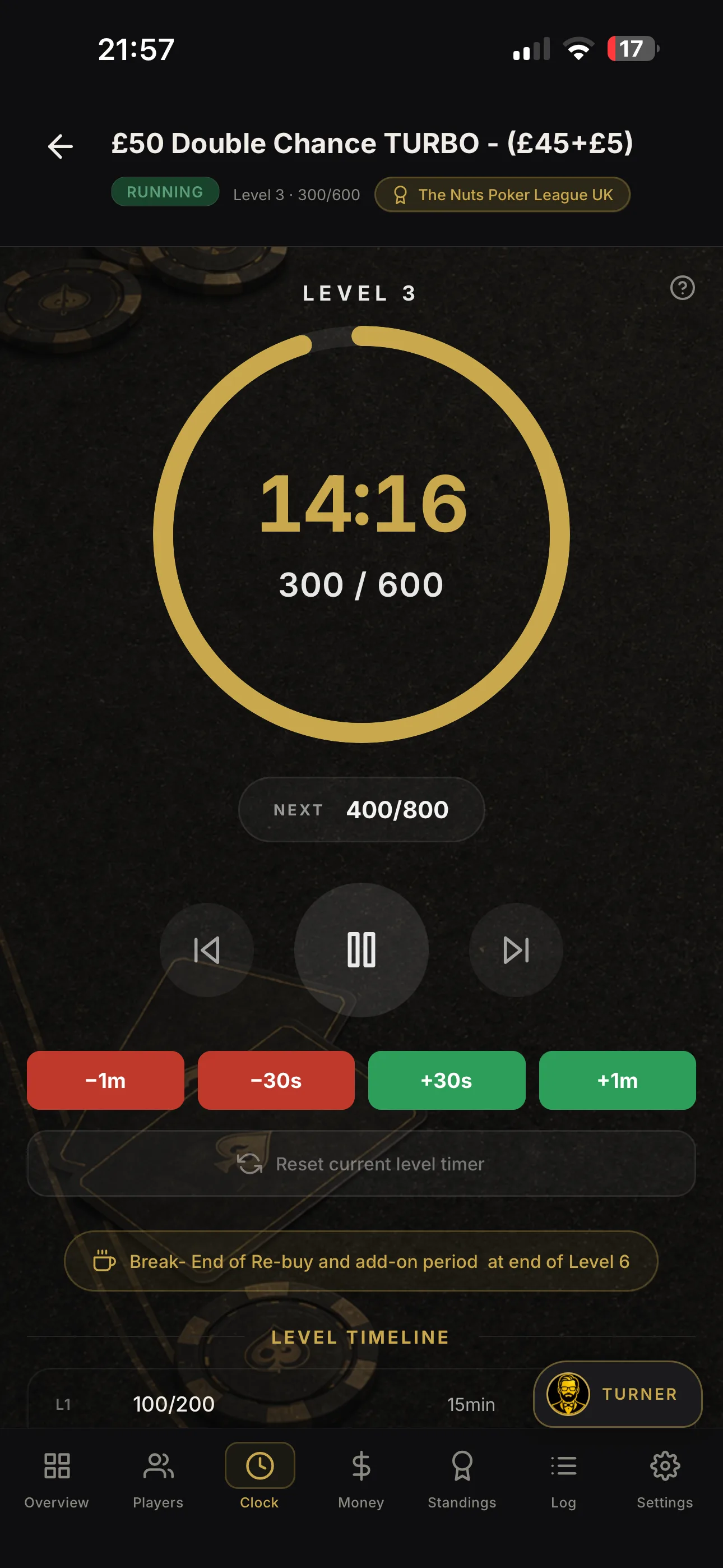
A level is a timed period during which the blinds stay the same. When the level ends, the clock moves the blinds up. A well-planned blind structure is the backbone of a good tournament: it decides whether you finish in three hours or five, and how much play your players actually get. That is why saving your structures - blinds, antes and breaks - so you can reuse them event after event saves you real time on the night.
An ante is a small forced bet from every player in the hand, separate from the blinds. Antes are usually introduced in the middle levels to speed play up.
Buy-in, fee and starting stack
The buy-in is the amount a player pays to enter. It is normally split into two parts: the prize-pool portion, which funds the payouts, and the fee, which covers the house or the organiser. Keeping those two figures separate and shown clearly is what makes a tournament feel professional before a single card is dealt.
The starting stack is the number of chips each player receives. Together with the blind structure, it sets how deep the play is and how long the tournament will run.
Rebuy, re-entry, add-on and late registration
These are the four terms that trip up new players most often.
- A rebuy lets a player who has been knocked out pay again and rejoin the same tournament, and it usually only counts while they are down to (or below) their starting stack.
- A re-entry is a fresh entry after elimination - often after the rebuy period has closed - and the player comes back with a new full stack.
- An add-on is a one-off chip purchase offered at a set point, usually at the end of a break, on top of the stack a player already holds.
- Late registration is the window during which a player can still enter a tournament after it has started. Closing late reg is a decision that directly affects your prize pool.
Track all four precisely - who is in, who has rebought, who is still eligible for the add-on - and you avoid the disputes that come from doing it on paper.
Seat draw and table balancing
A seat draw assigns every player a starting table and seat. Doing it randomly and in the open keeps the tournament fair, and doing it automatically keeps it quick. Randomly drawing seats is what players mean when they talk about a fair seat draw - nobody wants to feel they were placed to suit somebody else.
Table balancing is what happens when the field shrinks or grows unevenly. If one table is short-handed while another is full, the director moves players to even things out. When you are balancing multiple tables mid-event, the move has to be made fast and shown clearly, or play grinds to a halt. Automatic balancing and breaking does the maths for you so you can keep the room moving.
Knockouts and bust-outs
A knockout (also called a bust-out) is a player being eliminated from the tournament. Recording knockouts accurately matters twice over: it keeps the field size correct, and it is how you track finishing positions and any bounty or knockout prizes.
Mistakes here are costly. A player marked out who is still in, or a position recorded wrongly, undermines trust in the whole event. Recording eliminations - and being able to undo one quickly when an error is spotted - is one of the most practical features a director can have.
The bubble, the stone bubble and ITM
The bubble is the point in the tournament where the next player eliminated will leave without a payout - just outside the money. Play gets tense, and short stacks start to stall. The stone bubble is the harshest version: it describes a situation where two players are forced all in against each other, so exactly one of them will bust and miss the money.
ITM means "in the money" - a player has finished in a paid position. Announcing when the field hits the bubble and then goes hand-for-hand is one of the moments that makes a tournament feel like a real event.
Payouts and the final table
Payouts are the prizes handed out to the players who finish ITM. A payout structure decides how many places get paid and how the money is split - flatter if you want more players rewarded, steeper if you want to reward the deep runs.
The final table is the last table of the tournament, when the field has been reduced enough to combine onto one table. Reaching it is every player's goal, and how smoothly you seat, balance and track that final table is what people remember about your event.
Why the terms matter as much as the tools
You can run a tournament off spreadsheets, paper seat draws and a stopwatch - plenty of directors do. But every manual step, from the seat draw to the bubble, is a place where an error can creep in and a player can lose confidence in your event.
Shuffle Up and Deal! puts the whole vocabulary under one roof: the tournament clock and blind timer, registration, automatic seat draws, table balancing and breaking, eliminations and undo, payout management and finishing positions, league standings and external displays. You say the words - the software does the work behind them.
So next time you step to the mic - whether it is a single-table home game or a multi-day card room event - you will know exactly what you are calling. Shuffle up and deal.