
Poker Tournament Management App
Run Poker Tournaments Like a Pro!
From First Hand to Final Table
Seat draws, table balancing, the clock, payouts and league standings: Shuffle Up and Deal! runs the whole night from your iPhone or iPad.

Spreadsheets vs Poker Tournament Software: The Real Cost on Tournament Night
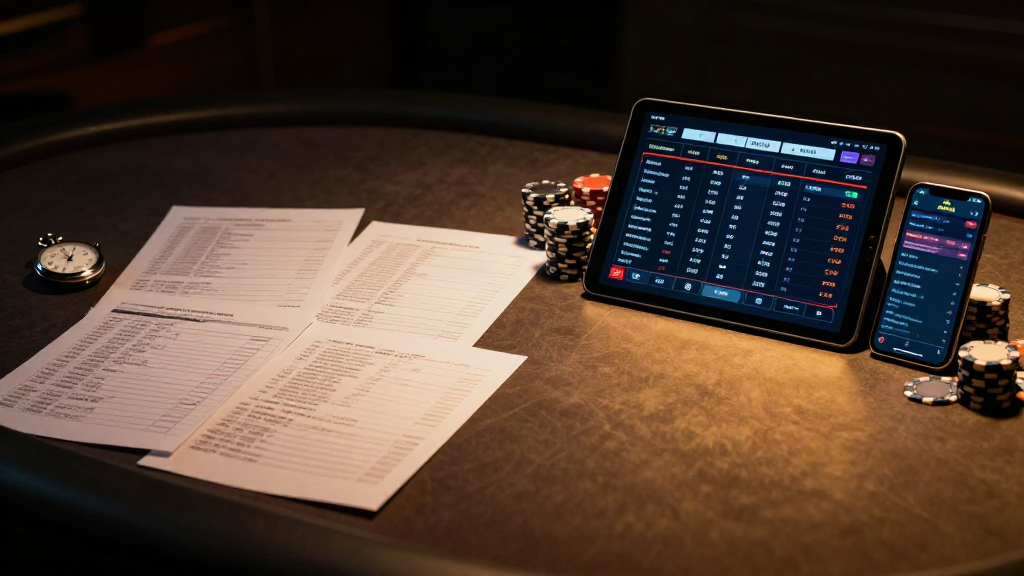
Every tournament director has been there. The clock on your phone, a laptop open on a spreadsheet, a stack of paper seat slips, two players arguing about whether the break has been called and three late entries waving cash at the desk. Nothing has gone badly wrong yet - but the whole night is being held together by you.
Spreadsheets and paper aren't the problem. The problem is what they quietly cost you once the room is full and the blinds are climbing. Here's an honest look at running a tournament the manual way versus running it with a proper poker tournament management app - not the sales pitch, just what actually changes on the night.
The real cost of a spreadsheet-run tournament
A spreadsheet can hold a blind structure. It can hold a player list. What it can't do is keep up with a live event. Every change - a knockout, a re-entry, a player who's moved tables - has to be typed in by a human. And that human is also the one calling the break, seating the late reg and fielding questions.
The cost isn't a single dramatic failure. It's a hundred small interruptions. You spend the night as a data-entry clerk rather than a tournament director, and the players can feel it. Blinds get called late because you were busy hand-balancing tables. The average stack on the display is ten minutes stale. Seat draws get redrawn because someone was seated twice.
That's the gap a dedicated system closes. Not by being clever, but by being the one version of the truth that the whole room can see.
Where manual methods actually break down
The clock and the blind structure
A countdown timer is fine until reality intervenes. You forget to start it after a break. You push a level too early because a hand is running long. You have no clean way to show the current level, the next level, the break schedule and the average stack on the big screen at once.
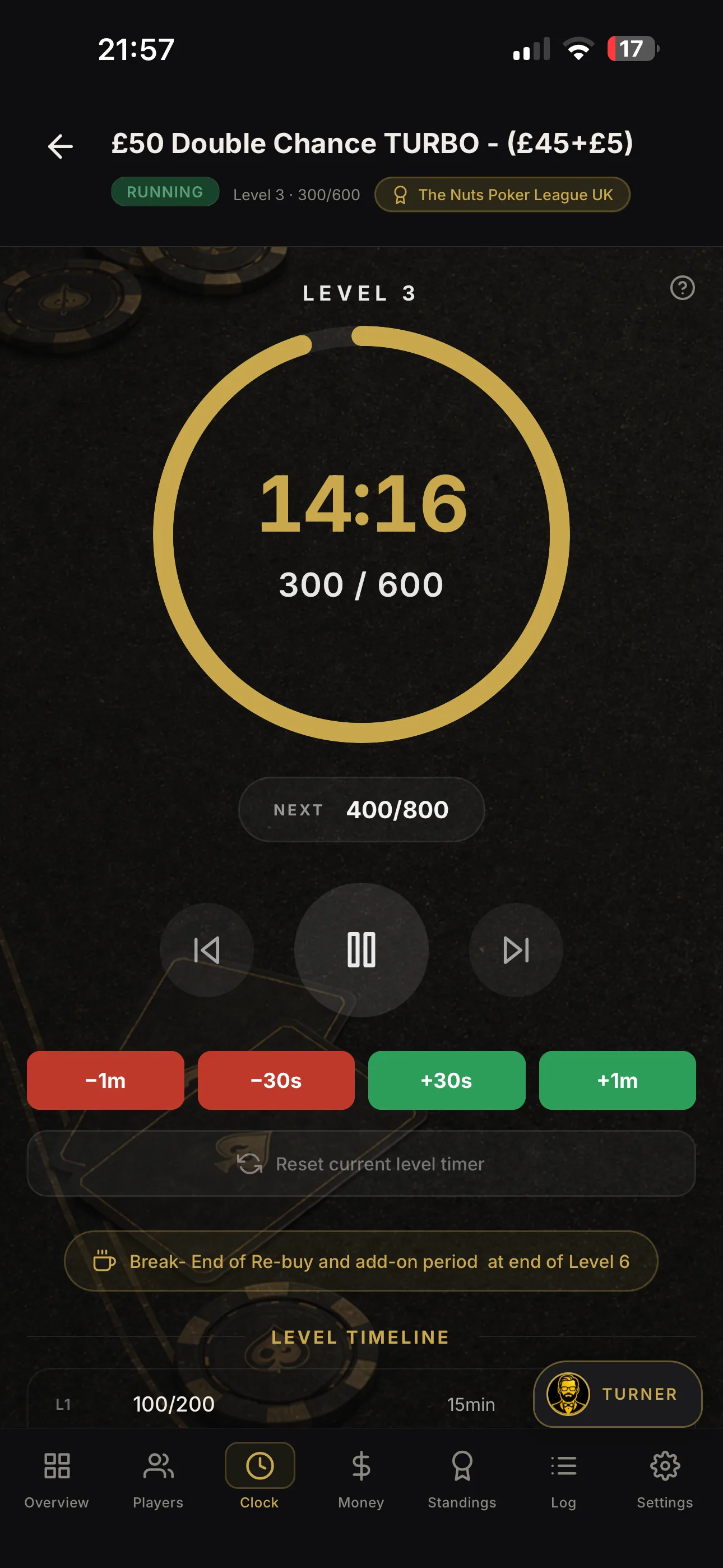
A proper tournament clock runs the structure you saved, calls the breaks, and shows blinds, antes, level, time to the next break and player counts on an external display without you touching it. When it's running, you're free to run the room.
Seat draws and table balancing
Paper seat draws are fair - right up until someone busts and the tables fall uneven. Now you're counting players, redrawing, and moving stacks mid-level, all while trying to keep the game moving. Breaking a table correctly, keeping the short-handed tables balanced, and doing it fast enough that nobody notices is one of the hardest parts of live tournament directing.
Automatic seat draws, table balancing and table breaking do this for you. The software knows who's still in, which tables are short, and where the next player should sit. When a table has to break, it does the move for you - including the awkward part.
Payouts and finishing positions
This is where spreadsheets get genuinely risky. Payout structures, the bubble, ITM finishes, knockouts and league points all have to be calculated correctly, and a mistake here is the one players will remember. Manual payout maths under time pressure is how directors make avoidable errors.
A tournament management app calculates finishing positions, payouts and knockouts as the tournament runs. When the bubble bursts, it knows. When the final table is set, it knows. When it's time to pay out, the numbers are already there - no late-night arithmetic, no disputes.
What a poker tournament management app actually does differently
The difference isn't a longer feature list. It's that everything lives in one place and updates live.
- Registration and re-entries are handled as players arrive, including late registration, rebuys, re-entries and add-ons.
- The clock, blinds and breaks run from a saved structure so your tournament plays exactly as designed.
- Seating, balancing and breaking happen automatically, with manual reseating available when you want it.
- Eliminations and knockouts are recorded in a tap, with undo when the wrong player comes out.
- Payouts, finishing positions and statistics are calculated for you and can feed straight into league standings.
- External displays turn any TV or second screen into a professional room display - blinds, clock, prizes, seats and player counts, with animations at each level, break, knockout, bubble and finish.
- Live Trackers let players follow the tournament on their own phones, so far fewer questions land at the desk.
For a director, that list really means one thing: fewer things to remember, and fewer chances to get them wrong.
What it saves you on the night
Think about the difference between managing a spreadsheet and directing a tournament.
With the manual setup, you're the calculator, the timer, the seating chart and the customer service desk. The night drains you, and you finish wondering whether the numbers were right.
With a tournament management app, the system holds the admin and you hold the room. Blinds call themselves. Tables balance themselves. Payouts are ready before the last hand. Players see the same information you do, on the display and on their phones, which quietly kills a lot of the arguments before they start.
That's the honest trade. You're not buying features - you're buying back the attention you need to run a professional event.
Is it worth switching? An honest answer
If you run one casual home game a year, a spreadsheet will do. Nobody needs a system for that.
If you run regular tournaments - weekly leagues, club nights, multi-table events, anywhere the same players come back and expect the night to be run properly - the manual method is costing you more than you think. It costs accuracy. It costs time. And it costs the professional feel that keeps players coming back to your room instead of someone else's.
The test is simple. Count how many times last tournament night you stopped running the room to fix a spreadsheet, redraw a seat, or recalculate a payout. That number is the real price of doing it by hand.
The bottom line
Spreadsheets and paper were never built for live poker tournaments. They were built for static lists, and a poker tournament is anything but static. It changes with every bust, every re-entry and every table that breaks.
A poker tournament management app like Shuffle Up and Deal! is built for the event itself - registration to final payouts, in one place, updating live, with the clock, seating, payouts and displays all working from the same numbers. Run it on the iPhone or iPad you already own, cast it to the big screen, and get back to the job you actually took on: running a fair, sharp, professional tournament.
Your players won't see the spreadsheet you stopped using. They'll just notice that the night ran better.