Poker Tournament Management App
Run Poker Tournaments Like a Pro!
From First Hand to Final Table
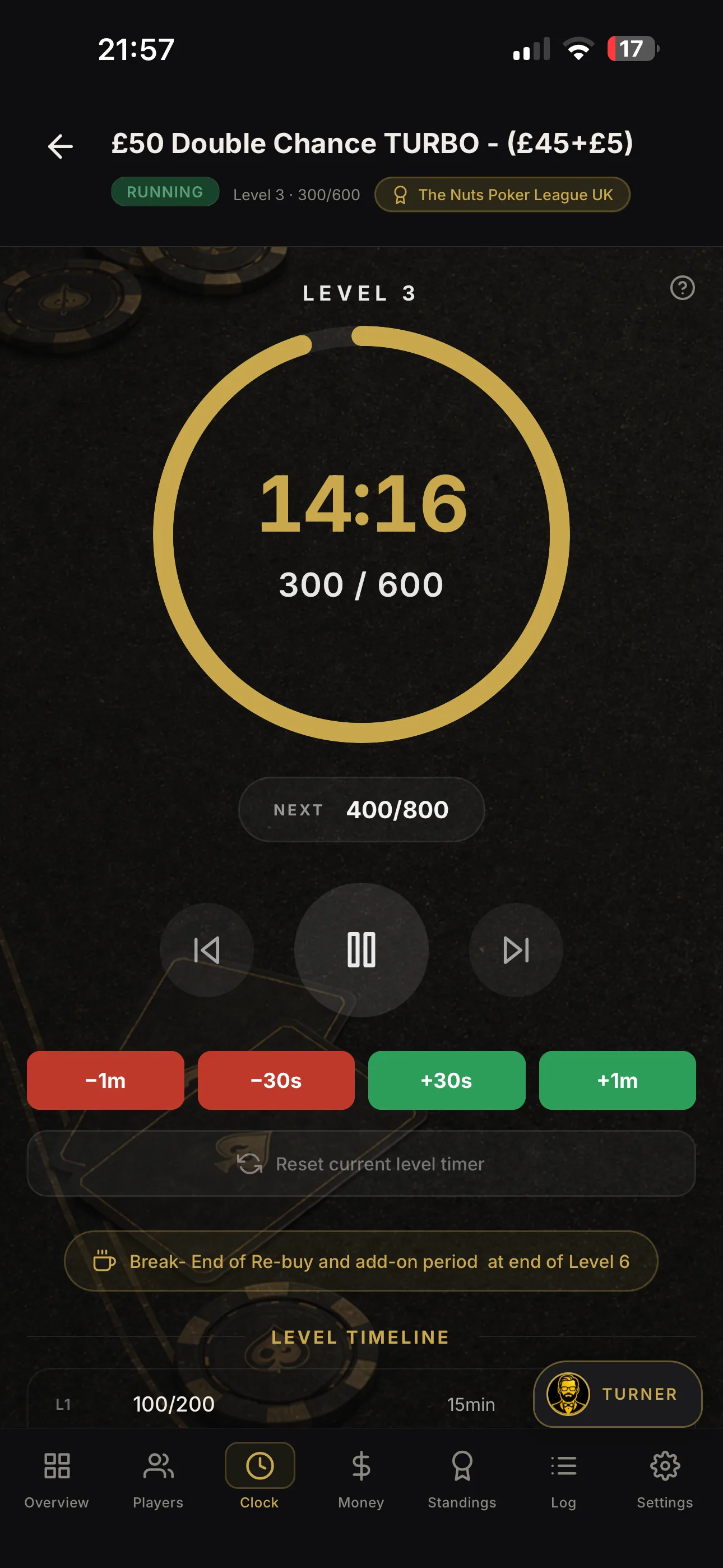
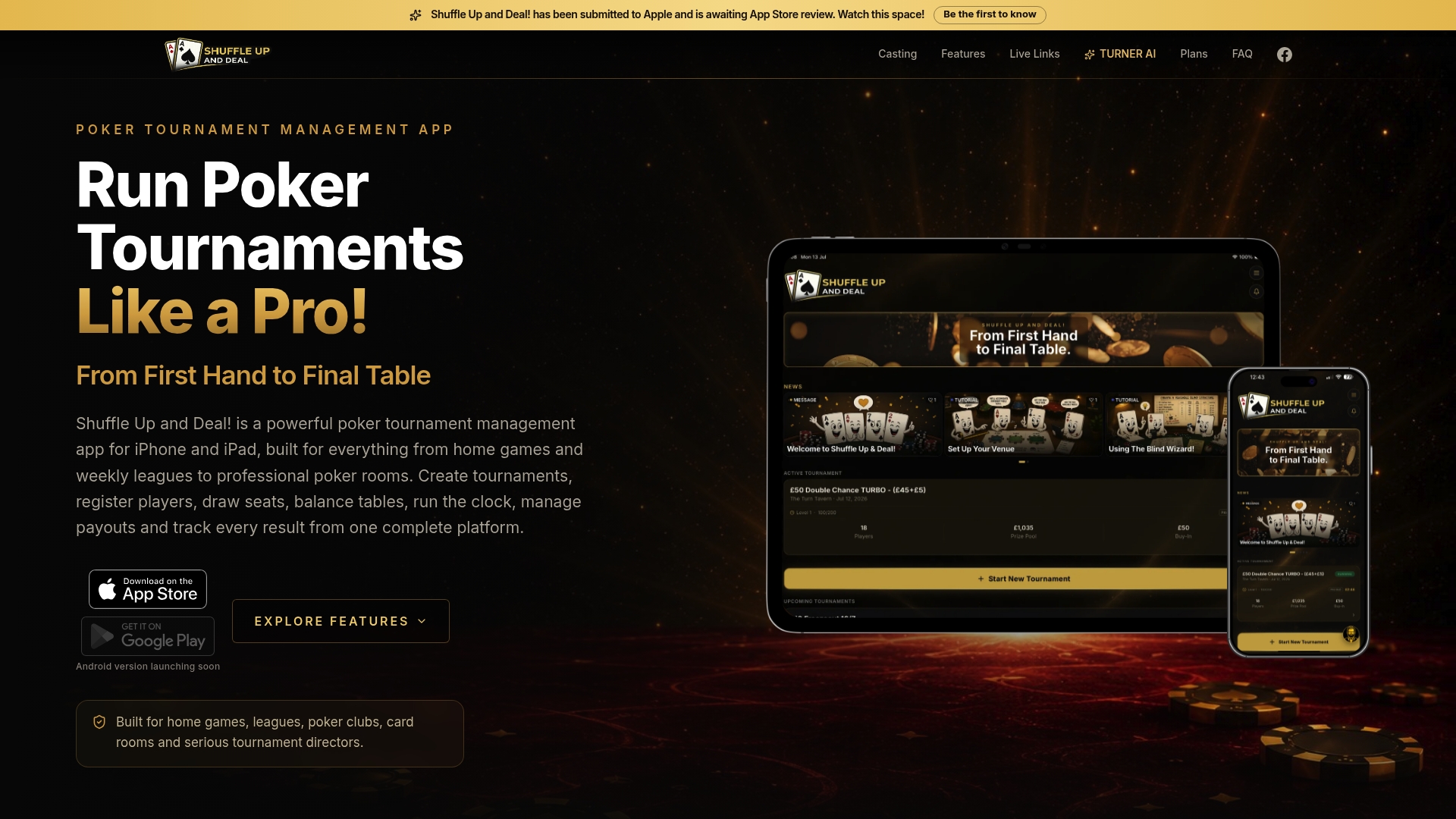
Seat draws, table balancing, the clock, payouts and league standings: Shuffle Up and Deal! runs the whole night from your iPhone or iPad.

Tournament penalties in poker: the complete player and TD guide

Tournament penalties in poker are formal disciplinary measures applied by a Tournament Director (TD) to maintain fairness, pace, and integrity during live events. The Tournament Directors Association (TDA) codifies the standard enforcement options used at most UK events: verbal warnings, missed-hand penalties, missed-round penalties, chip forfeiture, and disqualification. Major operators including PokerStars Live and the World Series of Poker (WSOP) adopt this framework, with their own supplementary rules layered on top.
The immediate operational effect of any penalty beyond a warning is straightforward:
- The player is asked to leave the table and remain away for the duration of the penalty.
- Cards are dealt into their seat on every hand during the absence and killed immediately after the initial deal.
- Blinds, antes, and stud bring-ins are posted as normal from the player’s stack.
- Chips remain in play unless the player is disqualified, in which case they are removed from the table.
Understanding exactly which infraction triggers which penalty, and how TDs apply them in practice, is what separates a well-run event from a chaotic one.
Key takeaways
Missed-round penalties are the most impactful formal sanction in live poker, calculated as one hand per seated player multiplied by the number of penalty rounds, and they carry a direct, quantifiable chip-equity cost that grows at short-handed tables.
| Point | Details |
|---|---|
| Penalty ladder | Sanctions escalate from verbal warning through missed rounds to disqualification; each level has a distinct operational effect on the absent player’s stack. |
| Missed-round calculation | One round equals one hand per player at the table; record the seat count at the moment of issue, as it determines the total hands missed. |
| Reaction shapes the outcome | According to Matt Savage, a player’s response to the floor’s intervention often determines whether a penalty is applied, not just the initial act. |
| Document every incident | Log the time, blind level, rule cited, and seat count for every warning and penalty; this record is the foundation of any fair appeal. |
| Shuffle Up and Deal! for TDs | Shuffle Up and Deal!’s incident logging, player status flags, and exportable reports give TDs an auditable penalty trail that supports consistent, defensible enforcement. |
Table of Contents
- What types of tournament penalties exist in poker?
- Which actions actually trigger a penalty at the table?
- How is a penalty applied step by step in a live event?
- How do you dispute or appeal a penalty in a UK event?
- How to avoid penalties: a practical checklist for players
- Real incidents that show how penalties work in practice
- How Shuffle Up and Deal! helps TDs record and apply penalties accurately
- What rule sets govern penalties at UK poker tournaments?
- How TDs can enforce penalties consistently and prevent disputes
- Timing, recording, and the window for rectifying an action
- How penalties affect your chip stack and tournament equity
- Live versus online: how penalty enforcement differs in UK tournaments
- Why consistent enforcement is the hardest part of the TD role
- Run your next event with penalty management built in
- Sources
What types of tournament penalties exist in poker?
The TDA rules and the TDA 2024 Rules PDF define a clear escalation ladder. Each level carries a distinct operational meaning.
Verbal warning. The lightest sanction. The TD or floor staff addresses the player directly, names the infraction, and notes it. No hands are missed. A warning is typically the first response to minor etiquette breaches, though TDs can skip it entirely for serious misconduct.
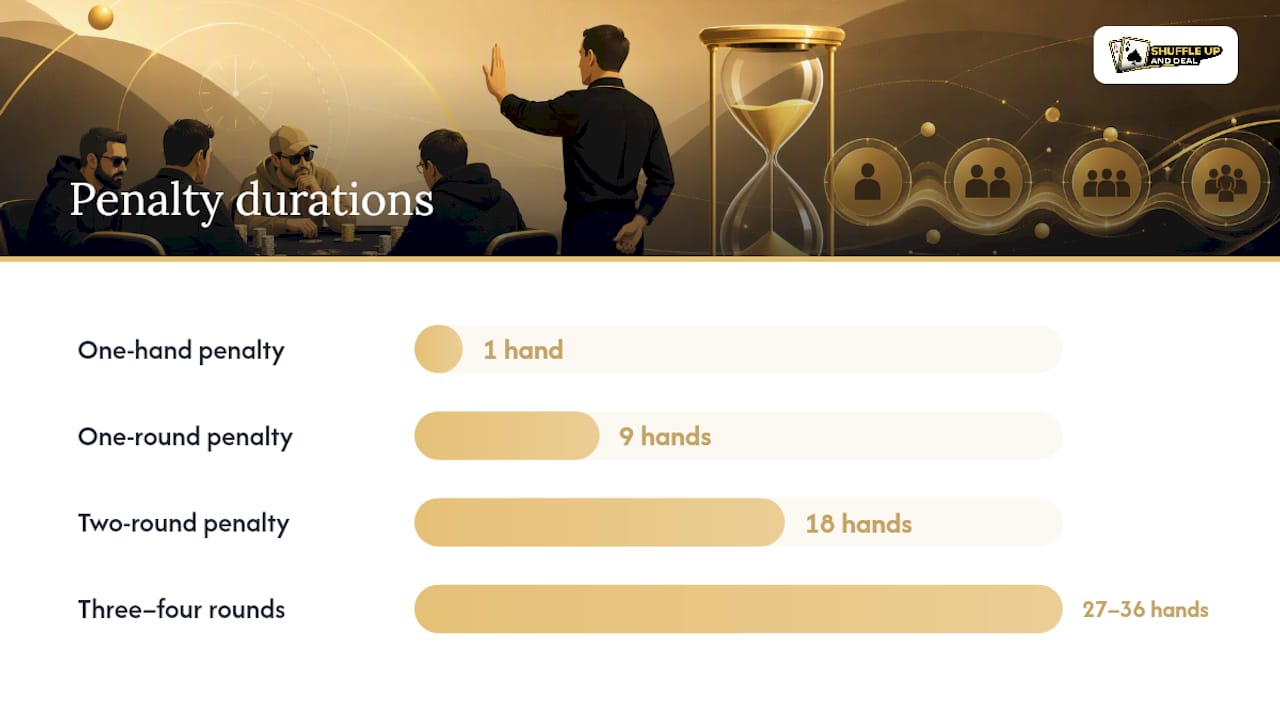
One-hand penalty. The player misses one deal. This is a precise, short sanction often used for a first offence involving exposed cards or a single act-out-of-turn incident.
Missed-round penalties (one, two, three, or four rounds). These are the most commonly applied penalties at UK live events. One round equals one hand per player currently seated at the table. So at a nine-handed table, a one-round penalty means the offending player misses nine hands. A two-round penalty at the same table means eighteen missed hands. The calculation scales with table size, which is why TDs must record the seat count at the moment the penalty is issued.
Chip penalty. A portion of the player’s stack is removed and taken out of play. The TDA permits chip penalties as an alternative or supplement to missed-round penalties. Typical amounts are expressed as a multiple of the current big blind, though the exact size is at the TD’s discretion. Chip penalties are relatively rare in UK events but appear in some casino-run tournaments where a financial deterrent is considered more proportionate than time away from the table.
Disqualification. The player is removed from the tournament entirely. Their chips are pulled from the table and taken out of play. Prize eligibility depends on the circumstances: a player disqualified for conduct may still collect a prize if they finished in a paid position before the infraction, but ejection from the venue can result in full prize forfeiture. TDs must document the distinction clearly.
| Penalty type | Duration / size | Chips remain? | Typical trigger |
|---|---|---|---|
| Verbal warning | None (noted only) | Yes | Minor etiquette breach, first offence |
| One-hand penalty | 1 hand | Yes | Single exposed card, minor OOT action |
| One-round penalty | 1 hand × players at table | Yes | Aggressive language, card throwing |
| Two-round penalty | 2 × hands × players at table | Yes | Repeated or escalated misconduct |
| Three/four-round penalty | 3–4 × hands × players at table | Yes | Serious or repeated violations |
| Chip penalty | TD discretion (big-blind multiples) | Partially | Severe misconduct, alternative to rounds |
| Disqualification | Permanent removal | No | Cheating, threats, extreme conduct |
PokerStars Live rules confirm that players on penalty are dealt in and their hands killed after the initial deal, meaning the stack bleeds blinds and antes throughout the absence regardless of the penalty type.
Which actions actually trigger a penalty at the table?
Most penalties in poker tournaments stem from a handful of recurring behaviours. The list below runs from low-severity infractions that typically earn a warning to high-severity acts that can end a player’s tournament on the spot.
Low severity (warning likely):
- Exposing one card with no action pending and no strategic advantage gained.
- Failing to protect your hand (cards mucked by the dealer through player negligence).
- Minor acting out of turn with no material effect on the hand.
- Using a mobile phone at the table in breach of house policy.
Medium severity (one-hand or one-round penalty likely):
- Exposing hole cards with action still pending at a televised feature table.
- Throwing cards towards the muck in a way that exposes them or disrupts play.
- Deliberate act-out-of-turn that influences another player’s decision.
- Soft play or collusion (checking down a hand to eliminate a third player).
- Dodging blinds by leaving the seat just before the blind reaches you.
- Leaving your seat with action pending on your hand.
High severity (multiple rounds or disqualification):
- Abusive, threatening, or discriminatory language directed at any player or staff member.
- Physical aggression or deliberate damage to equipment.
- Cheating, marked cards, or any form of collusion confirmed by evidence.
- Repeated violations after prior warnings or penalties in the same event.
The grey area worth noting: a celebratory reaction, table-pounding after a big pot, or a frustrated card flick can start as a minor incident and escalate into a one-round penalty the moment the player’s response to the TD becomes confrontational. Veteran TD Matt Savage makes this point directly: it is frequently the reaction to an incident, not the incident itself, that determines whether a penalty is applied. A player who accepts the floor’s intervention calmly often avoids a formal penalty; one who argues aggressively almost always receives one.
How is a penalty applied step by step in a live event?
The procedure is consistent across well-run UK events and follows a clear sequence.
Step 1: The incident is flagged. The dealer calls the floor, or a player requests a ruling. The dealer should stop the hand if possible and preserve the state of play.
Step 2: The TD assesses. The TD (or senior floor) arrives, gathers the facts from the dealer and any witnesses, and decides on the appropriate sanction. This should take no more than two to three minutes. Prolonged deliberation at the table disrupts the event and creates uncertainty.
Step 3: The announcement. The TD announces the penalty to the table, naming the infraction and the sanction clearly. The player is told the penalty type, its duration, and that they must leave the table immediately. Transparency here prevents rumour and protects the TD from later claims of inconsistency.
Step 4: The player is removed. The player steps away from the table. They may not communicate with active players during the penalty period. At most UK venues, the player must remain visible to floor staff, typically at the rail.
Step 5: Hands are dealt and killed. On each hand during the penalty, cards are dealt into the absent player’s seat and killed immediately after the initial deal. Blinds and antes are posted from the stack as normal. In stud games, if the absent player is dealt the bring-in card, the bring-in is posted.

Step 6: Documentation. The TD records the incident: time, blind level, infraction, penalty type, seat count at the time (for round calculation), and any witnesses. This record is the foundation of any later appeal.
Step 7: Return. The player returns to the table at the start of the first hand after the penalty expires. They may not return mid-hand.
Pro Tip: If a player is moved to a new table while serving a penalty, the penalty continues at the new table. The TD should note the move in the incident record and confirm the remaining hands with the new table’s dealer.
Televised and feature-table situations add one layer: camera operators and producers may request a brief pause for hole-card coverage. TDs should not delay the penalty announcement for broadcast convenience; the announcement takes priority.
How do you dispute or appeal a penalty in a UK event?
Appealing a penalty is a legitimate part of the process, and TDs who run good events expect it. The key is how you do it.
Immediate steps for the player:
- Stay calm. Arguing aggressively almost always makes the situation worse and can convert a warning into a penalty or a one-round into a two-round.
- Ask the TD to state the specific rule that was breached. Every penalty should have a rule citation, whether TDA, house rules, or both.
- Request a review if the venue’s hierarchy permits it. Most UK casino events have a senior TD or card room manager above the floor TD; ask politely whether a second opinion is available.
- Do not delay the game. Accept the penalty operationally (leave the table) while the appeal is processed. Refusing to leave the table is itself a penalisable offence.
Evidence that supports an appeal:
- CCTV or stream footage showing the incident from a different angle.
- Dealer notes recorded at the time.
- Independent witness statements from other players at the table.
- Time-stamped entries in the TD’s tournament management software, such as the incident log in Shuffle Up and Deal!, which creates an auditable record of the exact moment a penalty was issued.
Likely outcomes:
- Penalty upheld: the most common result when the infraction is clear and documented.
- Penalty reduced: possible when the initial assessment was disproportionate or when mitigating evidence emerges.
- Penalty overturned: rare, but it happens when footage contradicts the original account.
- Escalated to disqualification: if the appeal process itself involves abusive conduct or if new evidence reveals a more serious infraction.
One distinction that matters for prize money: tournament disqualification and venue ejection are not the same thing. A player disqualified from the tournament may still collect prize money if they finished in a paid position before the infraction occurred. Ejection from the venue, however, can result in full prize forfeiture. TDs must document which sanction is being applied and communicate it clearly to the player and the cage.
How to avoid penalties: a practical checklist for players
Most penalties are avoidable. The behaviours that trigger them are almost always known in advance.
Before the event:
- Read the house rules and confirm whether TDA rules apply in full or with modifications.
- Check the chip denomination and colour-up schedule so you are not caught off guard during a colour-up dispute.
- Know the venue’s device policy. Many UK card rooms prohibit phones at the table during hands.
At the table:
- Protect your hand at all times. Place a card protector or chip on your cards. A hand mucked through your own negligence is a dead hand, and the TD will not restore it.
- Follow the one-player-to-a-hand rule. Do not receive advice from a friend, coach, or spectator while a hand is live.
- Avoid commentary on live hands. Discussing what you folded, or what you think another player holds, can influence the action and trigger a penalty.
- Stay in your seat while action is pending. Leaving the table with a live hand is a penalisable offence.
- Keep celebrations proportionate. A fist pump is fine; aggressive table-pounding or chip-throwing is not.
- Act in turn. If you are unsure whether the action is on you, ask the dealer rather than acting prematurely.
If you receive a penalty:
- Accept the TD’s instruction and leave the table without argument.
- Note the time, the blind level, and the rule cited.
- Gather any evidence calmly and follow the formal appeals process.
Pro Tip: If you are involved in a ruling dispute, ask the TD to show you the specific rule in writing before the hand is concluded. Most UK events use TDA rules, and the TDA rules are publicly available. Knowing the text gives you a factual basis for any appeal.
Real incidents that show how penalties work in practice
Theory is useful; real cases are better. These incidents from major events illustrate how penalties are applied and what they teach both players and TDs.
The Mike Matusow one-round penalty at the 2026 WSOP Main Event
Reports from the 2026 WSOP Main Event confirm that one-round penalties were applied for aggressive verbal outbursts, petulant physical actions including throwing cards, and exposing hole cards at televised feature tables. The incidents illustrate a consistent pattern: it is rarely the initial act alone that earns the penalty. The player’s response to the floor’s intervention is what pushes a borderline situation into formal sanction territory.
The lesson for players: the moment a TD approaches the table, your conduct in the next thirty seconds matters more than what happened before they arrived.
Swearing at a floor manager during a colour-up dispute, 2025 WSOP
A player deep in a 2025 WSOP event received a one-round penalty for directing expletives at a floor manager during a colour-up dispute. The underlying dispute about chip values was legitimate; the language was not. The penalty was applied immediately, deep in the money, where a one-round absence at a short-handed table carries real chip-equity cost.
The lesson for TDs: colour-up disputes are a known flashpoint. Having a clear, pre-announced colour-up procedure, and documenting it in your TD software before the level begins, removes the ambiguity that causes these confrontations.
The David Lappin one-round penalty and the reaction principle
Matt Savage’s analysis of the David Lappin penalty case, Poker, makes the reaction principle explicit: TDs prioritise de-escalation, and an aggressive response to a floor ruling converts a borderline infraction into a clear one. Lappin’s case generated significant debate precisely because the initial act was ambiguous, but the reaction was not.
The pattern across all three cases is identical: the infraction triggers a floor call, the player’s reaction determines the penalty level, and the TD’s documentation determines whether the outcome survives an appeal.
How Shuffle Up and Deal! helps TDs record and apply penalties accurately
Running penalties correctly is as much an administrative task as a judgement call. Shuffle Up and Deal!’s tournament management app gives TDs the tools to handle both sides with confidence.
Here is what the app does for penalty workflows specifically:
- Time-stamped incident logging. Every penalty can be recorded with the exact time and blind level at the moment of issue. This is the single most important piece of documentation for any appeal.
- Player status flags. Mark a player as “on penalty” within the app. Their status is visible across all connected devices, so every floor staff member knows the situation without a radio call.
- Automatic blind and ante posting. The app tracks the absent player’s stack obligations, so the dealer always knows what to post without manual calculation.
- External display integration. Shuffle Up and Deal! can cast the tournament state to an external screen, making the penalty status visible to the whole room. Transparency reduces disputes before they start.
- Exportable incident reports. At the end of an event, every logged penalty can be exported for review, useful for post-event debriefs and for any formal complaints process.
- Multi-device syncing. Senior TDs and floor staff can all see the live tournament state simultaneously, so a penalty issued at Table 4 is immediately visible to the TD managing Table 9.
Pro Tip: Pair the Shuffle Up and Deal! incident log with your venue’s CCTV timestamp. If a penalty is disputed, you can pull the exact clip that corresponds to the log entry. That combination, a time-stamped app record and matching video, is close to indisputable in any appeal.
For more on how the app aligns with TDA standards, the best TDA rules app guide on the Shuffle Up and Deal! site is worth reading before your next event.
What rule sets govern penalties at UK poker tournaments?
UK poker tournaments do not operate under a single statutory rulebook. Instead, most events adopt one of two frameworks, often with venue-specific modifications.
The TDA rules are the de facto international standard and the most widely used framework at UK live events. The TDA 2024 Rules PDF is the current operative document. Events including the UK Poker Open and the British Poker Championships typically reference TDA rules as their base, with supplementary house rules covering venue-specific matters such as device policy, dress code, and food at the table.
PokerStars Live rules govern events run under the PokerStars Live banner, including EPT UK stops and PokerStars-branded festival events held at UK venues. These rules mirror TDA language on penalties but include additional provisions for televised feature tables, pace-of-play obligations, and the possibility of exclusion from future events for serious misconduct.
Neither framework is a legal instrument in the UK regulatory sense. The Gambling Commission licenses venues and operators but does not prescribe specific tournament conduct rules. The practical legal context is contract law: when a player enters a tournament, they agree to the published rules, and those rules govern the TD’s authority to apply penalties and withhold prizes.
For home games and smaller league events, the Shuffle Up and Deal! articles hub provides practical guidance on adapting TDA rules to smaller formats, including how to handle penalties when there is no dedicated floor staff.
How TDs can enforce penalties consistently and prevent disputes
Consistency is the foundation of player trust. A penalty applied differently to two players for the same infraction, even if both outcomes are technically defensible, damages the event’s credibility.
Establish the rules before the event starts. Announce the rule set in play (TDA, house rules, or a combination) at the player briefing. Post the key penalty triggers visibly at the registration desk. Players who knew the rules in advance have no grounds to claim surprise.
Apply penalties publicly and verbally. Every penalty announcement should name the infraction and the sanction out loud at the table. Quiet, private penalties create the impression of inconsistency even when they are not. The TDA forum’s penalty guidelines reinforce this: community precedent strongly favours visible, announced enforcement.
Document every incident, not just formal penalties. A verbal warning that is not recorded cannot be used to justify escalation if the same player commits a second infraction. Log warnings as well as penalties.
Calibrate to the infraction, not the player. The same act earns the same penalty regardless of whether the player is a recreational participant or a sponsored professional. Perceived favouritism is one of the fastest ways to lose a room’s confidence.
Brief your floor staff before the event. Every floor member should know the penalty ladder, the calculation method for missed rounds, and the escalation path. A floor member who gives a different answer to the same question than the senior TD creates confusion and appeals.
Timing, recording, and the window for rectifying an action
Not every infraction is immediate and clear-cut. Some involve a window during which the player or the TD can correct the situation before a formal penalty is warranted.
Acting out of turn. If a player acts out of turn and the action has not yet reached them, the TD may allow the action to be retracted if it has not materially influenced another player’s decision. Once another player has acted based on the premature action, the out-of-turn action typically stands and a penalty may follow.
Exposed cards. If a card is briefly flashed with no action pending and no player gains an advantage, a warning is usually sufficient. If the card is exposed with action pending, particularly at a feature table, the penalty window has already closed: the damage is done and a formal sanction follows.
Blind dodging. A player who stands up just before the blind reaches them and returns immediately after is typically given one warning. A second instance in the same session is treated as deliberate and earns a missed-round penalty.
The rectification window in practice. TDs should communicate clearly when a player has an opportunity to correct an action before a penalty is applied. Saying “you have until the action reaches you to retract that bet” is both fair and operationally clear. Once the window closes, the penalty is applied without further negotiation.
Recording the exact moment a penalty is issued, including the blind level and hand number, matters because missed-round calculations depend on it. A penalty issued at the start of a level with nine players at the table produces a different hand count than the same penalty issued mid-level after a player has busted. Shuffle Up and Deal!’s time-stamped logging captures this automatically.
How penalties affect your chip stack and tournament equity
A missed-round penalty is not just a time-out. It has a direct, calculable effect on tournament equity.
Every hand you miss, your stack is reduced by the blind and ante obligations posted on your behalf. At a nine-handed table with a 1,000/2,000 blind structure and a 2,000 ante, a one-round penalty costs your stack roughly 21,000 chips in posted obligations across nine hands. That is before accounting for the hands you could have won.
The equity impact compounds at short-handed tables and in late-tournament situations. A one-round penalty at a six-handed final table, where blinds are large relative to average stacks, can represent a meaningful percentage of your stack in posted blinds alone. This is why one-round penalties at feature tables in deep runs generate so much discussion: the chip cost is real and immediate.
For TDs, this equity dimension is a reason to apply penalties proportionately. A two-round penalty at a nine-handed table early in a tournament is a minor inconvenience. The same penalty at a six-handed final table with big blinds is a potentially tournament-ending sanction. Proportionality does not mean leniency for serious infractions; it means calibrating the penalty type to the severity of the act rather than defaulting to the maximum available option.
From a strategic standpoint, players who understand the equity cost of penalties have an additional incentive to manage their conduct carefully, particularly deep in events where every chip matters.
Live versus online: how penalty enforcement differs in UK tournaments
Online poker tournaments in the UK, primarily run through platforms regulated by the Gambling Commission, handle conduct infractions differently from live events, and the differences are worth understanding.
Automated enforcement. Online platforms detect most technical infractions automatically: acting out of turn, timing out, disconnecting. These are handled by the software without a TD’s intervention. There is no equivalent of a verbal warning; the system simply enforces the rule.
Conduct penalties. Abusive chat, collusion, and account-sharing are the primary conduct issues in online tournaments. These are investigated by the platform’s security team, not a floor TD, and the process is slower. A player suspected of collusion in a live event can be removed from the table within minutes; the same investigation online may take days.
No missed-round penalties in the traditional sense. Online platforms do not remove a player from the table and deal them in while away. Instead, a timed-out player simply misses the hand entirely, with no blind obligation posted. This is a structural difference: the chip-bleeding effect of a live missed-round penalty does not apply online.
Disqualification and prize forfeiture. Online platforms can and do disqualify players and withhold prizes for confirmed cheating or collusion. The process is governed by the platform’s terms and conditions rather than TDA rules, and the Gambling Commission’s licensing conditions require operators to have fair dispute resolution procedures in place.
PokerStars UK provides explicit tournament rules for its UK-facing platform, including provisions for pace of play, disconnection policy, and conduct. These differ from the PokerStars Live rules that govern their live events, so players moving between online and live formats should read both.
The practical takeaway: if you run both live and online events, your penalty procedures need to be format-specific. A single rulebook covering both formats will have gaps.
Why consistent enforcement is the hardest part of the TD role
There is a version of this article that lists every rule, cites every authority, and leaves you with the impression that penalty enforcement is a clean, mechanical process. It is not.
The hardest calls are not the obvious ones. Throwing cards across the table at a WSOP feature table earns a one-round penalty; that is clear. The difficult decisions are the borderline reactions, the frustrated mutter that might be directed at a player or might be self-directed, the celebratory gesture that reads differently depending on where you are standing, the player who is visibly distressed in a way that raises a genuine duty-of-care question rather than a conduct question. Organisations like BeGambleAware exist precisely because the line between competitive frustration and genuine distress is not always obvious, and TDs who run regular events will encounter both.
What I have seen consistently is that the TDs who earn the most respect are not the ones who apply the harshest penalties. They are the ones who are predictable. Players accept a one-round penalty they disagree with far more readily when they know the same penalty would be applied to anyone else in the same situation. The moment enforcement looks personal or inconsistent, you lose the room.
Documentation is the mechanism that makes consistency visible. When every warning and every penalty is logged with a time, a level, and a rule citation, you can demonstrate that your enforcement is principled rather than arbitrary. That log is not just an appeals tool; it is the evidence of your professionalism as a TD.
The Shuffle Up and Deal! app makes that documentation fast enough that it does not interrupt the flow of the event. That matters more than it sounds. A TD who has to stop and write notes by hand will sometimes skip the log under pressure. A TD who can tap a flag in an app will not.
Run your next event with penalty management built in
Penalty administration is one of the most stressful parts of running a live tournament, but it does not have to be. Shuffle Up and Deal! gives you a complete poker tournament management platform that handles the operational side of penalties so you can focus on the judgement calls.
Log incidents with a single tap, flag players as on-penalty across every connected device, and let the app handle blind and ante tracking for absent players automatically. When a dispute arises, your time-stamped incident log is already there, ready to export. The seating chart display feature keeps the whole room informed in real time, so penalty status is never a mystery to your floor staff.
Shuffle Up and Deal!’s free plan covers smaller events with no time limit. Paid tiers unlock multi-table syncing, advanced reporting, and the AI rules assistant for resolving tricky rule questions on the spot. Start your free account at Shuffle Up and Deal! and run your next event with the confidence that every penalty is documented, consistent, and defensible.
Sources
The sources below form the operational and legal backbone for penalty enforcement at most UK live events. TDs and players who want to read the primary texts rather than summaries should start here.
- View Poker TDA rules, procedures & addendum - Poker Tournament Directors Association
- Poker player penalised at WSOP for expletives - PokerNews
- Poker