
Poker Tournament Management App
Run Poker Tournaments Like a Pro!
From First Hand to Final Table
Seat draws, table balancing, the clock, payouts and league standings: Shuffle Up and Deal! runs the whole night from your iPhone or iPad.


Add-on tournament rules: clear TD templates

An add-on is a one-time, fixed-fee purchase of extra chips, usually offered at the end of the rebuy period regardless of how many chips a player already has. Every tournament director needs one published rule covering three things: who qualifies, when the window opens and closes, and whether the money lands in the prize pool or the house fee.
The core rule to publish: “One add-on per player, available only during the designated break, priced at [fee] for [chips]. Add-on funds are added to the prize pool.” Adapt the bracketed terms and post them before Level 1 starts.
Regulators take this seriously. Some US jurisdictions write add-on timing directly into gaming statutes, requiring preannounced windows and fixed chip counts. In the UK, organisers running events with real-money stakes should check obligations with the Gambling Commission before finalising any add-on structure. Tools like Shuffle Up and Deal! exist precisely to keep this kind of rule enforceable in real time rather than scribbled on a whiteboard.
Key Takeaways
Add-on tournament rules work best when timing, eligibility, and prize-pool allocation are published in writing before the event, not decided on the fly at the break.
| Point | Details |
|---|---|
| Define the add-on clearly | State it’s a one-time, optional chip purchase available regardless of current stack size. |
| Publish timing in advance | Announce the exact break and level for the add-on window before Level 1 starts. |
| Separate add-ons from rebuys | Rebuys require busting or a low stack; add-ons are open to every player at the break. |
| Account for the money transparently | State whether add-on fees go fully to the prize pool or partly to house fees. |
| Use Shuffle Up and Deal! for enforcement | The app’s add-on toggles, live lobby updates and reconciliation reports remove manual tracking errors. |
Table of Contents
- What is an add-on in poker tournament rules?
- How do add-on tournament rules work in practice?
- What rule templates can TDs copy for add-ons?
- Add-on vs rebuy: which should your event offer?
- Should you take the add-on? A player’s decision checklist
- How does an add-on change the prize pool and payouts?
- What’s the TD checklist for running add-ons smoothly?
- How does Shuffle Up and Deal! support add-on rule enforcement?
- Do multi-flight tournaments need different add-on rules?
- Do add-on rules differ between No-Limit Hold’em and Omaha?
- What add-on disputes come up most often, and how are they resolved?
- Run add-on rules without the spreadsheet headache
- Sources
What is an add-on in poker tournament rules?
An add-on is an optional chip purchase available at a set point in the tournament, typically the end of the rebuy period, and it doesn’t depend on how few or how many chips you’re holding. That’s the key difference from a rebuy, which usually only applies once you’ve busted or dropped below a minimum stack. Late registration is a separate mechanism again: it lets new players buy in as a fresh entrant, not top up an existing stack.
Your rules document should nail down these specifics:
- Eligibility: is it every player still seated, or only those who took at least one rebuy?
- Frequency: one add-on per player, full stop, or capped per level?
- Chip quantity and price: stated in actual numbers, not “similar to the starting stack.”
- Optional or automatic: does the player have to request it, or is it billed automatically unless declined?
A quick glossary helps players who’ve never seen the term before: the rebuy period is the early stage where players can buy back in after busting; the add-on break is the pause (often the first scheduled break) when everyone gets the one-time top-up option; a freezeout is a format with no rebuys or add-ons at all, where your starting stack is all you get.
How do add-on tournament rules work in practice?
Add-ons are almost always scheduled at the end of the rebuy period or at the first break, and the smart move is publishing that exact time on your tournament sheet before Level 1 deals a single card. Players hate ambiguity here more than almost anything else in tournament structure. If the add-on window is “sometime around level 6,” you’ll get arguments. If it’s “immediately following Level 6, during the 15 minute break,” you won’t.
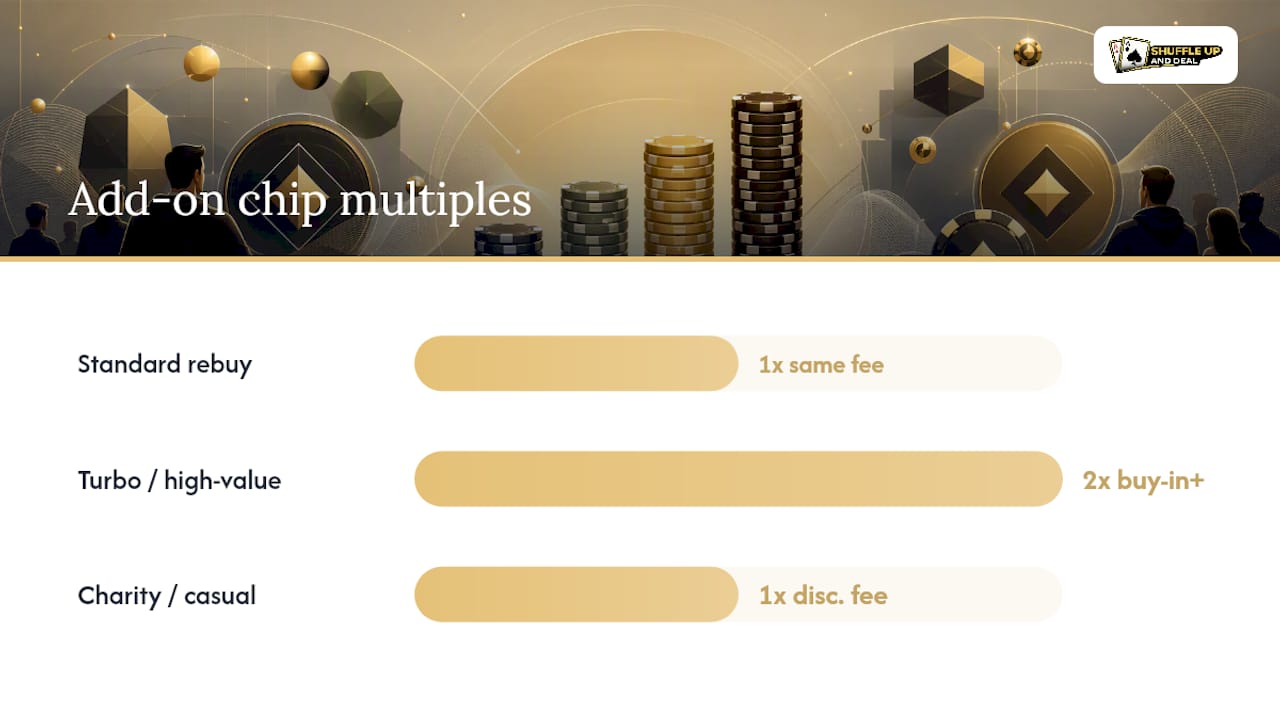
Chip amounts vary but tend to follow simple multiples of the starting stack:
| Structure type | Typical add-on chips | Typical price |
|---|---|---|
| Standard rebuy event | 1x starting stack | Same as rebuy fee |
| Turbo/high-value events | 2x starting stack | Same or slightly higher than buy-in |
| Charity/casual events | 1x starting stack | Discounted flat fee |
Every add-on purchase needs a paper trail. Whether that’s a physical receipt slip, a timestamped ledger entry, or an app log, you need to be able to answer “did this player actually pay?” hours after the fact when someone disputes their chip count.
Pro Tip: Never rely on memory or verbal confirmation for add-on payments. A timestamped digital record, even a simple photo of a receipt stapled to the player’s entry card, saves you from he-said-she-said arguments during the money bubble.
What rule templates can TDs copy for add-ons?
Three variants cover almost every home game and card room scenario, and picking the right one comes down to how much fairness debate you’re willing to tolerate against how much admin time you have.
- Permissive: any registered player may take the add-on regardless of stack size or attendance at the break, purchased through a floor staff member or app at any point before the next level starts.
- Standard: each player gets exactly one add-on, available only during the designated break, purchased in person or via app before cards are dealt for the next level.
- Strict: only players physically present at their seat when the break ends may take the add-on, with no proxy purchases and no grace period.
“Clear, preannounced times for add-ons reduce disputes.” That’s the consistent thread running through every regulatory example worth following, and it’s the single easiest fix available to any TD writing rules for the first time.
The permissive version grows your prize pool fastest but invites arguments about fairness toward players who busted early. The strict version is airtight but annoys players stuck in a bathroom queue when the break ends.
Pro Tip: *Define “present” precisely: seated at the table, chip stack visible, before the dealer’s first card of the new level.
Add-on vs rebuy: which should your event offer?
Rebuys and add-ons solve different problems, and confusing them in your rules document is a common rookie TD mistake.
- Eligibility: rebuys typically require busting or falling under a minimum stack; add-ons are open to everyone regardless of chip count.
- Timing: rebuys run throughout the rebuy period (often 60 to 90 minutes); add-ons happen once, at a single designated break.
- Cost structure: rebuys usually match the initial buy-in price; add-ons are often priced the same or discounted, since they’re a one-time offer rather than a repeatable purchase.
Most commercial organisers treat add-ons as a prize-pool growth lever that doesn’t require raising the advertised buy-in, which is exactly why casual and charity events lean on them heavily. If you want a guaranteed freezeout feel with no artificial chip inflation, skip both. If you want maximum prize pool with minimum structural complexity, add-ons alone usually beat running both mechanisms.
Should you take the add-on? A player’s decision checklist
Here’s the honest answer for most players walking up to that break: take it, unless you have a specific reason not to.
- Compare your current stack to the average stack. If you’re well below average, the extra chips matter more.
- Work out how many big blinds the add-on actually adds at the current level. A 10,000 chip add-on when blinds are 500/1,000 is ten big blinds. That’s meaningful.
- Check where you sit relative to the bubble. Near the money, adding chips changes your ICM equity in ways worth thinking through before you pay.
- Confirm your bankroll rule allows the extra buy-in on top of any rebuys already taken.
Strategy guides consistently land on the same heuristic: take the add-on almost every time you’re offered one, unless you’re already a dominant chip leader or the extra chips amount to a trivial number of big blinds at the current level. Stack-versus-average comparisons remain the most usable shortcut during a ten-minute break, since nobody’s running full ICM maths with a coffee in hand.
Pro Tip: Watch how your table reacts to the add-on break. If three players decline and you take it, you’ve bought yourself a real chip advantage for the next few orbits, not just extra chips on paper.
How does an add-on change the prize pool and payouts?
Add-on money almost always inflates the prize pool, which is worth walking through in real numbers rather than the abstract.
Say 40 players enter at $100, with 25 taking a $100 rebuy and all 40 taking a $50 add-on:
If your house takes a fee slice from add-on money rather than passing it fully to the pool, state that split explicitly in your rules, since silent deductions are one of the most common sources of player complaints. For deal-making near the bubble, that inflated pool also shifts ICM calculations meaningfully, since every stack is now worth a different fraction of a bigger total.
What’s the TD checklist for running add-ons smoothly?
Running a clean add-on break comes down to preparation more than anything you do in the moment.
- Before the event: publish add-on timing, chip quantities, pricing, and fee allocation in your written rules, and set up whatever payment method (cash box, card reader, app) you’ll use.
- At the break: designate exactly one person authorised to process add-on purchases and update chip counts, whether that’s a floor manager or the TD themselves.
- Recording: log every purchase against the player’s registration entry immediately, not after the break ends, so lobby stacks and leaderboard displays stay accurate.
- Enforcement: decide your no-show and refund policy in advance. If a player misses the window because they stepped away, is that their problem or the floor’s? Write the answer down before it happens.
Pro Tip: Physical tokens or coloured chips for add-ons work well in home games, but they only help if someone’s actually counting them against a list. An app-based toggle removes that manual reconciliation step entirely.
How does Shuffle Up and Deal! support add-on rule enforcement?
Running add-on rules on paper works until your field grows past a handful of tables, at which point manual tracking becomes the single biggest source of tournament delay. Shuffle Up and Deal! was built to close that gap.
- Rebuy/add-on toggles: switch add-on availability on or off per event, with the chip amount and price locked into the structure you configured beforehand.
- Automated prize-pool tracking: every add-on purchase updates the prize pool total and generates a receipt automatically, no manual ledger required.
- Live lobby updates: player stacks refresh instantly across every synced device the moment an add-on is processed, so your seating and stack display stays accurate mid-break.
- Share links: players and spectators watching remotely see updated stacks without you announcing anything out loud.
A tournament management platform that reconciles add-on income against registration data after the event removes most of the guesswork that fuels disputes in the first place.
Setting it up takes minutes: configure the add-on chip count and fee inside your event structure, set the window to your designated break, and let the app handle stack updates as players pay. Afterwards, pull the post-event report to reconcile total add-on income against your prize pool figure. That single report is usually enough to settle any dispute about whether the numbers add up.
Pro Tip: Run your post-event reconciliation report before players leave the venue. Resolving a discrepancy while everyone’s still there beats an email argument three days later.

Do multi-flight tournaments need different add-on rules?
Multi-flight and multi-day events add a layer most single-table home games never encounter: multiple starting flights that need to merge into one field, each potentially with its own add-on window.
The cleanest approach is offering the add-on identically across every flight, at the equivalent point in each flight’s structure (the same level number and break, even if the flights run on different days). That keeps the field fair once flights combine, since a player in Flight B isn’t disadvantaged just because their add-on break landed at a different clock time than Flight A’s.
Some organisers instead offer a single combined add-on window only on Day 2, after all flights have merged. This is simpler to administer but shifts the decision later, meaning players from Flight A carry their Day 1 chip count into Day 2 without the early boost, while a player who barely survived Flight A gets the same access to a top-up as someone who ran hot. Whichever model you choose, write it into your rules explicitly per flight, not as a single blanket statement that assumes one flight structure.
Chip conversion matters here too. If Day 2 uses converted chips (say, a 1:100 ratio) rather than actual tournament chips, state whether the add-on chip amount is quoted in Day 1 chips or already-converted Day 2 chips. That single ambiguity causes more multi-day disputes than almost any other add-on detail, because a 10,000 chip add-on means something very different depending on which side of the conversion it lands.
Track add-on totals per flight separately before merging your prize pool figures, particularly if flights had different field sizes or add-on take-up rates.
Do add-on rules differ between No-Limit Hold’em and Omaha?
The core mechanics of add-ons don’t change between poker variants: it’s still a one-time, fixed-price chip purchase at a set point in the schedule. What changes is how much that add-on actually matters to your strategy and structure.
In No-Limit Hold’em, chip stacks translate fairly directly into playable big blinds, so an add-on’s value is straightforward to calculate: divide the chips by the current big blind to see how many extra big blinds you’re buying. In Pot-Limit Omaha and Omaha Hi-Lo, four-card hands and bigger average pot sizes mean stacks get contested more aggressively and variance runs higher, so the same add-on chip count often gets through fewer hands before it’s back in play. Some organisers running Omaha events set slightly larger add-on chip amounts than they would for an equivalent Hold’em structure, precisely to compensate for that faster variance.
Mixed-game formats (HORSE, 8-Game) create the trickiest rule-writing challenge, since the add-on typically happens during whichever game is live at the scheduled break, and that game rotation is arbitrary relative to when players would prefer to top up. The fix is simple: state the add-on window as a fixed time or level number, not “during Hold’em rounds only,” so the rule applies identically regardless of which game happens to be running.
Pricing and chip quantity should still scale with your buy-in structure rather than the variant itself. A $200 buy-in Omaha event and a $200 buy-in Hold’em event can reasonably use the same add-on price and chip count.
What add-on disputes come up most often, and how are they resolved?
Most add-on disputes trace back to one of three failures: unclear timing, unclear eligibility, or unclear accounting, and every one of them is preventable with better rule wording rather than better refereeing.
The most common dispute is a player claiming they missed the add-on window because nobody announced it clearly. The resolution almost always favours the published rule over verbal recollection, which is exactly why timestamped, written add-on times matter so much. If your rule says “add-on available during the break following Level 6” and that’s what happened, a player who was in the bathroom queue doesn’t get a retroactive exception, however unlucky the timing.
The second most common dispute involves prize pool accounting: players suspecting add-on fees are quietly padding the house rake rather than the prize pool. This is why stating the fee split explicitly in your published rules, before the event starts, matters more than almost any other single line of text you’ll write. Transparency here costs you nothing and prevents the accusation entirely.
The third involves eligibility arguments in multi-flight events, typically a player from an earlier flight claiming they should get the same add-on access as someone in a later flight who happened to bust and rebuy closer to the merge. Consistent per-flight rules, published before Day 1 starts, resolve this before it ever becomes a live argument.
A tournament director’s take on where to draw the line
My default is the standard template: one optional add-on per player, available at the first consolidation break, funds going straight to the prize pool. It’s the version that grows the pool meaningfully without inviting the fairness arguments the permissive model attracts, and it doesn’t demand the rigid seat-checking the strict model needs. Simplicity wins more often than clever structuring does, and the rule you can explain in one sentence is usually the rule players actually respect.
Run add-on rules without the spreadsheet headache
Shuffle Up and Deal! is the alternative to juggling paper receipts and a whiteboard when you’re running regular events with rebuys and add-ons. You get one place to toggle add-ons on or off per event, log every purchase against a player’s registration the moment it happens, and watch the prize pool total update automatically instead of adding it up by hand at 2am.

Live lobby stacks sync across every device you’ve got running, so your add-on break doesn’t grind the whole room to a halt while someone counts chips at the front desk. If you’re running leagues across multiple events, the same reconciliation reporting carries through season after season, so add-on income stays trackable long after the final table’s gone home. Head to the Shuffle Up and Deal! app to start on the free plan and set up your first add-on structure in minutes.
Sources
Check your national gambling regulator before finalising add-on structures involving real money, since licensing and consumer-protection rules vary by jurisdiction.
- Add-On Definition: All You Need to Know About Add-On – PokerStrategy
- 11VAC20-30-100. Tournament play.
- Gamblingcommission
Always confirm add-on rules against your own jurisdiction’s regulator rather than relying on general guidance alone.