
Poker Tournament Management App
Run Poker Tournaments Like a Pro!
From First Hand to Final Table
Seat draws, table balancing, the clock, payouts and league standings: Shuffle Up and Deal! runs the whole night from your iPhone or iPad.

Announcing Blinds in Poker: TDA Rule and 90 Second Dealer Script

The new blind level becomes official the moment the tournament clock sounds its audio signal or an authorised floor announcement is made, and it applies from the next hand onward. Dealers must never raise blinds off their own initiative before that signal. The moment it sounds, pause dealing, glance at the clock or blind board, update the display, and announce the new level clearly before the next hand starts.
TL;DR:
- The new blind level starts immediately when the tournament clock’s audio signals or a floor announcement, not dealer judgment, and it governs the next hand only.
- Dealers must confirm the current level on the display before dealing and never assume a change has occurred without the official signal to avoid disputes.
- Blinds typically increase every 20 to 30 minutes in home or club tournaments, with shorter or longer intervals used depending on event speed and structure.
- In case of a missed or incorrect level change, the floor usually corrects the blinds before the next hand unless substantial action has occurred, then the hand is settled at the previous level.
- Consistent operator scripts and automated timers like Shuffle Up and Deal! significantly reduce timing errors and disputes during level changes.
Table of Contents
- What the announce blinds poker rule actually says: TDA Rule 23 and hand definitions
- Dealer and floor procedures for announcing and implementing blind changes
- How often should blinds go up in a poker tournament?
- What happens when a blind level is announced incorrectly?
- What should a dealer say when announcing new blinds?
- How Shuffle Up and Deal! keeps blind announcements accurate
- Why consistency between dealers matters more than the rule itself
- Try Shuffle Up and Deal! for automated blind announcements
- Sources
- FAQ
What the announce blinds poker rule actually says: TDA Rule 23 and hand definitions
The 2024 Poker TDA Rule 23 is the backbone of every proper announce blinds poker procedure, and it settles an argument that used to eat up floor time at every card room. A new level begins the instant the tournament clock’s audio plays or a director makes a floor announcement, and it governs the next hand, not the one currently in progress. Nothing else counts. Not a dealer’s watch, not a player’s phone, not someone shouting “blinds are up” from the rail.
That last point matters because a hand needs a fixed starting line, and the rule gives dealers one. A hand is considered started once the first card is dealt off the first riffle, the shuffler button is pressed, or the dealer physically pushes the cards out, depending on house equipment. Anything that happens before that moment belongs to the old level; anything after belongs to the new one.
The other phrase worth knowing is “substantial action” (SA), meaning a call, raise, or all in has already occurred in the hand. SA is the tiebreaker when a level change lands awkwardly mid-hand. Recent industry rulings have reinforced that the clock is treated as the single source of truth precisely so that every table changes level at the same second, with no room for a dealer’s personal interpretation.
Dealer changes add friction because a new dealer arriving mid-orbit may not know exactly where the level stood. The routine that solves this reliably:
- Confirm the current level on the visible display or clock before dealing your first hand
- Ask the outgoing dealer or floor if a level change is imminent
- Never assume the previous dealer already actioned the change
- Treat the clock’s audio as the only trigger, regardless of what a player claims happened at another table
Dealer and floor procedures for announcing and implementing blind changes
Clean level changes come down to sequencing, not memory. Get the order wrong and you invite disputes; get it right and nobody at the table even notices the transition happened.
- Ninety seconds before the signal, stop initiating brand new hands where practical. This is the industry’s 90 second rule, and it exists to stop a hand spilling awkwardly across a level boundary.
- Use the pause to check the button, stacks, and any pending all ins so you are not scrambling once the audio fires.
- At the signal itself, swap the displayed blind level immediately, whether that is a physical card, a whiteboard, or a synced screen.
- If a hand is already under way by the hand start definition, finish it at the old level. Do not adjust blinds retroactively mid-hand.
- Deliver the announcement clearly before pushing the next hand, stating both blind figures and any ante.
- Confirm live and dead blinds for any player who missed a blind through a seat change, a break, or a late return, and post accordingly.
- Log absent players who owe a blind so the floor can resolve it consistently rather than case by case.
Do keep your script identical every level. Don’t rely on memory for the new numbers, glance at the clock or blind sheet every single time. Do flag uncertainty to the floor immediately rather than guessing. Don’t let a chatty table distract you from the 90 second checkpoint.
Pro Tip: Rehearse the exact wording of your announcement before the event starts, not during level one with players watching. A dealer who fumbles the script on the first change loses credibility for the rest of the night.
How often should blinds go up in a poker tournament?

Most home tournaments run blind levels of 20 to 30 minutes, which typically produces a four- to six-hour event depending on starting stacks and field size, according to chip structure analysis from BetMGM. Turbo formats compress that to 10 minutes or less, trading strategic depth for speed. High buy-in or deep-stack events often stretch levels to 40 or 60 minutes to preserve room for genuine post-flop play.
Interval length shapes more than duration. Faster cadence pushes players toward push-fold decisions sooner and increases variance, while slower cadence rewards patience and rewards the stronger long-game player. Choosing a cadence is really choosing what kind of night you want to run:
- Short 10 to 15 minute levels suit turbo formats and casual weeknight games where players want a result within two hours
- Standard 20 to 30 minute levels balance strategy and pace for most club and home tournaments
- Extended 40 to 60 minute levels fit high-stakes or televised-style events where skill needs room to show
A printed or on-screen blind schedule removes most confusion before it starts. Community templates like the T1000/T1500 examples give organisers a ready-made progression to adapt rather than building one from scratch. Pair that schedule with a visible clock carrying an automatic two-minute warning, so players see the change coming rather than being ambushed by it. Our guide to building a poker blind structure walks through picking a progression that matches your field size and target finish time.
What happens when a blind level is announced incorrectly?
Errors happen, usually when a dealer misses the signal during a hectic multi-table event. The fix depends entirely on substantial action.
- If no substantial action has occurred in the hand dealt at the wrong level, the floor can correct the blinds immediately and continue the hand at the proper level.
- If substantial action has already happened, most floors let the hand stand as dealt and correct the level from the very next hand, since unwinding calls and raises creates worse disputes than it solves.
- If a level was skipped entirely by dealer error, the floor typically applies the correction going forward rather than trying to retroactively charge missed blinds.
- If a player dodges a blind by stepping away at a convenient moment, the standard remedy is a dead button or a required post on return, decided by house rules rather than improvisation.
Call the floor the moment a dispute surfaces rather than ruling on it yourself at the table. Document what happened, which hand it affected, and what remedy was applied, so the same situation gets treated consistently at every other table running the same event. Our piece on handling clock disputes and floor calls covers the etiquette side of this in more depth.
What should a dealer say when announcing new blinds?
Consistency in wording matters as much as timing. A few short scripts cover almost every situation a dealer will face during a level change.
- Two-minute warning: “Two minutes to the next level, players.” Said once, loud enough for the table, timed against the clock’s own countdown.
- At the signal: “New level, blinds now [X] and [X].” State both numbers, then deal.
- Introducing an ante: “New level, blinds [X] and [X], ante [X] per player.”
- Ending late registration: “This is the final level for late registration, closing after this hand.”
- Starting a break: “That’s the last hand before break, back in [X] minutes.”
Where possible, let an automated voice announcement carry the message instead of relying purely on a human dealer shouting across a noisy room. Professional tournament timer software broadcasts the same audio to every table simultaneously, which removes the risk of one dealer announcing a level thirty seconds ahead of another.
How Shuffle Up and Deal! keeps blind announcements accurate
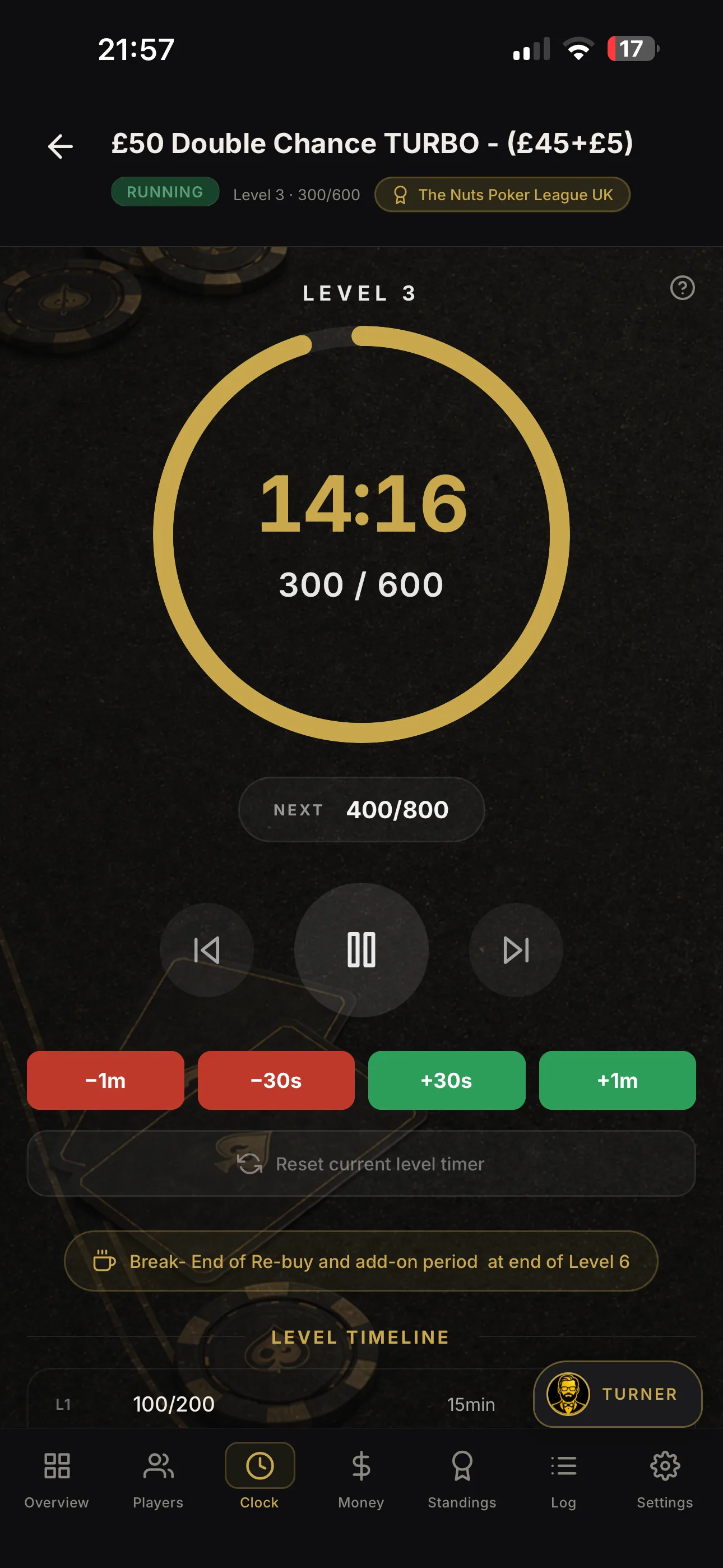
Manual announcements break down the moment you are running more than one table, and that is exactly the gap Shuffle Up and Deal! closes. The app’s live tournament clock drives every level change centrally, so every screen in the room updates at the same second with no dealer guesswork involved.
- Live tournament clock with automated voice announcements for every level change
- Multi-device sync so tables, floor staff, and a casting display all show identical blinds
- A blind schedule editor for building custom progressions in advance
- Shareable live displays players can check from their phones without asking the dealer
Because the clock itself is the authority, not a person’s memory, the exact dispute this article covers, someone dealing a hand at the wrong level, becomes far less likely to happen in the first place.
Why consistency between dealers matters more than the rule itself

Most blind disputes have nothing to do with the rulebook and everything to do with two dealers running the same rule two different ways. Rule 23 is clear enough on paper. What breaks down is execution, one dealer treats the 90 second rule as optional, another announces blinds after dealing rather than before, and players notice the inconsistency long before they notice the actual level change.
The fix is boring but effective: a pre-event checklist, a two-minute rehearsal of the 90 second routine, and standard wording written into your house rules rather than left to individual style. Get every dealer saying the same script the same way, and blind disputes drop close to zero.
- Jason
Try Shuffle Up and Deal! for automated blind announcements
You have just read what it takes to run announce blinds poker procedures correctly by hand, checking the clock, timing the 90 second pause, scripting the announcement, logging disputes. Shuffle Up and Deal! removes the manual steps entirely by running the tournament clock, voice announcements, and blind schedule from one synced platform across every table.
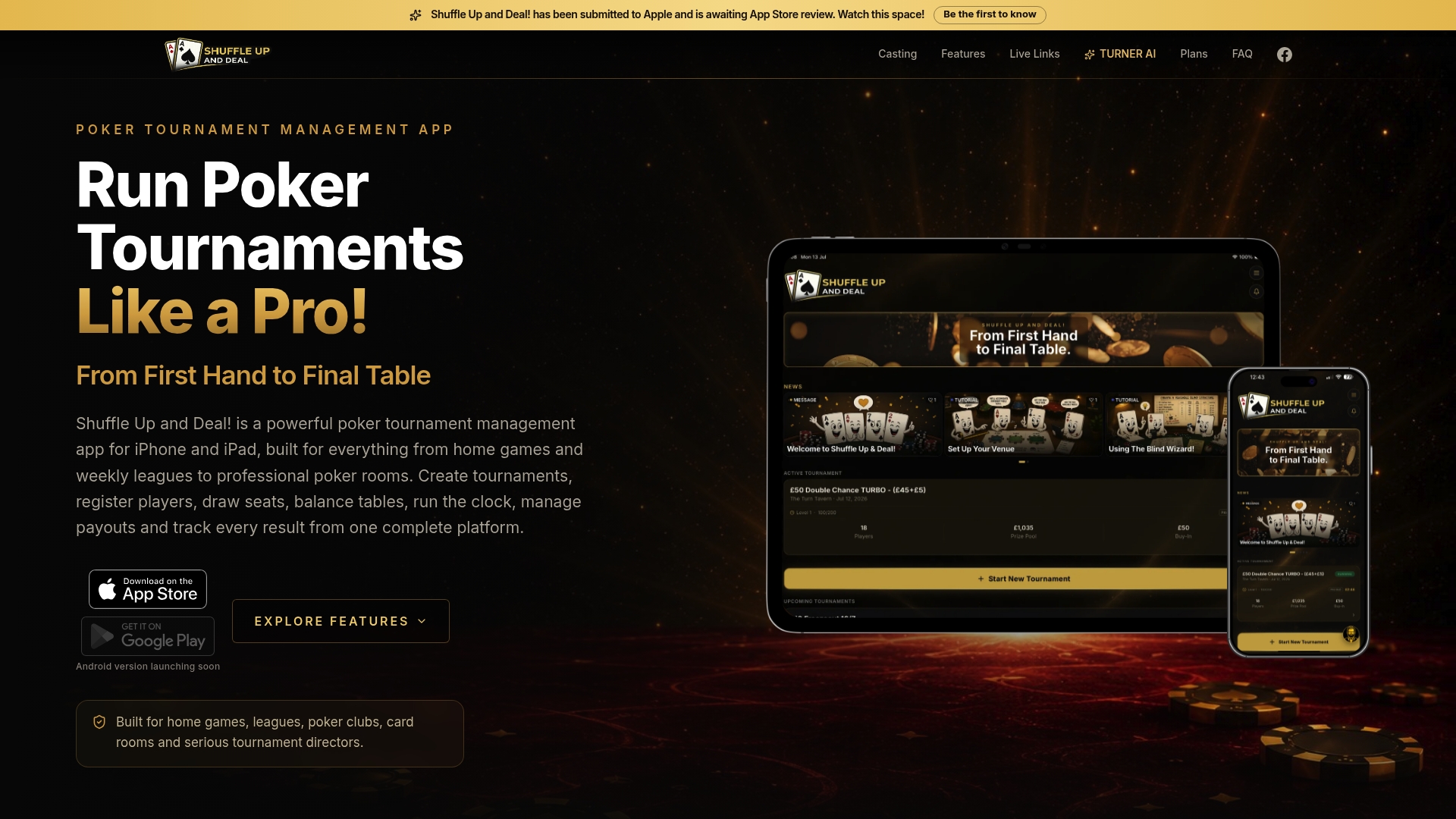
Whether you run a weekly home game or a multi-table card room, the Shuffle Up and Deal! platform scales with you: start on the free Home Game plan, or move up to Tournament Director at £13.99 per month, TD Pro at £24.99 per month, TD Elite at £39.99 per month, or Card Room at £59.99 per month for larger operations. Head to Shuffle Up and Deal! to set up your first blind schedule and clock, or check the tournament clock setup guide to get your first event running level changes automatically tonight.
Sources
- Poker Tournament Directors Association (POKER TDA) - Rules & Procedures (2024 updates)
- Poker Tournament Chip Structures Explained: Blinds, Levels, and Stacks – BetMGM
- Poker
- Poker Clock – Professional Tournament Timer
FAQ
Why do poker tournaments use blinds instead of an ante?
Blinds create forced action for just two players each hand rather than charging everyone, which keeps the pot growing without slowing the game down for a full-table ante collection. Many structures add an ante alongside blinds at higher levels to accelerate action further, as explained in CardPlayer’s blinds glossary.
What do blinds mean in poker?
Blinds are forced bets posted before any cards are dealt, with the small blind typically half the big blind, rotating around the table with the button each hand. They exist purely to guarantee a pot worth playing for, according to CardPlayer.
How often do the blinds go up in a poker tournament?
Most home and club tournaments raise blinds every 20 to 30 minutes, which tends to produce a four to six hour event depending on stack sizes, based on chip structure guidance from BetMGM. Turbo formats shorten this to 10 minutes or less, while deep-stack events often stretch to 40 or 60 minutes per level.
How should a dealer announce a raise or a new blind level in poker?
A dealer should state both blind figures clearly the moment the clock signals or the floor announces the change, before dealing the next hand, using a consistent script such as “new level, blinds now X and X.” Shuffle Up and Deal!'s automated voice announcements can deliver this message identically across every table, removing timing gaps between dealers.
Can a dealer raise the blinds before the official signal?
No. Under TDA Rule 23, a dealer must never increase blinds ahead of the tournament clock’s audio signal or an authorised floor announcement, even if their own timing suggests the level should have changed already. Doing so risks the hand being corrected or replayed by the floor.