
Poker Tournament Management App
Run Poker Tournaments Like a Pro!
From First Hand to Final Table
Seat draws, table balancing, the clock, payouts and league standings: Shuffle Up and Deal! runs the whole night from your phone or tablet.



How to Run a Poker Tournament: Part 1, Planning and Preparation

Welcome to the first of three guides to help make your poker game the best it can be. Across the series, I’ll walk you through equipment, structure, registration, seating, running the game and paying out.
In part one, we’ll focus on what you can prepare before the day of your poker tournament, making your night as a tournament director (TD) as easy as possible. There’s also a checklist at the end that you can save for when it’s your turn.
Before the day: choosing your tournament format
The first decision is what type of poker tournament you want to run. Three common formats are:
Freezeout: each player gets one entry. Once they lose all their chips, they’re out.
Rebuy: players can buy more chips under conditions you set, during a specified rebuy period.
Re-entry: eliminated players can enter again during the re-entry period, subject to any limits you set.
For this guide, I’ll focus on a freezeout tournament. One player, one entry. When they’re out, they’re out!
Choosing your poker chips and starting stacks
Now you know the format, you need to decide how many chips each player will start with. This will depend partly on the chip set you have and how many players you expect.
My chips are marked with their values, which makes things much easier for players. The denominations in my set are 100, 500, 1,000, 5,000 and 25,000.
With these chips, I usually choose a starting stack somewhere between 20,000 and 50,000. For a 20,000 starting stack, I use:
5 × 100 chips = 500
3 × 500 chips = 1,500
3 × 1,000 chips = 3,000
3 × 5,000 chips = 15,000
Total: 20,000 across 14 chips.
To increase that to 50,000, I can add one 25,000 chip and one extra 5,000 chip.
Make sure you have enough chips for every starting stack, plus some spare chips for making change and replacing smaller denominations later in the tournament.
You want enough lower-value chips for players to post blinds and make bets comfortably, without putting so many into play that removing them later becomes a chore. Your starting stack and opening blinds need to work together: a 20,000 stack plays very differently with blinds of 100/200 than it does with blinds of 500/1,000.
Planning your poker tournament blind structure
How long you have to play will help shape your blind structure. Shuffle Up and Deal! (SUAD) has a handy tool to help you plan this if you get stuck.
The more time you have, the longer your blind levels can be. But remember, more players means more chips in play, so you need to take that into account too. Level length, blind increases, starting stacks and player numbers all affect how the tournament progresses.

Most of my games have a four-and-a-half-hour window, starting at 7:30pm and aiming to finish around midnight. I usually use 15-minute blind levels, allowing time for breaks within that window. This works as a starting point for my games, but it isn’t a guaranteed finish time for every tournament.
Deciding when late registration closes
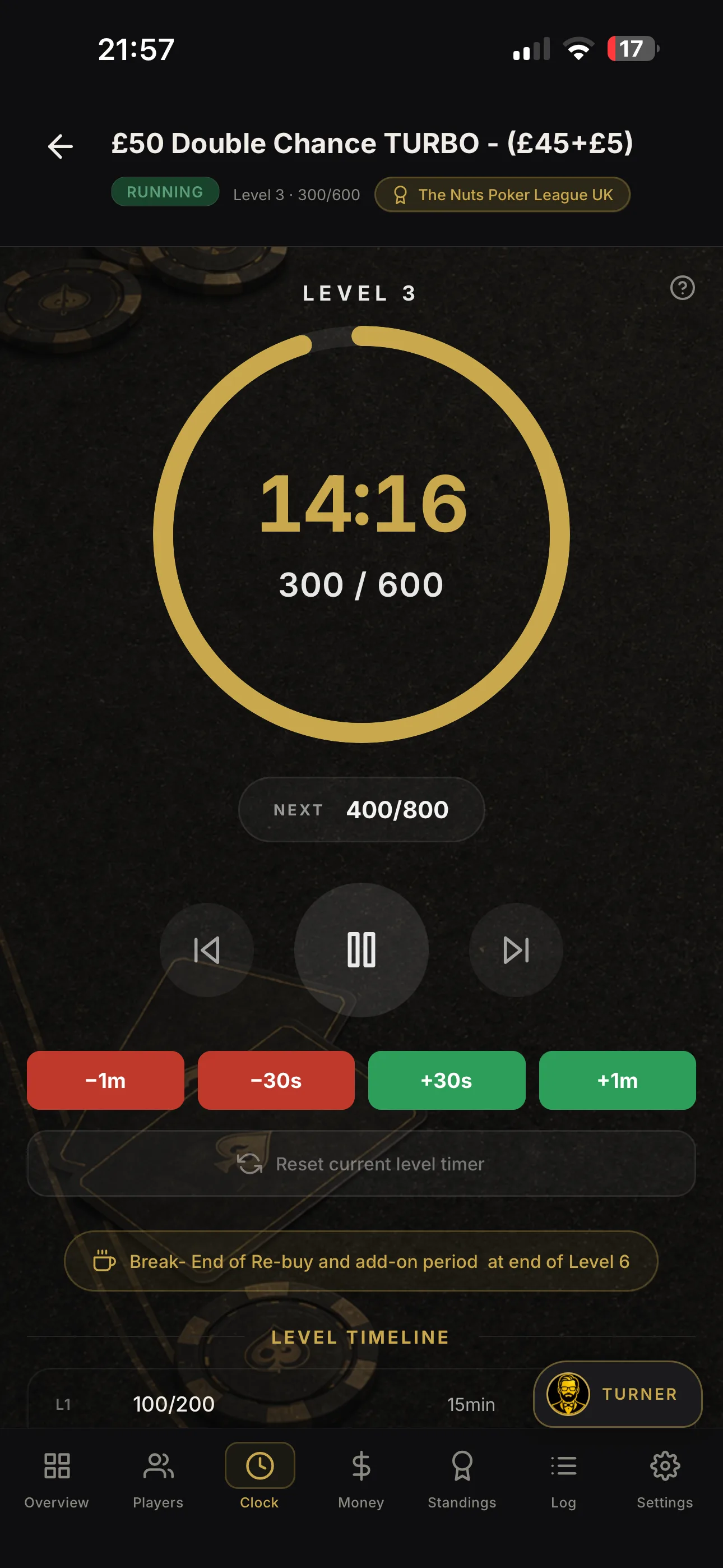
This is also when I decide whether to allow late registration and how long to keep it open. I usually close it at the first break, at the end of level six.
A freezeout can still allow late registration. Players arriving late are taking their first and only entry, rather than returning after being eliminated.
Whatever you choose, make the cutoff clear before the game so everyone knows when they need to arrive.
Planning breaks and chip colour-ups
Remember to build breaks into your structure. Some players don’t like leaving the table and missing hands, so planned breaks give everyone a chance to step away.
Breaks are also a good opportunity to remove chip denominations that are no longer needed and replace them with larger ones. This is often called a colour-up. Plan these around your blind structure so you don’t remove chips that players still need.
Keeping the tournament moving
If you have a firm finishing time, you can plan shorter levels later in the structure. It’s best to decide this beforehand and let players know, rather than unexpectedly changing the pace during the game.
SUAD also supports big blind antes, where the player in the big blind posts the ante for the table. Antes add more chips to the pot before the cards are dealt and can influence the pace of play, so factor them into your structure from the start.

Setting up your tournament in Shuffle Up and Deal!
We’re nearly ready. Now it’s time to put your choices into SUAD and get the tournament set up.
One thing I haven’t covered is the buy-in, as that depends on your game and what your players are comfortable with. Make the amount clear in advance, including any separate fee, so everyone knows the cost before arriving.
Check your tournament format, starting stack, blind structure, breaks and late registration settings before saving. Getting these sorted now means fewer things to think about when players start turning up.

Your pre-tournament checklist
Before the day, make sure you have:
Chosen your tournament format.
Confirmed your expected player numbers and available seating.
Checked you have tables, chairs, decks of cards and dealer buttons.
Chosen your starting stack and checked you have enough chips.
Set aside spare chips for making change and colour-ups.
Planned your blind levels around your intended playing time.
Decided whether to use antes.
Added breaks and planned any chip colour-ups.
Decided whether to allow late registration and set a clear cutoff.
Confirmed the buy-in and any fee.
Saved and checked your tournament setup in SUAD.
Checked your device is charged and you have a charger available.
With that done, you’re ready to turn up with a plan and concentrate on giving your players a good night of poker.
Next in part two: setting up on the night, registering players and getting everyone seated.