
Poker Tournament Management App
Run Poker Tournaments Like a Pro!
From First Hand to Final Table
Seat draws, table balancing, the clock, payouts and league standings: Shuffle Up and Deal! runs the whole night from your iPhone or iPad.

Poker Seating Draws: Card vs App by Event Size for Organizers
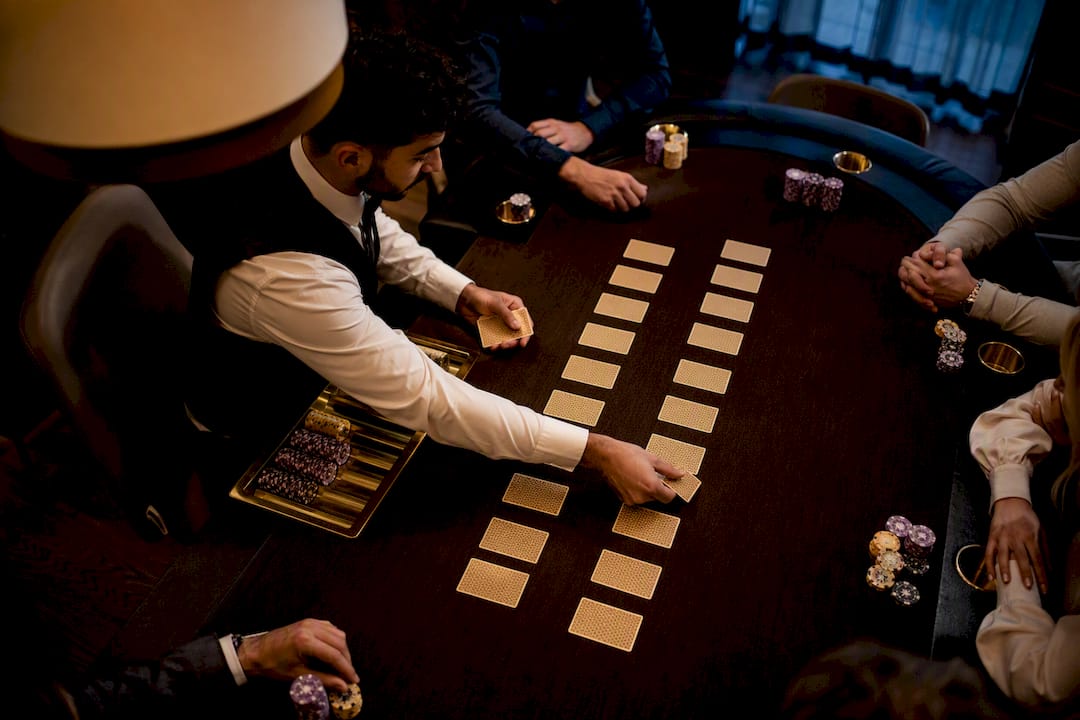
The fairest way to run a poker seating draw is the one that matches your event’s size: a simple card draw for a single table or small live game, and a tournament management app for anything with multiple tables or repeat events. Both remove human bias from seat assignment, but speed and consistency tip the scales towards digital tools once you pass one table.
TL;DR:
- Card draws are ideal for events under twenty players due to their simplicity and speed, while digital tools excel in larger, multi-table tournaments.
- Proper preparation includes exactly matching the deck or slips to the number of players, reserving a seat for the director, and announcing the process transparently.
- Digital seating apps provide error reduction, instant rebalancing, and live on-screen displays, making them essential for complex or high-player-volume events.
- Reseating between rounds should follow strict rules, such as moving players from the fullest to the emptiest table and redrawing for final tables to ensure fairness.
- Seating randomness directly impacts game dynamics, table image, and fairness, especially critical in multi-table events where uneven distributions can shape strategies.
Table of Contents
- What is a poker seating draw and which method suits your game?
- How do you run a step-by-step card-draw seating assignment?
- How do you size and balance tables for multi-table events?
- What should you expect from digital seating tools and apps?
- Why a tournament management app helps: how Shuffle Up and Deal! automates fair seating
- Common mistakes and a fairness checklist
- How do you handle odd numbers of players and vacant seats?
- What are the rules for reseating between tournament rounds?
- How does seating affect game dynamics and player strategy?
- A note from a tournament director
- Try Shuffle Up and Deal! for your next tournament
- Sources
What is a poker seating draw and which method suits your game?
A poker seating draw is simply the process of assigning players to seats, and often to tables, using a random method rather than letting people choose where they sit. It matters because seat position affects everything from who acts first to who gets to steal blinds late in a hand, and a visibly random process keeps every player convinced the game started on equal footing.
There are three methods most organisers reach for:
- Card draw: shuffle a prepared deck, deal one card per player, and let rank and suit determine seat and table. Needs only a deck of cards and takes under five minutes for a full room.
- Paper slips: write seat numbers on slips, drop them in a container, and have players draw blind. Slightly slower than cards but works when you don’t have a full deck to hand.
- Digital seat assignment: a tournament app randomises everything instantly and displays the result on screen. Fastest option, and the only one that scales cleanly past two tables.
Card draws and paper slips both score well on perceived fairness because players watch the process happen in front of them. Digital tools trade a little of that theatre for speed and accuracy, though a live display on a screen or projector recovers most of the transparency you’d lose otherwise.
How do you run a step-by-step card-draw seating assignment?
The card-draw method used at registration relies on a simple rule: rank sets your seat, suit sets your table. It’s the standard poker tournament seating draw for home games and small clubs, and it takes minutes to set up.
- Count your players and tables. For one table, use only the ranks you need (ace through ten covers a ten-seat table). For multiple tables, assign one suit per table, so spades go to table one, hearts to table two, and so on.
- Set the seat order. Ace usually takes seat one (often the button), two takes the small blind, three the big blind, and so on around the table.
- Shuffle and deal. Deal one card face down to each player as they register. No peeking until everyone has one.
- Reveal together. Have players turn their cards at the same time and walk to the seat and table their card indicates.
- Handle the dealer. Decide in advance whether you’re using a player-dealer (rotating the button) or a dedicated dealer, and factor that seat into your card count so numbers still match.
Pro Tip: If you expect a dealer/player, account for that seat in your card-preparation step or select a dedicated dealer before seating to keep seat counts standard. Reserving a clearly marked “tournament director” seat prevents unintended advantage.
When you announce the draw, say plainly that every seat is assigned by the cards, not by choice, and that nobody, including the organiser, gets to pick their table.
How do you size and balance tables for multi-table events?
Table size shapes how the game plays as much as it shapes logistics. Eight to ten players per table is the sweet spot for most cash games and tournaments, while six-handed tables play noticeably faster and reward more aggressive ranges, according to Home Poker Tourney’s seating guidance.
- Around a dozen players, two tables with about half the players each is typical, or one table close to full plus a few waiting, though that is less common.
- For numbers approaching twenty, organizers aim for balanced tables with near-equal players per table.
- Around two dozen players commonly split evenly into tables of around eight for best play balance.
- Odd totals generally: round towards even tables rather than leaving one table short-handed for the whole event.
Close a table once player numbers drop low enough that consolidating improves balance, and always draw fresh seats for anyone moving to a new table, never simply “slot them in” at the first empty chair.
What should you expect from digital seating tools and apps?
Software earns its place the moment you run more than one table. A manual card draw gets awkward fast when you’re juggling four tables, late registrations, and a rebuy period all at once, and that’s precisely where digital tools take over.
The advantages are practical rather than flashy:
- Speed: seats assign in seconds rather than minutes, even for a room of eighty players.
- Error reduction: no risk of two players ending up with the same seat number because a card got miscounted.
- Repeatable redraws: rebalancing a table takes one tap instead of a fresh shuffle.
- Live display: results appear on a screen instantly, keeping the transparency a manual draw offers.
When evaluating an app, look for a genuine seating algorithm rather than a basic random number generator, automatic table balancing as players bust out, dealer and blind assignment built into the draw, and multi-device sync so staff on different devices see the same seating chart. Good tools also handle table consolidation cleanly: as tables empty, the software recalculates who moves where and can display the updated seating chart on an external screen without anyone touching a deck of cards.
Why a tournament management app helps: how Shuffle Up and Deal! automates fair seating
Shuffle Up and Deal! Builds the seating draw straight into tournament setup, so you’re not running a card draw and a spreadsheet at the same time. Its smart seating algorithm assigns players and tables the moment registration closes, then rebalances automatically as the field shrinks, no manual redraws needed.
The features that matter most to tournament directors are the ones that save time under pressure. A live tournament clock keeps blind levels running while seating happens in the background, and shareable seating charts mean players can check their table on their own phone instead of crowding around a printout. Multi-device syncing lets several staff members manage registration and seating from different devices without anyone seeing conflicting information.
For recurring games, this matters even more. A league that runs weekly doesn’t want to reinvent its seating process every session, and preserving that history alongside player statistics and leaderboards keeps regulars engaged between events. The poker tournament management app handles registration, table balancing, blind levels, and payouts from one screen, which is exactly the kind of consolidation that stops a busy tournament floor from turning into chaos.
Common mistakes and a fairness checklist
Most seating disputes trace back to preparation, not the draw itself. Run through this before registration opens:
- Prepare exactly one card or slip per seat, no more, no fewer.
- Reserve a marked seat for the tournament director if one is needed.
- Announce the method out loud before anyone draws.
- Record every assignment as it happens, on paper or in the app.
The usual errors are a miscounted deck, late arrivals who need a slot after the draw has already run, and forgetting to remove a card for a player who withdrew. Fix a missing player by pulling their card from the deck before you deal, not after.
Pro Tip: Announce the draw method clearly and let players watch the process. Transparency is what prevents disputes far more than the method itself does.
How do you handle odd numbers of players and vacant seats?
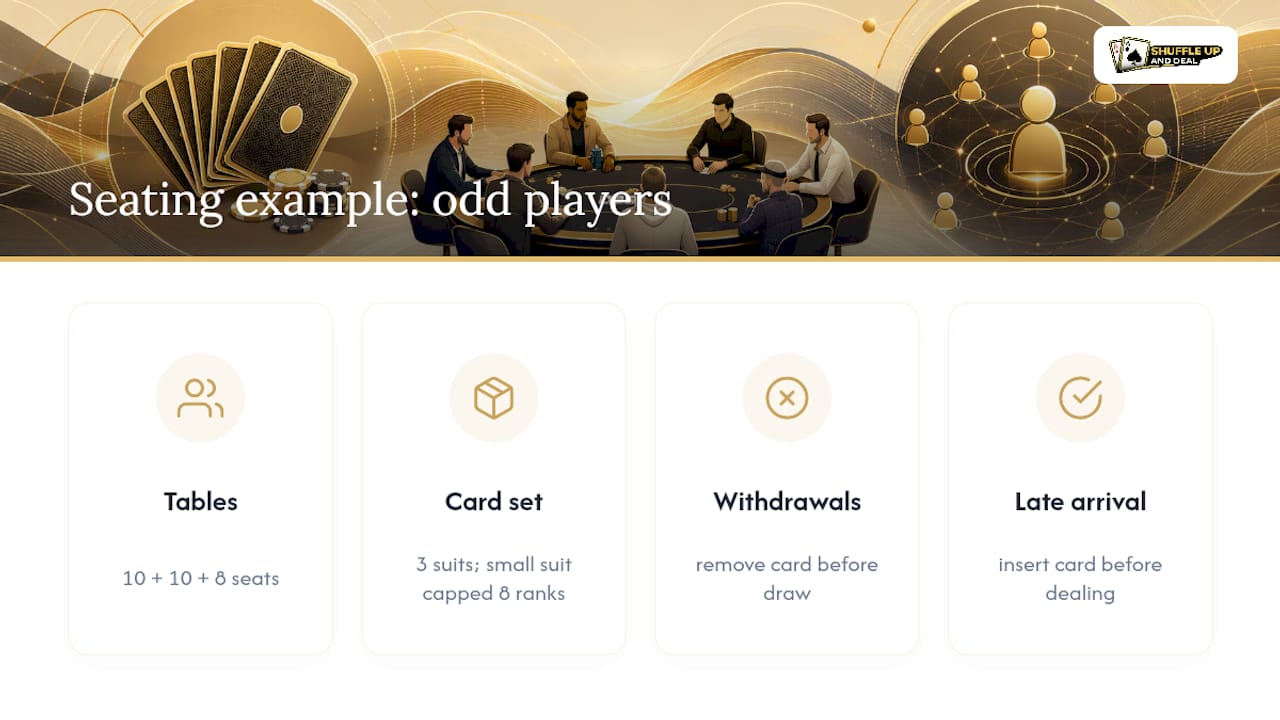
Odd numbers are the norm, not the exception, and they trip up organisers who plan seating around perfectly even tables. The fix starts at the card-preparation stage: count your confirmed players first, then build your deck or slip set to match that exact number, never the number of seats physically available.
If you’ve got 25 players for two ten-seat tables and one eight-seat table, prepare cards in three suits, with the smaller suit capped at eight ranks rather than ten. Anyone who withdraws before the draw gets their card pulled from the deck immediately, and anyone who arrives after cards are dealt but before the draw is revealed can usually be added by inserting one more card, provided you haven’t started dealing yet.
Vacant seats cause more disputes than odd totals. A seat that looks empty because a player is on a break reads very differently from a genuinely open seat, so mark breaks clearly on your seating chart, whether that’s a paper sign or a note in your tournament app. Don’t fill a break seat with a moved player, and don’t leave a table permanently short a seat when a no-show never turns up. Once it’s clear a registered player isn’t coming, pull them from the table balance the same way you’d remove a bust-out, and redraw or consolidate if the table drops below a playable size.
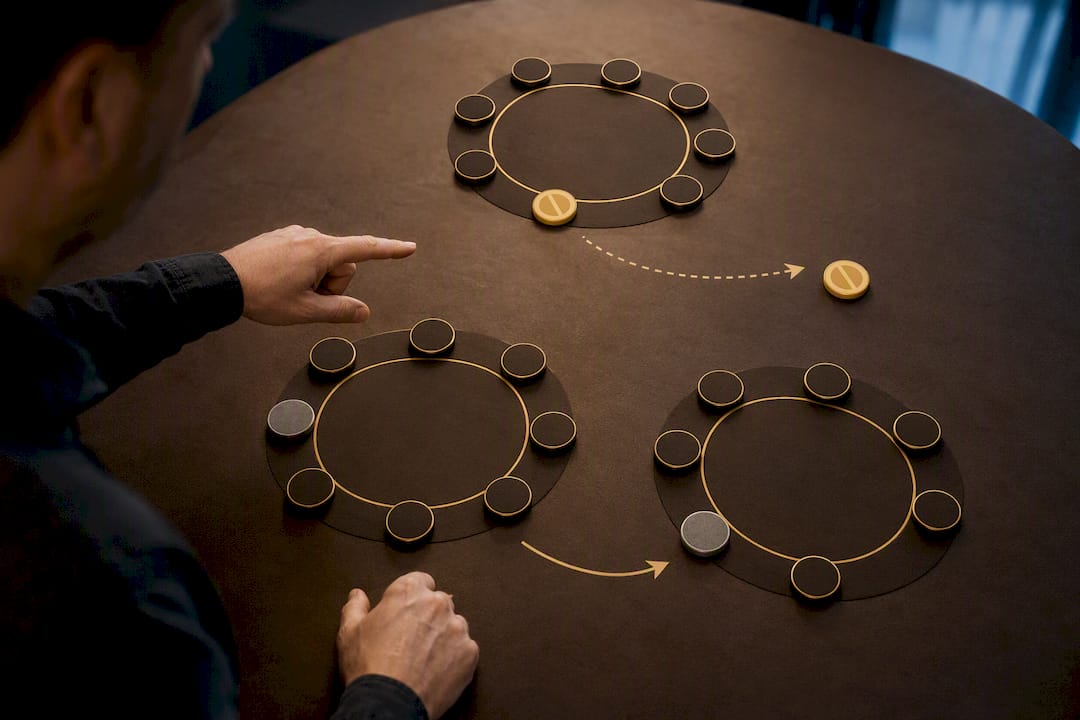
Digital tools handle this more cleanly than paper ever will, because the seating algorithm recalculates the moment a player is marked as a no-show or a late addition, without you needing to manually recount cards or slips.
What are the rules for reseating between tournament rounds?
Reseating between rounds exists for one reason: to stop tables from drifting into wildly different sizes as players bust out. The standard practice, confirmed by Home Poker Tourney’s balancing guidance, is to move players from the fullest table to the emptiest one whenever the gap between tables reaches two seats or more.
The player who moves should never get to choose their new seat. When a table needs to send someone to a new table, prepare a reduced deck matching the number of open seats there and have the moving player (or players) draw blind, exactly as they did at initial registration. This keeps the process consistent and stops accusations that a moved player was placed favourably next to short stacks or away from aggressive opponents.
Final tables get their own rule, and most organised events redraw completely once the field reaches the last table. Every remaining player draws a fresh seat, regardless of where they sat before, which resets any positional patterns that built up over the earlier rounds. This matters more than it sounds: a player who’s spent three hours to the left of an aggressive opponent shouldn’t carry that disadvantage into the part of the tournament with the biggest pay jumps.
Closing a table entirely follows the same logic as redrawing for the final table. Once a table drops to a size that makes it unbalanced against the rest of the field, break it, redraw its players into open seats elsewhere, and update the chart immediately so nobody arrives back from a break to find their old seat occupied by someone else.
How does seating affect game dynamics and player strategy?
Seat position isn’t a minor detail. It shapes who acts first, who sees more information before deciding, and who gets to apply pressure late in a hand, and PokerNews’ analysis of seat selection makes the strategic stakes clear: players sitting to the left of the button see more of the action unfold before they have to commit chips.
This is exactly why randomising the poker table seating arrangement matters more than casual organisers assume. A player who happens to sit consistently to the right of a loose, aggressive opponent gets to exploit that position hand after hand, while a player stuck to that same opponent’s left is forced to play defensively all night. Neither outcome has anything to do with skill. It’s simply where the cards put them.
Random seating strategy also affects table image. A tight player seated near several loose ones might get more respect for their raises than the same player would at a table full of nits, purely because of who’s watching. None of that is something an organiser can plan for, and that’s precisely the point: nobody should be able to plan for it, including the organiser.
Multi-table events add another layer. Table draws that happen to cluster several strong regulars at one table and mostly recreational players at another create an uneven event, even if every individual seat assignment was random. Rebalancing between rounds, discussed above, is partly a fairness mechanism and partly a mechanism for keeping the overall standard of play similar across every table still in the room.
A note from a tournament director
Card draws win for anything under twenty players. I’ve watched digital seating turn a four-table Sunday game from a half-hour scramble into a five-minute setup, and once you’ve run it that way, going back to a deck and a clipboard feels like using a paper map. Simplicity wins small, speed wins big. Either way, announce the method and stick to it.
- Jason
Try Shuffle Up and Deal! for your next tournament
Shuffle Up and Deal! is the practical middle ground between a manual card draw and a spreadsheet full of seating notes: it does the randomising, the balancing, and the redrawing automatically, so you spend registration talking to players instead of counting cards.
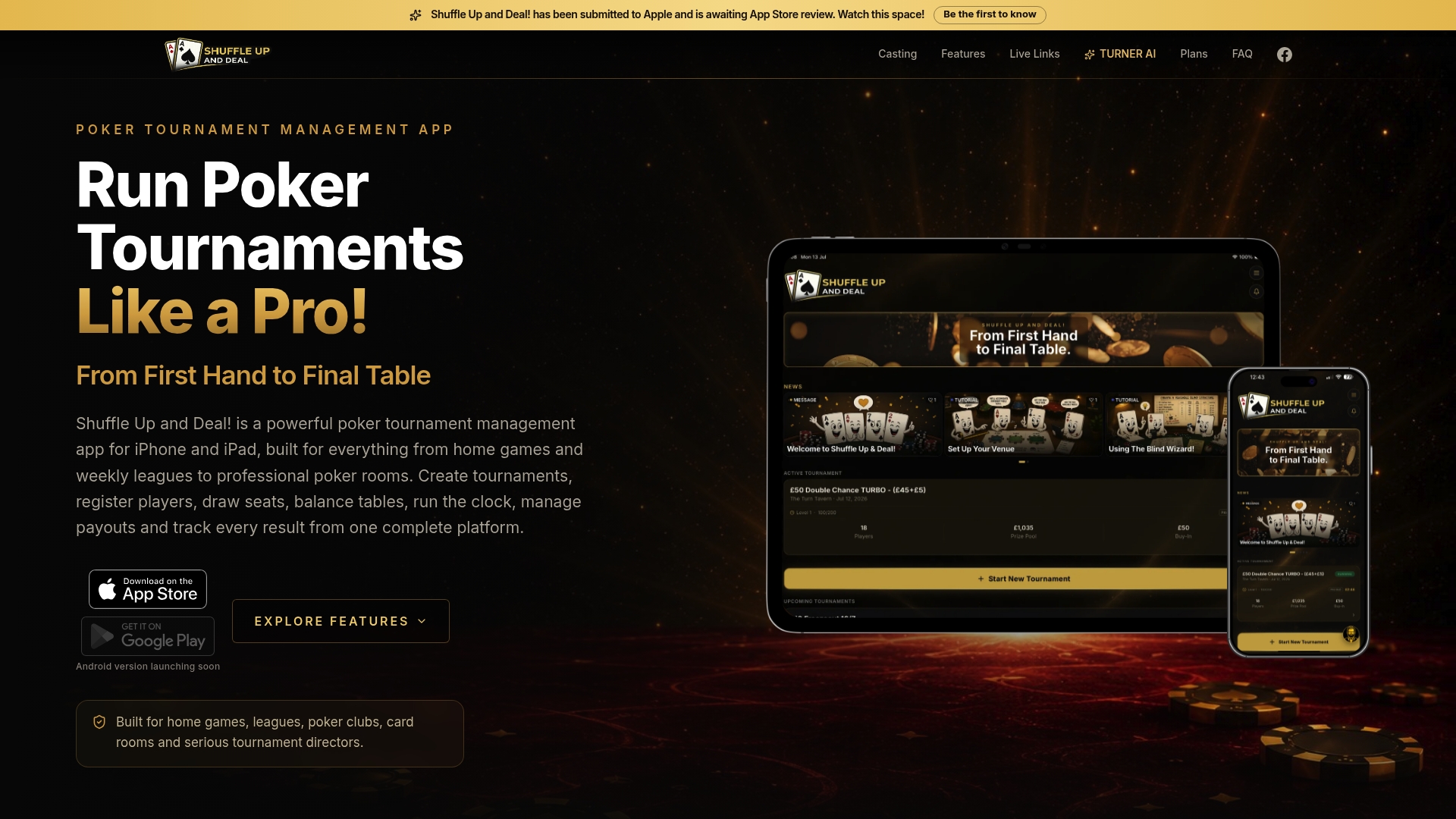
Every feature covered above, smart seating algorithms, live tournament clocks, shareable seating charts, and multi-device sync, is available in a tournament management platform designed for tournament directors running anything from a kitchen-table game to a multi-table club event. If reseating between rounds or handling a late rebuy currently means pausing the whole room, this is the fix. Visit the Shuffle Up and Deal! tournament management app to see the free plan and find out which paid tier fits the size of event you run.
Sources
- Draw For Seats | Poker Terms (PokerNews)
- How to seat poker players in a poker tournament (Home Poker Tourney)