
Poker Tournament Management App
Run Poker Tournaments Like a Pro!
From First Hand to Final Table
Seat draws, table balancing, the clock, payouts and league standings: Shuffle Up and Deal! runs the whole night from your iPhone or iPad.

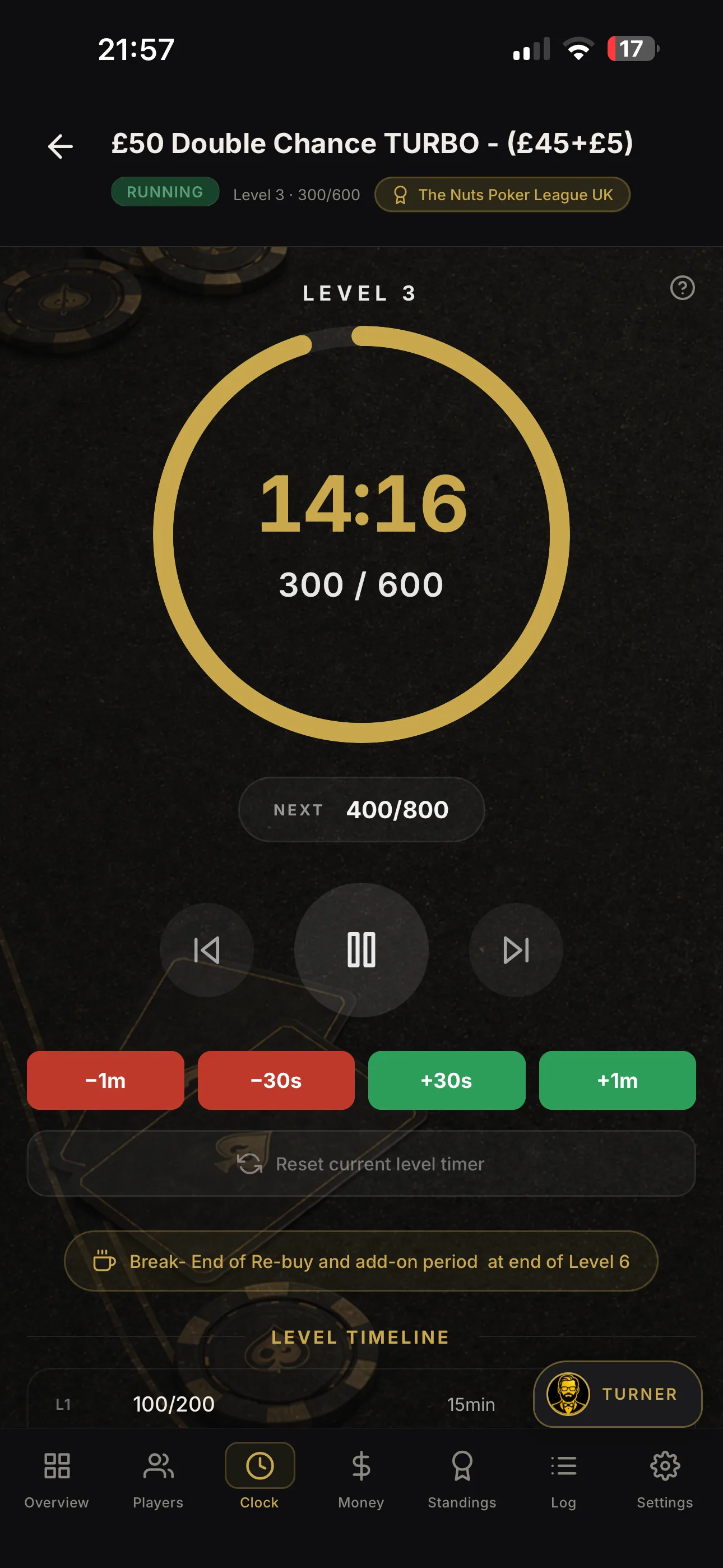

Automate poker tournament alternates: first break cutoff and TD workflow

An alternate is a waitlisted player who gets seated as busted players free up seats until a set cutoff. Industry practice, codified in the Poker Tournament Directors Association rules, sells alternates a full starting stack and seats them from the same pool as new entrants, dealt straight into the action except between the small blind and the button. Anything outside that standard sits with the tournament director’s judgement.
TL;DR:
- Most large poker events give alternates a full starting stack identical to registered players, following the industry standard in the TDA rules.
- Alternates are seated only after bust-outs, except when the open seat is between the small blind and the button, where they wait one hand to ensure fairness.
- Dead-stack deductions are common in smaller rooms, reducing chips for blinds and antes missed, but all methods must be clearly documented and consistently applied.
- Cutoff policies should be explicitly stated as a specific level or break, with response windows and logging procedures to avoid disputes.
- Automation tools like Shuffle Up and Deal! streamline seating, cutoff enforcement, and dead-stack calculations, reducing errors and disputes during busy tournaments.
Table of Contents
- What is a poker tournament alternate?
- Starting stacks and blind handling for alternates
- Seating rules and the small blind exception
- When can alternates join, and what’s the cutoff?
- Alternates vs re-entries vs late registration: what’s the difference?
- Running the alternates list: a step-by-step workflow for TDs
- Table balancing and chip handling when alternates join
- Edge cases: when TD discretion actually applies
- How Shuffle Up and Deal! takes the guesswork out of running alternates
- A tournament director’s take on alternates
- Run alternates without the spreadsheet chaos
- Where to check the rules yourself
- Sources
- FAQ
What is a poker tournament alternate?
The term gets used loosely, so it’s worth pinning down before you write it into a rule sheet. A tournament alternate is a player who registered but couldn’t get a starting seat because the event sold out, and who waits on a list to be seated once a registered player busts or a no-show slot opens up. That’s different from a substitute, which usually refers to someone standing in for a specific player under exceptional circumstances, and different again from a player simply arriving during late registration.
The standard reference point for how alternates should be treated is the TDA rulebook, and most card rooms, from small home-game circuits to major series, build their house rules on top of it. Under those rules, alternates, late registrants and re-entries are all sold full stacks and drawn from the same seat pool as fresh players. That single decision, sell alternates a full stack rather than a reduced one, is the biggest fork in the road for how your tournament plays out, and it’s covered properly in the next section.
Alternates fall into a few practical categories, and knowing which type you’re dealing with changes how you manage the list.
- Pre-registered alternates signed up online or in advance and hold a numbered position before the event starts.
- On-site alternates show up on the day, find the tournament full, and add their name to a physical or digital waitlist at the registration desk.
- Rolling waitlist alternates get added throughout the late registration period as the tournament fills further than expected.
Ordering the list is where most disputes start. Some rooms run strict first-come, first-served, timestamping each name as it’s added. Others rank by loyalty tier, buy-in history, or league standing, which works fine for a members’ club but needs to be stated clearly on the rule sheet before anyone complains. On-site check-in typically requires the player to remain within earshot or view of the registration desk, or to leave a phone number the floor staff can call.
Documentation matters more than most new TDs expect. A simple system, a numbered ticket plus a logged timestamp, protects you from arguments about who was “next” when three names get called in the same minute. If you take payment upfront for alternate positions (some venues do, others collect on seating), issue a receipt and record whether that payment is refundable if the alternate never gets seated. Pro Tip: keep the alternates list visible on a shared screen or clipboard near the desk. Disputes drop sharply once players can see their own position rather than having to ask.
Starting stacks and blind handling for alternates
Two approaches dominate, and the difference between them is the single biggest variable in how fair (or how forgiving) your tournament feels to the field. According to the TDA rules used at The Lodge Card Club, venues either issue alternates a full stack identical to every other entrant, or they use a dead-stack method that deducts chips to reflect blinds and antes already missed.
Full stacks. Most large series and card rooms default to this because it’s simple to administer and it removes any argument about fairness. An alternate seated in level four gets exactly the same stack as someone who registered an hour earlier. The TDA rules on late entrants confirm this is the accepted baseline: alternates, late registrants and re-entries are all sold the same full stack drawn from the same pool.
There’s a catch worth stating plainly to your field: giving every alternate a full stack, with no deduction for the levels they missed, effectively turns an advertised freezeout into something closer to a rebuy structure. If forty per cent of your field enters during a two-hour late registration window on full stacks, the average stack size and the practical dynamics of the tournament shift noticeably. Say so on the rule sheet. Players who feel blindsided by a “freezeout” that behaved like a rebuy event are the ones who leave bad reviews.
Dead stacks with blind deductions. Smaller rooms, and TDs who care about encouraging punctuality, often prefer this. The chip count is reduced to reflect antes and blinds the alternate missed while they sat on the waitlist. A basic version most rooms can implement:
Starting stack minus (levels elapsed × average blinds/antes paid per level at that stage) = alternate’s seated stack.
Iowa Wild’s published tournament rules use a related mechanism, allowing alternates through the first few levels with proportional deductions rather than flat full stacks, and Mohegan Sun’s rule sheet does something similar, permitting alternates through the first two levels with blinds and antes removed in proportion to time elapsed.
Statistic to know: there’s no universal split published across the industry on which method dominates, but practitioner discussion on the TDA forum’s late-entrant thread consistently frames it as a size trade-off: small daily tournaments lean towards dead stacks to keep the field punctual, while very large series lean towards full stacks and simply staff the extra workload.
Whichever method you pick, the “dead money” (chips deducted from a dead stack, or blinds an alternate would have posted) needs a clear home. Log it. If your structure returns dead money to the prize pool rather than removing it from play entirely, state that explicitly, because players do the maths on total chips in play and they will ask.
- Record every dead-stack deduction against the specific alternate’s name and seating time.
- Decide in advance whether dead money returns to the felt or leaves the game, and print that decision on the rule sheet.
- Never mix methods mid-event. Switching from full stacks to dead stacks halfway through a late registration period is the fastest way to get a floor argument you can’t win cleanly.
Seating rules and the small blind exception
Alternates draw seats from the same pool as every other new entrant, and the process should look identical regardless of whether the player in the chair is a fresh registrant or someone who’s been waiting an hour. The TDA standard, reflected in The Lodge’s published ruleset, treats seat assignment as a blind draw from open seats, never a TD’s personal pick.
There’s one seating rule every director needs memorised, because it comes up constantly and it’s the one players actually know: alternates are dealt in immediately upon seating, except when the open seat sits between the small blind and the button. In that specific window, the incoming player waits one hand rather than joining mid-street, because being dealt in there would let them see the action develop before committing chips, an unfair informational edge the rule exists specifically to close.
Here’s the practical sequence most rooms run:
- Identify the open seat the moment a player busts and confirm it against the current seating chart.
- Check the seat’s position. If it sits between the small blind and the button, mark it “closed” for the alternate until that button passes.
- Call the next alternate from the ordered list and confirm they’re present and ready.
- Seat and deal in immediately if the position is clear, or hold the alternate at the rail until the button clears if it isn’t.
- Update the seating chart and notify the floor so nobody double-seats the same open chair.
The other question every new TD asks: do you seat at the exact end of the hand, or can you slot someone in mid-hand if a seat opens? Iowa Wild’s tournament rules take the cleaner approach here, seating and recording the exact timestamp only once the hand in progress has finished, never mid-street. That timestamp discipline matters more than it sounds: when a dispute arises about who was seated first or whether an alternate missed a blind they should have posted, a logged time beats a floor staff’s memory every time.
Table changes complicate this further. If a bust-out triggers a table-balance move rather than a straightforward reseat, redraw the alternate into the balanced configuration rather than assigning them to whatever seat happens to be physically nearest the desk. Consistency in the draw process is what keeps players trusting that the felt is fair, even when they can’t see every step of it.
When can alternates join, and what’s the cutoff?
Every event needs a hard stop on alternates, stated in writing before the first card is dealt. The two most common cutoffs are tied to the clock (a fixed number of levels) or tied to structure (the first break), and both work, provided you pick one and print it.
- First-break cutoff. Alternates can be seated any time up to the first scheduled break, after which the list closes entirely. This is the tidiest option for standard-length events because it gives you a clean administrative boundary everyone can see coming on the clock.
- Level-based cutoff. Some rooms extend the window further, permitting alternates through a specified number of early levels. Mohegan Sun’s house rules cap this at the first two levels, a tight, predictable window that suits fast-structure events.
- Extended cutoff for oversold events. If you’ve oversold the room and expect a longer bust-out tail before every alternate gets seated, some venues extend the window rather than turning away paid alternates, though this needs sign-off from whoever owns the tournament, not a floor-level call mid-event.
Communication is what separates a smooth cutoff from an argument at the rail. State the cutoff on the printed structure sheet, announce it verbally at the start of the event, and repeat it over the microphone as the cutoff approaches. Organised amateur circuits like the FSGA’s published tournament policies go further, specifying exact response windows for how long an alternate has to confirm before their slot passes to the next name on the list, and reserving the right to pull in local alternates the day before an event if response times run short.
Day-of pressure is where most cutoff policies actually get tested. If you’re two names deep into the alternates list with five minutes before your stated cutoff and nobody’s answering their phone, the honest answer is: enforce the cutoff you printed. Bending it for one late arrival because the room “feels” short on players sets a precedent every subsequent event will be judged against.
Alternates vs re-entries vs late registration: what’s the difference?
Players conflate these three terms constantly, and a rule sheet that doesn’t distinguish them clearly invites arguments at the felt. All three can result in a player sitting down with a full stack mid-event, but the mechanics and eligibility differ.
- Late registration covers a player buying in for the first time after the tournament has started, during a published window, with no prior waitlist involvement.
- Re-entry covers a player who busted out and buys back in during the permitted re-entry period, typically capped at one or two re-buys per structure.
- Alternates cover players who wanted a seat before the tournament even started but were shut out by a full room, and who are seated only as vacancies appear.
Operationally, an alternate being seated with a full stack looks identical, from the felt’s perspective, to a late registrant or a re-entering player. That similarity is exactly why the TDA-standard rule sells alternates the same full stack as new registrants and re-entries: it keeps the mechanics consistent even though the player’s route to that seat was different.
The player-facing confusion usually comes from the “freezeout” label. A player who bought in expecting no rebuys, then watches alternates and re-entries flood full stacks into the field for two hours, can feel like the structure quietly changed underneath them. Print something like this on your rule sheet to head it off:
One sentence, printed clearly, saves a dozen conversations at the rail.
Running the alternates list: a step-by-step workflow for TDs
A clean operational process turns alternates from a source of chaos into a five-minute routine. Here’s the sequence worth building into your pre-event checklist:
- Open the alternates list at registration and timestamp every name the moment it’s added, whether pre-registered online or added on-site.
- Assign a floor role specifically responsible for calling alternates as seats open. In a one-person room, this falls to the TD; in larger events, delegate it so the clock and the floor never compete for the same person’s attention.
- Set a response window for each call, commonly a few minutes, mirroring the kind of response-time standard organised events like the FSGA publish for their own alternates procedures.
- Move to the next name immediately if an alternate doesn’t respond within the window, and log the missed call rather than silently skipping it.
- Confirm the seat and stack size with the alternate directly before they sit, so there’s no confusion about full stack versus dead stack at the table.
- Update the master seating chart the moment the alternate sits, and note the exact time in your records.
Fallback planning matters as much as the primary process. If your entire alternates list has gone quiet, decide in advance whether you’ll pull in walk-up players from the rail, hold the seat open, or (as some organised circuits do) source local alternates the evening before a scheduled event when response times are genuinely too tight to manage live.
Pro Tip: treat every alternate call the same way you’d treat a chip count dispute: write it down as it happens, not from memory an hour later. The single biggest source of avoidable disputes in club-level poker is a floor staff member recalling events differently to the player at the table.
Recordkeeping doesn’t need to be elaborate. A simple log, name, timestamp added, timestamp called, response, seat assigned, gives you a defensible paper trail if a dispute ever escalates past the felt. Rooms running the same event weekly benefit most, because patterns in no-shows or response times become obvious after a few sessions and let you tighten the process rather than reinvent it each time.

Table balancing and chip handling when alternates join
Every alternate seated mid-event is, from a table-balance perspective, identical to a re-entering player: a new stack landing in a specific seat that may or may not need the table redrawn. The trigger points that matter are the same ones you’d use for any bust-out or rebalance.
- Combine or redraw once a table drops below your house threshold for players, commonly when two tables can be consolidated into one without breaking the two-away seating rule.
- Route alternates into balanced seats, not simply the nearest open chair, whenever a bust-out coincides with a table-balance trigger.
- Escort chip movements physically rather than letting an alternate carry their own rack across the room, particularly at larger buy-in levels where a miscount is expensive to fix after the fact.
Dead stacks add one more layer to get right. If you’re deducting blinds and antes for elapsed levels, the deducted chips need to go somewhere accountable, either back into the total prize pool ledger or removed from play entirely, and that decision has to be made once, in advance, not improvised table by table. Recovering the correct amount matters less than recovering it consistently: an alternate seated at level three should lose the same proportion as every other alternate seated at level three that day, not a number the dealer estimated on the spot.
Dealer procedure is where small errors compound into big ones. Handing an alternate their stack in full view of the table, counted out loud by the dealer or a chip runner rather than passed across in a closed rack, removes any ambiguity about what they actually received. It also protects your floor staff: a publicly verified count is much harder to dispute later than a private handoff.
Table changes triggered by an alternate’s arrival should be logged the same way as any other balance move; the seating chart, whether it’s a physical card table or a live digital display, needs to reflect the change the moment it happens, not at the next break when someone remembers to update it.
Edge cases: when TD discretion actually applies
Standard rules cover the vast majority of alternate situations cleanly, but the exceptions are where a TD’s judgement genuinely earns its keep. Practical guidance on ruling controversies confirms the general principle: substitutes may be permitted in extreme, well-documented circumstances at the director’s discretion, but the default position everywhere else is a flat no.
- Medical emergencies are the clearest case where a substitute might reasonably be allowed, and they need contemporaneous documentation, not a verbal explanation reconstructed after the fact.
- Transfers of a registered seat between two people are typically banned outright, because they undermine the integrity of the seat pool and open the door to selling positions.
- Team play is banned in essentially every ruleset for the same reason: it lets two players coordinate strategy or bankroll in a way the structure was never designed to accommodate.
- Late arrivals who’ve technically already been eliminated by a missed blind schedule fall into a genuine grey area, and the fairest approach is to apply your published cutoff rule exactly as written rather than negotiate case by case.
Documentation is what makes a discretionary ruling defensible rather than arbitrary. If you allow a substitute for a medical situation, write down the circumstance, the time, and who authorised it, then announce the ruling to the affected table so nobody’s left guessing why the rules bent for one player and not another.
Pro Tip: any discretionary call you make should be one you’d be comfortable explaining to the entire field, out loud, immediately. If it wouldn’t survive that explanation, it’s probably the wrong call.
How Shuffle Up and Deal! takes the guesswork out of running alternates
Everything covered so far, ordered lists, seating exceptions, stack deductions, table-balance triggers, is manageable on paper for a home game with a dozen players. It gets genuinely difficult to run cleanly by hand once you’re juggling a rolling waitlist, a live clock, and multiple tables filling and breaking at once.

Shuffle Up and Deal!'s smart seating algorithms handle exactly the seat-pool logic covered in the TDA rules: drawing alternates into open seats, respecting the small blind and button exception automatically, and updating the live seating chart display the instant a player sits, so nobody’s working from a paper chart that’s already out of date. The app’s approach to late registration cutoffs lets you set your first-break or level-based deadline once and have it enforced automatically, rather than relying on a floor staff member watching the clock and hoping they remember to close the list on time.
Practical settings worth configuring before your next event:
- Set your alternates cutoff to match your printed rule sheet, whether that’s the first break or a fixed level count.
- Enable blind-deduction calculations for dead-stack policies so the app does the maths rather than a dealer estimating it under pressure.
- Turn on live notifications so alternates get called automatically as seats open, cutting the response-window guesswork out of the process entirely.
The failure points that cause most alternates disputes, a missed call, a wrong seat assignment, a miscalculated dead stack, are precisely the ones automation is good at closing. Tournament directors running events with heavy alternates traffic tend to find the biggest time saving isn’t in the seating itself, but in never having to reconstruct what happened after a player complains.
A tournament director’s take on alternates
For a small daily tournament, full stacks and a first-break cutoff will serve you well almost every time; the administrative simplicity outweighs any fairness argument for dead stacks when you’re only seating two or three alternates a night. For a larger, genuinely oversold event, the calculus flips: you’ll want a level-based cutoff, tighter response windows, and a serious answer to how you’re calculating dead money, because the volume of alternates makes ambiguity expensive fast.
The three mistakes I see most often aren’t about which method a room chooses, they’re about inconsistency. Switching from full stacks to dead stacks mid-event because the room feels behind schedule. Seating an alternate mid-hand because the floor is busy and nobody’s watching the clock. And, most commonly, never printing the cutoff rule anywhere a player can actually read it before they complain about it.
Before your next event, run this against your own rule sheet:
- Is your stack policy (full or dead) written down and printed, not just known by you?
- Is your cutoff stated as a specific level or break, not “sometime early”?
- Does every floor staff member know the small blind and button exception without being prompted?
- Is there a timestamp log for every alternate added, called, and seated?
- Jason
Run alternates without the spreadsheet chaos
Shuffle Up and Deal! is the alternative to running your alternates list on a clipboard and a stopwatch: the app tracks the waitlist, enforces your cutoff automatically, and calculates dead-stack blind deductions the instant a seat opens, so nothing depends on a floor staff member’s memory under pressure.
The Tournament Director plan, at £13.99 a month, covers the core seating and clock automation most single-room events need, while TD Pro and TD Elite add the multi-table and league-management depth larger series rely on. Card rooms running events daily can step up to the Card Room plan for the full feature set across simultaneous tournaments. If you’re only running the occasional home game, the Home Game plan gets you started at no published cost.
Check the full plan breakdown on the Shuffle Up and Deal! site and see how the smart seating engine maps against TDA-standard rules before your next event. If your alternates policy involves something bespoke, an oversold series, a members’ club ranking system, get in touch through the site to talk through a setup that fits your room.
Where to check the rules yourself
The rules covered in this guide draw directly on published, checkable sources rather than convention alone, and it’s worth reading the originals if you’re drafting your own house rules.
- The TDA rulebook is the closest thing the industry has to a shared standard, and it’s the best starting point for the full-stack seating and draw process.
- The Lodge Card Club’s TDA-based rules show how one card room implements both full-stack and dead-stack approaches side by side.
- Mohegan Sun’s published tournament rules offer usable sample wording for a level-based alternates cutoff with proportional blind deductions.
- Iowa Wild’s tournament rules PDF is a clear, concrete example of an early-level cutoff policy in practice.
- FSGA’s tournament policies detail response-window standards for calling alternates that translate well to adult club events.
Borrow the wording, adjust it to your room’s terminology, and print it where players can actually see it.
Sources
- View Poker TDA Rules, Procedures, & Addendum - Poker Tournament Directors Association
- TDA RULES - The Lodge Card Club
- Mohegan Sun poker tournament rules
- Iowa Wild No-Limit Texas Hold ‘Em poker tournament rules
- FSGA policies - alternates procedures
FAQ
What is the 7/2 rule in poker?
The 7/2 rule is an informal side bet some home games run, where a player who wins a hand holding a weak hole card combination gets a bonus from the other players at the table. It has nothing to do with tournament structure or alternates rules; it’s purely a table-stakes side game some rooms adopt for fun.
What are the different types of poker tournament structures?
The main structures are freezeouts (no rebuys once you’re out), rebuy or re-entry events (you can buy back in during a set window), and satellites (which award entry into a bigger event rather than cash). Deepstack and turbo formats describe the pace of the blind structure rather than the entry rules, and alternates can apply to any of these formats depending on house policy.
What is a deepstack poker tournament?
A deepstack tournament gives players a starting stack that’s large relative to the starting blinds, which slows the early pace of the event and rewards skill over survival. It’s a structural choice separate from how alternates are handled, though rooms running deepstack events still apply the same full-stack or dead-stack seating rules covered by the TDA standard.
What is the 10/20/30 rule in poker?
The 10/20/30 rule is a general strategy heuristic, not a tournament administration rule, suggesting players fold quickly when they have no real interest, call within a moderate time, and only take longer when genuinely deciding a tough spot. It’s unrelated to alternates procedures or seating rules.
Do alternates get a full stack or a reduced stack?
Most large events sell alternates a full stack identical to new registrants, following the standard set out in the TDA rules. Smaller rooms often prefer a dead-stack method that deducts chips for blinds and antes missed, and either approach is acceptable provided it’s stated clearly on the rule sheet.
Can Shuffle Up and Deal! manage my alternates list automatically?
Yes. The app’s smart seating and waitlist tools call alternates as seats open, enforce your chosen cutoff, and calculate dead-stack deductions automatically, removing the manual tracking covered throughout this guide. Plans start with the Tournament Director tier at £13.99 a month.