
Poker Tournament Management App
Run Poker Tournaments Like a Pro!
From First Hand to Final Table
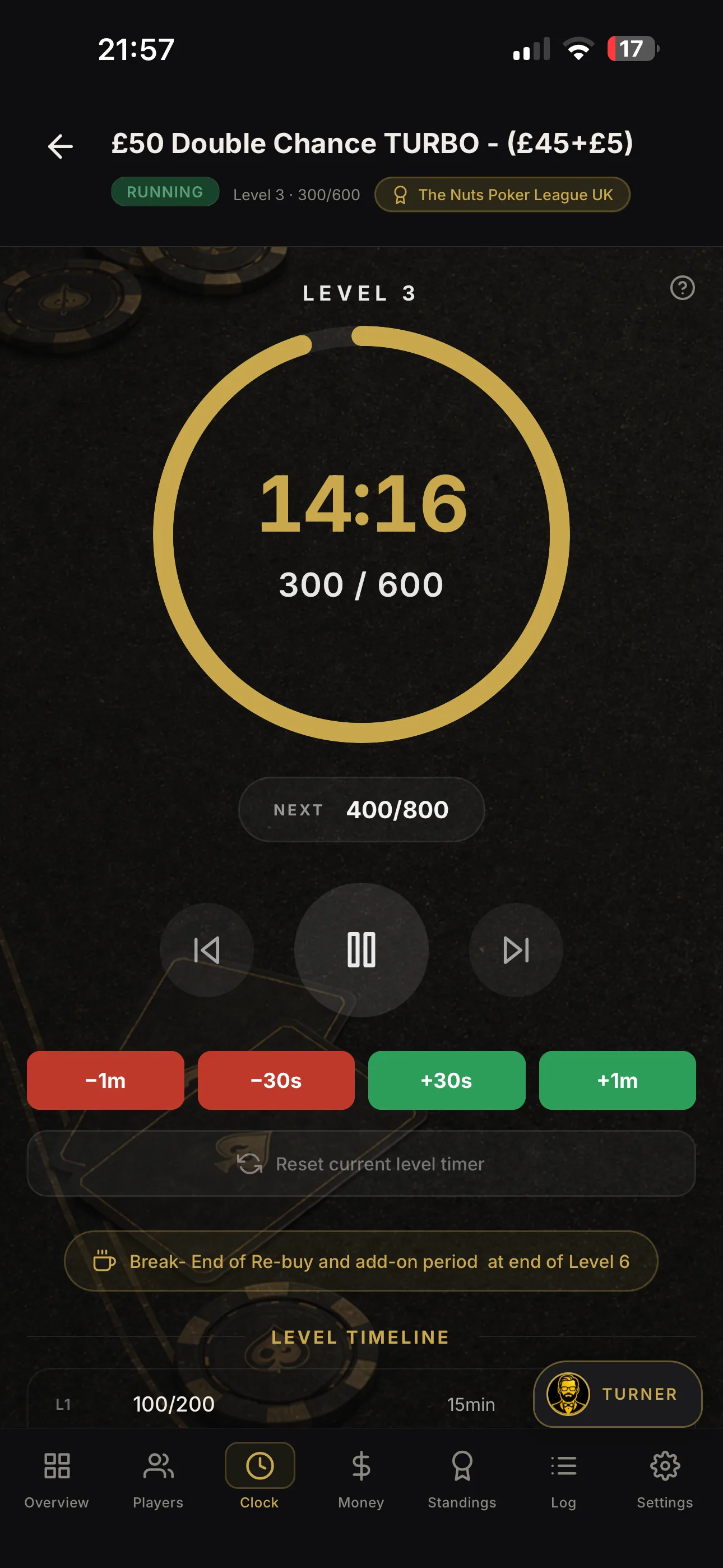
Seat draws, table balancing, the clock, payouts and league standings: Shuffle Up and Deal! runs the whole night from your iPhone or iPad.

Poker tournament bubble: stack rules for MTT players

The poker tournament bubble is the moment when one more player must be eliminated before everyone remaining is guaranteed a payout. Your entire decision-making framework should shift the instant you reach it: big stacks apply pressure, medium stacks protect equity, and short stacks prioritise survival above all else.
Here is the stack-size playbook at a glance:
- Big stack (25+ BB): Open wider, steal blinds aggressively, and target medium stacks who cannot call without risking elimination.
- Medium stack (10–25 BB): Avoid marginal confrontations, protect your equity, and wait for premium spots before committing chips.
- Short stack (under 10 BB): Shove or fold. Limping and calling are almost always wrong. Pick a hand and move.
Pro Tip: The single most profitable adjustment on the bubble is not tightening your own range - it is identifying which opponent is most terrified of busting and making their life miserable with relentless late-position opens.
Key takeaways
The bubble is the highest-leverage moment in any tournament: big stacks should apply pressure, medium stacks should protect equity, and short stacks should shove or fold with no middle ground.
- Big stacks: Open wide from late position, target medium stacks, and avoid calling off large portions of your stack against short-stack shoves unless you hold a premium.
- Medium stacks: Fold marginal hands, avoid 3-bet bluffs, and shove only with hands that have genuine equity and blocker value.
- Short stacks: Shove or fold. Prefer high-card hands with blocker value over suited connectors that need postflop play to realise their equity.
- Post-bubble: Tighten your calling range immediately, let short stacks collide, then shift to value-heavy accumulation.
- Track it all: Use Shuffle Up and Deal!'s blind clock, payout tracking, and in-app ICM calculator to monitor bubble zones in real time and practise decisions between sessions.
Table of Contents
- What the poker tournament bubble is and when it occurs
- Why the bubble fundamentally changes every decision you make
- Concrete stack-based rules for big, medium, and short stacks
- How to play the most common bubble spots
- What changes the moment the bubble bursts
- Common bubble mistakes and how to avoid them
- Tools and drills to sharpen your bubble decisions
- The bubble is not the moment to play safe - it is the moment to play smart
- Key takeaways
- Sources
What the poker tournament bubble is and when it occurs
Tournaments commonly pay roughly the top segment of entrants, and the bubble is the precise point when one or a few more players must be eliminated before the remaining field locks up a payout. In a 100-player field paying some of the top players, the bubble sits at eleven players remaining. Player eleven is “on the bubble” - one hand away from leaving empty-handed.
There are several distinct bubble types worth recognising.
The money bubble is the most familiar: the last elimination before the entire remaining field cashes. The final-table bubble occurs when, say, ten players remain and only nine advance to the televised or featured final table, creating a secondary ICM pressure point even for players already in the money. Soft bubbles appear at significant pay jumps within the payout structure - moving from the minimum cash to a meaningful prize, or from a mid-tier payout to a top-three finish. Each soft bubble behaves mathematically like a mini money bubble and deserves the same strategic respect. You can read more about how these structures interact with payout design in mystery bounty poker formats, where soft bubbles are especially pronounced.
The stone bubble (sometimes called the hard bubble) is the moment when the field is literally one elimination away from the money. Tournament directors call hand-for-hand play at this point: every table plays exactly one hand simultaneously before the next begins, preventing a slow table from stalling while a short stack busts elsewhere. As a player, this is your signal that the pressure is at its peak. Play tightens noticeably, limping increases, and confrontations between big stacks become rare. Recognising hand-for-hand as a strategic trigger - not just an administrative procedure - is what separates experienced players from those who simply wait it out.
Why the bubble fundamentally changes every decision you make
Standard chip-EV thinking tells you to call a shove if you are getting the right price. ICM tells you that chips you lose are worth more than chips you gain near a pay jump, which means many calls that look profitable in a cash game become clear folds in a tournament.
The concept that captures this precisely is the bubble factor. Bubble factor measures how much worse it is to lose your stack than to win an equivalent number of chips near the money and it explains why shoving for fold equity so often outperforms calling on the bubble. When you shove, you risk elimination only if called and you lose. When you call a shove, you risk elimination the moment the cards are dealt. Shoving gives you the option of winning without a showdown; calling removes that option entirely.
A simplified example makes this concrete. Suppose you hold a hand with 55% equity against a shover’s range. In a cash game, calling is straightforward. On the money bubble, the ICM cost of busting - losing all future payout equity - can easily outweigh that 5% edge, flipping the decision to a fold. The deeper the pay jump, the larger the bubble factor, and the wider the gap between chip-EV and tournament EV.
Key principle: Near the money, the question is rarely “do I have equity?” It is “do I need to risk my tournament life to realise that equity?”
Key reasons why ICM reshapes bubble decisions:
- Chips gained do not increase your payout proportionally; chips lost can eliminate your payout entirely.
- Every player who busts increases the value of every remaining stack, even if you win zero chips.
- Calling all-ins concentrates risk; shoving distributes it by inviting folds.
Pro Tip: When facing a shove decision, ask yourself whether folding still leaves you with enough chips to apply pressure. If yes, folding is almost always the higher-EV play unless you hold a premium hand.
Concrete stack-based rules for big, medium, and short stacks
Stack size is the single most important variable in bubble strategy. The same hand played from different stack depths can require completely opposite actions.
| Stack band | BB range | Primary objective | Typical action |
|---|---|---|---|
| Short stack | Under 10 BB | Survive or double up | Shove or fold only |
| Medium stack | 10–25 BB | Protect ICM equity | Avoid marginal spots, wait for premiums |
| Big stack | 25+ BB | Accumulate and pressure | Open wide, 3-bet shove, steal relentlessly |
Big stacks: the aggressor’s mandate
Big stacks should loosen opens and apply consistent pressure, particularly against medium stacks who face the highest ICM pain. From the button or cutoff, open with a range that includes suited aces, broadway hands, and suited connectors - but be selective when calling re-shoves. A big stack that calls off 40% of its chips against a short-stack shove and loses is no longer a big stack. The power is in the threat, not the call.

A late-position open to 2.2–2.5x against a medium stack in the big blind is one of the most profitable plays on the bubble. The medium stack cannot call without significant ICM damage, and cannot shove without a premium hand. You collect the blinds at a high frequency.
Medium stacks: the ICM pressure cooker
Medium stacks sit in the most uncomfortable position. They have enough chips to survive a few orbits but not enough to absorb a bad call. The correct response is patience: fold marginal hands, avoid 3-bet bluffs, and look for spots where you can shove with genuine equity rather than pure fold equity. Hands like A-J and K-Q become shove candidates from late position when the action folds to you, but calling a big-stack open with them is often a mistake.
Short stacks: shove or fold, nothing in between
Under 10 BB, the maths are unambiguous. Open-limping bleeds chips and signals weakness. Calling a raise and then folding the flop is a disaster. The correct strategy is to identify a hand with reasonable equity - any ace, any pair, K-x suited, Q-J - and shove it from any position before the blinds eat you alive.
Suited connectors lose practical value on the bubble because their strength comes from postflop play that rarely materialises when you are short. High-card hands with blocker value - A-x in particular - are comparatively stronger because they reduce the likelihood that an opponent holds a premium calling hand. An A-7 offsuit shove from the small blind is often correct when a 7-4 suited shove is not.
Pro Tip: When shoving with a blocker hand like A-x, you are not just hoping for fold equity - you are mathematically reducing the chance your opponent wakes up with A-A or A-K. That blocker effect is real and measurable.
For a deeper look at how chip denominations and blind structures interact with these stack bands, the poker chip breakdown guide is worth reading before your next tournament.
How to play the most common bubble spots
Open-shoving from late position
The most common short-stack spot: action folds to you in the cutoff or on the button with 8–12 BB. Shove any pair, any ace, K-x suited, and broadways. Against a tight big blind who is protecting ICM equity, your fold equity is enormous. See this in action with a short-stack shove example from Railbird’s public hand replays.
Facing a big-stack shove
When a big stack shoves over your open, the calling threshold tightens dramatically. Medium stacks should call only with hands that dominate the big stack’s range: A-K, A-Q, and pairs above sevens. Folding A-J to a big-stack re-shove is not weakness - it is correct ICM play.
Big blind defence
The big blind is the one position where you get a discount to see a flop, but on the bubble that discount rarely justifies calling with speculative hands. Against a late-position open from a big stack, fold suited connectors and low pairs. Call or shove with hands that have strong equity and blocker value: A-x, K-Q, and medium pairs.
Small-pot pressure plays
Big stacks can extract enormous value from small-pot pressure: open, continuation-bet small on a dry board, and take the pot when a medium stack folds rather than risk their tournament life. These pots add up quickly and cost almost nothing in ICM terms.
Common bubble spots and recommended actions:
- Short stack, late position, 8 BB: Shove any ace, any pair, K-x suited.
- Medium stack facing a big-stack open: Fold marginal hands; 3-bet shove only with premiums.
- Big stack, button, medium stack in BB: Open 2.2x; fold to a shove unless you hold a premium.
- Big blind facing a late-position open: Call or shove with A-x and pairs; fold suited connectors.
Play tightens close to the money and loosens immediately after the bubble bursts - so the reads you build during the bubble phase are only useful for a short window. Act on them while they last. For a deep-stack squeeze example that mirrors big-stack bubble aggression, the Railbird deep-stack hand is a useful reference.
What changes the moment the bubble bursts
The shift is immediate and dramatic. Players who were folding every hand suddenly shove with marginal holdings. Short stacks who survived by folding now have nothing left to protect and move all-in at the first opportunity. The table dynamic that rewarded patience for the last thirty minutes evaporates in a single hand.
Key adjustments to make straight after the bubble:
- Short stacks: Expect them to shove wide. Tighten your calling range accordingly; do not call off a big chunk of your stack against a range that now includes any two cards.
- Medium stacks: Re-evaluate your ranges upward. Hands you folded on the bubble - suited connectors, small pairs - regain their value now that postflop play is back on the table.
- Big stacks: Shift from indiscriminate aggression to selective accumulation. Continuing to steal every pot when short stacks are shoving into you is how big stacks bleed chips unnecessarily.
Pro Tip: The two or three hands immediately after the bubble bursts are among the highest-variance in any tournament. Avoid marginal gambles in that window. Let the short stacks collide with each other, then pick your spots.
Common bubble mistakes and how to avoid them
Many amateurs over-tighten on the bubble while experienced players widen their stealing ranges to exploit that fear. Both extremes are costly. The goal is calibrated aggression based on stack size, not a blanket policy of tightening or loosening.
Common errors and their fixes:
- Over-tightening as a medium stack: Folding every hand to avoid busting is itself a leak. Blinds erode your stack until you have no fold equity left. Pick spots and shove with hands that have genuine equity.
- Calling too wide as a big stack: Calling a short-stack shove with K-J and busting them is fine. Calling a medium-stack shove with K-J and losing half your stack is a disaster. The asymmetry matters.
- Cash-game mindset: Pot odds that justify a call in a cash game often do not justify one on the bubble. ICM changes the maths. If you find yourself thinking “I’m getting 2-to-1, I have to call,” pause and factor in what busting costs you in payout equity.
- Speculating to accumulate: Calling a raise with 7-6 suited because “I could flop a monster” is a bubble leak. Realised playability is reduced when you cannot call a continuation bet without risking your tournament life.
Pro Tip: If you feel the urge to “just min-cash and reassess,” that instinct is costing you EV. The correct goal is to accumulate chips through the bubble, not merely survive it. Survival and accumulation are not opposites - the right shove achieves both.
Tools and drills to sharpen your bubble decisions
Practice is where bubble instincts are built. A few targeted drills will improve your decision speed and accuracy faster than any amount of passive reading.
Recommended tools and practice routines:
- ICM calculators: Use a dedicated ICM calculator to input stack sizes, payout structures, and hand ranges. Run the same spot with different stack sizes to see how the bubble factor shifts. The independent chip model explained on the Shuffle Up and Deal! blog is a solid starting point.
- Hand history review: After every tournament, flag every bubble hand where you were unsure. Review the decision against ICM-correct ranges, not just chip-EV.
- Railbird public hand replays: Study real hands from Railbird’s hand replay library to see how experienced players navigate shove/fold decisions in practice.
- Shuffle Up and Deal!’s in-app ICM calculator: The Shuffle Up and Deal! app includes built-in ICM and deal calculators, a live blind clock, and payout tracking - so you can run real-time ICM checks during your own tournaments and track exactly when bubble zones occur.
- Simulated shove scenarios: Set up a 9-player bubble scenario with a friend or training partner. Assign stack sizes, run ten shove/fold decisions each, and compare results against a solver or ICM calculator.
- Player stats and league tracking: Shuffle Up and Deal!’s player statistics and league management features let you log results across sessions, spot recurring leaks (do you consistently bust on the bubble?), and measure improvement over time.
Tournament directors benefit from Shuffle Up and Deal!’s seating and display features too - knowing which tables are approaching the bubble zone in real time removes the guesswork from hand-for-hand calls and keeps the room running smoothly.
The bubble is not the moment to play safe - it is the moment to play smart
The conventional advice on bubble play is “tighten up and survive.” That framing is half-right for short stacks and almost entirely wrong for everyone else. The bubble is not a moment to retreat; it is a moment when the entire table’s fear creates exploitable gaps that experienced players fill with well-timed aggression.
What the research and the maths actually support is a stack-first, ICM-aware playbook. The bubble factor does not tell you to fold everything - it tells you that the cost of losing chips is asymmetric, which means the way you put chips at risk matters enormously. Shoving to generate fold equity is often the correct play precisely because it avoids the worst outcome: calling, losing, and busting. The player who understands that distinction has a structural edge over the entire table.
The part most players underestimate is the post-bubble window. Everyone focuses on surviving the bubble; almost nobody has a clear plan for the three to five hands immediately after it bursts. That window is where stack sizes shift dramatically and where a prepared player can accumulate chips that the unprepared player bleeds away in confusion.
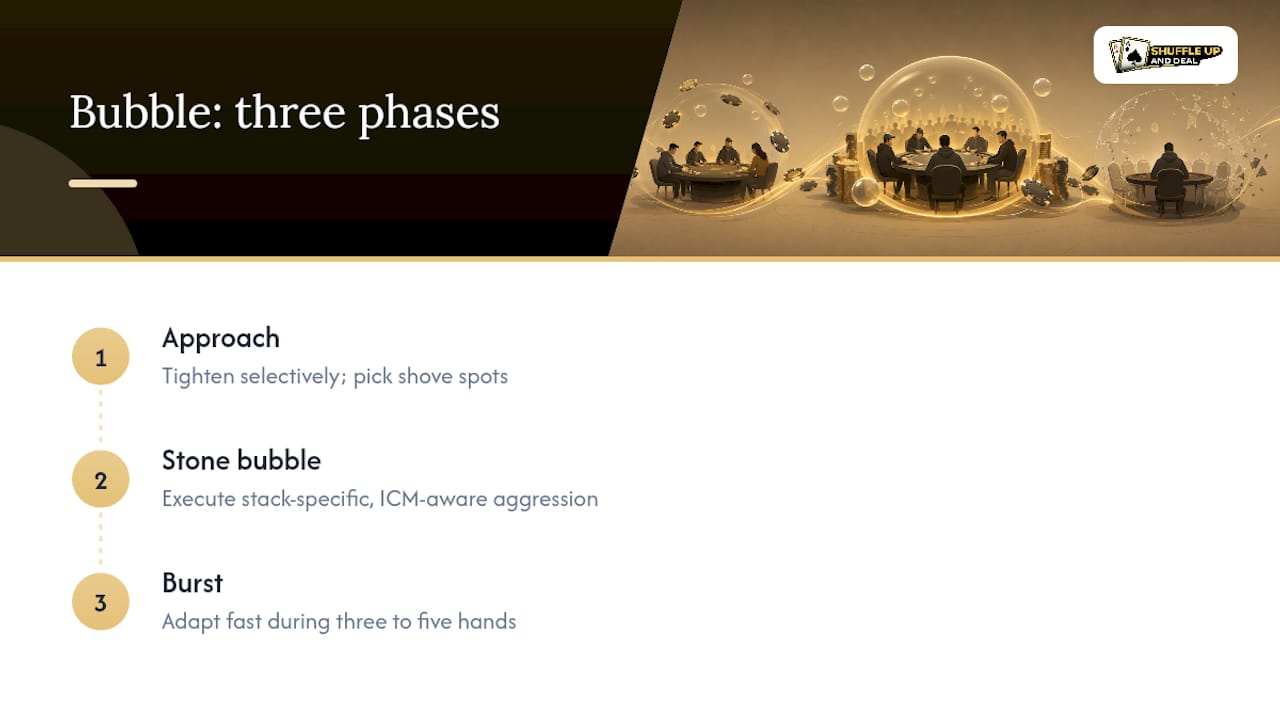
My honest recommendation: stop thinking about the bubble as a single moment and start treating it as a zone with three distinct phases - the approach (tighten selectively), the stone bubble (execute your stack-specific plan), and the burst (adapt fast). Players who manage all three phases outperform those who only manage one.
Key takeaways
The bubble rewards stack-aware, ICM-correct decisions: big stacks pressure, medium stacks protect, and short stacks shove or fold with no deviation.
| Point | Details |
|---|---|
| Define your stack band | Know whether you are big (25+ BB), medium (10–25 BB), or short (under 10 BB) before every decision. |
| Shove beats call on the bubble | Shoving generates fold equity and avoids risking your tournament life; calling removes that option entirely. |
| Blocker hands outperform suited connectors | A-x hands reduce opponents’ premium calling ranges; suited connectors need postflop play that rarely materialises short-stacked. |
| Adapt immediately post-bubble | Tighten calling ranges, let short stacks collide, then shift to value-heavy accumulation within a few hands. |
| Track bubble zones in real time | Use Shuffle Up and Deal!'s blind clock, payout tracking, and ICM calculator to monitor and practise bubble decisions. |
Sources
The sources below underpin this guide and are worth reading in full for anyone who wants to go deeper on ICM theory and bubble-factor maths.
- What is the Bubble in Poker? - Upswing Poker
- What Is The Bubble Factor In Tournaments? - PokerCoaching
- Poker
Poker involves variance and financial risk. If gambling is causing you concern, BeGambleAware offers free, confidential support.