
Poker Tournament Management App
Run Poker Tournaments Like a Pro!
From First Hand to Final Table
Seat draws, table balancing, the clock, payouts and league standings: Shuffle Up and Deal! runs the whole night from your iPhone or iPad.


Tournament series leaderboard: how to read and find standings

A tournament series leaderboard is a ranked, live-updating table showing every competitor’s points, placing, or score across a run of connected events, refreshed as results come in from each stage. It exists to answer one question at a glance: who is winning the series, not just today’s match.
Live leaderboards share a few common elements wherever you find them. Expect a rank, a points or score total, a live stage indicator (round, hand count, or map score), and an event identifier showing which leg of the series produced the latest movement. Miss any one of these and the table is a snapshot, not a leaderboard.
You’ll typically find these published through:
- Official tour or federation websites (golf tours, athletics bodies, cup competitions)
- Event microsites built for a single tournament weekend
- Dedicated apps that push live standings to a phone or tablet
- Shared links distributed by organisers directly to players and spectators
Poker leagues and home game circuits increasingly rely on organiser software to generate this last category. Tournament management platforms like Shuffle Up and Deal! calculate and publish series standings automatically as events conclude, so players see accurate points without waiting for a spreadsheet to circulate.
Key Takeaways
A trustworthy tournament series leaderboard combines automated points calculation, a published stage-factor and decay policy, and real-time syncing across every display players and fans actually check.
| Point | Details |
|---|---|
| Definition | A series leaderboard ranks competitors by cumulative points or score across connected events, refreshed live as results confirm. |
| Scoring formula | Base points by placing get multiplied by a stage factor, then adjusted for field strength and win bonuses. |
| Decay matters | Rolling windows or recalibration, as IBJJF and FIBA use, keep totals reflecting recent form rather than early-season luck. |
| Tie handling | Averaging tied points and publishing secondary tie-breakers in advance prevents most on-the-night disputes. |
| Organiser tooling | Shuffle Up and Deal! automates registration, seating, live clocks, and league scoring so leaderboards sync in real time across every device. |
Table of Contents
- What does a tournament series leaderboard look like in golf, poker and esports?
- How are ranking points actually calculated?
- What features do organisers need for live series leaderboards?
- Why do organisers recalibrate leaderboard points?
- How should players and fans follow a leaderboard during a live series?
- Why do real-time updates matter for series standings?
- How does series structure create separate tier leaderboards?
- How do event schedules feed into the overall leaderboard?
- How are leaderboard disputes and errors resolved?
- What technical problems come up when managing a series leaderboard?
- What are some well-known tournament series leaderboards?
- How have tournament leaderboard systems changed over time?
- A tournament director’s checklist for a leaderboard people trust
- Get your series leaderboard running properly with Shuffle Up and Deal!
- Sources
What does a tournament series leaderboard look like in golf, poker and esports?
Recognising a leaderboard format matters as much as understanding the maths behind it, because golf, poker, and esports each present the same underlying idea (accumulated performance across events) in a completely different visual language.
-
Golf leaderboards show round-by-round totals first, then aggregate tour standings across a season. A single event page updates hole-by-hole, with a running “to par” score, while the tour-level table converts finishing positions into ranking points that carry forward. World Athletics uses a broadly comparable two-factor structure, blending a performance score with a placing score, and golf’s major tours follow the same logic: how you finished matters, but so does the calibre of the field you beat.
-
Poker series leaderboards organise by tier and buy-in range far more explicitly than golf or esports tables do. A typical season leaderboard, such as the one run by the Ace & Jacks Poker League, lists Rank, Player, Points, Events Played, Average, and Wins side by side. That “Average” column matters more than casual players assume: a player who cashes twice in five events can outrank someone with three min cashes in twelve, because points per event, not raw totals, often decide close finishes. Prize-pool leaderboards add a further layer, ranking by total winnings rather than points, which produces a different order entirely.
-
Esports leaderboards run on match points and map or game win differentials, with playoff qualification lines drawn directly into the table. A team sitting third with a strong map differential can look more secure than one sitting second on match wins alone, because tie-breakers often favour game-level dominance over bare win counts.
Across all three, the elements to check before trusting a number are the same: is the total points or score, is it round/stage-specific or series-wide, and does the table show how many events have counted towards that figure? A leaderboard showing “8th, 340 points” tells you nothing useful without knowing how many rounds fed into that 340.
How are ranking points actually calculated?
Every credible leaderboard system runs on a formula, and the formula usually has four moving parts: a base points scale for where you finished, a stage or competition factor, an adjustment for the strength of the field, and rules for how points fade or refresh over time.
Base points by placing work exactly how you’d expect: first place earns more than second, second more than third, and so on down a published scale. What separates a fair system from a confusing one is what happens next.
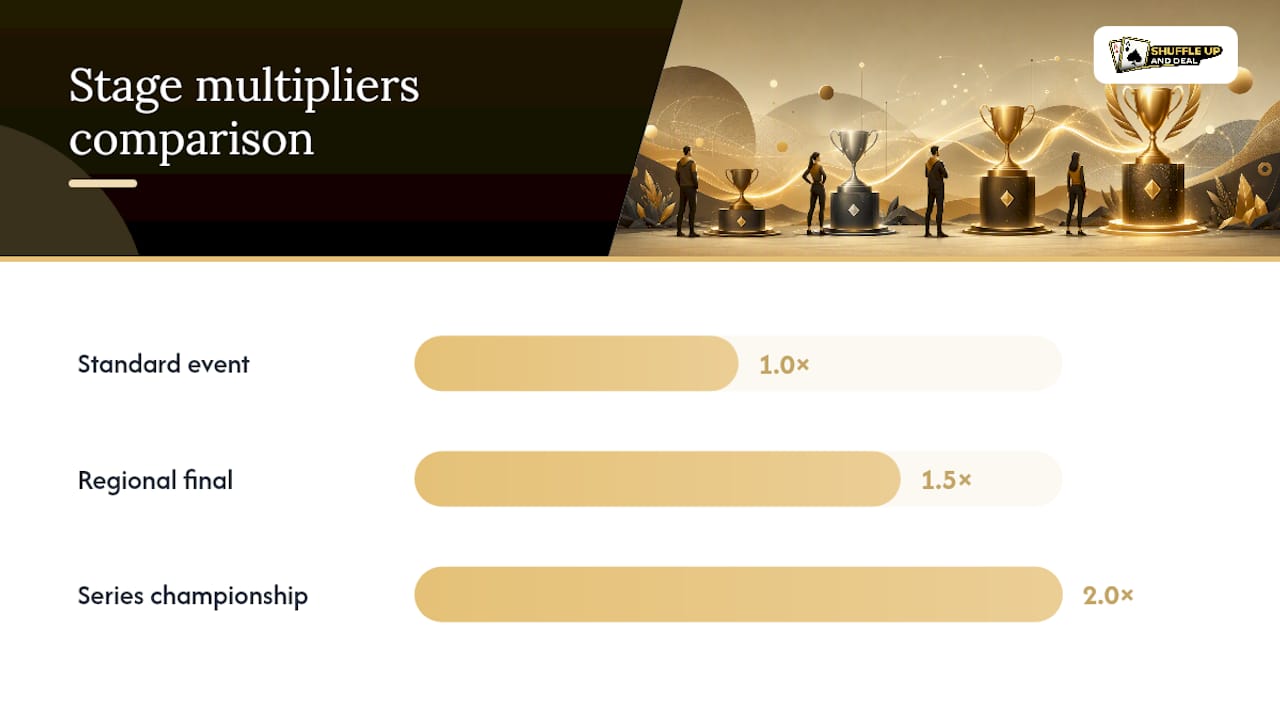
Stage factors multiply that base, and this is where series leaderboards diverge sharply from single-event scoring. FIBA’s ranking methodology applies competition stage factors and quantity/strength adjustments on top of base points, so a win in a marquee event is worth measurably more than the identical placing in a lower-tier heat. A well-designed system uses a small, clearly documented set of multipliers, commonly something like 1.0 for a standard event, 1.5 for a regional final, 2.0 for a series championship, so competitors can predict their point return before they even register.
Statistic: FIBA’s methodology explicitly combines base points, stage factors, and field-strength adjustments, then applies the same recalibration discount to every competitor before major phases, refreshing totals without disturbing the existing order. Read the full breakdown in FIBA’s world ranking methodology.
Rolling windows and point decay decide how much of your history still counts. Some series use a single-season model where every point resets to zero at year end. Others run multi-year windows: the IBJJF’s rolling system counts points from the current season plus the previous two, dropping anything older automatically. This matters practically because it rewards consistency over a lucky one-off run three years ago, while still giving competitors credit for recent form rather than a single weekend.
Opponent and field-strength functions adjust points based on who you actually beat. A poker series might weight points by the size of the field or the average buy-in tier in the room; an athletics event weights by the calibre of entrants using the same performance-and-placing hybrid World Athletics documents in its ranking rules.
Win bonuses and tie handling round out the system:
- A flat bonus is often added on top of base points for outright wins, separate from the placing scale
- Tied placings are commonly resolved by averaging: add the points allocated to all tied positions, divide by the number of tied players, and award that figure to each
- Two players tied for 4th/5th where those spots are worth 40 and 30 points respectively would each receive 35 points under this rule
- Multi-year cup formats, including Davis Cup, publish explicit stage-based win bonuses so competitors know exactly what a qualifier win versus a finals win is worth
What features do organisers need for live series leaderboards?
Running a leaderboard that people actually trust takes more than a spreadsheet and good intentions. It takes a defined workflow from registration through to the final published number.
The essentials break down into a handful of non-negotiable features:
- Player registration that ties a unique player ID to every event, so points attach correctly across a multi-leg series
- Smart seating and tier handling to keep buy-in brackets or divisions separated, preventing a micro-stakes result from bleeding into a high-stakes leaderboard
- Real-time sync across devices, so a table update on the floor reflects on the display screen and any shared link within seconds
- Live display and casting for tournament rooms, turning a spare screen or iPad into a dedicated standings board
- Tie resolution rules built into the scoring engine rather than handled manually after the fact
- ICM and pot-odds calculators for poker specifically, useful during final-table deal negotiations that can affect how points are ultimately allocated
Update frequency matters more than most organisers initially plan for. A push-based system, where the app sends updates the moment a result is confirmed, produces near-instant leaderboard changes. A pull-based system, where a display or website checks for updates on a timer, introduces latency, usually acceptable at intervals of five to thirty seconds for a live-display page, but frustrating if stretched much longer during a fast-moving final table.
Pro Tip: If you’re running a live display for a final table or leaderboard screen, keep the refresh interval under 30 seconds. Anything slower and players start checking their phones instead of the screen, which defeats the purpose of having a live display at all.
Automation earns its keep here by removing the manual re-entry that causes most leaderboard errors. A dedicated tournament management app reduces the calculation mistakes that come from copying numbers between a clock spreadsheet and a separate standings document, and it lets you sync multiple concurrent events without duplicating effort. Shuffle Up and Deal! builds this directly into its workflow: smart seating algorithms balance tables automatically, a live tournament clock keeps blind levels synced across every device in the room, and league management features carry points forward between events without a manual re-entry step. For organisers running a bounty structure alongside a series leaderboard, tools built for mystery bounty poker handle the extra prize tracking that standard scoring doesn’t account for.
Why do organisers recalibrate leaderboard points?
Recalibration sounds like a technical afterthought, but it’s the single feature that decides whether a series leaderboard still feels fair six months in. Left alone, cumulative points systems drift: early-season winners build a lead that becomes mathematically unassailable, and late-joining players have no realistic path to the top regardless of form.
Discounting solves this by applying an identical reduction across every competitor’s total at a fixed point in the calendar, typically ahead of a major phase or the start of a new season quarter. FIBA’s methodology does exactly this: the same discount hits every player’s total, so the leaderboard order doesn’t shift from the recalibration itself, but the absolute numbers shrink enough that recent results carry proportionally more weight again.
A leaderboard that never refreshes its own scoring window eventually stops measuring current form and starts measuring who joined first. Recalibration exists to keep the table honest about what “current” means.
Choosing a decay policy is a genuine trade-off, not a box-ticking exercise:
- A short window (single season) rewards hot streaks and keeps the leaderboard exciting week to week, but punishes players who peak early and fade
- A rolling multi-year window, as used in IBJJF’s ranking system, smooths out variance and rewards long-term consistency, at the cost of making the top of the table harder to shake up
- A hybrid that weights the current season heavily but keeps a smaller residual from prior years balances both, though it’s the hardest to explain to players in a single sentence
Tie handling deserves its own published rule, not an improvised decision on the night. Averaging tied placement points is standard practice: add the points for every position involved in the tie, divide by the number of tied players, and award the result to each. Secondary tie-breakers, head-to-head record, most events played, or best single finish, should be documented in advance, not decided after the fact when two players are actually tied for a qualifying spot.
Publishing the full methodology, and keeping an audit trail for any manual correction, is what separates a leaderboard people trust from one people quietly stop checking.
How should players and fans follow a leaderboard during a live series?
Following a series leaderboard well is a skill, not just a habit of refreshing a browser tab. Get it wrong and you either panic over noise or miss a genuine shift in your standing.
-
Watch through the right channel. Official tour sites and organiser apps are more reliable than third-party aggregators, which often lag by a round or more. A shared link from the organiser, common in poker leagues using tools like Shuffle Up and Deal!, is usually the fastest route to an accurate number.
-
Separate noise from signal. A single strong cash can jump you fifteen places on a leaderboard with only three events counted so far; the same jump six events into a twelve-event series means far more, because there’s less schedule left to correct for it.
-
Plan buy-ins around the schedule, not the moment. If a series rewards event count or average finish, chasing every event to “stay visible” on the leaderboard can actually hurt your average more than sitting one out.
-
Set alerts where the platform allows it. Live share links and app notifications beat manually refreshing a webpage, particularly during multi-table events where standings shift every few minutes.
-
Verify before you celebrate or panic. Cross-check a sudden move against the official standings page before assuming it’s final. Provisional in-progress totals and confirmed post-event totals are not always the same number.
Why do real-time updates matter for series standings?
A leaderboard that updates once a day isn’t a live leaderboard, it’s a summary. The value of real-time updates comes from what they let people do in the moment: a player deciding whether to register for a final flight, a rail deciding whether to keep watching, a tournament director confirming payouts match the published standings before players leave the room.
Auto-refreshing displays work best when the update interval matches how fast the underlying event actually changes. A golf leaderboard tracking hole-by-hole scoring needs updates measured in minutes. A poker final table nearing the bubble needs something closer to instant, because eliminations and re-seats change the standings picture within seconds. Esports match trackers sit somewhere between the two, updating on map completions rather than continuously.
The technical backbone behind this is usually one of two models. Push-based systems send an update the instant a result is confirmed, which is how most modern tournament software handles live displays. Pull-based systems have the display check for changes on a timer, introducing a small lag that’s barely noticeable at short intervals but becomes obvious once you stretch beyond a minute or so.

For organisers, the practical lesson is straightforward: multi-device syncing isn’t a luxury feature, it’s what makes real-time actually real. A clock update, a table balance, or an elimination needs to reach every connected display and shared link simultaneously, or players start seeing conflicting numbers depending on which screen they’re looking at.
How does series structure create separate tier leaderboards?
Most tournament series aren’t a single leaderboard at all, they’re several leaderboards running in parallel under one banner, split by tier, division, or buy-in bracket. Treating them as one table produces nonsense results, which is why serious organisers separate them deliberately.
A poker league running weekly events at $20, $60, and $150 buy-ins typically maintains three distinct leaderboards, not one blended table. Combining them would let a player who only ever enters the cheapest events outrank someone competing consistently at the top tier, simply because the point totals were never designed to be compared across brackets. IBJJF’s ranking structure follows the same logic across weight divisions and belt levels, keeping each category’s points separate so a result in one division never inflates standing in another.
Esports series apply the same principle through regional and divisional splits: a team’s placement in a regional qualifier feeds a regional leaderboard first, with only the top finishers carrying points into a global or championship-level table. Golf tours run comparable tiering between developmental circuits and the main tour, where points don’t simply transfer one-to-one.
For organisers building this structure, the practical requirement is a scoring system that tags every result with its correct tier from the moment it’s entered, rather than sorting it out afterwards. Get the tagging wrong at registration and the cleanup afterwards is far messier than setting it up correctly from the first event.
How do event schedules feed into the overall leaderboard?
A series leaderboard is only as good as the schedule feeding it, and the schedule itself usually carries its own hierarchy of importance. Not every event on a calendar is worth the same to the standings.
Most series designate certain legs as headline or “majors” events, carrying a heavier stage factor than routine weekly or monthly stops. The Disc Golf Pro Tour publishes live standings that update across a published season calendar, letting players and fans see exactly which events remain and how the table might shift before the season closes. That visibility matters: a player sitting fourth with two counted events left has a genuinely different position than one sitting fourth with the whole season already banked.
Highlighted or marquee events typically do double duty, they draw a stronger field, which itself increases the points on offer under most field-strength adjustment models, and they often sit near the calendar’s midpoint or close, giving them outsized influence on the final table. A poker series that runs a “Championship” or “Main Event” as its closing leg is deliberately engineering a bigger swing at exactly the moment fans are paying closest attention.
For anyone following a series, checking the schedule alongside the leaderboard tells you something the points total alone can’t: how much of the season is actually left to fight for. A commanding lead with three events remaining reads very differently from the same lead with one event to go.
How are leaderboard disputes and errors resolved?
Errors happen, a miscounted chip stack, a mistyped result, a player entered under the wrong tier, and how an organiser handles the correction matters more to trust than the mistake itself.
The standard approach starts with a documented correction window: a published period after results go live during which players can flag a discrepancy before the standings are treated as final. Beyond that window, changes typically require sign-off from a tournament director rather than a unilateral edit, and a genuinely trustworthy system keeps an audit log of every manual change, who made it, when, and why, rather than silently overwriting a number.
Disputes usually fall into one of three categories. A data entry error (wrong finishing position, wrong buy-in tier) gets corrected against the physical or digital record of the event itself. A rules interpretation dispute (was a late-registration entry eligible for series points?) needs a clear published rulebook to resolve quickly, which is exactly the gap that rules-assistance tools aim to close, an app built for interpreting tournament rules can settle an on-the-spot question before it escalates into a leaderboard dispute after the fact. A methodology disagreement (should this event’s stage factor really be 2.0?) should never be settled mid-series, it’s a governance decision that belongs in the published rules before the season starts.
The organisers who avoid repeated disputes are, without exception, the ones who published their tie-breaking and correction rules in advance rather than improvising them under pressure.
What technical problems come up when managing a series leaderboard?
Running a leaderboard across dozens of events surfaces the same handful of technical headaches again and again, regardless of the sport.
Duplicate or mismatched player records top the list. A player registering under a slightly different name spelling, or a nickname one week and a legal name the next, splits their points across two identities and silently understates their true position. The fix is a unique player ID assigned at first registration and reused every time, rather than matching on name text.
Sync conflicts across devices cause the second most common headache: a tournament director updating results on a laptop while a floor staff member updates the same event on a tablet can create a race condition where one update overwrites the other. Multi-device syncing needs a single source of truth, with every connected screen pulling from it rather than each device holding its own copy.
Latency between event conclusion and leaderboard update frustrates fans more than almost anything else, particularly when a shared link is meant to show near-live standings but actually lags by several minutes because someone forgot to trigger the sync.
Tier or bracket misclassification at data entry, discussed above in the context of series structure, causes standings errors that only surface when someone actually checks the maths on a mid-table position.
Software built specifically for tournament management, rather than a general spreadsheet, addresses most of these by design: unique IDs, single-source syncing, and automated point calculation remove the manual steps where these errors typically creep in.
What are some well-known tournament series leaderboards?
Looking at how established series structure their leaderboards is genuinely useful groundwork before designing or following your own. A few patterns repeat across very different sports.
Golf’s major tours run tour-wide points leaderboards that convert weekly event finishes into a cumulative season total, with a small number of marquee events carrying extra weight toward end-of-season standings and qualification. The structure rewards both consistency across a full season and standout performances at the biggest stops.
In poker, home game and card room leagues frequently publish season-long tables in a format close to the Ace & Jacks Poker League’s overall leaderboard, tracking rank, points, events played, average finish, and win count side by side. This format has become something of a template because it gives players multiple ways to judge their own standing, not just a single points figure.
Esports leaderboards for major regional and global circuits typically separate qualifier standings from championship-stage standings, only feeding a subset of qualifier results into the leaderboard that actually determines playoff seeding. Combat sports organisations like IBJJF run belt-and-weight-division leaderboards using rolling multi-season windows, a structure increasingly borrowed by other individual-competitor sports looking to reward sustained form over a single big result.
Some entertainment-adjacent leaderboards, like the standings pages run by Megasports Arena for its games format, show how the same live-table principles extend beyond formal competitive sport into casual and semi-competitive play.
How have tournament leaderboard systems changed over time?
Leaderboards used to mean a whiteboard, a marker pen, and a tournament director doing mental arithmetic between rounds. That era isn’t as distant as it sounds, plenty of home games and small card rooms still ran this way well into the last decade, and the shift away from it happened faster than most other parts of tournament management.
The first major change was digitisation of the display, moving from a physical board to a projected or printed sheet, which solved visibility but did nothing for accuracy. The second, more consequential shift was automated calculation, where a spreadsheet or dedicated system applied a fixed points formula instead of a director doing the sums by hand under time pressure. This is where most of today’s stage-factor and field-strength models originated, formalising rules that experienced directors had been applying informally for years.
The most recent shift is live syncing and public accessibility. Where a leaderboard used to exist only on a screen physically inside the venue, share links and dedicated apps now put the same live table in front of a player’s phone or a fan’s browser anywhere in the world, updating within seconds of a result being confirmed. Governance has matured alongside this: published methodologies, documented recalibration policies, and audit trails for corrections, once rare outside major federations, are increasingly standard practice even for mid-sized poker series and regional golf tours.
What hasn’t changed is the underlying goal: a number that fairly reflects who is actually winning, updated fast enough that it still means something when you check it.
A tournament director’s checklist for a leaderboard people trust
Having worked through how these systems are built and where they tend to break, a pattern becomes obvious: the leaderboards that earn trust are never the most complicated ones, they’re the most consistently documented ones. Players forgive a strict rule far more readily than they forgive an inconsistent one applied differently from week to week.
Before publishing a series leaderboard, run it against six checks:
- Clarity - can a new player understand the points formula in under a minute of reading?
- Automation - is the scoring calculated by software rather than manual entry, removing the human error that erodes trust fastest?
- Public methodology - is the full scoring model, including stage factors, published somewhere players can actually find it?
- Recalibration policy - is there a documented decay or discount schedule, stated before the season starts, not decided reactively?
- Tie rules - are averaging and secondary tie-breakers written down in advance?
- Display - does the leaderboard actually reach players and fans in real time, via a screen, a share link, or both?
Get all six right and disputes drop sharply, because most leaderboard arguments aren’t really about maths, they’re about a rule nobody wrote down. Shuffle Up and Deal! was built around exactly this checklist, handling the automation, syncing, and league management pieces so the documentation is the only part left to you.
Get your series leaderboard running properly with Shuffle Up and Deal!
Running a fair, live series leaderboard by hand means juggling a spreadsheet, a clock, and a seating chart across every single event, and the moment one falls out of sync with the others, players notice. Shuffle Up and Deal! puts all of it on one iPhone and iPad platform, so the leaderboard updates the instant a result does, not whenever someone finds time to update a formula.

The features map directly onto the checklist above: smart seating algorithms keep your tiers separated automatically, the live tournament clock syncs blind levels across every connected device, and league management carries points forward between events without a single manual re-entry. Live share links let players and rail-watchers follow standings from their phones in real time, while built-in ICM and pot-odds calculators support final-table decisions that can affect the leaderboard itself. If your series runs multiple divisions, the league season planning guide walks through structuring scoring windows before your first event even starts.
Shuffle Up and Deal! offers a free forever plan alongside paid tiers that unlock higher usage limits and advanced features as your series grows. Start setting up your next event and see how quickly an automated leaderboard replaces the spreadsheet chaos.
Sources
- IBJJF athlete ranking info
- FIBA world ranking methodology (how it works)
- World Athletics world ranking rules - basics
- Davis Cup rankings explained