
Poker Tournament Management App
Run Poker Tournaments Like a Pro!
From First Hand to Final Table
Seat draws, table balancing, the clock, payouts and league standings: Shuffle Up and Deal! runs the whole night from your phone or tablet.



Finish tournament series scheduling in 20 minutes for organizers

Pick your format, declare your constraints, auto-generate the draw, then validate before you publish. That order matters more than any single tool you use. Constraint-driven schedulers and apps such as Shuffle Up and Deal! exists precisely because manual conflict resolution eats hours that organisers rarely have to spare, and following this four-step sequence gets a fair, workable schedule finished in one sitting.
TL;DR:
- Large tournament series should use a Swiss or pools plus knockout format to balance match volume and logistical complexity.
- Proper constraint encoding-venue availability, rest times, blackout dates, and seed protection-is crucial to avoid schedule conflicts during generation.
- Validation before publishing is essential; fixing clashes early saves time and maintains trust, especially for series spanning multiple venues.
- Using the right tools, from local generators to constraint solvers and visual editors, significantly speeds up schedule creation for complex setups.
- Publishing real-time updates, consistent scoring, and live resource links help ensure transparency and trust among players throughout the event.
Table of Contents
- Which format fits your tournament series?
- How do you build a tournament series schedule step by step?
- Why do schedules fail, and which constraints matter most?
- Turning rounds into a real timetable
- What tools actually speed this up?
- Publishing schedules and keeping standings current
- What I’ve learned from organisers who get this wrong
- Get your series scheduled without the spreadsheet chaos
- Sources
Which format fits your tournament series?
The format decision drives everything downstream, so make it before you touch a spreadsheet or an app. Get it wrong and you’ll be rebuilding the whole timetable at step three.
- Round robin: everyone plays everyone. Fair, but it scales badly. This only works well for small fields or shorter series legs, as the number of matches grows quickly with more entrants.
- Swiss system: pairs players with similar records each round instead of playing every combination. It handles large fields well and finishes in far fewer rounds than a full round robin, which is why chess and many poker leagues lean on it.
- Single or double elimination: fast and dramatic, ideal when you need a winner in a fixed window, but a bad early draw can knock out a strong player after one bad beat. Double elimination softens that risk with a losers’ bracket.
- Pools then knockout: group stages that seed a smaller bracket. This is the standard for larger multi-day series because it guarantees everyone a minimum number of games before elimination bites.
As a rule of thumb, round robin suits small entrant numbers, Swiss handles mid-sized fields where a full round robin is impractical, and pools plus knockout are common for larger series spanning multiple venues or days. For multi-leg or home-and-away formats, the circle method generates deterministic fixtures that balance who plays where and hands out byes automatically when your entrant count is odd.
How do you build a tournament series schedule step by step?
Treat this as a checklist you run through once per series, then reuse for each new season.
- Collect your inputs first. List entrants, expected match length, available venues, blackout dates, and your points or payout rules. Skipping this step is the single biggest cause of a schedule that has to be rebuilt halfway through.
- Declare your stage plan. Decide how many rounds or legs each stage runs, how many qualifiers advance, and whether late registration or rebuys affect early rounds.
- Encode your constraints and pick a generation strategy. Round robin uses the circle method, larger open fields usually need a Swiss engine, and bracket-based formats need seeding rules decided in advance, not on the fly.
- Generate a candidate schedule and run it through validation. Check for venue clashes, rest-period breaches, and seed protection failures before you commit to anything.
- Iterate, then export and share. Adjust the constraints that caused failures, regenerate, and once the schedule passes validation, publish it and distribute the share link.
Constraint-driven schedulers report exactly where a schedule fails and use backtracking or optimisation to search for a valid alternative rather than leaving you to spot the clash yourself. That single feature is the difference between a schedule that takes twenty minutes and one that takes an afternoon.
Pro Tip: Run your validation pass before you tell players anything. A schedule that gets revised twice in the first week erodes trust faster than one that arrives a day late but correct.
Why do schedules fail, and which constraints matter most?
Most schedule failures trace back to a handful of repeat offenders. Venue conflicts top the list: two matches booked into the same room at the same time, usually because a blackout date wasn’t logged before generation ran. Rest-period breaches come next, where a player or table is scheduled back to back with no recovery window. Seed protection failures follow, where top seeds meet far earlier than the bracket design intended. Shared-facility clashes round it out, common in series that split games across multiple rooms or partner venues on the same calendar day.
Typical constraints worth encoding before you generate anything:
- Venue and room availability, including shared or partner facilities.
- Minimum rest periods between a player’s matches or a table’s turnover.
- Maximum games per day, per player and per venue.
- Blackout dates for holidays, other bookings, or staff availability.
- Seed protection rules that keep top performers apart until later rounds.
Commercial scheduling platforms typically handle constraint types like these and use optimisation to resolve them in seconds rather than hours. When generation still fails after you have declared every constraint, the fix usually isn’t more manual editing. Relaxing one or two of your highest-cost constraints, rather than hand-adjusting each individual clash, tends to unlock a valid schedule faster and with fewer downstream surprises.
Turning rounds into a real timetable
A round number on a bracket means nothing until it becomes an actual time, on an actual table, on an actual day. This is where organisers underestimate the work, because a schedule can pass every fairness check and still fail in practice if the venue only has three tables and you’ve booked five concurrent matches.
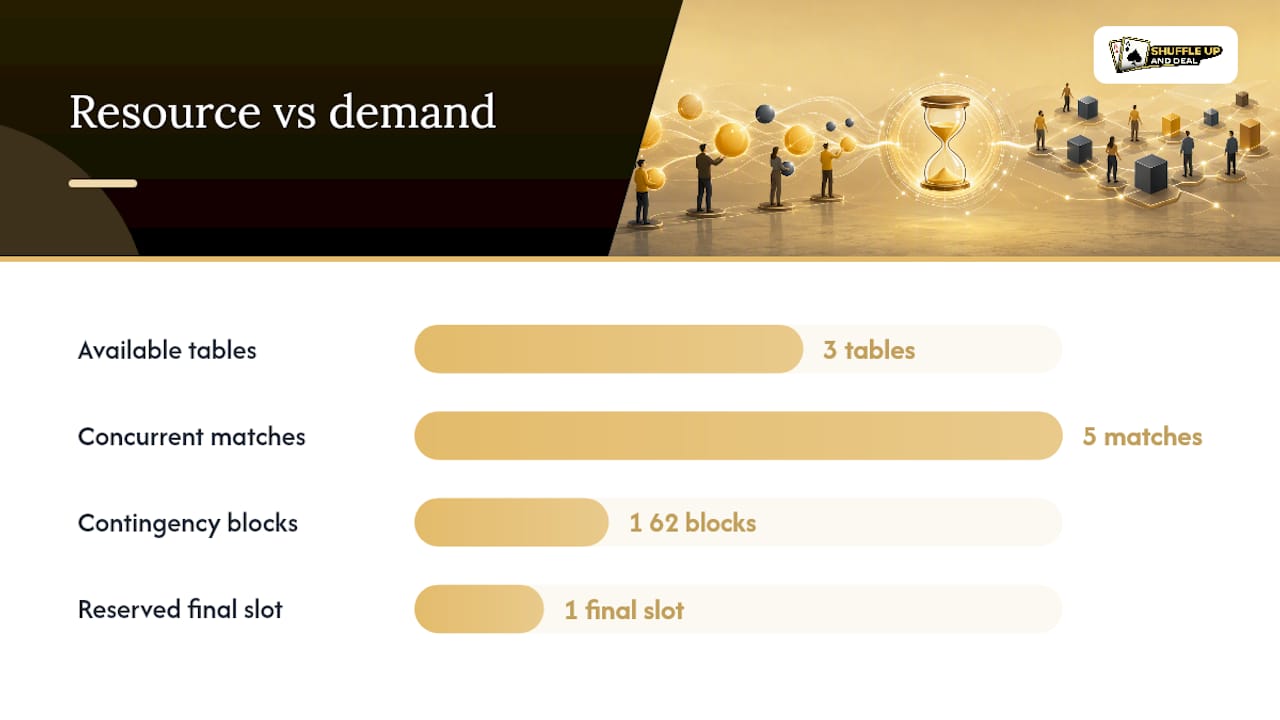
Think of it as a slot by resource grid: each time slot maps to a specific table, room, or streaming station, and no resource can hold two matches at once. Visual scheduling engines built on this slot and resource model flag overlaps instantly and let you drag a match to a new slot without breaking everything else around it.
Build in buffers deliberately, not as an afterthought:
- Fifteen to thirty minutes between matches on the same table for player turnover and chip counts.
- Longer travel windows if your series spans multiple venues in one day.
- A reserved, untouchable slot for the final, so it never gets squeezed by an earlier match running long.
- One or two contingency blocks per day that absorb delays without cascading into the evening session.
Test the timeline the same way you’d test the format: run it past someone who wasn’t involved in building it and see where they get confused. A timetable that only makes sense to its author isn’t finished yet. For events split across catering, staff, and multiple rooms, the same run sheet discipline used in large venue operations applies directly to tournament floors.
What tools actually speed this up?
Three categories of tool cover most organisers’ needs, and picking the wrong one is usually what makes scheduling feel harder than it should be.
- Local generators, built around the circle method, are fast and keep player data private since nothing leaves your device. Deterministic local generation suits small round robins and home games well.
- Constraint solvers take your full rule set, venues, rest periods, blackout dates, seed protection, and search for a schedule that satisfies all of them, flagging anything that can’t be resolved.
- Visual editors sit on top of either approach, letting you drag matches between slots while the system checks for new conflicts in real time.
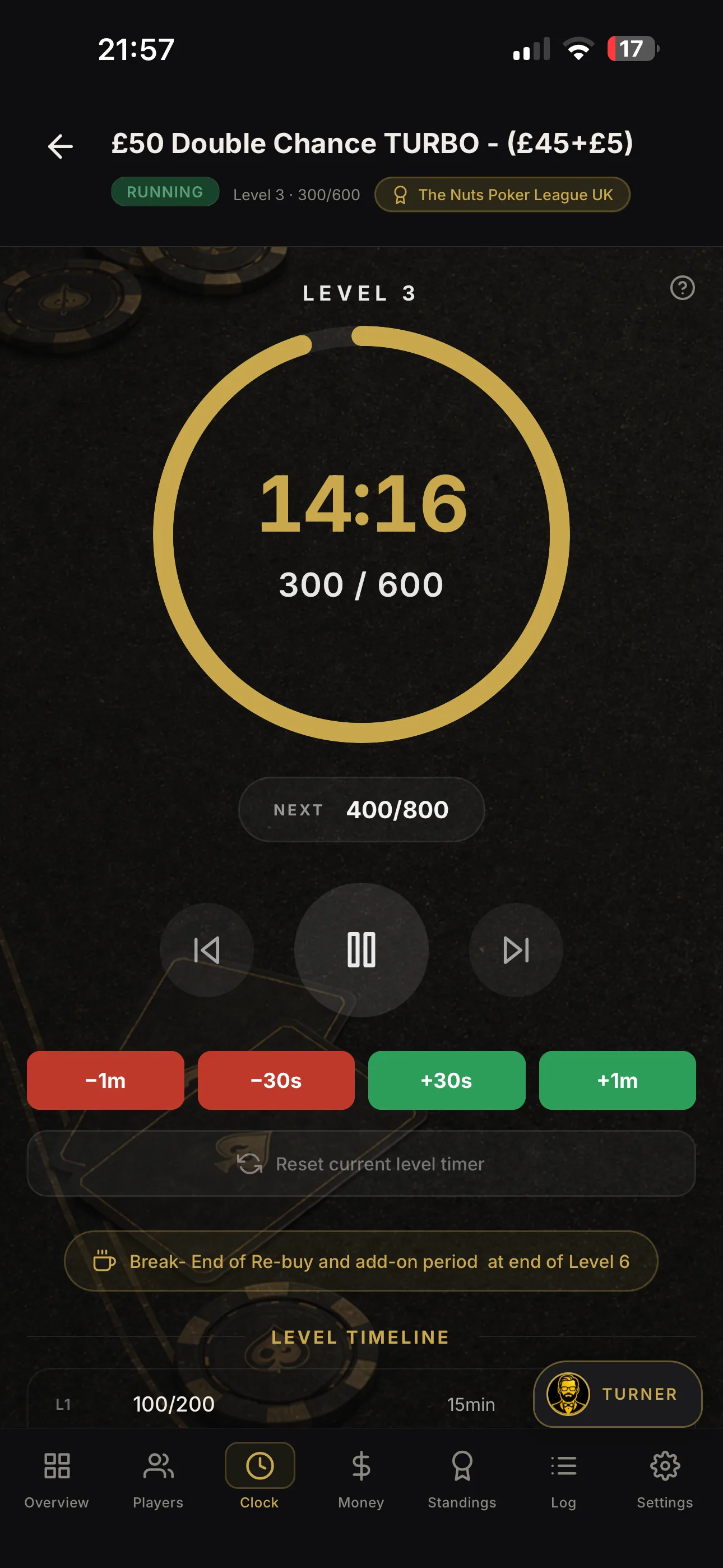
Shuffle Up and Deal! folds several of these stages into one workflow rather than making you stitch tools together. Smart seating removes manual table balancing as players bust or register late. The live tournament clock keeps blind levels synchronised across every table without a director shouting across the room, and points templates carry your series’ scoring rules from one event straight into the next.
A schedule is only as good as the resource it’s mapped onto. A grid that links every slot to a live result feed doesn’t just look tidy, it cuts down the stream of “what table am I on?” questions your front desk fields all day.
Use a simple generator for a one-off home game with eight players. Reach for a full solver with a timeline assigner once you’re running a multi-venue series with blackout dates, shared facilities, and seed protection all in play at once.
Publishing schedules and keeping standings current
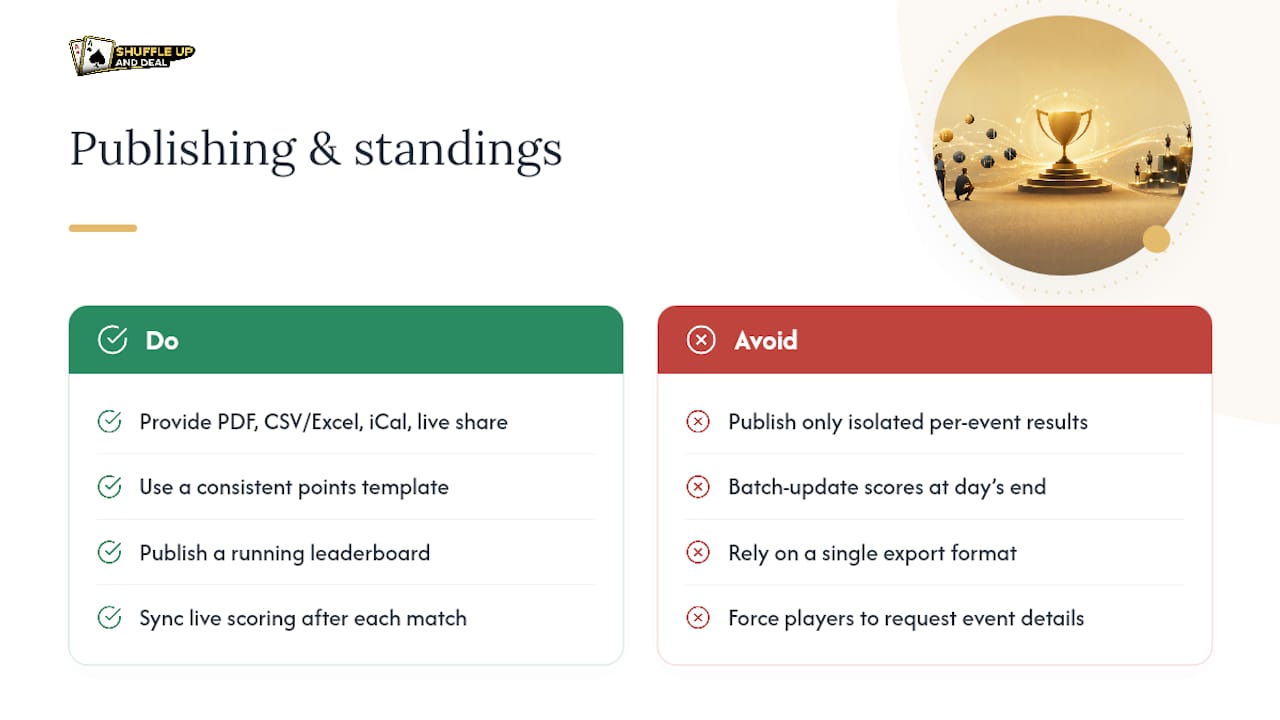
A schedule isn’t finished until players can see it and trust it. Export as PDF for print and noticeboards, CSV or Excel for anyone building their own tracking sheet, iCal for players who want fixtures in their phone calendar, and a live share link for real-time updates. Fixture platforms typically support all four, and each serves a different audience.
Standings need the same discipline. Use a consistent points template across every leg of the series so cumulative totals stay comparable, and publish a running leaderboard rather than isolated per-event results. Large multi-day series set the benchmark here, publishing full event tables with times, buy-ins, and structure sheets as one authoritative reference players can check without asking anyone. Sync live scoring to the schedule as each match finishes, not in a batch at the end of the day, and the leaderboard stays trustworthy throughout the series.
What I’ve learned from organisers who get this wrong
The mistakes repeat: late drops that leave a bracket lopsided, blackout dates nobody checked until after the draw went out, and turnover times that looked fine on paper but collapsed the moment real players showed up late from lunch. None of these are exotic failures. They’re the predictable cost of generating a schedule before your constraints are actually locked down.
The organisers who avoid this treat validation as a separate step, not an afterthought bolted onto generation. Run the check, fix what fails, then publish. It costs ten extra minutes and saves a week of apologetic messages.
- Jason
Get your series scheduled without the spreadsheet chaos
Everything covered here, format selection, constraint checks, timeline mapping, still takes real effort by hand. Shuffle Up and Deal! removes most of that manual grind directly inside a single app built for exactly this job.

Smart seating handles table balancing automatically as your field shrinks, so you’re not manually reseating players between levels. The live clock and blind management keep every table synchronised without a director walking the floor. When a round finishes, exports and live share links get results in front of players immediately, no separate publishing step required. Larger series running multiple events at once get the added benefit of league management and player statistics carrying across legs automatically. If you’re running seating on a second screen, the seating chart display feature is worth checking before your next event.
Start with Shuffle Up and Deal!'s free plan and see how much of this workflow it takes off your hands before your next series kicks off.
Sources
- Tactician usage docs (scheduling library)
- Schedule IQ - R2 Sports
- LeagueOptima - conflict‑free scheduling
- Playinga - tournament scheduler features
- Grand Poker Series schedule (example)