
Poker Tournament Management App
Run Poker Tournaments Like a Pro!
From First Hand to Final Table
Seat draws, table balancing, the clock, payouts and league standings: Shuffle Up and Deal! runs the whole night from your phone or tablet.



Avoid 1am Disputes: Poker Buy In Tracking for Organizers Using an App

The quickest way to avoid arguments at the end of a poker night is to log every buy-in, rebuy and cash-out the moment it happens, using an organiser app built for real-time entry and instant settlement. Spreadsheets still work for tiny, casual groups of four or five regulars who trust each other implicitly. Anything bigger, or with money that matters, needs the same discipline that industry bankroll standards recommend for serious players, delivered through a tool like Shuffle Up and Deal!.
TL;DR:
- Tracking buy-ins, rebuys, and cash-outs in real time prevents disputes and ensures accurate settlement, especially in larger or money-critical games.
- Logging timestamped events for rebuys, side pots, and add-ons immediately reduces errors and maintains clear records for audit and reconciliation.
- Using a dedicated tournament management app like Shuffle Up and Deal! streamlines workflow, from player registration to payout calculation, with live syncing and automatic updates.
- Common errors include batching entries instead of real-time logging, estimating cash-out amounts, and neglecting to publish session summaries for transparency.
- Maintaining discipline with proper data entry and avoiding these pitfalls enables smoother gameplay, quicker settlement, and fewer disputes.
Table of Contents
- What to record every time: essential fields and why they matter
- Live workflow: how organisers should log buy-ins, rebuys and cash-outs in real time
- Settlement best practice: payments, splitting pots, IOUs and avoiding arguments
- Bankroll and buy-in sizing: rules of thumb for cash games and tournaments
- How a tournament organiser tool solves these problems
- Methods for handling and recording side pots and add-ons
- Common mistakes in buy-in tracking and how to avoid them
- Practical organiser perspective: a one-run checklist
- Bring this workflow into Shuffle Up and Deal!
- Sources
What to record every time: essential fields and why they matter
Buy-in tracking poker only works when the underlying data is complete. Half-finished records are the single biggest cause of “who owes what” arguments at 1am, and the fix is boring but effective: capture the same fields, every session, without exception.
At minimum, your session log needs:
- Date and format (cash game, tournament, or mixed session)
- Stake level so you can compare sessions later
- Player name, matched consistently across the night
- Initial buy-in amount, logged the moment cash or chips change hands
- Rebuys and add-ons, each timestamped separately rather than bundled into a running total
- Cash-out amount, recorded when the player actually leaves, not estimated afterwards
- Session duration, from first hand to last chip counted
Each field earns its place. Timestamped rebuys stop the “I only bought in twice” dispute that surfaces after three beers and a bad beat. Duration lets you calculate hourly rate later, which matters more than most players admit. Dealer tips should be logged as a separate deduction from the pot rather than folded into cash-outs, and partial cash-outs (a player who leaves for an hour and returns) need their own timestamped entry rather than a note in the margin. A simple session log covering these fields is enough to compute ROI and hourly rate reliably.
Live workflow: how organisers should log buy-ins, rebuys and cash-outs in real time
Good tracking is a workflow, not an app feature you remember to use halfway through the night. Here’s the sequence that actually holds up under pressure:
- Set up the template before anyone arrives. Buy-in amount, rebuy policy, blind schedule and prize structure should all be decided and entered in advance, not negotiated at the table.
- Register players at the door. Log the buy-in the second cash is handed over. A QR code or share link speeds this up considerably when you’ve got eight players arriving within ten minutes of each other.
- Log rebuys the moment they happen, with a timestamp and seat number attached. This single habit eliminates the most common source of home-game disputes, since logging events instantly beats end-of-night reconciliation every time.
- Run an end-of-night routine that auto-calculates net position. Each player’s total buy-ins minus their cash-out gives you the number you need, without anyone doing mental arithmetic while tired.
- Settle in a sensible order. Pay out the biggest winners first, then work down, so nobody’s waiting on someone else’s transfer to complete their own.
Pro Tip: If you’re running the game solo, batch anything that isn’t time-critical, chip counts, side conversations, snack orders, into breaks between hands. Never let a non-urgent task delay logging a buy-in or rebuy in the moment.
Settlement best practice: payments, splitting pots, IOUs and avoiding arguments
Settlement should happen the same night, while everyone’s still in the room and the numbers are fresh. Waiting until “we’ll sort it out later” is how home games lose friends over $40.
Real-time payment links speed this along considerably. Instead of chasing bank transfers over the following week, players settle before they’ve even put their coat on.
The maths itself is straightforward:
- Calculate each player’s net: total buy-ins plus rebuys, minus their final cash-out.
- Distribute shared costs (food, table hire, dealer tip) evenly, or by an agreed formula, before finalising individual balances.
- Record any IOU with an amount, a name and a date, never a vague verbal promise.
- If a player leaves early, note their outstanding balance immediately rather than trying to recall it later.
A one-line session summary works well as a shared reference: “Session closed, all buy-ins and cash-outs reconciled, three IOUs outstanding, settle by Friday.” Publishing this via a shared link, rather than a group chat message that scrolls away, keeps everyone accountable and gives you a record if a dispute ever resurfaces.
Bankroll and buy-in sizing: rules of thumb for cash games and tournaments
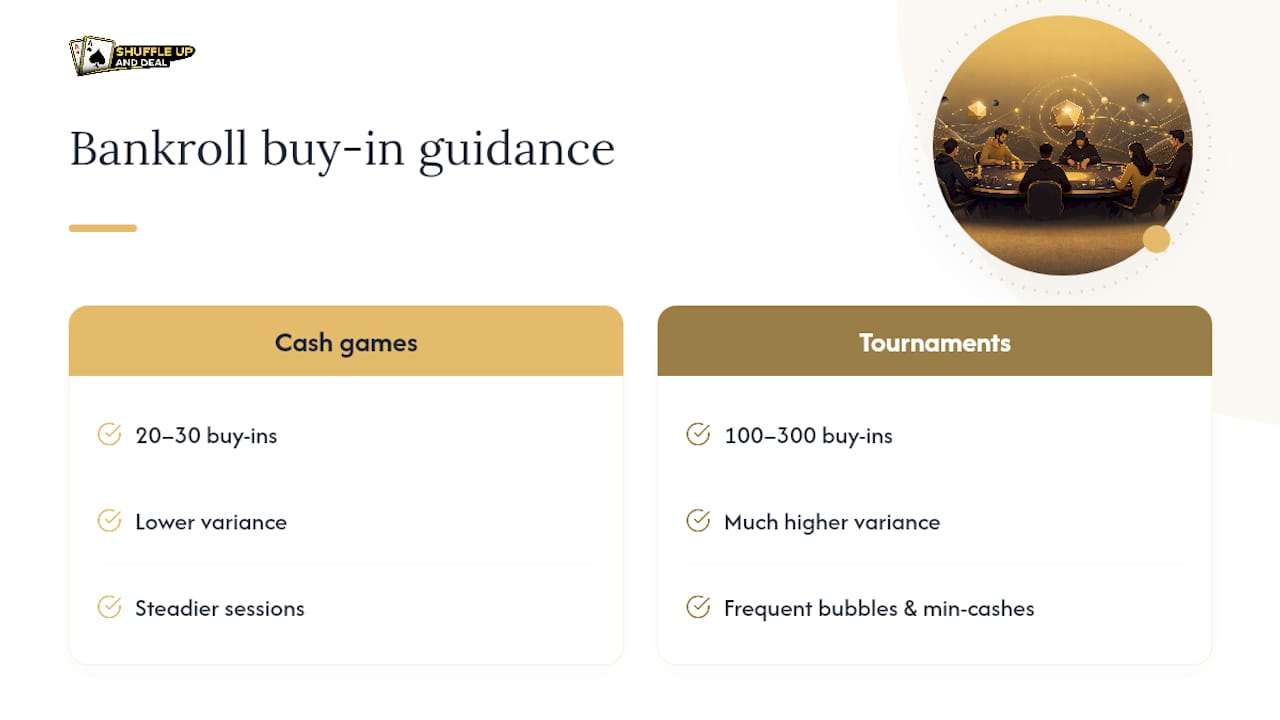
Tracking isn’t just about settling one night cleanly, it’s the data that tells you whether you’re playing the right stakes at all. Standard guidance suggests holding 20 to 30 buy-ins for live cash games, but 100 to 300 buy-ins for tournament series, because tournament variance runs dramatically higher: min-cashes and bubbles happen far more often than deep runs.
Session history, tracked properly, becomes your review tool. Win rate, hours played and dollar-per-hour, reviewed periodically, tell you whether a move up in stakes is a reasoned decision or wishful thinking.
Here’s a worked example using six tracked sessions at $1/$2:
Total buy-ins: $1,200. Total profit: $470.
How a tournament organiser tool solves these problems
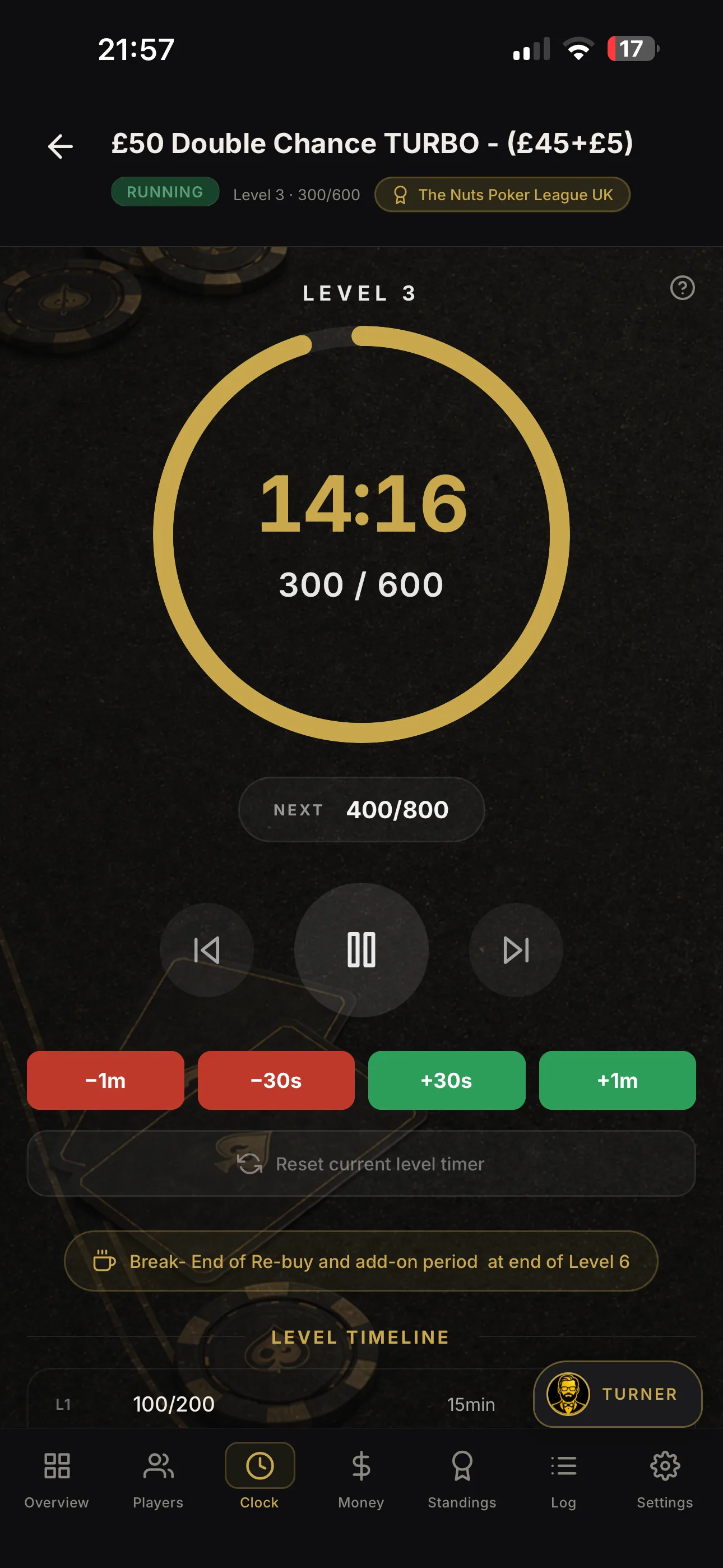
This is exactly the gap Shuffle Up and Deal! was built to close. Session templates handle buy-in amounts and rebuy policy before the first card is dealt. Player registration logs each entry the moment it happens, rather than relying on someone’s memory an hour later.
The features map directly onto the workflow above:
- Smart seating removes manual seat assignment when players rebuy or a table breaks.
- Live tournament clock keeps blind levels and structure consistent without anyone watching a phone timer.
- Rebuy and late registration controls timestamp every entry automatically.
- Payout calculations turn final chip counts into settlement figures instantly.
- Multi-device syncing and live share links let co-organisers and players see the same numbers in real time, from any device.
Pro Tip: Send the live share link to players before the game starts. It cuts “what’s the buy-in again?” questions to almost zero and gets everyone checking their own running total instead of asking you.
Methods for handling and recording side pots and add-ons
Side pots and add-ons are where manual tracking systems fall apart fastest, mainly because they happen mid-hand, under time pressure, with chips already in motion.
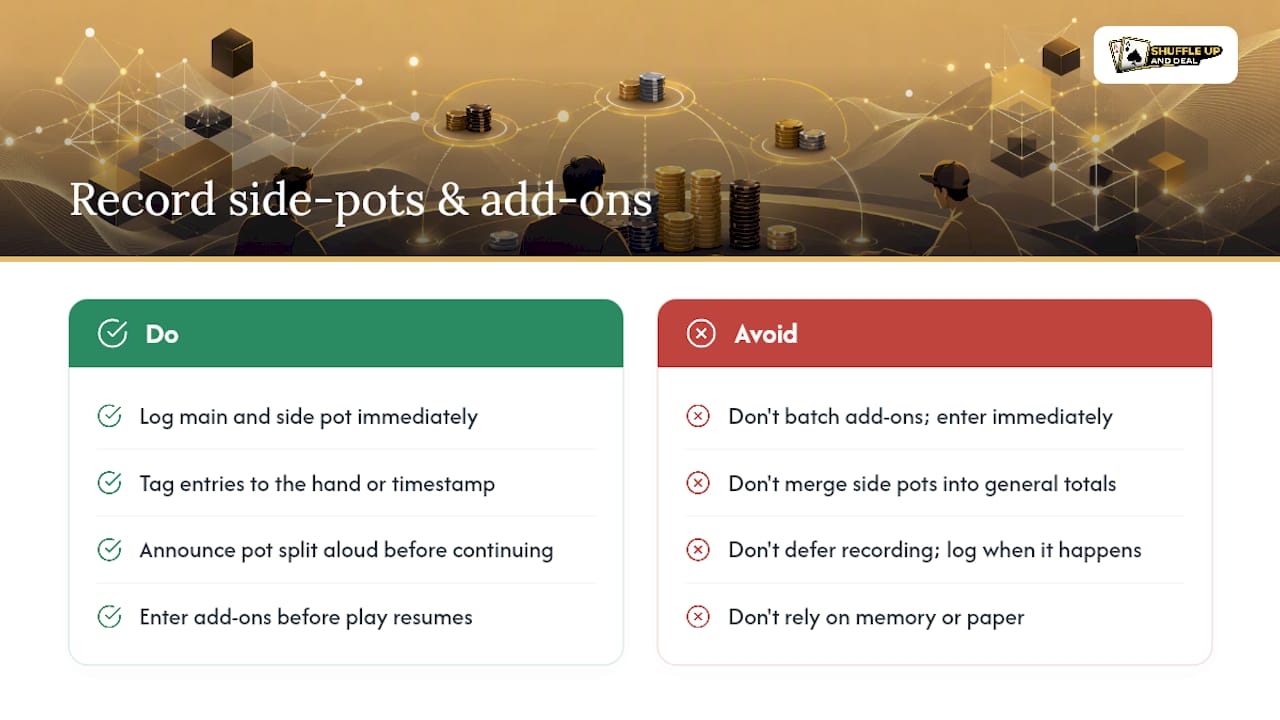
For side pots, the cleanest method is to log the main pot and side pot as two separate entries the instant an all-in creates the split, tagged to the specific hand or timestamp rather than merged into a general total. Whoever’s tracking the game (organiser, dealer, or an assigned player) should announce the split out loud before continuing, so there’s a verbal record alongside the written one. This matters more in tournaments with uneven stack sizes, where a short stack going all-in against two bigger stacks creates a side pot almost every other orbit.
Add-ons, common in rebuy tournaments at the break, should be treated identically to rebuys: timestamped, tied to a specific player, and entered before play resumes rather than batched afterwards. The temptation is to wait until several players have added on and log them together. Resist it. A batch entry is exactly where errors creep in, someone’s add-on gets missed, or two get attributed to the wrong seat.
The general principle holds for both: record the event when it happens, not when it’s convenient. A tool that timestamps automatically removes the temptation to defer the entry, which is precisely where side pot and add-on tracking usually goes wrong in home games run on paper or memory.
Common mistakes in buy-in tracking and how to avoid them
Most tracking failures aren’t complicated, they’re small habits that compound over a long night. Three come up again and again.
Batching entries instead of logging in real time. Writing down three buy-ins from memory at the next break introduces errors that are almost impossible to catch later. The fix is simple: log the moment money changes hands, even if it interrupts what you’re doing.
Treating cash-outs as estimates. “About $180, I think” becomes a real number nobody agrees on by the end of the night. Count it, log it, move on.
Losing track of who’s paid what across a multi-table or multi-day event. This is where organiser guides recommending published session summaries earn their keep, a shared record beats a memory every time, especially across events that span more than one sitting.
A fourth, subtler mistake: treating rebuys and add-ons as the same thing when your structure distinguishes them. If your tournament format caps add-ons at one per player but allows unlimited rebuys during the registration window, conflating the two categories in your log makes it impossible to audit compliance later. Keep the categories separate, even if it feels like extra typing at the table.
Practical organiser perspective: a one-run checklist
Run this sequence and you’ll rarely have a dispute worth remembering. Before the game: set the template, confirm payment methods with players, sort the seating plan. At the door: register fast, confirm how each player intends to pay out. At the end: publish the session summary, trigger settlement immediately, save the log somewhere it won’t vanish in a week.
The three mistakes that undo all of this: batching entries, guessing cash-out figures, and skipping the published summary because “everyone remembers anyway.” Nobody remembers anyway. Fix those three habits and buy-in tracking stops being a chore and starts being background noise, which is exactly where it belongs.
- Jason
Bring this workflow into Shuffle Up and Deal!
Everything above, real-time logging, timestamped rebuys, instant settlement, works best when it’s built into the tool running your night rather than bolted on afterwards as a spreadsheet habit.

Shuffle Up and Deal! handles the mechanics directly: session templates lock in your buy-in and rebuy rules before anyone sits down, smart seating keeps tables balanced without manual reshuffling, and payout calculations turn final numbers into settlement figures the moment the last hand finishes. Multi-device syncing means co-organisers see the same live totals you do, and share links let players follow along without asking you for updates all night.
If you’re still tracking buy-ins on paper or piecing together a spreadsheet between hands, it’s worth seeing what a purpose-built tournament management app does instead. Visit the Shuffle Up and Deal product page and set up your first session template before your next game night.
Sources
- Poker Bankroll Management: Cash, MTT, and Live Play | DC
- What Is a Poker Bankroll? Full Guide by Bodog Poker