
Poker Tournament Management App
Run Poker Tournaments Like a Pro!
From First Hand to Final Table
Seat draws, table balancing, the clock, payouts and league standings: Shuffle Up and Deal! runs the whole night from your iPhone or iPad.


5 Red Flags TDs Use to Enforce Chip Accountability in Poker

Chip accountability means every chip on the table can be traced to a legitimate hand, hold, or transaction, and it exists to protect equity for honest players. If you suspect a deliberate transfer, do not confront anyone. Note the hand number, time, and seats involved, take a screenshot or photo if you can, and report it straight to the floor. This protects players, directors, and venues alike, and it works because you acted fast, not because you tried to solve it yourself.
TL;DR:
- Repeated, low-scenarios of one-sided chip loss to the same opponent across multiple sessions suggest deliberate transfers rather than normal variance.
- Spotting suspicious exchanges requires noticing patterns like fast calls, correlated player departures, or stack size tracking that match across several hands.
- Using mandatory chip counts and recording counts aloud helps prevent disputes; inconsistencies should be flagged immediately and documented for review.
- RFID technology provides a near-continuous record of chip movements, especially useful in large tournaments and regulated venues, but manual counts remain essential during outages.
- Reporting incidents with specific details such as hand ID, timestamps, and player positions enables proper investigation and potential penalties, including disqualification or legal referral.
Table of Contents
- What chip accountability in poker actually means
- Common chip-related misconduct to watch for
- Spotting suspicious chip transfers: the red flags that matter
- Chip counting and table presentation best practices
- Technology and tools that improve accountability
- Reporting suspected chip misconduct: what to record and what happens next
- How tournament software supports the accountability chain
- Why accountability starts with your own decisions, not just enforcement
- Try Shuffle Up and Deal! to keep every stack accountable
- Sources
- FAQ
What chip accountability in poker actually means
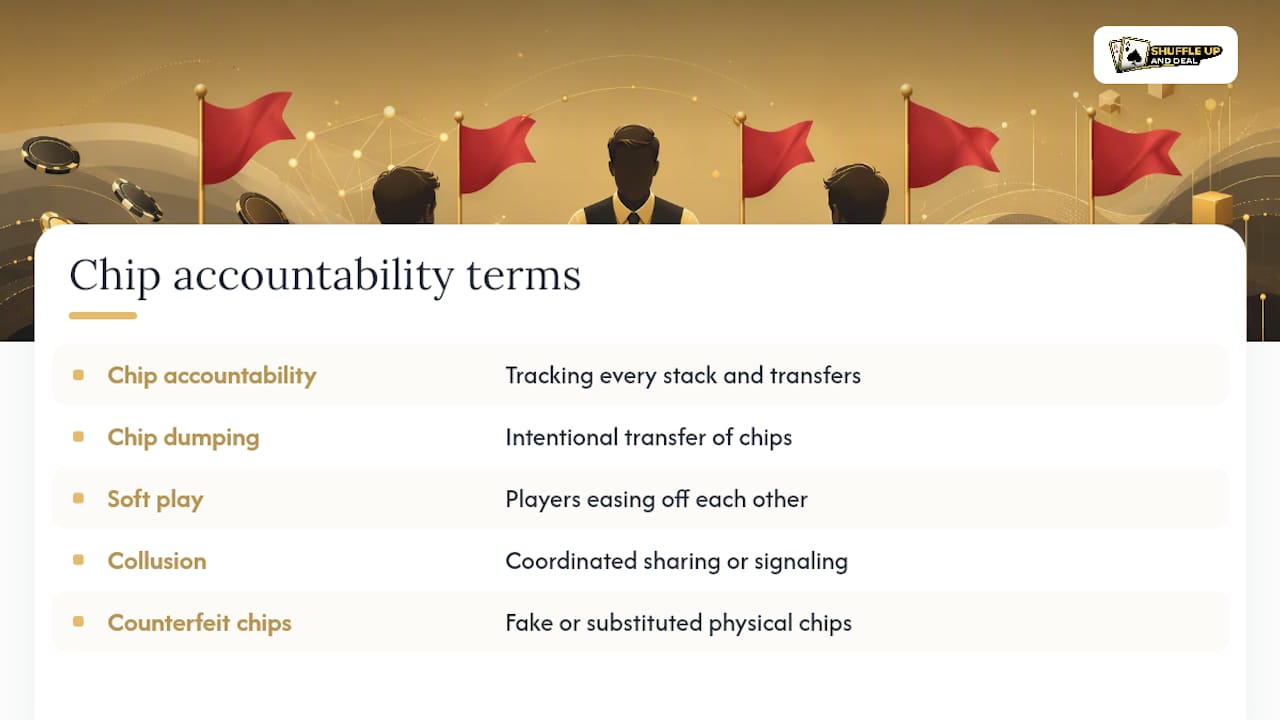
Chip accountability is the discipline of keeping every stack traceable: who holds it, how it grew or shrank, and whether every transfer matches a hand that was actually played straight. It sits underneath a handful of related terms that get blurred far too often.
Chip dumping is the deliberate, engineered transfer of value from one stack to another, usually through a series of calls or shoves that make no sense as poker decisions. Soft play is milder: two players easing off each other, checking down pots they’d normally contest, without necessarily moving chips outright. Collusion covers coordinated action between two or more players, sharing hole card information or signalling, which can produce chip dumping as one of its symptoms rather than the cause. Counterfeit chips are a separate physical problem: fake or substituted chips introduced into play to inflate a stack.
Why bother separating these? Because the equity damage differs. A dumped stack in a knockout event can hand one player a bounty and a seat they didn’t earn, distorting ICM for everyone left in the field. The Tournament Directors Association framework and most card room rulebooks treat chip dumping as a serious integrity offence precisely because it doesn’t cheat just one opponent. It reshapes the whole prize pool. Operators and tournament organisers have started coordinating more closely on these cases, which is a signal worth taking seriously if you run games regularly.
Common chip-related misconduct to watch for
Most chip misconduct falls into a small number of recognisable patterns, whether the game is live or online.
- Chip dumping shoves: one player repeatedly moves all-in with weak holdings against the same opponent, who calls light and wins, transferring value with no genuine poker logic behind either decision.
- Soft play passivity: two players check down pots, skip value bets against each other, or fold big hands uncontested when facing one specific opponent but nobody else.
- Physical theft or short-changing: chips lifted from an unattended stack, or a player claiming a wrong denomination during a cash-out.
- Counterfeit chips: substitute chips introduced mid-session, often spotted only when a colour-up or a chip race forces a recount.
- Online multi-accounting: one person controlling two accounts at the same table to dump chips between them, frequently paired with VPN masking to hide the shared IP address.
- Account selling and coordinated dumping rings: a purchased or shared account used specifically to transfer value out of a bankroll, a tactic explored in detail in Sumsub’s guide to chip dumping.
The line between misconduct and bad luck usually comes down to pattern, not a single hand. One loose call proves nothing. Ten loose calls to the same opponent over three sessions proves quite a lot.
Spotting suspicious chip transfers: the red flags that matter
Deliberate transfers rarely look like a single dramatic hand. They look like a pattern that only becomes obvious once someone bothers to check.
Watch for these behavioural signs at the table:
- Unusually fast calls or shoves with no timing tell, especially on marginal spots where a genuine decision would take a few seconds.
- No visible reaction to a big loss, win, or bad beat, particularly when the same two players are involved repeatedly.
- One-sided losses that repeat: the same player bleeding chips to the same opponent across several sessions, far beyond normal variance.
- Correlated arrivals and departures: two accounts or players consistently registering and busting out around the same time.
- Stack-size correlation: one player’s stack growth tracks almost exactly with another’s decline, hand after hand.
Statistically, this is where hand-history review earns its keep. A TD or a suspicious player can pull the hand logs and check for negative expected value calls directed at a single opponent, meaning calls that would lose money against a random range but somehow keep winning against one specific player. Win-rate deviations that sit well outside a normal variance band, especially over a small number of hands, are a second useful check. Historical cheating cases repeatedly show that this kind of player-driven hand-history analysis exposed the fraud long before any operator noticed, because the people playing against the cheats were the ones who felt the pattern first.
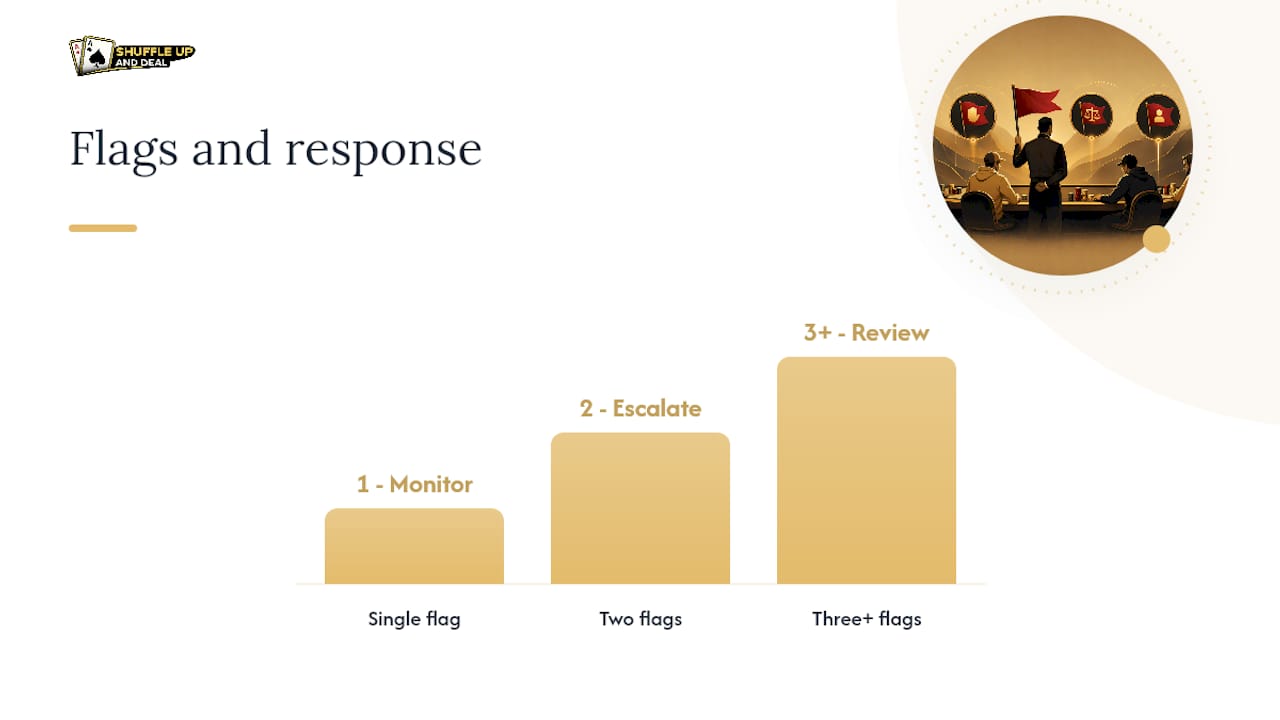
If two or three of these signs stack up in the same match-up, escalate to the floor. One flag alone is not proof. Three flags across multiple sessions is a pattern worth a formal review.
Chip counting and table presentation best practices
Countable stacks are the first line of defence, and they cost nothing to enforce beyond a bit of table discipline.
For players, keep your stack organised: highest denominations visible at the back, chips arranged in even columns of five or ten, and no hiding valuable chips behind lower-value ones. A stack that takes the dealer thirty seconds to count is a stack nobody can dispute later.
For dealers, mandatory counts should happen at colour-ups, at the final table, and whenever a player requests one. Announce the count out loud so the whole table hears the number, and if a recount is needed, do it in full view rather than adjusting quietly.
Here’s a simple procedure any table can follow:
- Request the count clearly: say “count please” to the dealer rather than pointing or muttering, and specify which stack.
- Wait for the announcement: the dealer states the total aloud before play resumes.
- Flag a discrepancy immediately: if the number doesn’t match your own tracking, say so before the next hand starts, not three orbits later.
- Document what you saw: note the hand number and the count given, in case the floor needs it later.
TDs enforce this with a tiered response: a first mismatch gets a warning and a correction, repeated sloppy stacking earns a formal warning under most rulebooks, and deliberate concealment of chips can draw a penalty or disqualification. A table that repeatedly can’t produce an accurate count on request should be closed and reseated rather than left to fester.
Pro Tip: Ask for a count at the start of every level change, not just when you’re suspicious. It normalises the habit, so nobody feels singled out when you genuinely need one.
Technology and tools that improve accountability
RFID chip tracking is the most mature technology in this space, and it works by embedding a unique ID chip inside each poker chip so a reader beneath the table surface can log its location in real time. That gives a venue an instant, unbroken audit trail: every chip’s movement between seats is recorded automatically rather than relying on a dealer’s memory.
The limitations matter just as much as the benefits. RFID systems can struggle to read chips stacked too tightly, antenna placement affects accuracy, and a reader outage during a live session leaves a gap in the record that has to be bridged manually. It’s a strong layer, not a complete one.
- Best fit: large-field tournaments, regulated card rooms, and high-stakes cash games where the cost of a reader network is justified by the risk being managed.
- Audit evidence: tournament software logs and hand histories serve the same purpose at a fraction of the cost, recording timestamps, stack sizes, and action sequences that can be pulled the moment a dispute arises.
- Regulatory angle: several jurisdictions now expect operators using RFID to retain audit trails and data-retention policies as part of their compliance obligations, not just as a nice-to-have.
- Incident response: when a reader fails, the fallback is a manual chip count, a witness statement, and a note in the incident log, so play doesn’t grind to a halt while the tech gets fixed.
Reporting suspected chip misconduct: what to record and what happens next
A vague complaint gets a vague response. A specific one gets investigated properly.
When you report an incident, give the floor exactly this: the hand ID or approximate hand number, the timestamp, stack sizes before and after the suspicious action, the names and seat positions involved, and any screenshots or hand-history exports you have. Specificity is what turns a report into something a TD can actually act on.
Phrase it carefully. Say “I’d like this hand reviewed, here’s what I noticed” rather than levelling an accusation across the table. Tournament staff need room to investigate without a public confrontation escalating things further.
Once a report lands, a TD typically works through this sequence:
- Freeze further stack movement at the affected table if the situation is live and ongoing.
- Pull the hand history for the players in question, checking for the patterns covered earlier in this guide.
- Check CCTV or RFID logs where available to corroborate the hand data.
- Interview the players involved separately, without revealing who raised the concern.
- Preserve every record generated during the review, in case the case needs escalating further.
Outcomes range from a warning and a chip penalty, through disqualification and forfeiture of winnings, up to a report to the relevant licensing body or, in cases involving suspected money laundering, a referral to law enforcement. Coordinated action between major operators on integrity violations means a serious finding at one venue can now follow a player elsewhere.
Pro Tip: Save your hand-history export the moment you notice something odd, not after the session ends. Logs can rotate or become harder to retrieve once a few hours pass.
How tournament software supports the accountability chain
Software won’t catch every dumped chip, but it builds the paper trail that makes an investigation possible in the first place. Shuffle Up and Deal! timestamps every player registration, so a TD can see exactly when someone entered or re-entered a field, which matters when checking correlated arrivals between two suspicious accounts.
Its blind level and clock logs, covered in more detail here, give a precise sequence of when each hand was likely played, useful for lining up a player’s report against the actual level in progress. Payout and prize-pool tracking, plus rebuy and late-registration controls, mean a dispute over stack size at bust-out has a record to check against rather than relying on memory. Smart seating and table balancing, detailed in the app’s balancing playbook, also reduce the window for two colluding players to sit together for extended stretches. Shareable live displays and multi-device sync mean players watching remotely can flag anomalies too. None of this replaces a proper investigation, but it gives the floor something solid to investigate with.
Why accountability starts with your own decisions, not just enforcement
Most TDs think of chip accountability as a policing problem. It’s also a self-audit problem, and that half gets ignored far too often.
Review your winning hands with the same scrutiny as your losing ones. It’s easy to grade a big pot you won as “good poker” purely because it worked, which is exactly the result-based bias worth guarding against. Try a weekly ten-hand audit: pull ten hands from recent sessions, grade the decision process rather than the outcome, and share a few with peers who’ll ask diagnostic questions instead of handing out a verdict.
This matters for accountability because a floor staffed by people who audit their own thinking spots inconsistency faster in others. Culture change, not just enforcement, is what raises the standard of play and shrinks the room for cheating to hide in.
- Jason
Try Shuffle Up and Deal! to keep every stack accountable
Shuffle Up and Deal! gives you the audit trail a traditional pen-and-paper tournament sheet never could, without asking you to run a card room’s RFID budget to get it. Registration timestamps, blind and clock logs, smart seating, and payout tracking all sit in one place, so when a player raises a chip dispute, you’re not reconstructing the session from memory.

Plans range from a free option for casual use to paid subscriptions that unlock advanced features such as enhanced logging, multi-device syncing, and league-wide statistics as your events scale. None of this replaces a fair floor ruling or a properly documented report; it just gives you the records to back one up. Visit Shuffle Up and Deal! to pick the plan that matches the size of your next event.
Sources
- Poker Operators Must Prioritise Game Integrity & Security | PokerNews
- Chip Dumping: How Fraudsters Exploit Gaming Accounts
- Poker Cheating Scandals: The Complete Timeline | DeucesCracked
- How does RFID work on a poker table?
FAQ
What does chip accountability mean in poker?
Chip accountability means every chip in play can be traced to a legitimate transaction or hand, so stacks reflect real results rather than manipulated transfers. It covers table procedures like mandatory counts alongside detection methods for chip dumping and collusion.
What is the one-chip rule in poker?
The one-chip rule means a player who tosses a single chip into the pot without declaring an action is deemed to have called, not raised, even if that chip’s value exceeds the bet. It exists to stop ambiguous table talk from being used to disguise intent, which matters directly for accountable, unambiguous chip movement.
Do casinos clean their poker chips?
Yes, many casinos periodically clean and sanitise chips, and larger venues also inspect them for wear, counterfeiting, or tampering during routine maintenance. This inspection process doubles as a chance to catch substituted or counterfeit chips before they cause a dispute.
Is poker luck or skill?
Poker blends both, but skill dominates over a large enough sample of hands, which is exactly why sustained one-sided losses to a single opponent are a red flag rather than normal variance. Hand-history analysis that shows negative-EV patterns repeating against one player points toward deliberate chip dumping, not bad luck.
How much does Shuffle Up and Deal! cost?
Shuffle Up and Deal! offers a free basic plan along with several paid subscription tiers. For current pricing details, please visit the official Shuffle Up and Deal! website. Full plan details and features are available at Shuffleup.