Poker Tournament Management App
Run Poker Tournaments Like a Pro!
From First Hand to Final Table
Seat draws, table balancing, the clock, payouts and league standings: Shuffle Up and Deal! runs the whole night from your phone or tablet.



Lose Every Hand? Poker One Round Penalty Explained for Players & TDs
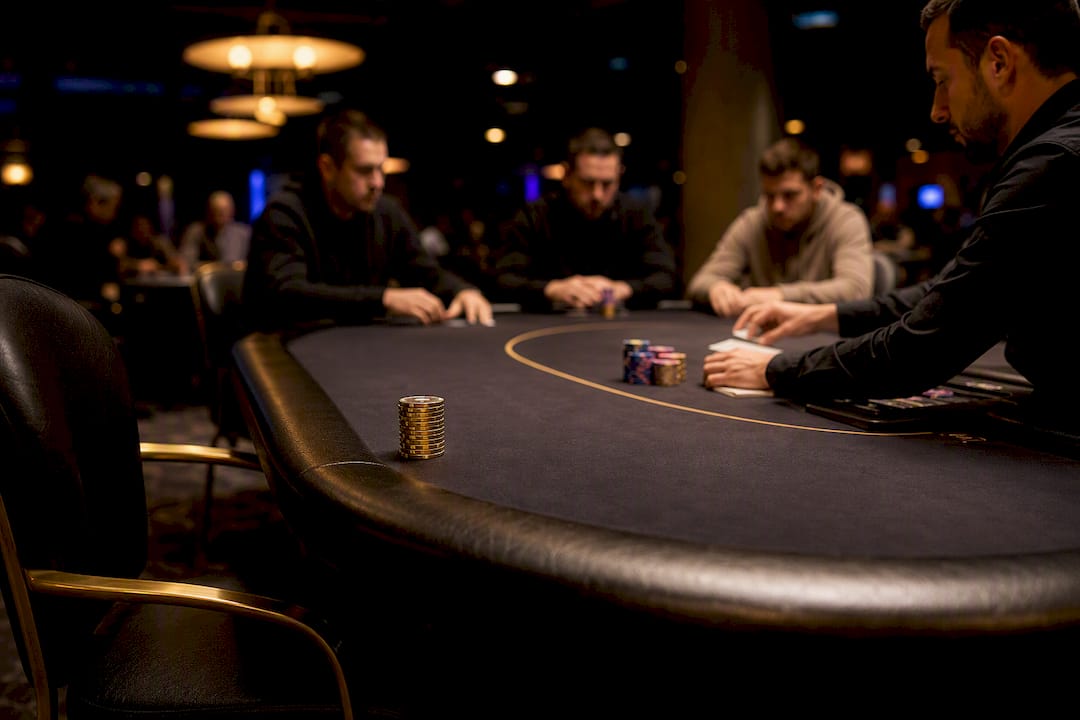
Player penalties in poker follow a predictable ladder: a verbal warning, then a missed hand or missed round, then a timed sit-out, and finally disqualification or exclusion from the venue. Enforcement is always discretionary rather than automatic, but every serious tournament runs on a recognisable framework, with rule sets like the Poker TDA rules and individual venue policies filling in the specifics. Feature tables at major events tend to see stricter, faster enforcement because the cameras are rolling.
TL;DR:
- Penalties escalate from warnings to disqualification, with the specific escalation depending on severity, intent, and repeat infractions.
- Missed-round penalties are calculated by multiplying the number of rounds by the total players, affecting the offender’s entire orbit regardless of table size.
- Infractions like acting out of turn or exposing cards typically lead to warnings, but severe offenses like collusion can result in immediate disqualification.
- Consistent enforcement requires logging each incident, applying penalties fairly, and documenting rulings clearly to protect tournament integrity.
- Using dedicated management tools helps maintain accurate incident records across multiple tables, ensuring fairness and reducing disputes over penalties.
Table of Contents
- Types of poker player penalties and what they mean at the table
- What actually gets you penalised at the poker table
- Who enforces penalties and how the missed-round math works
- Real penalty cases and the lessons they leave behind
- How to avoid poker penalties: a practical checklist
- A short guide for tournament directors on consistent enforcement
- The psychological side of penalties and how they shape strategy
- Can you appeal a poker penalty, and what rights do players have?
- How penalties affect your standing and prize eligibility
- Do penalty rules differ across poker variants and formats?
- Why fair enforcement is the real test of a well-run event
- Keep penalty enforcement consistent with Shuffle Up and Deal!
- Sources
Types of poker player penalties and what they mean at the table
Not every infraction gets the same response. Tournament directors have a menu of sanctions, and which one they reach for depends on severity, intent, and whether the player has form.
- Verbal warning: the lightest sanction, usually a first response to a minor slip like acting slightly out of turn.
- Missed hand: the player sits out a single hand. Their cards are dealt then killed once the deal completes, so they never see the flop or get to act.
- Missed round: the player sits out for a full orbit, missing every hand until the button passes back to their seat.
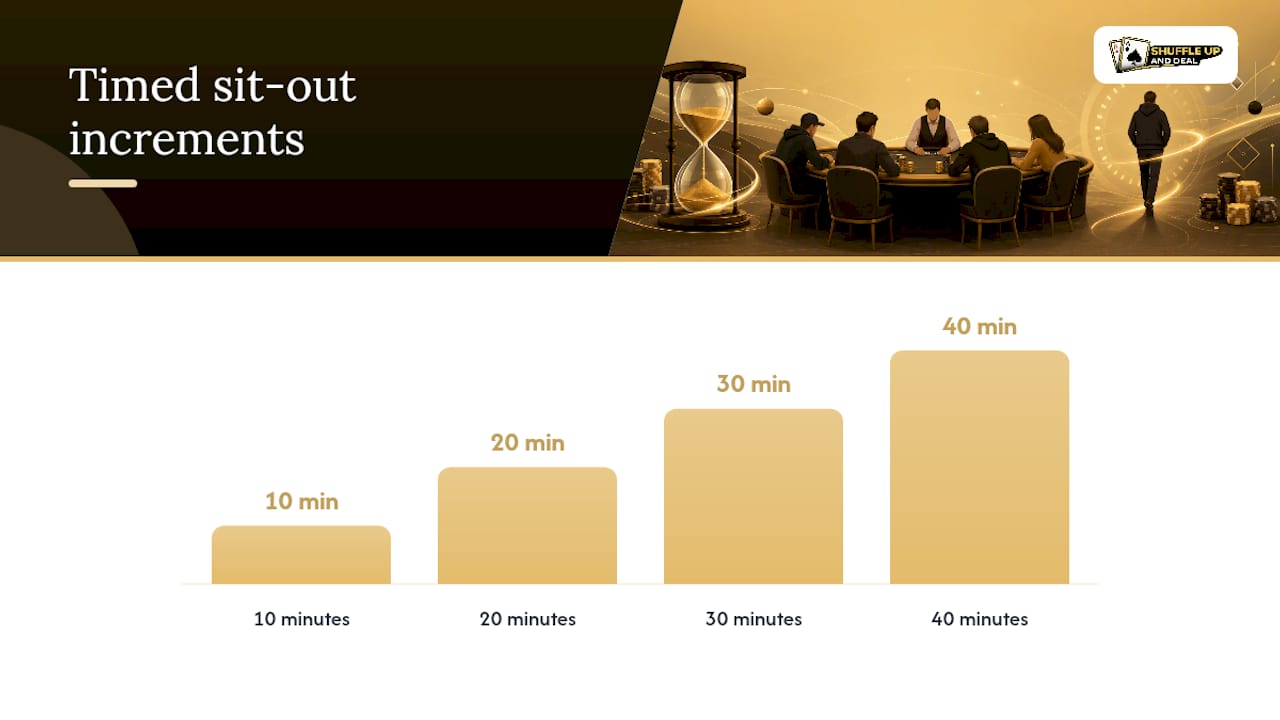
- Timed sit-out: a fixed period away from the table, commonly set in 10, 20, 30, or 40 minute increments depending on the severity of the offence.
- Disqualification or exclusion: removal from the event entirely, sometimes with forfeiture of chips and prize eligibility.
Whatever the sanction, the mechanics stay consistent. A player serving a penalty must physically leave the table area, and their blinds and antes are posted as normal even though they can’t act, which effectively bleeds their stack while they wait. If cards reach them during the penalty, those cards are killed immediately after the deal rather than mucked at showdown.
Venues vary on the finer details. Some card rooms round penalty time to the nearest completed hand rather than the clock, and others differ on whether a penalised player’s chips can be protected by a dealer or must sit exposed at the seat. Provincial gaming rules, such as the British Columbia gaming licence rules, spell out these local variations, which is exactly why checking the specific rule sheet posted at a venue matters more than assuming standard practice applies everywhere.
What actually gets you penalised at the poker table
Most penalties trace back to a short list of repeat offenders. Understanding them is the fastest way to stay off a tournament director’s radar.
- Acting out of turn. Betting, raising, or folding before the action reaches you disrupts the information flow of the hand. Depending on the situation, a floor person may bind the action to what was declared or allow it to be retracted if no one has acted behind.
- Exposing cards. Flashing a hole card to a neighbour, showing a fold before it’s mucked, or “helicopter folding” (flinging a card face up) all count. Venue policy generally treats exposure as a penalty trigger even when an exposed card doesn’t automatically kill the hand.
- Improper mucking. Folding into the muck when your hand might have been live, or mucking out of turn, causes disputes that penalties are designed to discourage.
- Soft play, chip dumping, and collusion. These strike at tournament integrity directly, and they carry the harshest sanctions on the list, often skipping straight past warnings to missed rounds or disqualification.
- Etiquette breaches. Abusive language, theatrics aimed at needling opponents, and touching another player’s cards or chips without permission all count as conduct violations under standard tournament rules.
- Device use and dodging blinds. Checking a phone for strategy help during a hand, or deliberately leaving the table to avoid posting a blind, both invite immediate penalty.
None of these require malicious intent to trigger a sanction. A player who genuinely didn’t realise it was their turn still gets a warning, because the rule exists to protect the game, not to punish motive.
Who enforces penalties and how the missed-round math works
Dealers spot most infractions first, but they rarely issue penalties themselves. The typical chain runs dealer flags the issue, floor staff assesses it, and the tournament director makes the final call on anything beyond a routine warning. Escalation usually follows a ladder: warning, then missed hand, then missed round or timed sit-out, then disqualification. Serious cases can jump straight to the top of that ladder.
The calculation behind a missed-round penalty is one of the more misunderstood parts of tournament rules, and it catches players off guard because it scales with table size, not with the clock.
The Poker TDA rule sets the formula plainly: multiply the number of penalty rounds by the number of players seated at the table, including the offender, to get the total number of hands missed.
Statistic: A one-round penalty at a full nine-handed table costs the penalised player every hand in that orbit since the round ends only after the button has passed every seat at that table.
That single detail explains why tournament directors are often conservative about handing out round penalties on short-handed final tables versus full ring games earlier in an event. The practical mechanics stay the same regardless of table size: the player must be away from the table for the duration, their dealt hands are killed after each deal, and blinds and antes are posted throughout as though they were present and folding every time.
Director discretion sits over all of this. A single serious incident can justify skipping straight to disqualification without working through the intermediate steps, and well-run tournaments document the reasoning at the time, which matters enormously if the decision is challenged later.
Real penalty cases and the lessons they leave behind
Documented incidents from major tournaments tell you more about how enforcement actually plays out than any rulebook clause.
- A WSOP Europe event in 2026 saw a player disqualified after continued abusive and disruptive behaviour, with reporting showing the escalation ran through prior warnings before the tournament director removed the player entirely.
- At a featured, streamed WSOP Main Event table, Mike Matusow received a one-round penalty for exposing cards, a sanction that likely would have drawn less scrutiny at an unfilmed table.
- Both cases show visibility changes enforcement intensity. A minor slip on a feature table under camera can attract faster, firmer action than the same slip at table 47 in the same event.
The lesson for players is straightforward: minor infractions compound quickly once a tournament director has already logged a warning against your name, and reacting calmly to a penalty call tends to keep things at that level rather than pushing a director toward the next rung on the ladder.
How to avoid poker penalties: a practical checklist
Most penalties are entirely avoidable with a few habits built into your table routine.
- Protect your cards physically. Use a card protector or a chip on top of your hole cards, and never let them drift toward the muck or another player’s view.
- Keep your chips visible and organised. Stacked, countable chips prevent disputes over exposed information and speed up any count a dealer needs to run.
- Wait your turn, every time. If you’re unsure whether action is on you, ask the dealer rather than guessing. It costs two seconds and avoids a bound action you didn’t intend.
- Announce your action clearly. State “raise” and a number, rather than just sliding chips forward, so there’s no ambiguity for the dealer or the floor.
- Keep language civil. Table talk about the hand you’re not in, or frustration aimed at another player, is one of the fastest routes to a warning.
- Leave the phone alone during hands. Even glancing at a device can look like you’re seeking outside help, which invites a penalty regardless of intent.
- If you’re penalised, don’t argue at the table. Accept the ruling, ask the floor calmly how to appeal if you disagree, and raise it through the proper channel afterward.
Pro Tip: If a ruling feels wrong, say “I’d like to appeal this to the floor” and step back rather than continuing to argue with the dealer. Directors respond far better to a calm request for review than to a raised voice, and it protects your case if the decision does get reconsidered.
A short guide for tournament directors on consistent enforcement
Fair enforcement isn’t about being lenient or harsh. It’s about applying the same standard to every player, every time, and being able to show your reasoning if challenged.
Build an escalation ladder before the event starts, not during it: warning, missed hand, missed round or timed sit-out, disqualification. Reserve the right to skip steps for genuinely severe conduct, such as collusion or physical intimidation, and write down why you skipped them the moment you make the call.
- Log every infraction against the player’s name, not just the table number, so repeat offenders across different levels of the same event don’t slip through unnoticed.
- Record the ruling, the rule cited, and the time it was issued, so an appeal later has something concrete to review.
- Announce penalties to the table clearly enough that everyone understands what happened and why, which reduces grumbling and copycat behaviour.
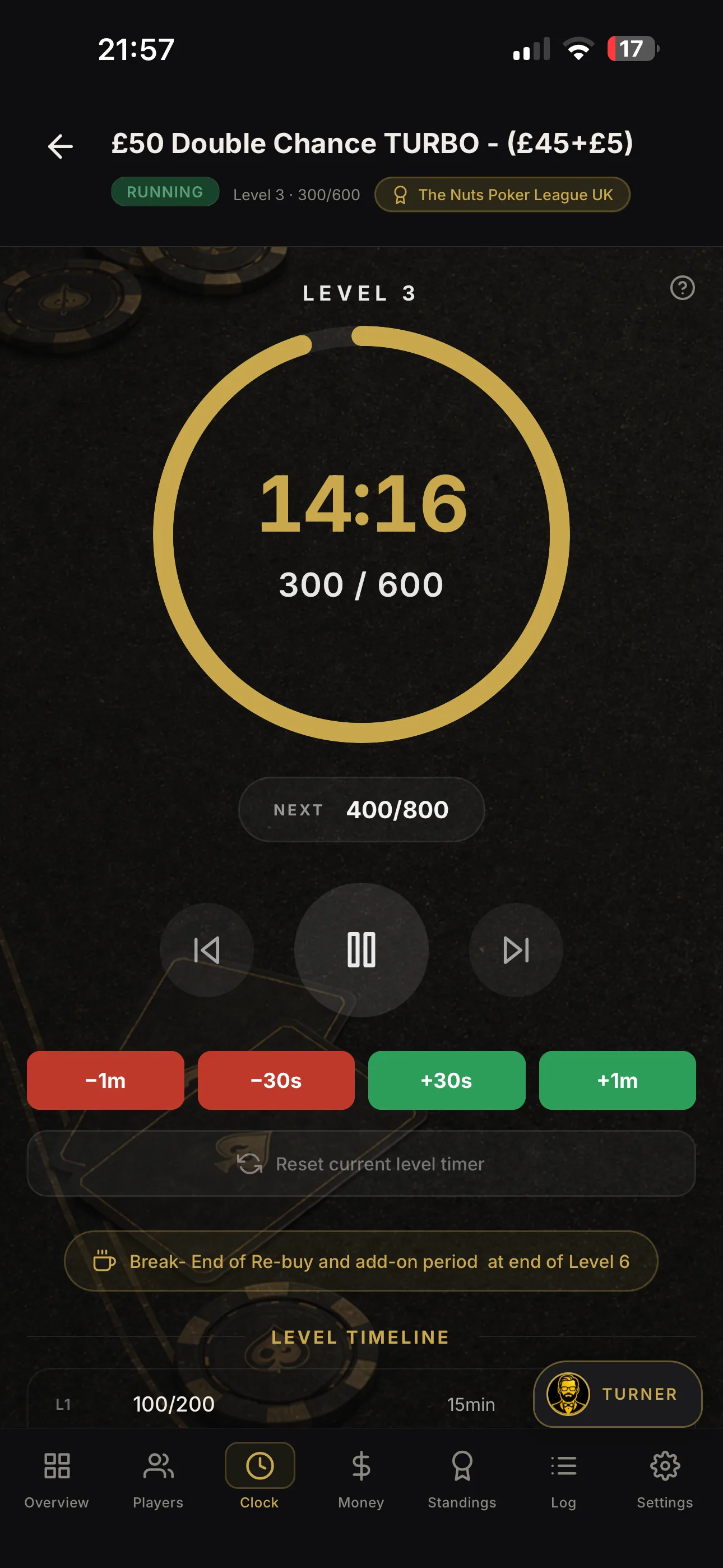
This is precisely where a dedicated tournament management guide earns its keep, and where tools built for the job save real time. Shuffle Up and Deal lets you attach incident notes directly to a player’s profile, so if the same name shows up twice across an event, you see it instantly rather than relying on memory. Paired with the live tournament clock, you can time a sit-out penalty precisely and know exactly when a player is cleared to return to their seat.
The psychological side of penalties and how they shape strategy
Getting penalised changes how a player plays, and not always for the worse. A missed round burns blinds and antes with no return, which puts real pressure on a short stack and can force uncharacteristically loose decisions once the player returns to the table, purely to make up ground. Directors who understand this sometimes see penalised players overcompensate by playing more aggressively than their normal range for several orbits afterward.
There’s a reputational layer too. A public penalty, especially one called out at the table or on a feature stream, carries a social cost that outlasts the sanction itself. Opponents remember who’s had a warning and may adjust how they engage with that player, sometimes needling them deliberately to provoke a second infraction. Smart players treat a first warning as a hard reset rather than a grudge, since dwelling on it tends to produce exactly the frustrated play that leads to the next sanction.
For tournament directors, this psychological dimension is worth factoring into how penalties are delivered. A calm, private word from the floor tends to defuse a situation that a loud public correction would inflame. The rule enforcement matters, but so does the manner of it, particularly with players who are clearly rattled rather than defiant. Reading that distinction is part of the skill of running a room, not just applying a rulebook.
Can you appeal a poker penalty, and what rights do players have?
Every well-run tournament has an appeal path, and it typically runs upward through the floor to the tournament director, whose decision is usually final at that event. Some larger series maintain a rules committee above the individual TD for genuinely contested rulings, though this is the exception rather than the norm at smaller card rooms and home game series.
Players have the right to ask for the specific rule being applied and to have their side heard before a final sanction is confirmed, but they don’t have the right to relitigate a decision mid-hand by refusing to comply. The practical move is to comply with the ruling immediately, note your objection clearly, and request a review once the hand or the level is finished. Directors are far more receptive to a considered appeal after the fact than to a dispute that holds up the table.
Documentation cuts both ways here. A tournament director who has logged the infraction, the rule cited, and the time of the ruling gives a player a clear basis to challenge if they believe it was wrongly applied, and gives the director a clear defence if it wasn’t. Vague, unrecorded rulings are the ones that generate the messiest disputes days after an event has finished.
How penalties affect your standing and prize eligibility
A missed hand or missed round costs chips through forfeited blinds and antes, but it doesn’t touch your tournament standing directly. Disqualification is a different matter entirely: it typically forfeits your remaining stack and removes you from the prize pool altogether, regardless of how deep you’d run before the infraction occurred.
The grey area sits between those two extremes. Some events rule that a player disqualified after the money bubble retains their min-cash, while others strip it entirely depending on the severity of the conduct that led to the ruling. This is precisely the kind of detail worth confirming from the specific rule sheet posted at registration, since it varies by venue and by the operator running the series, and assuming a “standard” answer can cost you a genuine payout dispute later.
Do penalty rules differ across poker variants and formats?
The core penalty framework, warning through missed round through disqualification, applies almost identically across Texas Hold’em, Omaha, and mixed games, because the sanctions target conduct rather than the specific card game being played. What changes is the practical texture of enforcement.
Multi-table tournaments give directors more room to apply a missed-round penalty without materially damaging a short stack’s tournament life, since blinds are usually still low relative to stack depth in early levels. Heads-up and short-handed formats are far less forgiving: a one-round penalty at a three-handed table burns through blinds far faster proportionally than the same penalty nine-handed, which is exactly why the Poker TDA missed-round formula scales with players at the table rather than applying a flat time period.
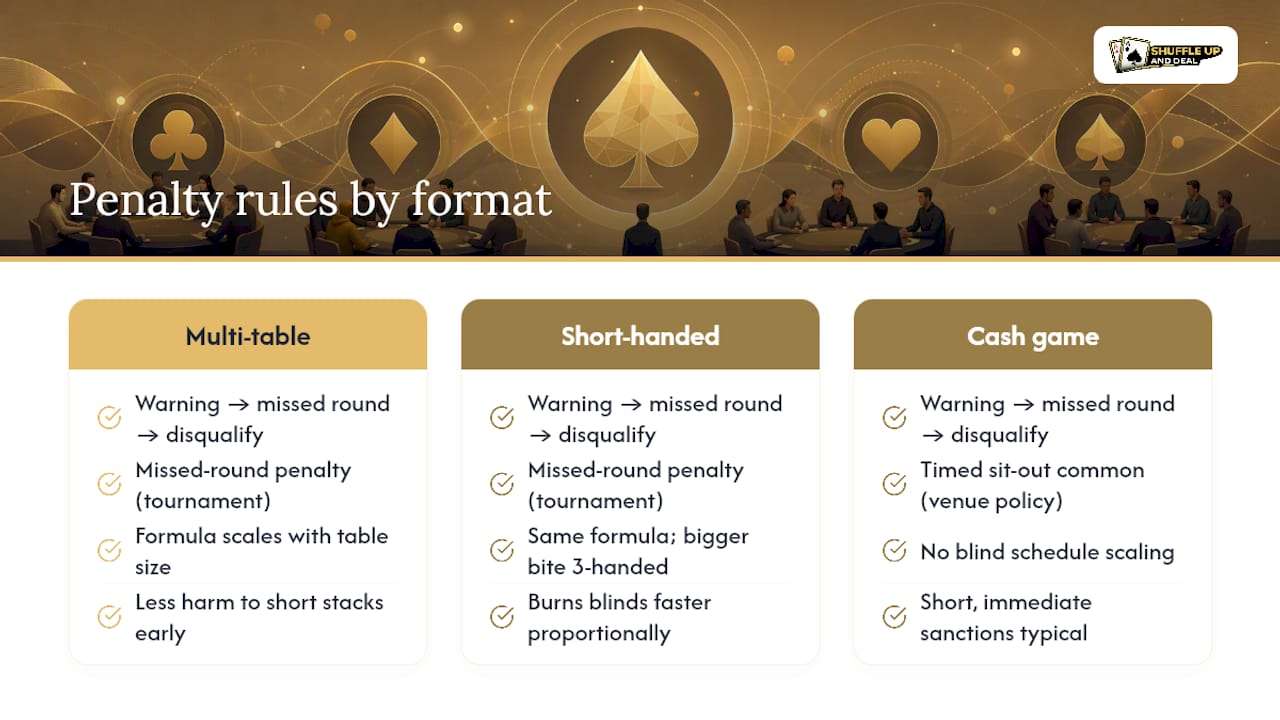
Cash games differ again. Venue-specific policies, like those published for PokerStars Live cash tables, tend to favour shorter, more immediate sanctions such as a timed sit-out rather than tournament-style missed rounds, since there’s no blind schedule escalating against the player and no bubble or prize pool at stake to weigh against the penalty.
Why fair enforcement is the real test of a well-run event
Rules only matter if they’re applied the same way to everyone, every time. Players tolerate penalties they disagree with far better than they tolerate penalties that look inconsistent, and that’s the real risk directors should be managing, not just rule violations themselves.
Running home games and smaller series has made one thing obvious: the penalty itself rarely causes the argument. The perception that someone else got away with the same thing does. Directors who log incidents properly and explain rulings clearly at the table lose that argument before it starts, and that consistency is what actually protects an event’s integrity over the long run.
- Jason
Keep penalty enforcement consistent with Shuffle Up and Deal!
Applying penalties fairly gets harder the moment you’re running more than one table or juggling multiple events, and that’s exactly where most tournament directors lose track of who’s been warned and who hasn’t. Shuffle Up and Deal solves that with player profiles that hold a running incident history, so a repeat offender at level three doesn’t slip through unnoticed by level nine.

The app’s smart seating algorithm and live tournament clock work alongside those profiles, letting you time a sit-out penalty precisely and log the ruling against the right player without pausing the room to check notes. Multi-device syncing means your floor staff see the same record you do, so a ruling made at one table stays consistent if the same player turns up at another. If you’re running events regularly and want penalty tracking that keeps pace with everything else on your plate, start with Shuffle Up and Deal and see how quickly consistent enforcement stops being a headache.