
Poker Tournament Management App
Run Poker Tournaments Like a Pro!
From First Hand to Final Table
Seat draws, table balancing, the clock, payouts and league standings: Shuffle Up and Deal! runs the whole night from your iPhone or iPad.


Fix Inconsistent Rulings With One Tool for Card and Esports TDs

Publish a clear rulebook before the first card is dealt, then apply one documented procedure to every incident without exception. That means setting the Rules Enforcement Level in advance, investigating on a balance of probabilities rather than gut feeling, and logging every ruling so it can survive an appeal. Get those three things right and the rest of tournament rule enforcement falls into place.
TL;DR:
- Applying a consistent Rules Enforcement Level before the event prevents player disputes over expectations and ensures fair treatment across all infractions.
- Using a documented penalty matrix and recording all rulings, including warnings and escalations, supports transparency and effective appeals.
- Collecting multiple forms of evidence such as video footage, logs, admissions, and witness statements, allows judges to weigh cases on the balance of probabilities.
- Conduct violations like harassment should be treated more severely and documented separately, with lower thresholds for immediate disqualification.
- Tools like Shuffle Up and Deal! streamline enforcement through synchronized clocks, timestamped logs, and AI assistance, reducing manual errors and disputes.
Table of Contents
- What are rules enforcement levels and who has authority?
- Common infractions and how penalties escalate
- How should judges investigate and weigh evidence?
- How do you apply penalties consistently across an event?
- What prevention measures cut down on disputes before they start?
- Why record-keeping and appeal limits protect everyone
- What should a documentation and appeals process actually contain?
- How do you handle disputes between players effectively?
- What training and certification do enforcement officials need?
- Case studies: how real enforcement scenarios get resolved
- How should judges communicate during an enforcement action?
- How do you handle unsportsmanlike conduct and harassment?
- An organiser’s checklist for staying consistent
- How Shuffle Up and Deal! supports fair enforcement
- Sources
- FAQ
What are rules enforcement levels and who has authority?
Rules Enforcement Levels (RELs) tell everyone in the room how strictly the rulebook will be applied before a single hand is dealt. The Flesh and Blood Procedure and Penalty Guide splits events into Casual, Competitive and Professional tiers, and the difference matters enormously: a misplaced token at a Casual kitchen-table event might get a verbal reminder, while the same error at a Professional REL event triggers a documented penalty.
Setting the REL before registration opens removes the biggest source of player complaints: inconsistency between what people expected and what they got.
Authority within that structure is equally clear-cut. A Tournament Director or Head Judge holds final ruling power on the floor, and most rulebooks, including the PDGA’s official enforcement rules, state explicitly that their decisions on fact and procedure stand unless a formal appeal process overturns them. That authority typically covers:
- Eligibility - registration status, deck or kit legality, age or membership checks.
- Equipment - card sleeves, dice, scoring devices, prohibited accessories.
- Conduct - sportsmanship, communication with opponents and judges, venue behaviour.
- Timing - round length, extension rules, slow play, no-shows.
- Appeals - who can challenge a ruling, and within what window.
Common infractions and how penalties escalate
Most competitive rulebooks group infractions into three families: gameplay errors, tournament errors, and conduct violations. Treating all three the same way is a common mistake. Gameplay slips, like a misplaced counter, are usually accidental and low-stakes. Conduct issues, like abusive language toward a judge, are never accidental and demand a heavier response regardless of how “minor” the triggering action seemed.
The KDE-E Tournament Infractions and Penalties Policy offers one of the clearest public penalty taxonomies in competitive gaming, and it maps closely onto what most other rulebooks use in some form:
- Warning - recorded but no competitive impact; used for first-time, low-severity, unintentional errors.
- Game Loss - applied for repeated warnings on the same infraction type, or a moderate single infraction such as a marked deck found mid-match.
- Match Loss - reserved for serious tournament errors or a pattern of game losses within one event.
- Disqualification - the top tier, applied for cheating, harassment, collusion, or repeated match losses, and it usually requires Head Judge sign-off.
The escalation logic matters as much as the categories themselves. A player who receives a warning for slow play in round one and repeats it in round three should not receive another warning; the rulebook expects an upgrade to game loss because the pattern shows the first warning did not correct the behaviour. Judges who apply penalties inconsistently, giving one player a warning and another a game loss for the same offence, are the fastest way to destroy confidence in the floor staff, so the penalty ladder needs to be applied the same way for everyone in the room.
How should judges investigate and weigh evidence?
Tournament floors are not courtrooms, and that distinction changes how you should gather and judge evidence. The ESIC Code of Conduct confirms that esports and card tournament bodies typically operate on an administrative standard, often described as “balance of probabilities” or “reasonably satisfied,” which sits well below the criminal standard of proof beyond reasonable doubt. In practice, that means a judge does not need certainty to rule; they need enough consistent evidence to say one explanation is more likely than another.
Reliable evidence usually falls into four categories, and building a habit of checking all four stops rulings from resting on a single shaky account:
- Video or camera footage, where a stream delay or table camera exists.
- Digital logs, such as scoring app timestamps or clock records.
- Admissions, where a player concedes part or all of the incident.
- Witness statements, gathered separately to avoid contamination between accounts.
Run interviews one player at a time, away from spectators, and ask open questions before closing ones. Asking “what happened?” before “did you move that card?” gets a cleaner account and avoids leading a nervous player toward the answer you expect. If the outcome of a match hangs on the ruling, apply a provisional measure, such as pausing the clock or holding the result, rather than rushing a decision under time pressure.
Pro Tip: Write down the exact wording a player uses in their first account before you ask any follow-up questions. If their story shifts later, that original phrasing is often the most useful evidence you have.
How do you apply penalties consistently across an event?
Consistency comes from following the same sequence every time, not from memorising every possible ruling. A workable procedure looks like this:
- Report - a player, judge or spectator flags the incident to floor staff immediately.
- Investigate - gather evidence and statements using the standard above.
- Classify - match the incident to a category in your penalty matrix (gameplay, tournament or conduct).
- Apply the standard penalty - use the matrix’s default outcome rather than improvising.
- Record - log the ruling in full before the next round starts.
- Educate - briefly explain the correct procedure to the player so the same error doesn’t recur.
A written penalty matrix, similar in structure to the KDE-E policy, gives judges a default answer for each infraction type while still allowing limited discretion for genuinely unusual circumstances. That discretion should be the exception, not the rule, and any upgrade beyond the matrix’s default, particularly toward disqualification, should require a second judge’s sign-off. Repeated infractions deserve escalation, but only when the pattern is genuine; treat each new incident on its own facts rather than assuming a player with one prior warning is automatically guilty of the next dispute raised against them.
What prevention measures cut down on disputes before they start?
The cheapest penalty is the one you never have to issue. Large organisers consistently point to two habits that reduce floor calls before they happen: a standardised pre-round brief, and structured judge training. Rulebooks used at events like IEM and ESL show that reading the same short set of floor rules aloud before each round measurably cuts procedural calls, simply because players hear the expectation stated once, together, rather than discovering it mid-dispute.
Judge calibration matters just as much. Running new judges through mock scenarios against a shared answer key, before they ever rule on a live table, closes the gap between how two different officials might read the same incident.
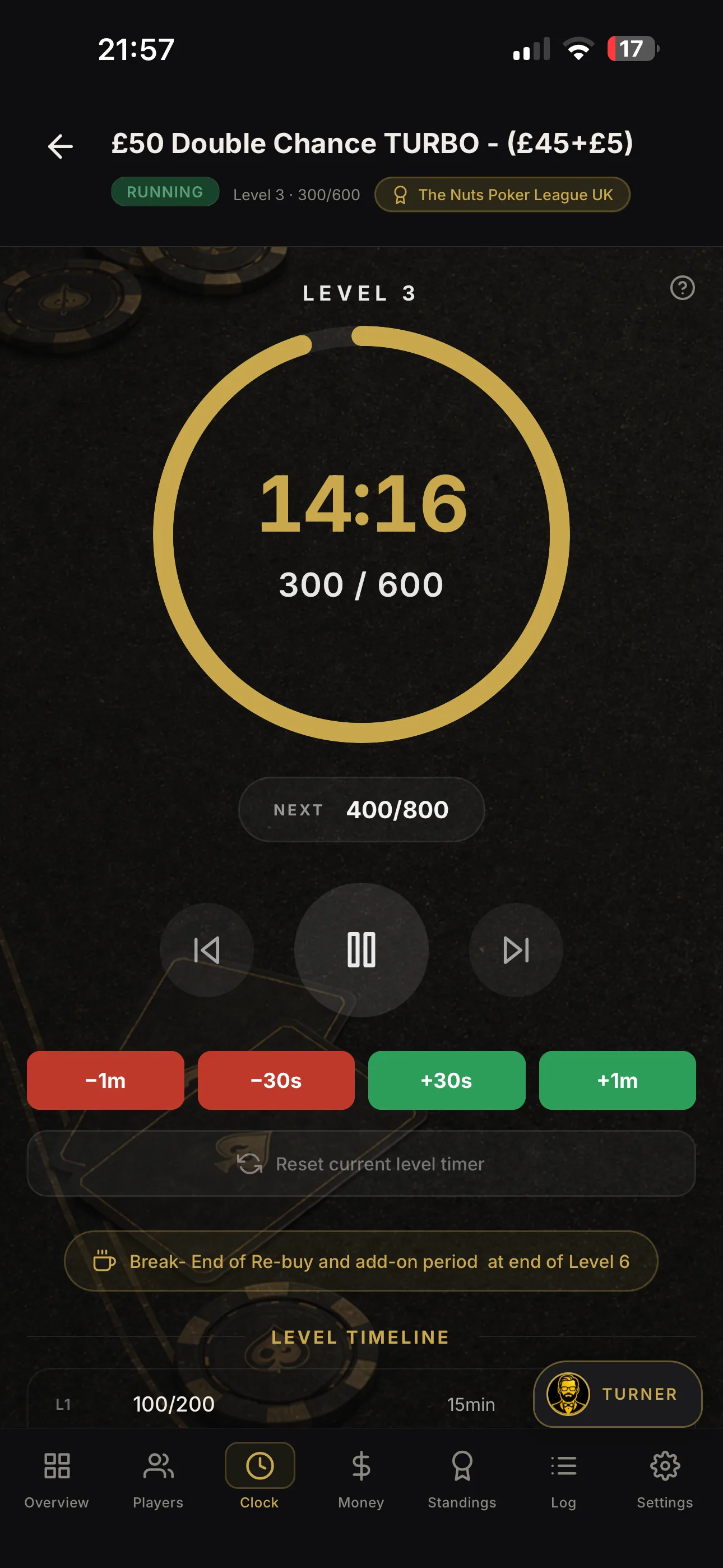
Beyond people, your operational setup either creates friction or removes it. Manual seating draws, hand-typed clocks and paper registration sheets are where errors creep in fastest, particularly during multi-table events running late into the night. This is where Shuffle Up and Deal! earns its place in the toolkit: its smart seating algorithm removes accusations of favouritism from table draws, its live tournament clock keeps blind levels synchronised across every table so no judge has to trust memory, and its registration log gives you a timestamped record of who was seated where and when, which is exactly the kind of detail an investigation needs within minutes rather than hours.
- Smart seating removes manual draw disputes entirely.
- The live clock syncs blind levels across every table in the room.
- Registration and event logs create a timestamped record for investigations.
- Multi-event sync keeps rulings consistent when you’re running several rooms at once.
- The built-in AI rules assistant gives judges a fast second opinion on obscure rulings mid-round.
Pro Tip: Export your event log at the end of every day, not just at the end of the tournament. A same-day export is far easier to cross-check against memory than one pulled a week later.
Why record-keeping and appeal limits protect everyone
Every ruling needs a paper trail, and the safest habit is to log the same fields every single time: incident ID, time, table or match number, players involved, the reporting party, witnesses, evidence links, the ruling itself, the penalty applied, judge notes, a timestamp and the appeal window. The ESIC Code of Conduct treats this level of detail as standard practice for anybody running disciplinary procedures, precisely because a thin log is nearly impossible to defend later.
Appeals exist to catch procedural errors, not to relitigate a judge’s read of the facts. A player can usually challenge whether the correct process was followed, whether evidence was ignored, or whether the wrong penalty tier was applied. What most rulebooks, including the PDGA’s, explicitly rule out is a straight appeal against a Head Judge’s factual judgement call made within their authority.
- Log every field, every time, even for warnings.
- Set and publish a fixed appeal window before the event starts.
- Run anonymised post-event reviews so judges calibrate against each other’s decisions.
What should a documentation and appeals process actually contain?
A workable appeals process has three visible parts: a published window for lodging a challenge, a named authority who hears it, and a decision that gets logged with the same rigour as the original ruling. Most competitive events set the window at somewhere between the end of the round and the start of the next one, because waiting longer makes evidence harder to reconstruct and delays the rest of the bracket.

The appeal itself should be written, even briefly, rather than a verbal complaint shouted across the room. Ask the challenging player to state exactly what they believe went wrong with the process, not simply that they disagree with the outcome. That single requirement filters out most frivolous appeals immediately, because players who cannot articulate a procedural flaw usually withdraw the challenge once asked to write it down.
Whoever hears the appeal, ideally a senior judge who was not involved in the original ruling, needs access to the full incident log described earlier. Without that record, an appeal becomes a fresh argument rather than a review, which defeats its purpose entirely. The outcome of the appeal gets logged in the same system: upheld, overturned, or partially amended, along with the reasoning.
One detail organisers frequently miss is publishing the appeals process itself before the event starts, not just having one ready if asked. A rulebook that mentions appeals only in response to a complaint looks improvised, and improvised rulings are the ones players trust least. State the window, the authority, and the format in the player pack alongside the REL declaration.
How do you handle disputes between players effectively?
Most player-versus-player disputes are not really about the rule in question. They’re about one player feeling unheard while the other feels accused. Separating the two players before either explains their side calms the situation faster than trying to mediate face to face, where each account gets shaped by the other’s presence.
Ask each player the same open question first: “Talk me through what happened, in order.” Resist the urge to ask leading questions until you’ve heard the full account unprompted. Judges who jump straight to “did you do X?” often get an answer shaped by the question rather than the memory.
Keep the tone flat and procedural, even when a player is visibly frustrated. Explaining that you’re following a standard process, the same one used for every incident that day, does more to calm a table than any reassurance about the outcome. Players trust a process that looks identical for everyone far more than they trust a judge’s personal warmth.
Once you’ve reached a ruling, deliver it to both players together where possible, not privately to one first. Hearing the same explanation at the same time reduces the chance of one player suspecting a different story was given to their opponent, which is often where a straightforward ruling turns into a wider integrity complaint.
What training and certification do enforcement officials need?
Judge quality varies enormously between events, and the gap usually comes down to structured training rather than natural instinct. New officials should shadow an experienced judge for at least one full event before ruling solo, watching how rulings get explained rather than just what gets decided.
Written scenario testing, working through a set of past incidents against a shared answer key, closes most of the gap between judges before they ever touch a live table. This is the same calibration principle major card game organisers use to keep rulings consistent across regional events run by different people.
Certification structures differ by game and by organiser, and no single global standard covers every competitive gaming discipline the way, say, refereeing badges work in traditional sport. What’s consistent across the rulebooks worth modelling, including the FAB Procedure and Penalty Guide, is a tiered structure: entry-level judges handle Casual and Competitive REL events, while Professional REL tournaments require judges who’ve demonstrated experience at the lower tiers first.
Refresher training matters as much as initial certification. Rules change between seasons, penalty guides get revised, and a judge who last read the rulebook update two years ago is a liability at a Professional REL event. Build a short annual recertification into your judge roster, even if it’s just a review session before the first major event of the year.
Case studies: how real enforcement scenarios get resolved
A marked-deck complaint at a mid-sized card tournament shows the standard escalation working as intended. A player reports suspicious wear patterns on an opponent’s sleeves between rounds. The judge separates both players, examines the deck under standard lighting, and finds consistent scuffing on cards of one rank. Because the pattern is repeatable and visible, rather than a single ambiguous card, the judge applies a game loss rather than a warning, documents the specific cards affected, and flags the player for a follow-up check in their next match.
A slow-play dispute at a Competitive REL event illustrates why escalation records matter. A player receives a warning for taking excessive time on a single decision. Two rounds later, a different judge, unaware of the first warning, is called to the same table for the same behaviour. Without a shared log, that second judge would likely issue another warning rather than the game loss the pattern actually warrants. A properly logged incident history closes that gap.

A harassment complaint at a Professional REL event shows the upper end of the penalty scale in action. A player reports abusive language directed at them mid-match, corroborated by a nearby judge who overheard part of the exchange. Because conduct violations sit outside the normal gameplay ladder, the Head Judge moves directly to a match loss with a disqualification review, rather than starting at a warning, reflecting how conduct infractions are treated separately from gameplay errors in the ESIC Code of Conduct.
How should judges communicate during an enforcement action?
The words a judge uses in the moment matter almost as much as the ruling itself. Announce that you’re reviewing an incident before you start, so both players understand what’s happening rather than wondering why the match has stopped. Silence during an investigation reads as uncertainty, even when the judge is simply following procedure carefully.
Explain the ruling in plain terms once you’ve reached a decision, naming the specific rule and the specific penalty, not just the outcome. “You’ve received a game loss for a marked deck under rule X” gives a player something concrete to accept or appeal, while “you’ve lost this game” invites argument about fairness rather than facts.
Keep communication with tournament staff equally structured. A judge who rules on a table should notify the scorekeeper or app operator immediately, so results and standings update without a second player disputing a score that hasn’t caught up with the ruling yet. This is one area where digital tools genuinely earn their keep, since a live tournament clock and results feed that updates the moment a ruling lands removes the lag where confusion usually creeps in.
How do you handle unsportsmanlike conduct and harassment?
Conduct violations get treated differently from gameplay errors for good reason: they’re rarely accidental, and they affect people beyond the two players directly involved. A rulebook that funnels harassment complaints through the same warning-first ladder used for misplaced tokens is not fit for purpose.
Set a lower tolerance threshold explicitly in your rulebook. A single credible harassment report, corroborated by even partial evidence, should trigger an investigation with the same rigour as a cheating allegation, not a quiet word and a warning. The WADA framework and most publisher codes reserve their most severe sanctions, suspension or permanent removal, for exactly this category of violation.
Protect the reporting player throughout the process. Separate them from the accused immediately, avoid requiring them to repeat their account publicly, and never seat them at the same table again during the same event without their agreement. Judges who treat harassment reports as routine floor calls, rather than escalating them to the most senior official present, undermine trust in the entire tournament’s integrity far more than any single gameplay ruling could.
Document the outcome with the same fields used for every other incident, but flag conduct cases for a mandatory post-event review regardless of the final ruling. Even where no penalty is issued, a pattern across multiple events involving the same player is only visible if every report gets logged consistently.
An organiser’s checklist for staying consistent
The pitfall I see most often isn’t a bad ruling. It’s an inconsistent one: a warning given freely in round one, then silence when a player asks how to appeal it in round four. Rulebooks fail on the gaps between rulings, not the rulings themselves.
Before your next event, run through six checks: REL published, penalty matrix printed, appeal window stated in writing, judges briefed on the day’s specific rulebook quirks, incident log template ready, and a named senior judge available for escalations. Miss any one of those and you’re improvising by round three.
- Jason
How Shuffle Up and Deal! supports fair enforcement
The controls covered above, seating without bias, a synchronised clock, a documented registration trail, only work if the tools running your event support them rather than fighting against them. Shuffle Up and Deal! was built for exactly this: it puts registration, smart table balancing, the live tournament clock, and exportable event records on one iOS platform, so a judge investigating a dispute can pull a timestamped seating and clock history in seconds rather than reconstructing it from memory.

The built-in AI rules assistant gives floor staff a fast second opinion on an obscure ruling mid-round, without leaving the table to find a physical rulebook. Multi-device sync keeps every judge and the tournament clock reading the same information across simultaneous events, which is where inconsistent rulings creep in fastest during a busy card room weekend. Whether you’re running a single Home Game night or a multi-table Card Room operation, the plans scale with you: Tournament Director starts at £13.99 per month, with TD Pro, TD Elite and Card Room tiers adding deeper league management and statistics as your events grow. Set up your next tournament on Shuffle Up and Deal! and see how much friction a synced clock and a clean registration log removes from your floor.
Sources
FAQ
How do you enforce the rules at a tournament?
Publish a rulebook with a stated Rules Enforcement Level before registration opens, then apply one documented procedure, report, investigate, classify, penalise, record, to every incident without exception. Consistency, not severity, is what keeps players trusting the process, as the FAB Procedure and Penalty Guide sets out for its tiered RELs.
Can you be banned from a tournament for breaking the rules?
Yes. Most competitive rulebooks, including publisher and anti-doping frameworks referenced by WADA, reserve disqualification or suspension for cheating, harassment, or repeated serious violations. Lower-tier infractions typically escalate through warnings and game losses first, rather than jumping straight to a ban.
What counts as reliable evidence in a rules dispute?
Video footage, digital logs, direct admissions and separately gathered witness statements all count as reliable evidence under the administrative standards most organisers use, as described in the ESIC Code of Conduct. Judges weigh what’s more likely true rather than requiring certainty.
What are the basic categories of tournament infractions?
Infractions generally split into gameplay errors, tournament errors, and conduct violations, with conduct issues carrying stricter penalties regardless of intent. The KDE-E policy maps these to a warning, game loss, match loss and disqualification ladder.
Can a player appeal a Head Judge’s ruling?
Appeals can usually challenge procedural errors, such as missed evidence or the wrong penalty tier, but not a Head Judge’s factual judgement made within their authority. The PDGA’s official rules confirm this finality, which is why detailed incident logs matter so much for any review that does proceed.
How much does Shuffle Up and Deal! cost?
Shuffle Up and Deal! offers a free Home Game plan alongside paid tiers starting at £13.99 per month for Tournament Director, rising through TD Pro, TD Elite and Card Room for larger operations. Full current pricing and features are listed on the Shuffle Up and Deal! site.