
Poker Tournament Management App
Run Poker Tournaments Like a Pro!
From First Hand to Final Table
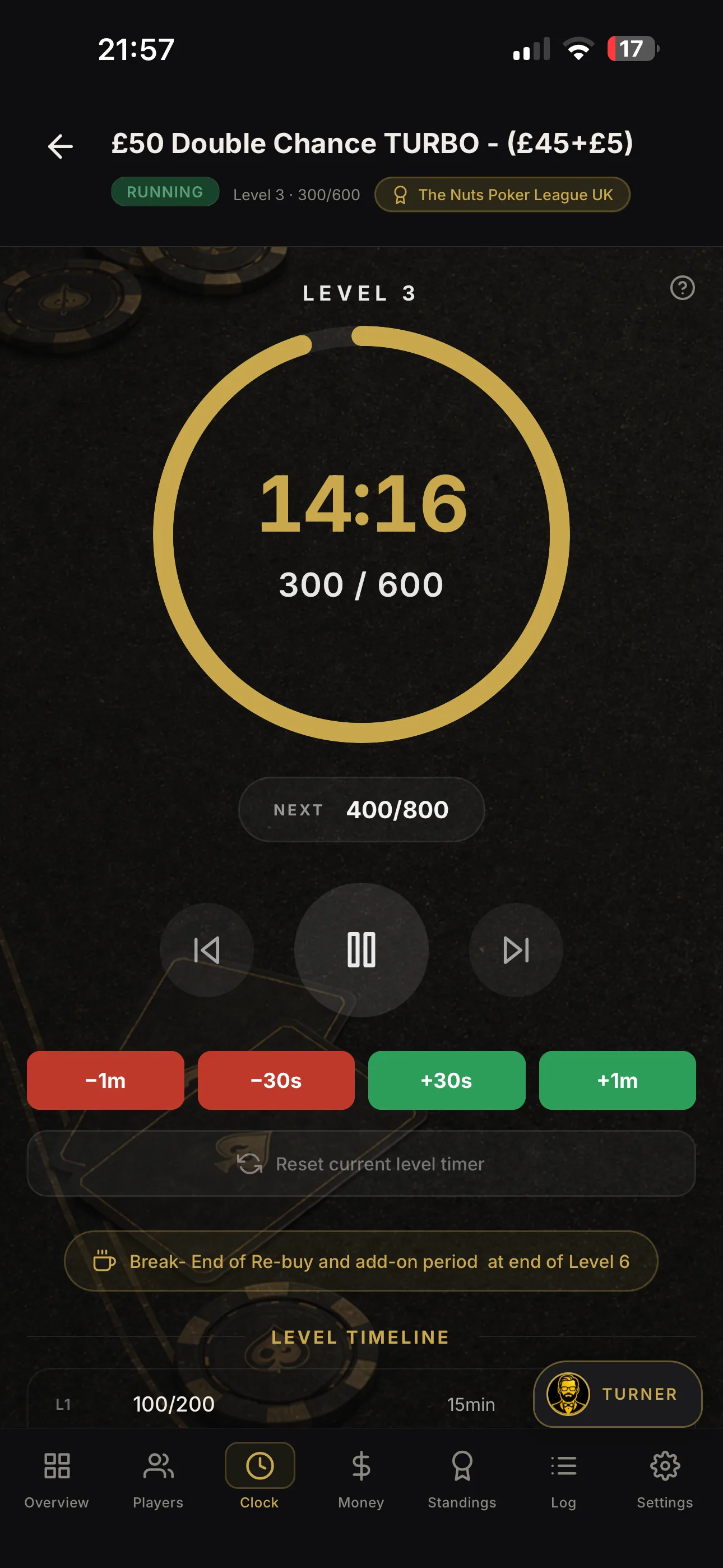
Seat draws, table balancing, the clock, payouts and league standings: Shuffle Up and Deal! runs the whole night from your iPhone or iPad.


Rebuy tournament rules: TD template and player guide
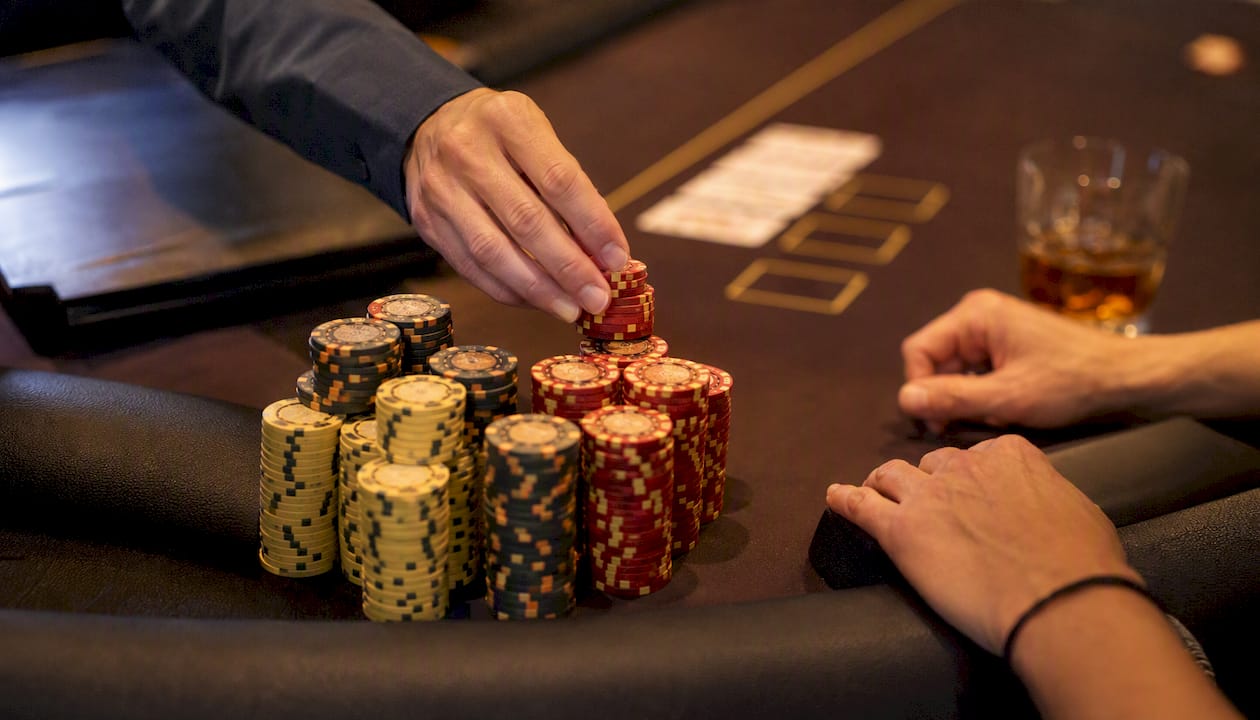
A rebuy lets a player purchase additional chips during a designated early phase of a tournament, without leaving their seat. Unlike a re-entry, which requires elimination first and typically attracts rake on each additional bullet, a rebuy keeps you in your seat and usually carries no extra rake on top of the original fee. The money goes straight into the prize pool.
The core rules, in brief:
- Eligibility: you may rebuy only when your chip stack is at or below the starting stack (some formats allow rebuy at any point during the period).
- Rebuy period: rebuys are available from the start of play through a set number of levels, commonly the first three to five blind levels.
- Double rebuy: many formats allow a double rebuy at the cost of two buy-ins, giving you twice the starting chips in one transaction.
- Add-on: a single, one-time chip purchase offered to every player at the end of the rebuy period, regardless of stack size, often for more chips than a standard rebuy.
- Unlimited vs capped: unlimited formats allow as many rebuys as you can afford; capped formats set a maximum (often one or two); the 1R1A format allows exactly one rebuy and one add-on.
- Seat retention: your seat is held throughout; you never re-draw.
Key takeaways
A clean rebuy event comes down to clear rules published before play, a disciplined add-on break, and an accurate log that reconciles chips against cash before the freezeout begins.
| Point | Details |
|---|---|
| Publish rules before registration | Post eligibility, cost, period length and add-on details in writing before the event opens. |
| Log every transaction | Record each rebuy and add-on with player name, table, seat and time to speed reconciliation. |
| Add-on is almost always worth taking | It typically offers more chips per pound than a rebuy and is available to every player regardless of stack. |
| Rebuy vs re-entry | Rebuys keep the seat and carry no extra rake; re-entries require elimination and usually attract rake. |
| Shuffle Up and Deal! automates the hard parts | Shuffle Up and Deal! enforces rebuy controls, updates prize-pool totals live, and produces a printable audit report at the break. |
Table of Contents
- How the rebuy phase runs, from registration to freezeout
- What the standard rebuy formats look like in practice
- Tournament director checklist and ready-to-copy rule text
- How live and online rebuy handling differs
- UK legal and compliance notes for organisers
- When should you rebuy? Practical guidance for players
- How Shuffle Up and Deal! enforces rebuy rules reliably
- A TD’s perspective on running rebuy events well
- Shuffle Up and Deal! takes the admin out of rebuy events
- Useful sources and further reading
How the rebuy phase runs, from registration to freezeout
Understanding the sequence is half the battle. Here is the standard timeline, step by step.
- Rebuy period begins. From hand one, eligible players may rebuy. Eligibility is typically triggered when your stack falls to or below the starting chip count, as Replay Poker’s rebuy documentation confirms.
- Add-on break. Every player, regardless of stack size, may purchase one add-on. PokerNews notes that add-ons typically provide more chips than a single rebuy, making them almost always worth taking.
Eligibility and seat retention
A player who busts completely may rebuy immediately and return to their seat. A player who still has chips may rebuy only if their stack is at or below the starting stack, unless the format specifies otherwise. The seat is never forfeited during the rebuy period, which is the clearest practical distinction from re-entry.
Where the money goes
Rebuy fees typically carry no additional rake. The full cost of each rebuy and the add-on goes into the prize pool, which is one reason rebuy formats remain attractive for charity and casual weekly events where a large guaranteed pool is the draw.
Pro Tip: Announce the rebuy period length and add-on cost before cards are in the air. Players who know the timeline make better decisions, and you field fewer disputes at the break.
What the standard rebuy formats look like in practice
Four formats cover the vast majority of events you will encounter or run.
Unlimited rebuy
Players may rebuy as many times as they like during the rebuy period. Prize pools grow quickly, and early play tends to be loose and aggressive. Best suited to experienced fields or events where a large prize pool is the primary selling point.
1R1A (one rebuy, one add-on)
One rebuy is permitted during the period; one add-on is available at the break. This sits between unlimited and freezeout in terms of field aggression and is the most common format for home games and mid-stakes UK club events. PokerListings’ format comparison notes that 1R1A produces more predictable prize-pool growth than unlimited formats.
Capped rebuy
A set maximum, typically two or three rebuys per player, with or without an add-on. Gives organisers tighter control over the event length and player chip counts.
1R0A (one rebuy, no add-on)
Simpler to administer and suits shorter events. The prize pool is more predictable, and the freezeout phase begins cleanly after the single rebuy window.
Format comparison
| Format | Max rebuys | Add-on | Prize-pool growth | Field behaviour | Best for |
|---|---|---|---|---|---|
| Unlimited | Unlimited | Usually yes | High, variable | Loose, aggressive | Large prize-pool events |
| 1R1A | 1 | Yes (1) | Moderate, predictable | Moderate | Home games, club events |
| Capped (2–3) | 2–3 | Optional | Moderate | Moderate | Mid-length events |
| 1R0A | 1 | No | Low, predictable | Tighter | Short events, beginners |
Sample structure for a 6-hour event (1R1A)
| Level | Blinds | Duration | Notes |
|---|---|---|---|
| 1 | - | - | Rebuy period open |
| 2 | - | - | Rebuy period open |
| 3 | - | - | Rebuy period open |
| Break | - | - | Add-on available |
| 4 | - | - | Freezeout begins |
| 5 | Escalating | - each | Standard play |
Starting stack: a fixed amount of chips. Single rebuy equals the starting stack. Double rebuy gives twice the starting chips. Add-ons usually provide more chips than a single rebuy.
Tournament director checklist and ready-to-copy rule text
Copyable rule text (paste into your lobby or printed sheet)
Rebuy rules for this event Rebuys are available from the start of play through the end of Level 3. Cost: £[X] per rebuy (equal to the buy-in). Players with a stack at or below the starting stack of [X] chips may rebuy. A double rebuy (2× cost, 2× chips) is available in the same window. One add-on of [X] chips is available to all players at the Level 3 break for £[X]. Late registration closes at the end of Level 3. All rebuy and add-on fees go entirely to the prize pool. No rake is charged on rebuys.
Operational checklist for TDs
- Table balancing: after each rebuy, check whether table counts require a seat move; use your seating chart display to identify imbalances quickly.
Common edge cases and TD rulings
- Add-on period IT issue: if your software fails during the add-on break, revert to the paper log. Accurate logs matter for crash recovery and prize-pool reconciliation.
Pro Tip: Use a simple staff script: “Rebuys are now closed. The add-on break is [X] minutes. The add-on costs £[X] and gives you [X] chips. Please bring cash to the desk.” Repeat it twice.
How live and online rebuy handling differs
The mechanics are the same; the execution is not.
Live events (UK venues and home games):
- Rebuys are TD-mediated. A player signals the dealer, who calls the floor. Payment is collected in cash or via a chip voucher system.
- Receipts are physical. Keep a duplicate copy at the desk and one with the player.
- Prize-pool totals are often published only after the add-on break, once cash is reconciled. Post a running total on a whiteboard or display to keep players informed.
- Table balancing after rebuys requires a TD decision and a physical seat move. A seating chart display makes this faster and reduces errors.
- Late registration at a venue like Q Billiards Arena typically requires a player to present at the desk before being seated, adding a short delay.
Online events:
- Rebuy buttons appear automatically when a player becomes eligible. The UI shows the time remaining in the rebuy period and the cost.
- Payments are processed instantly. Prize-pool totals update in real time in the lobby, though final totals are only confirmed after the add-on window closes.
- Seat retention is automatic. There is no physical seat to manage.
- Table balancing is handled by the platform’s algorithm.
Pro Tip: Mirror online clarity in your live room. A countdown timer on a screen, a whiteboard prize-pool total and a printed rebuy log give players the same confidence they get from an online lobby.
UK legal and compliance notes for organisers
This section is general information only, not legal advice. Consult a solicitor or your local authority before running paid poker events.
Running a paid rebuy tournament in the UK involves several regulatory considerations.
- Gambling Act 2005: most paid poker events require a licence or an exemption. The Gambling Commission is the primary regulator. Private games between friends with no operator profit may qualify for an exemption, but commercial events almost always require a licence.
The Gambling Commission’s guidance on non-commercial gaming and society lotteries is the starting point for any UK organiser unsure whether their event requires a licence. Check the current guidance at gamblingcommission.gov.uk before advertising a paid event.
Pro Tip: Publish your full rule set, refund policy and behaviour code on your event page before registration opens. It reduces disputes and demonstrates good faith to players and regulators alike.
When should you rebuy? Practical guidance for players
Three questions to ask before you reach for your wallet.
- What stack will you receive? A double rebuy that puts you above average stack is almost always better value than a single rebuy that leaves you short. Poker Coaching’s strategy notes recommend buying the maximum chips available when the maths justifies it.
Bankroll management for rebuy events
A common rule of thumb is to budget for the buy-in plus the maximum number of rebuys and the add-on before you register. If you cannot comfortably afford the full package, a freezeout is a better choice for your bankroll.
Gameplay adjustments during the rebuy period
Expect looser, more aggressive play from opponents who know they can rebuy. Preserve your equity by avoiding marginal all-ins early. Play your strong hands hard; fold the speculative ones you would normally call with in a freezeout.
The add-on: almost always take it
The add-on is available to every player, regardless of stack size, and typically offers more chips per pound than a rebuy. Skipping it is one of the three most common mistakes players make in rebuy events, alongside single-stacking when a double stack is available and gambling recklessly during the rebuy period.
Pro Tip: The moment the add-on break ends, mentally switch formats. You are now in a freezeout. The loose, aggressive mindset that served you during the rebuy period will cost you chips from this point forward.
How Shuffle Up and Deal! enforces rebuy rules reliably
Running a clean rebuy event by hand is possible. Running one with Shuffle Up and Deal!’s Shuffle Up and Deal! app is faster, more accurate, and far less stressful.
Feature checklist for rebuy events
- Live prize-pool display: the running total updates with every rebuy and add-on, visible on your tournament management display and on players’ devices via share links.
- AI rules assistant: - when a dispute arises mid-event, the built-in AI rules assistant helps you interpret and apply the correct ruling quickly.
Implementation tips
Use the app’s rebuy controls to lock out rebuys automatically when the period ends. This removes the risk of a player claiming they were mid-rebuy when the period closed. At the add-on break, trigger the add-on window in the app; it timestamps the open and close of the period, giving you a clean audit trail.
Pro Tip: Connect the app’s live display to a screen at the front of the room. Players can see the prize pool growing in real time, the rebuy period countdown, and their table assignments, all without asking the TD.
App feature summary
| Feature | Benefit during rebuy event |
|---|---|
| Rebuy/add-on controls | Enforces eligibility and period timing automatically |
| Live prize-pool display | Players and TDs see accurate totals in real time |
| Audit log | Timestamps every transaction; speeds reconciliation |
| Smart table balancing | Flags imbalances after each rebuy |
| Printable reports | One-click reconciliation at the add-on break |
| AI rules assistant | Resolves disputes quickly without stopping play |
A TD’s perspective on running rebuy events well
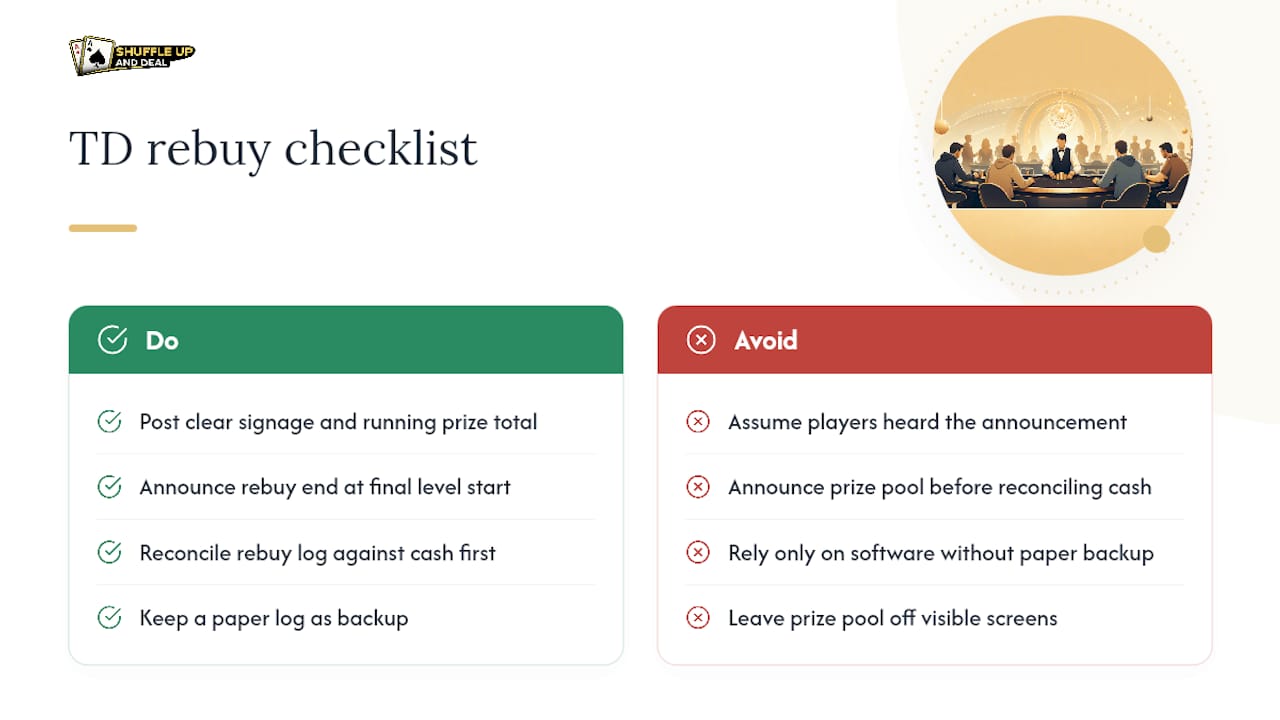
The part of rebuy events that catches most organisers out is not the rules themselves. It is the gap between the rules as written and the rules as communicated. Players who did not hear the add-on announcement, players who thought they had one more level to rebuy, players who dispute the prize-pool total because they never saw it update - these are the disputes that slow down your break and create bad feeling at the table.
The fix is almost always the same: more signage, more announcements, and a visible running total. If players can see the prize pool growing on a screen, they trust it. If they hear the rebuy period countdown called at the start of each level, they plan around it. The rules themselves are simple. The communication is where events succeed or fail.
Three practical lessons stand out from running these events repeatedly. First, announce the rebuy period end at the start of the final rebuy level, not just at the break. Players need time to decide. Second, always reconcile your rebuy log against cash before you announce the prize pool. A discrepancy discovered after the announcement is far harder to correct than one caught at the desk. Third, keep a paper log even when you are using software. If the app crashes during the add-on break, your paper trail is what protects you and your players.
The difference between a chaotic rebuy event and a smooth one is almost never the format. It is the preparation.
Shuffle Up and Deal! takes the admin out of rebuy events
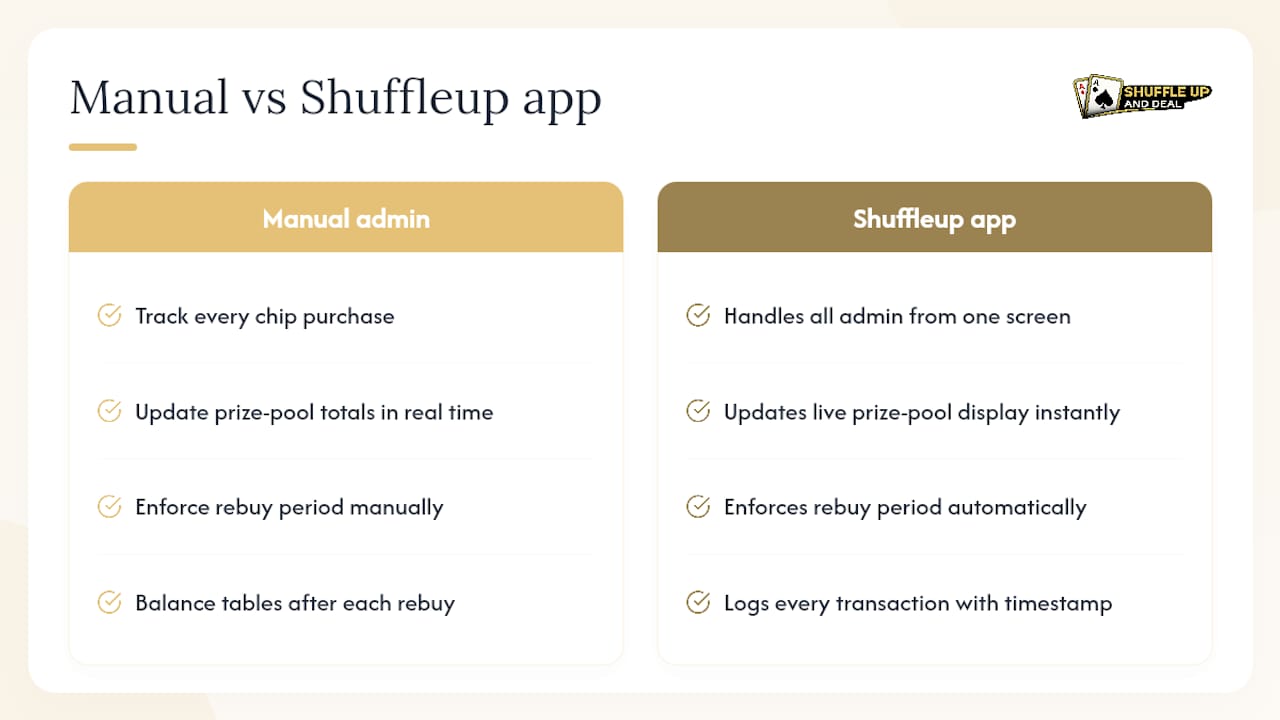
Running a rebuy tournament means tracking every chip purchase, updating prize-pool totals in real time, balancing tables after each rebuy, and reconciling cash at the add-on break, all while keeping the game moving. That is a lot to manage manually.
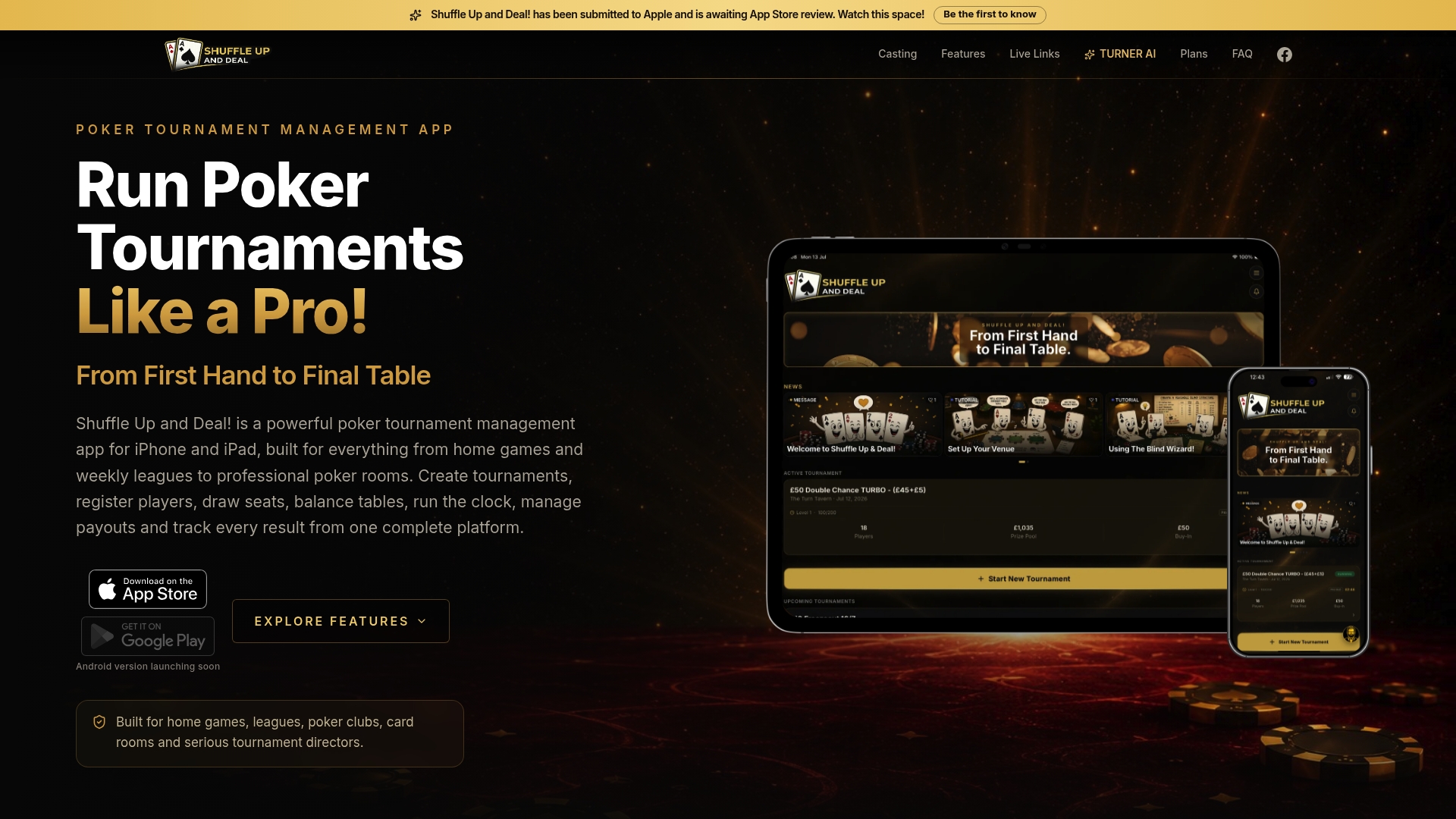
Shuffle Up and Deal!’s Shuffle Up and Deal! app handles all of it from a single screen on your iPhone or iPad. Set your rebuy controls before the event starts, and the app enforces the period automatically, logs every transaction with a timestamp, and updates the live prize-pool display the moment a rebuy is processed. At the add-on break, one tap generates a printable reconciliation report. No spreadsheets, no manual tallies, no disputes about what the prize pool actually is.
Whether you are running a home game or a card room event, the app gives your players the professional experience they expect and gives you the audit trail you need. Start your free trial at shuffleup.co.uk and see how much smoother your next rebuy event runs.
Useful sources and further reading
The sources below informed this guide and are worth bookmarking for ongoing reference.
- Rebuy tournaments – Replay Poker
- Rebuy poker tournaments - Poker Coaching
- What is Rebuy in Poker? - PokerNews
- Rebuy Poker Tournaments Explained | BetMGM Poker
- What is the difference between rebuy and re-entry - PokerListings
- Firing a second bullet: WPT Global examines re-entry tournaments | PokerNews
- You Need to Know About Rebuy - PokerStrategy
Keep a printed copy of your rule text at the TD desk throughout the event. Your app audit log is your primary record, but a physical backup protects you if technology fails during the add-on break.
Recommended
- Best TDA rules app for TDs: TURNER in Shuffle Up and Deal! | Shuffle Up and Deal!
- Freezeout tournament rules: the complete guide for players and TDs | Shuffle Up and Deal!
- Big blind ante explained: players and TDs guide | Shuffle Up and Deal!
- Poker chip breakdown: the UK tournament director’s guide | Shuffle Up and Deal!