
Poker Tournament Management App
Run Poker Tournaments Like a Pro!
From First Hand to Final Table
Seat draws, table balancing, the clock, payouts and league standings: Shuffle Up and Deal! runs the whole night from your phone or tablet.


Stop clock disputes in poker: etiquette, timing and TD rules
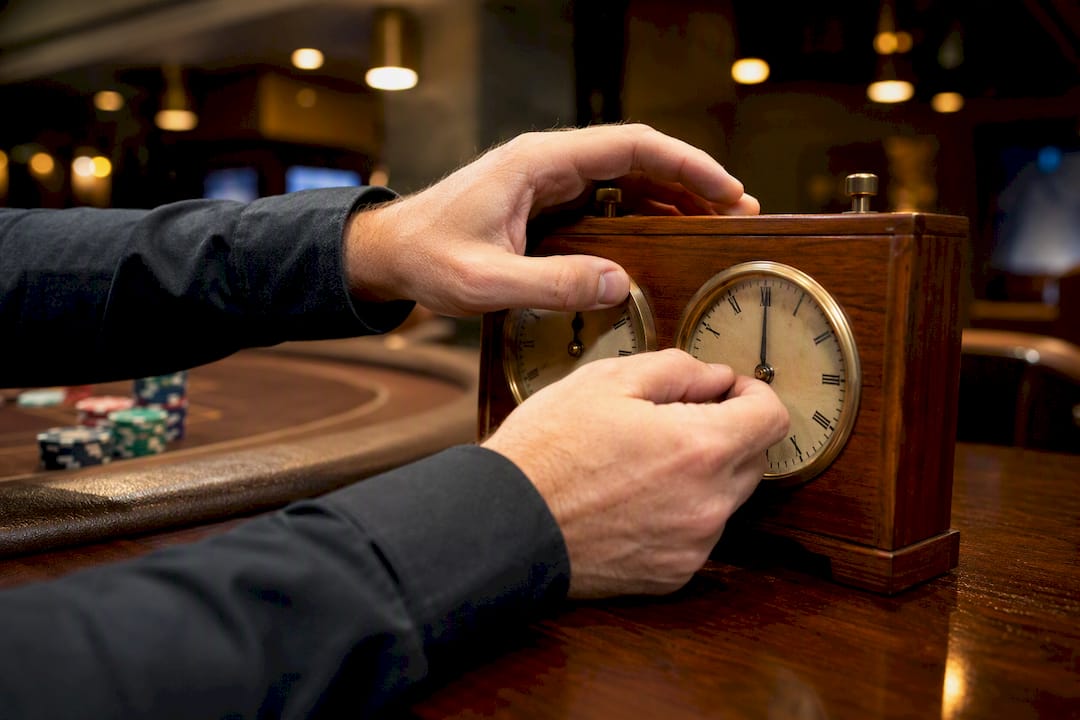
Calling the clock in poker means asking the dealer or floor staff to force a slow opponent into a timed decision, usually a minute, after which the hand is declared dead if they don’t act. Any player at the table can invoke it, though the actual countdown and any penalty sit with the dealer or tournament director. The rest of this guide covers how the process runs at the table, the timings that apply, when calling the clock is fair and when it isn’t, and how to handle it if the clock gets called on you.
TL;DR:
- Calling the clock typically grants the timed player one minute to act, with shorter or longer decision times depending on tournament stage and venue rules.
- Most courts and casinos require a player to wait at least one minute before calling the clock, reserving it for genuine delays rather than routine thinking.
- Automated shot clocks start the countdown immediately when action reaches a player, often with extra time banks available for complex decisions.
- Calling the clock can affect the table’s atmosphere by increasing pressure, which may lead to rushed decisions or deliberate exploitation.
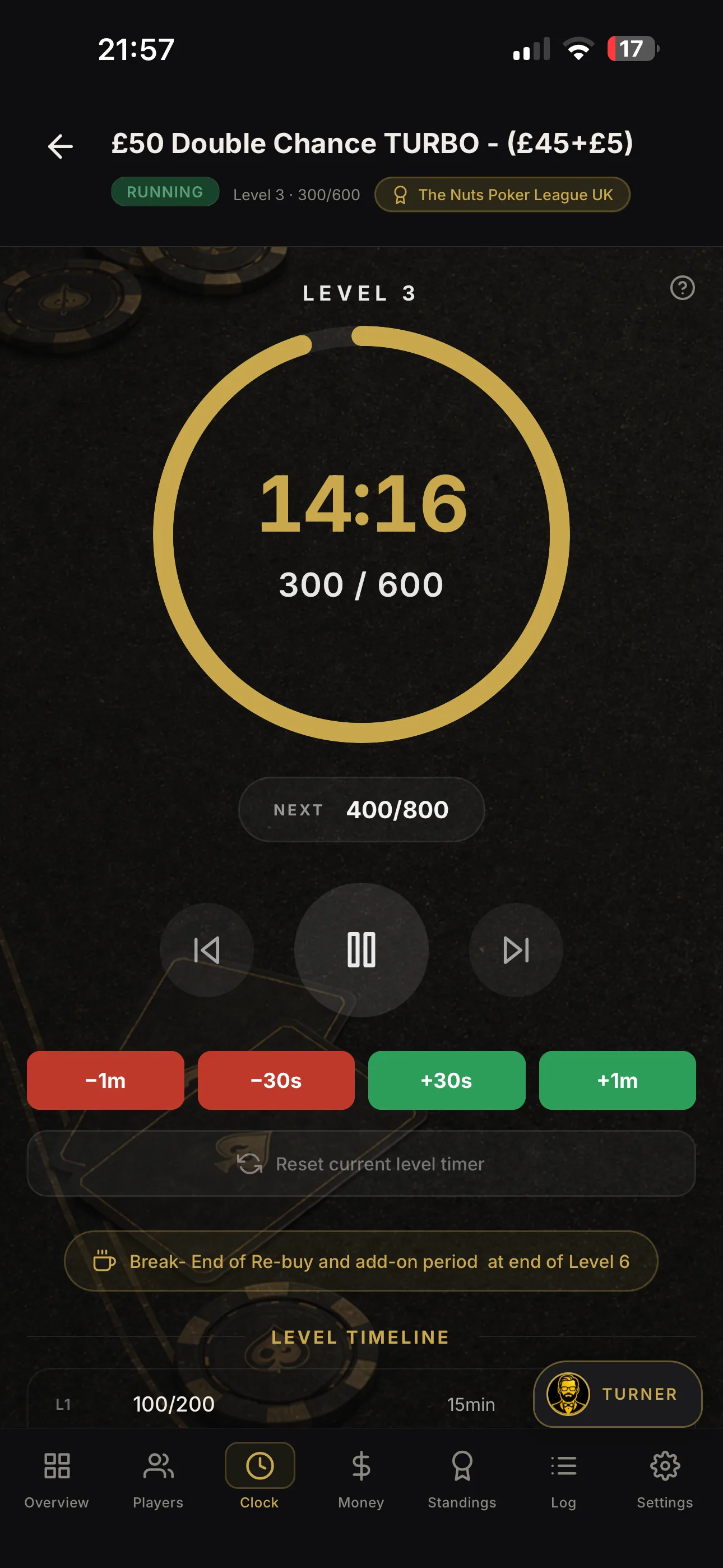
- Using a tournament app with a synced live clock reduces disputes and ambiguity by making timing transparent and visible to all players.
Table of Contents
- What happens when someone calls the clock
- How long do you actually get? Shot clocks and time banks explained
- When it’s fair to call the clock (and when it isn’t)
- Using the clock as pressure, and what to do when it’s called on you
- Why organisers build the clock into the tournament, not the table
- Where “calling the clock” actually comes from
- Real situations where the clock gets called
- How the rule changes between rooms, casinos and online platforms
- What a clock call does to the table’s mood and to the player under it
- An organiser’s view on keeping the clock fair
- Manage your tournament clock properly with Shuffle Up and Deal!
- Sources
What happens when someone calls the clock
Any player still in the hand can call the clock on an opponent who’s taking too long to act. In cardrooms and casinos, dealers are often authorised to start the process themselves once a decision drags on well past what’s reasonable, and floor staff get involved as soon as a formal call is made.
The mechanics are fairly consistent across live poker rooms, home games, and casinos:
- A player says “clock” or “I’m calling the clock,” and the dealer signals the floor.
- The floor person walks to the table and confirms the call is valid before starting the countdown.
- The countdown is announced aloud, often with a warning at 10 seconds remaining so the player knows time is nearly up.
- If time expires with no action, the standard penalty is a dead hand, though some venues instead force an automatic check or fold, particularly under an active shot clock.
This isn’t a formality that gets waved through automatically. Most floors will check that the calling player has waited a sensible amount of time before starting a countdown, which protects against clock calls used purely as harassment. Once the countdown starts, though, it runs regardless of table mood, and the outcome is binding.
How long do you actually get? Shot clocks and time banks explained
A minute is the benchmark most players quote, and it holds up as the standard decision window once a clock is called or a shot clock triggers. Some tournaments tighten that to 30 seconds at later stages, when fewer players remain and pace matters more, while others stretch early levels to 90 seconds so newer players aren’t punished for thinking.
Shot clocks remove the guesswork by automating the whole process. Rather than waiting for a player to invoke the rule, the countdown starts the moment action reaches you, and decision windows commonly run between half a minute and one and a half minutes depending on the tournament’s stage. Time banks sit alongside this: a limited pool of extra seconds, drawn from cards or a running balance, that players spend when a hand genuinely needs longer than the standard clock allows.
| Setting | Typical decision time | Extra time available |
|---|---|---|
| Ad hoc clock call (cash game) | 1 minute | None, unless house rules allow |
| Early tournament levels | between 30 seconds and 1.5 minutes | Time bank often unlocked later |
| Late tournament stages / final table | 30 seconds or more | Time-bank cards add roughly 30 seconds each |
| Automated shot clock | 30–1 minute | Fixed time-bank allocation per player |
Tournament directors frequently adjust shot-clock length by stage, tightening the window and sometimes dropping the 10-second warning as the field shortens. Check the specific event’s rules sheet before you rely on a particular number.
When it’s fair to call the clock (and when it isn’t)
Timing your clock call badly causes more table friction than the slow play ever did. In a casual home game, most experienced players expect you to wait at least two to three minutes before calling the clock on a genuinely tough spot, especially in big pots with real decisions to weigh. Tournament settings justify a faster trigger, because the format runs on a schedule and one player’s long tank affects everyone left in the field.
Good etiquette generally looks like this:
- Wait through the first minute or so of silence before saying anything, particularly in cash games.
- Catch the dealer’s eye quietly and state the request calmly rather than announcing it as a challenge.
- Reserve clock calls for genuinely disruptive delays, not routine tanks on a standard decision.
- Accept the floor’s ruling on validity without arguing the point at the table.
Industry glossaries frame this the same way: calling the clock exists to discourage excessive stalling, not to punish someone for thinking. Call it too early or too aggressively and you’ll come across as a bully rather than someone protecting the table’s pace.
Pro Tip: If you’re unsure whether a delay has crossed the line, ask the dealer quietly how long the player has already taken. A neutral third party confirming the wait time defuses most of the tension before you even call it.
Using the clock as pressure, and what to do when it’s called on you
Calling the clock isn’t only a fairness tool. Skilled players sometimes use it deliberately to rattle an opponent mid-decision, forcing a quicker read than they’d like to give. It works, but it’s a socially risky play: used too often or without real justification, it can sour the table against the player calling it, not the one being timed.
If the clock gets called on you, three things matter more than panic:
- Act on the obvious folds and calls immediately. If the decision genuinely isn’t close, don’t burn seconds proving you thought hard about it.
- Spend a time-bank card the moment you know a hand is complex enough to need it, rather than waiting until the countdown is already running.
- Ask the floor for a ruling if something is unclear (whether a bet size was announced correctly, for instance) rather than guessing under pressure.
Shot clocks and time banks work as a resource to manage deliberately, not a reserve to spend automatically on every close spot. Save cards for genuine multi-way decisions with real chips at stake, and practise making the routine folds and continuation bets faster in low-stakes spots, so your time bank is still there when a final-table pot actually needs it.
Why organisers build the clock into the tournament, not the table
Tournament directors who rely on players to police pace manually are inviting disputes. A visible clock and a published blind schedule remove most of the ambiguity before anyone needs to say a word, because every player at the table can see exactly how much time is left and what happens next.
That’s the practical case for building timing into the tournament structure itself rather than leaving it to ad hoc calls:
- A live tournament clock keeps blind levels, antes, and break timing visible to the whole room, not just the players closest to the dealer.
- Casting that clock to an external display or TV means nobody has to ask “how long left in this level?”, which is often the real question behind a premature clock call.
- Multi-device syncing keeps every table’s clock identical, so there’s no argument about whether one table is running ahead of another.
Shuffle Up and Deal! was built around exactly this problem: giving tournament directors a live clock, blind-level management, and external display casting that keep the whole room informed without a single manual countdown. Fewer surprises about time remaining generally means fewer clock calls in the first place.
Where “calling the clock” actually comes from
The rule predates modern televised poker by decades. Cardrooms in Las Vegas and California were running structured floor rules through the 1970s and 1980s as legal poker rooms formalised, and a mechanism for handling chronic stalling was a natural addition once games moved from private rooms into regulated, licensed cardrooms with paid dealers and a floor staff answerable to management.
Tournament poker’s boom after 2003 pushed the rule into sharper focus. Fields grew from dozens of players to thousands, and a single player tanking repeatedly at a final table could delay a broadcast, a payout structure, or an entire day’s schedule for everyone else in the room. That pressure is what eventually produced the modern shot clock: an automated version of the same idea, first trialled seriously in major televised events during the 2010s, designed to remove the social awkwardness of one player calling the clock on another by making the countdown a permanent feature of every hand rather than an exception.
Cash games kept the older, informal version largely intact, because the schedule pressure that drives tournaments simply doesn’t apply in the same way when there’s no field to move through and no clock on the whole event. The result is two versions of the same rule running in parallel today: one triggered by a player’s request, the other running automatically in the background of most serious tournament structures.
Real situations where the clock gets called
The clearest case is the marathon tank on a genuinely close river decision, where a player sits motionless for several minutes while the rest of the table waits. That’s the scenario the rule was built for, and it’s rarely controversial once the countdown starts.
Less obvious situations come up just as often. A player repeatedly asking for a stack count, then thinking again, then asking a second time, can stretch a routine decision well past what anyone would call reasonable, even without a single moment that looks like deliberate stalling. Multi-way pots near the money bubble in a tournament produce a different version of the same problem: everyone at the table has a genuine incentive to think slowly, because the min-cash implications are real, and a floor may need to call time across several players in the same orbit rather than just one.
Heads-up play late in a tournament brings its own pattern. With only two players left, a single slow decision affects one opponent directly rather than diluting across a full table, which is why final-table shot clocks tend to run shorter, not longer, than earlier levels. Online poker has its own version too: sitting out a disconnect timer or repeatedly using the maximum allowed think-time on trivial folds is functionally the same behaviour, even though no one at a physical table ever says the word “clock” out loud.
How the rule changes between rooms, casinos and online platforms
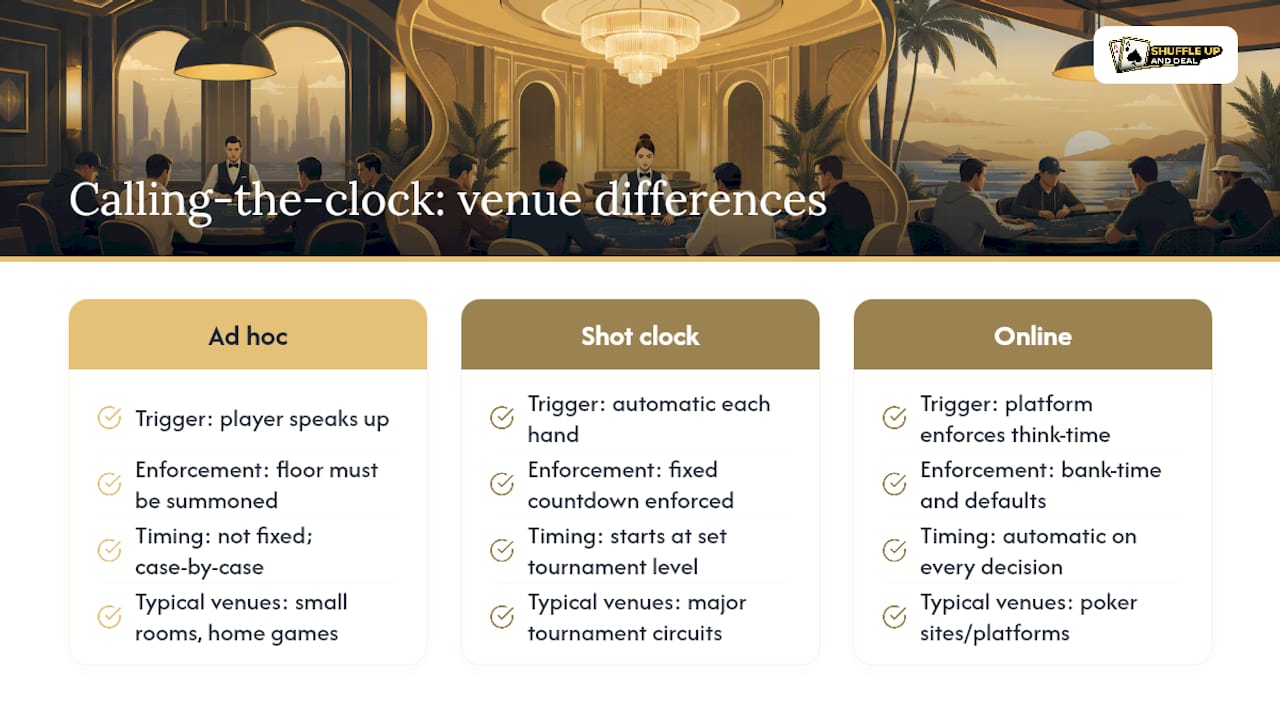
There’s no single global rulebook governing exactly how calling the clock works, which is why the details shift noticeably between venues. Some cardrooms require a minimum number of players to support a clock call before the floor will act on it, treating a single voice as insufficient to force the issue. Others let any one player trigger the process without backing from the table.
The bigger divide is between events that run on an ad hoc clock call and those built around a mandatory shot clock. Major tournament circuits increasingly default to shot clocks from a set level onward, removing the social element entirely and replacing it with a fixed countdown that starts on every hand regardless of table temperament. Smaller cardrooms and most home games still rely on the traditional version, where a player has to speak up and the floor has to be walked over before anything happens.
Online platforms handle it differently again. There’s rarely a literal “clock” to call, because most sites enforce a bank-time or think-time system automatically on every decision, with disconnect protection and default-action settings standing in for the live-floor ruling. The underlying principle carries across all three formats: give a player a bounded, known amount of time and enforce a consequence when it runs out. The mechanism enforcing that principle is what differs, and it’s worth checking a specific room’s or platform’s rules sheet before assuming your home-game habits will transfer directly.
What a clock call does to the table’s mood and to the player under it
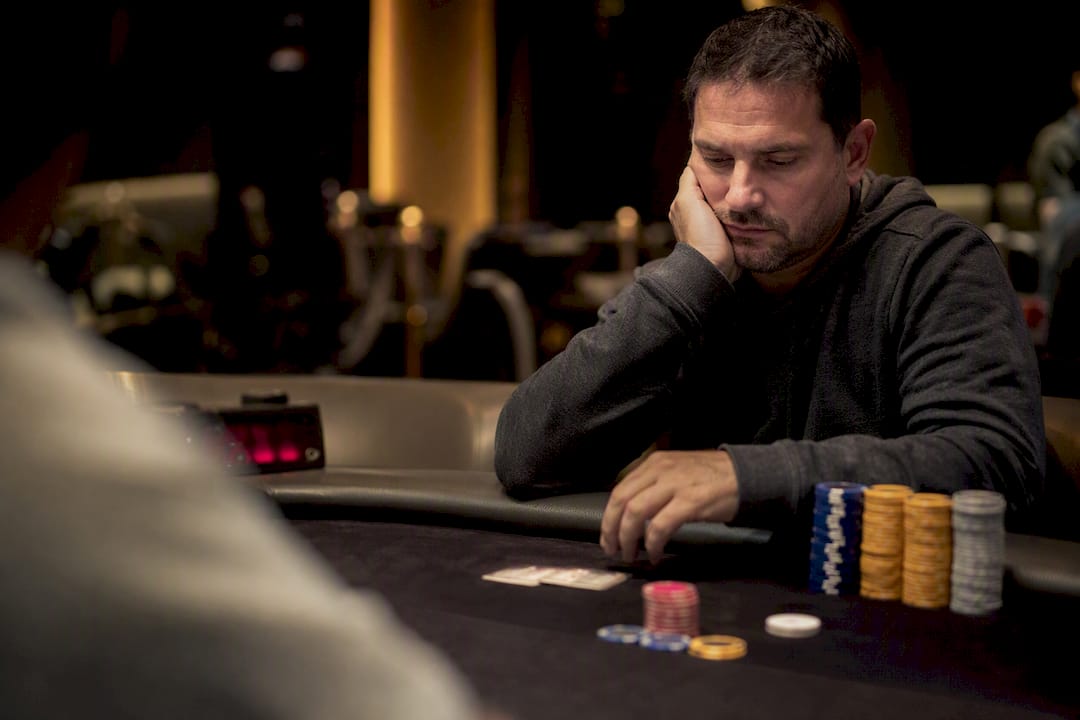
A clock call changes the emotional temperature of a table almost instantly, even when it’s applied fairly. The player being timed often feels singled out, and everyone else at the table becomes a spectator to what’s essentially a public countdown on someone’s decision-making. That shift in atmosphere is part of why the rule works as a deterrent against genuine stalling. Nobody wants to be the player who needs the clock called on them twice in one session.
The psychological effect cuts both ways, though. A player under real time pressure tends to default to their most instinctive read rather than their most considered one, which can produce worse decisions, not more honest ones. Some players deliberately exploit this, timing their own bet sizing or table talk to nudge an opponent toward exactly that instinctive, rushed call. Others simply freeze under the ticking clock and make a decision they’d take back given another thirty seconds.
For the wider table, the practical effect is usually positive once the countdown ends: the game moves again, the schedule stays intact, and the mild discomfort of one timed decision beats the slow erosion of an entire session dragged out by repeated stalling. That’s the trade-off tournament directors are making every time they publish a clock policy: a small, visible dose of pressure on individual hands in exchange for an event that actually finishes on time.
An organiser’s view on keeping the clock fair
Running enough tournaments teaches you that most clock disputes are really schedule disputes wearing a different name. Players get tense about time when they don’t trust the structure around them, and a visible, consistent clock does more to prevent conflict than any amount of floor diplomacy after the fact.
The lesson that’s stuck: publish your timing rules before Level 1, not after the first argument. A room that knows exactly what to expect rarely needs anyone to call anything.
- Jason
Manage your tournament clock properly with Shuffle Up and Deal!
Shuffle Up and Deal! gives you one less reason for anyone at your event to reach for the word “clock.” Every table runs from the same live tournament clock, synced across every device in the room, so blind levels, antes, and breaks are visible without a single player needing to ask a dealer how much time is left.
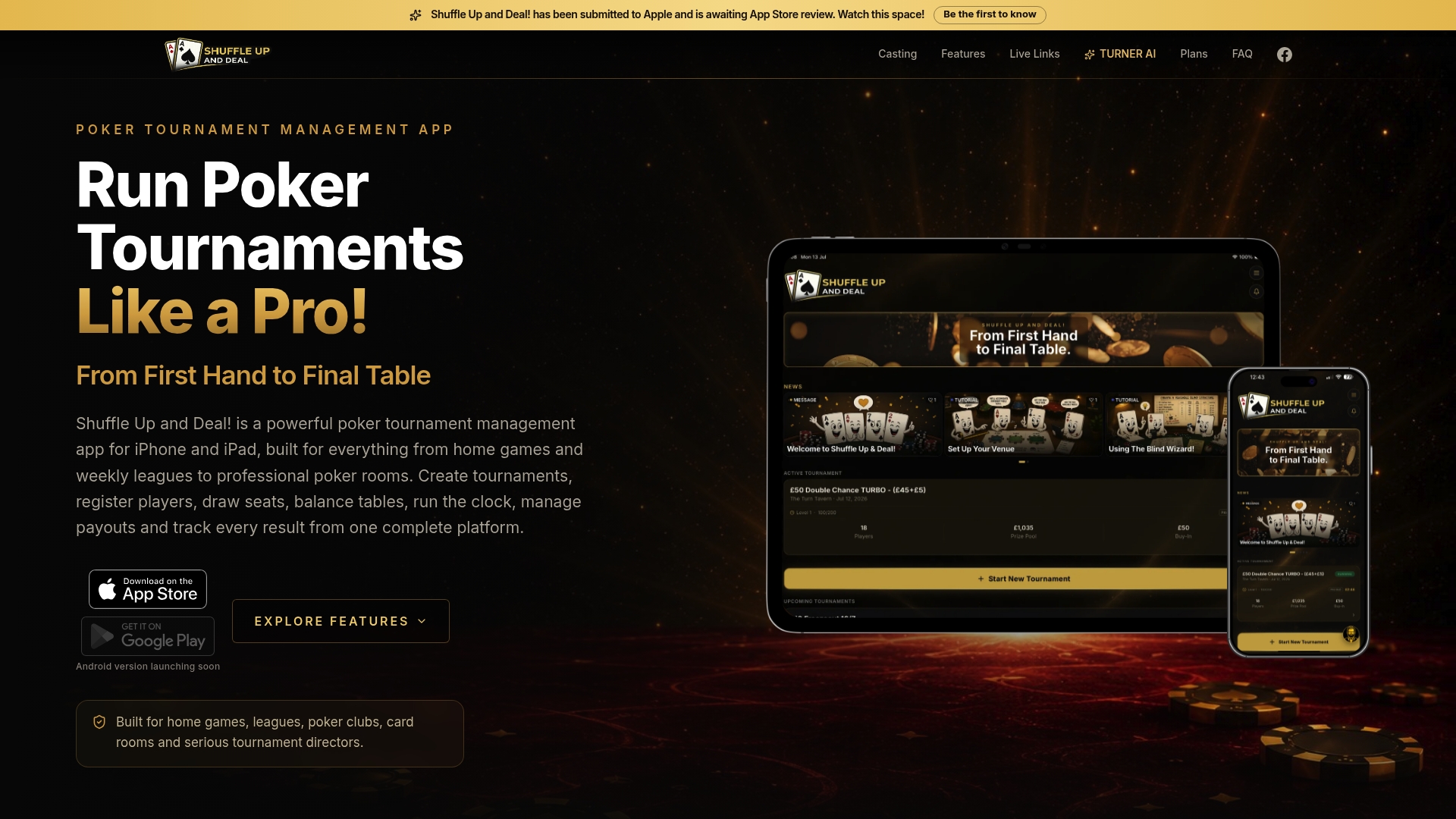
The app’s blind-level management handles the structure itself, letting you set escalating levels in advance so there’s no ambiguity about when the next jump happens. Cast the display to an external screen or TV, and the whole room sees the same countdown you’re running from your phone or iPad, which removes most of the guesswork that leads to premature or disputed clock calls in the first place. Multi-device syncing means a second organiser running a satellite table sees exactly the same numbers you do, so there’s never a “your clock says something different to mine” argument mid-level.
If you’re tired of chasing tables to confirm timing or fielding the same “how long left” question all night, set up your next event with Shuffle Up and Deal! and let the live clock do that work for you.
Sources
- Call the Clock – Learn What Is Call the Clock in Poker
- What is a Calling Clock in Poker? • Americas Cardroom
- Shot Clock | Poker Terms | PokerNews
- What is Calling the Clock in Poker? - Upswing Poker