
Poker Tournament Management App
Run Poker Tournaments Like a Pro!
From First Hand to Final Table
Seat draws, table balancing, the clock, payouts and league standings: Shuffle Up and Deal! runs the whole night from your iPhone or iPad.


Poker floor decisions: a director's guide to fast, fair rulings

A poker floor decision comes down to one thing: apply the written rule, protect the evidence, and rule before the game loses momentum. If you’re called to a table, the ruling is simple in structure even when the situation is messy. State your decision in one sentence, name the rule you applied (TDA guidance or your own house rule), and move on.
Three actions happen in the same breath as that ruling:
- Preserve evidence - impound the pot or mark the disputed chips before anyone touches them.
- Log the incident - table number, seat numbers, time, and who called the floor.
- Decide on continuity - is play paused, or does the hand carry on pending a final word?
You must request or issue that ruling before the next deal or shuffle. That’s the ruling window, and once it closes, your options narrow fast. A tournament app that timestamps hands and tracks pot history makes reconstruction inside that window considerably quicker than working from memory and scattered notes.
TL;DR:
- Most disputes should be resolved within the ruling window before the next shuffle, as reconstruction becomes unreliable afterward.
- Consistent application of written rules, along with quick evidence preservation and logging, is essential to maintain fairness and trust.
- Use a streamlined checklist and digital tools like Shuffle Up and Deal! to speed up decision-making and facilitate accurate future reconstructions.
- Escalate to a shift supervisor only for ambiguous or high-stakes issues, and handle dealer errors quietly to preserve authority and morale.
- Clear, neutral communication by staff can de-escalate disputes and foster smoother resolution with minimal tension.
Table of Contents
- What is the right framework for consistent poker floor decisions?
- What are common poker floor incidents and their standard rulings?
- How should you communicate a floor ruling to keep the table calm?
- How do you build a checklist for on-floor rulings?
- How does Shuffle Up and Deal! speed up floor decisions and record-keeping?
- How does the escalation hierarchy work on a poker floor?
- Why does consistency matter more than getting every call perfectly right?
- How should you handle dealer errors without undermining their authority?
- What counts as proper conduct when calling the floor?
- What communication skills does floor staff need for conflict resolution?
- What are the most common rule interpretations directors get asked about?
- Who wins when tournament rules and casino house rules conflict?
- What training and qualifications should floor staff have?
- What most guides get wrong about poker floor decisions
- Get faster, better documented poker floor decisions with Shuffle Up and Deal!
- Key Takeaways
- Sources
What is the right framework for consistent poker floor decisions?
Every solid ruling rests on four principles: fairness, consistency, timeliness, and documentation. Miss any one of them and you’ll either make a technically correct call that feels unjust, or a popular call that undermines your own rulebook next week. Consistency matters more than most directors admit. A floor that bends the rule for a well liked regular and enforces it strictly against a newcomer erodes trust faster than any single bad beat ever could.
The step sequence rarely changes, whatever the dispute:
- Verify the facts - get accounts from the dealer and both affected players before forming an opinion.
- Preserve the evidence - chips stay where they are, cards stay face up, and nobody stacks anything until you say so.
- Apply the written rule - check your house rules first, then TDA guidance where your own rules are silent.
- Deliver the remedy - reconstruct the pot, return chips, or void the hand, whichever the rule demands.
- Communicate and log - announce the ruling, then record it before you walk away from the table.
The ruling window typically closes at the first riffle or shuffle after the disputed action. Once cards are back in play, memories blur and reconstructing betting becomes guesswork rather than fact. Train your dealers to physically pause on a floor call rather than tidy the deck out of habit.
Fairness occasionally has to override strict rule text, but only in narrow, documented circumstances, such as a dealer error nobody at the table could have anticipated. When you bend a rule, write down exactly why. A pattern of undocumented exceptions is indistinguishable from inconsistency, and players notice the difference between principled discretion and favouritism within a single session.
Pro Tip: Keep a running exceptions log separate from your main incident log. If you find yourself citing the same exception twice in a month, it’s not an exception anymore. It’s a gap in your house rules that needs writing up properly.
What are common poker floor incidents and their standard rulings?
Most floor calls fall into a handful of repeatable categories, and having a default ruling ready for each one saves you from relitigating first principles at 2am on Day 2.
- Chip-count disputes: the dealer counts first, in full view of the table. Impound the disputed chips if the count materially changes the pot, and only return them once both players agree the recount is final.
- Exposed cards and mucked hands: if a dealer prematurely exposes a card or mucks a live hand, the hand is generally dead unless the error was clearly the house’s fault and the player acted in good faith, in which case the TDA framework allows a more lenient remedy.
- Mis-awarded pots: reconstruct the betting in chronological order and transfer the corrected amount, rather than trying to physically re-sort mingled chips under pressure.
- String bets and irregular betting: assess intent before penalising. A confused amateur pushing chips in two motions is not the same as an experienced player angling for a read.
A meaningful share of disputes at any card room trace back to chip handling and mis-stacked pots rather than genuine rule ambiguity, which is exactly why chip breakdown discipline at the table prevents more floor calls than any rulebook ever will.
Recorded footage earns its keep when accounts genuinely conflict and the pot at stake justifies the delay. Escalate to footage review only when a verbal reconstruction from dealer and players can’t settle the facts, since pulling camera footage for every minor dispute slows the whole room down without improving accuracy in the majority of straightforward cases.
How should you communicate a floor ruling to keep the table calm?
The words you use matter almost as much as the ruling itself. State the rule, state the decision, and stop talking. Something like: “Per our house rule on string bets, that’s a call only, no raise” gives the table a neutral, factual anchor rather than an opening for debate. Borgata’s own guidance on dispute handling frames the floor as a neutral referee, and that framing works because players calm down faster when they sense you’re applying a rule rather than picking a side.
- Announce the ruling publicly, briefly, and without editorialising.
- Correct a dealer’s mistake privately wherever possible, not from across the table.
- Escalate to a warning or a clock penalty only after a clear, repeated pattern, not a single frustrated outburst.
- Weigh a player’s history and evident intent when a rule allows discretion, but apply that same standard to everyone.
Pro Tip: Take the dealer aside between hands rather than correcting them mid-hand in front of players. A dealer who feels publicly embarrassed makes more mistakes, not fewer, for the rest of their down.
How do you build a checklist for on-floor rulings?
A workable checklist fits on one screen or one card, and it should never require you to think past the third bullet under pressure.
- Call accepted and floor is on the way.
- Chips and cards marked or impounded immediately.
- Time stamp recorded the moment you arrive.
- Witnesses and seat numbers noted before anyone leaves the table.
- Impound decision confirmed: hold in full, hold in part, or release.
- Escalate to shift supervisor if the ruling is contested or ambiguous.
Two short scripts cover most situations:
- Public announcement: “The floor ruling is [decision], based on [rule]. Play continues.”
- Escalation request: “I need a supervisor ruling on [table/seat], [brief fact summary], time [stamp].”
For later reconstruction, log the pot history at the moment of the dispute, the blind level in play, seat numbers involved, and the names of any witnesses. Skimping on this record is the single most common reason a ruling gets successfully re-argued days later.
How does Shuffle Up and Deal! speed up floor decisions and record-keeping?
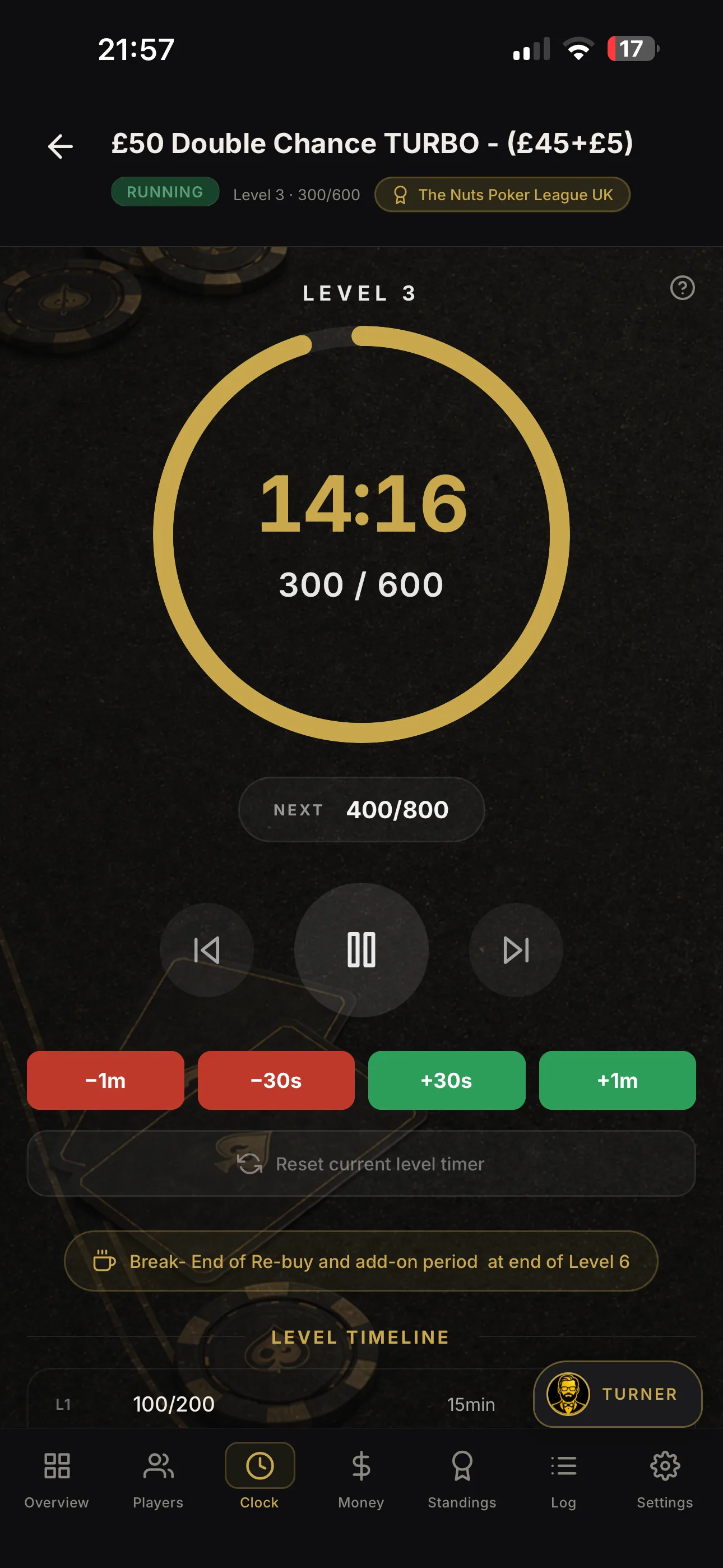
Fast rulings depend on fast facts, and that’s exactly where a dedicated tournament app earns its place beside your rulebook. Shuffle Up and Deal!'s live tournament clock and pot and payout history give you an instant, timestamped record of exactly what the blinds were and what the pot looked like when the dispute happened, without relying on a dealer’s memory. Smart seating and multi-device sync mean any floor staff member pulls up the same table state from their own iPad.
- Verify a disputed bet against the app’s live pot history instead of reconstructing from scratch.
- Retrieve the exact blind level and time context for a mis-awarded pot in seconds.
- Publish a live share link so a supervisor or the affected players can review the sequence independently.
- Lean on the built-in AI rules assistant when a ruling sits in a grey area between house rules and TDA guidance.
The workflow is simple: log the incident in the app, pull pot and payout history to reconstruct the hand, then export or share the log for supervisor review. Standardising this digital record is what keeps rulings consistent across an entire series rather than just within a single event, and a shareable pot history also raises player confidence that the ruling wasn’t made on a hunch.
How does the escalation hierarchy work on a poker floor?
The dealer handles the hand. The floorman handles the dispute. The shift supervisor handles the disagreement with the floorman’s ruling. That three tier structure exists so a dealer never has to referee their own mistake, and so a floor person’s call carries enough weight that players stop arguing once it’s made.
A floor ruling is generally binding the moment it’s delivered. That’s deliberate. If every decision could be re-argued indefinitely, the game grinds to a halt and the floor’s authority evaporates. Escalation exists for genuinely contested or complex cases, not as a routine second opinion for every borderline call.
Know your own room’s chain before you’re mid dispute, not during it. In most operations that means:
- Dealer: flags the issue, stops the action, calls the floor. Makes no ruling themselves.
- Floorman: gathers facts, applies the written rule, delivers the ruling, logs it.
- Shift supervisor or tournament director: hears escalations, resolves ambiguity the house rules don’t cover, has final say.
Reserve escalation for cases where the rule itself is ambiguous, the pot is large enough to justify a second set of eyes, or a player disputes the floor’s authority directly. Escalating every marginal call teaches players that your first ruling is provisional, which invites more disputes rather than fewer. A floor who escalates sparingly, but decisively when it’s warranted, earns the kind of authority that keeps the room moving.
Why does consistency matter more than getting every call perfectly right?
A technically flawless ruling that contradicts last week’s call on an identical situation does more damage to your room’s credibility than a slightly generous ruling applied evenly to everyone. Players don’t remember the exact rule text. They remember whether the floor treated similar situations the same way.
This is where standardised, documented rule application genuinely outperforms case-by-case judgement, even when the judgement is sound. Occasional bending of a rule for a sympathetic case feels reasonable in the moment. It stops feeling reasonable the third time a different player references it as precedent and you have no record of why the first exception was made.
The fix isn’t rigidity for its own sake. It’s writing your house rules down, keeping them close to TDA structure where possible, and treating any departure from them as an exception that gets logged with a reason attached. That log becomes your defence the next time someone claims favouritism, and it becomes your training material the next time a new floor person joins the team.
Consistency also compounds across a series, not just within one event. A regular who plays your circuit learns what to expect from your floor, and that predictability is worth more to your reputation than any single ruling that tries to be perfectly tailored to one player’s circumstances. Bend rarely, document every bend, and let the written rule do the heavy lifting on everything else.
How should you handle dealer errors without undermining their authority?
Dealer mistakes happen constantly across a long tournament day, from premature exposure of a card to a miscounted pot. How you respond in that moment either preserves the dealer’s standing at the table or quietly destroys it for the rest of their shift.
The instinct to publicly correct a dealer the second you spot an error is usually the wrong one. Quiet correction preserves both accuracy and morale, and a dealer who’s been embarrassed in front of a table tends to make more errors afterwards, not fewer, because they’re rattled rather than focused.
Practical guidance from experienced players on this point is worth repeating: when a dealer’s action looks wrong, the correct route is a quiet floor call, not a public argument at the table. That applies to players, and it applies doubly to you as the floor. Take the dealer aside between hands, explain what happened and what the correct procedure was, and let them return to the table with their authority intact.
None of this means dealer errors go unaddressed. It means the correction happens off to the side, the ruling that fixes the immediate hand happens at the table, and the two are kept separate. A dealer who feels supported when they make a genuine mistake reports uncertainty faster next time, rather than trying to quietly fix it themselves and creating a bigger problem. That’s a training outcome worth protecting.

What counts as proper conduct when calling the floor?
Players are entitled to call the floor whenever they believe a rule has been misapplied or a dealer has made an error, but there’s a right way and a wrong way to do it, and enforcing the right way is part of your job.
The correct call is calm, factual, and made before the next action rather than three hands later once memories have shifted. Calm, factual presentation from players speeds up fair resolution, because it gives you clean facts to work with rather than competing narratives shaped by frustration.
What you’re watching for as floor:
- A player raising their hand and stating “floor” clearly, rather than arguing directly with the dealer or another player.
- The call happening promptly, ideally before the next card is dealt or the pot is pushed.
- A factual account of what happened, not an argument about what the ruling should be.
Players who repeatedly argue with dealers instead of calling floor, or who use the floor call as a stalling tactic, are a conduct issue separate from the underlying dispute. Address that pattern directly and, if it continues, escalate through warnings or a time penalty rather than letting it slide because the underlying poker dispute was resolved. Good conduct at the point of the call makes every subsequent ruling faster for everyone at the table.
What communication skills does floor staff need for conflict resolution?
Technical rule knowledge gets you halfway. The rest is how you deliver a ruling to two players who each believe they’re right, sometimes in front of a table of spectators who all have an opinion.
Neutral, brief, factual language does more work than any amount of rapport-building in the moment. State the rule you’re applying, state the decision, and resist the urge to justify it at length, because extended explanation often reads as uncertainty rather than thoroughness. The neutral referee framing that works for de-escalating players applies just as much to how floor staff should carry themselves.
Reading the room matters too. A dispute between two calm regulars needs a different tone from a dispute involving a player who’s already tilted after a bad beat. Neither gets a different ruling, but the second situation may need a firmer, more clipped delivery to prevent the conversation sprawling into an argument about unrelated hands.
Training floor staff on this is often the gap in an otherwise solid operation. Rule knowledge is teachable from a document. Delivering an unpopular ruling to an agitated player without escalating the tension is a skill that needs practice, ideally through shadowing an experienced supervisor before being sent out solo. Rooms that invest in this training see fewer disputes spiral into shift supervisor escalations, simply because the initial ruling was delivered in a way that closed the conversation rather than reopening it.
What are the most common rule interpretations directors get asked about?
A handful of scenarios generate a disproportionate share of floor calls across almost every card room, and having a settled interpretation ready for each saves genuine debate for the situations that actually deserve it.
Acting out of turn typically stands if it doesn’t change the action for players still to act; if it does, the standard remedy is to hold the action and re-open betting for those affected. All-in for less than a full call usually creates a side pot, with the shortstack only eligible for the main pot, a distinction worth confirming against your own house rules before a big stack dispute forces the issue live.
Verbal declarations at the table are generally binding under TDA-style guidance, meaning a player who says “raise” has committed to a raise even if they physically push in a call-sized bet afterwards. Cards protected but not tabled at showdown can create genuine ambiguity, and this is exactly the kind of case where showdown and reconstruction rules give you formal text to point to rather than relying on table consensus.
Angle shooting versus genuine confusion is the hardest line to draw consistently, and it’s where intent assessment matters most. A player who’s angled the same play twice in one session is treated differently from a first-time offender making a genuine mistake, even though the physical action looked identical both times.
Write your interpretations down once you’ve settled them, and apply the same interpretation the next time an identical scenario appears, regardless of who’s involved.
Who wins when tournament rules and casino house rules conflict?
Tournament directors running events inside a casino or card room sometimes find themselves caught between the tournament’s own rulebook and the house rules the venue enforces on its cash games and general floor conduct. Knowing which governs which situation before it comes up saves an awkward mid-event negotiation with venue management.
As a general principle, tournament-specific rules (whether TDA-based or your own written variations) govern anything unique to the tournament structure: blind levels, chip values, seating, payout structure, and rulings on hands played within the event. House rules typically continue to govern venue-wide matters that sit outside the tournament format itself, such as conduct standards, alcohol service, or dress code, because those exist independently of any specific event running that day.
Where genuine conflict arises, usually around things like electronic device use at the table or specific betting structure quirks, the tournament director’s written rules should take precedence for that event, provided they were published or announced before play began. A ruling introduced mid-event that contradicts standing house policy needs sign-off from venue management, not just the floor’s own judgement, because the venue carries longer-term liability the tournament itself doesn’t.
The practical fix is prevention: agree the boundary between your tournament rules and the house’s standing policy with venue management before the series starts, then put anything unusual in writing on your published house rules sheet. A dispute over jurisdiction mid-tournament is far harder to resolve calmly than the same conversation had a week in advance.
What training and qualifications should floor staff have?
There’s no universal licensing body for poker floor staff, which means the qualification bar is set by each room’s own hiring and training standards rather than any external certification. That makes internal training the single biggest factor in ruling quality and consistency.
Solid floor training typically covers three layers. First, dealing experience itself, since a floor person who has spent real time dealing understands dealer error patterns from the inside and corrects them more credibly. Second, formal familiarity with a written rulebook, whether that’s TDA rules adopted wholesale or a house variant built on top of them, tested through scenario-based training rather than a read-through alone. Third, shadowing: new floor staff should sit in on live rulings with an experienced supervisor before making calls independently, because the judgement calls around intent and discretion are far harder to teach from a document than from watching them applied.
Training dealers specifically on common mishaps and quiet correction protocols reduces the volume of floor calls in the first place, which means investment in dealer training pays off in floor efficiency even though it looks like a separate line item. Ongoing refreshers matter too. Rules evolve, TDA updates its guidance periodically, and a floor team that hasn’t revisited the rulebook in a year will drift toward inconsistent interpretations without anyone noticing until a dispute exposes the gap.
What most guides get wrong about poker floor decisions
Most advice on this topic treats every ruling as a rules-lookup problem: find the clause, apply it, done. That undersells the job. The hardest part of floor work isn’t knowing the rule, it’s reconstructing what actually happened fast enough that the ruling still feels fair to both players, and that’s a logistics problem as much as a rules problem.
The conventional advice to “document everything” is correct but incomplete. Directors who write incident notes on paper or in a generic notes app lose the one thing that makes documentation useful under pressure: speed of retrieval. A note buried three pages back in a notebook is functionally useless mid-dispute. What actually matters is whether you can pull up the exact pot state, blind level, and time stamp in the seconds you have before the table starts getting restless.
If there’s one thing I’d tell a new tournament director, it’s this: build your consistency habit around a system that retrieves facts instantly, not around memory or willpower. The ruling window is unforgiving, and the director who wins the room’s trust over a season is the one whose rulings never seem to contradict each other, because they’re checking a record, not their memory of last month.
- Jason
Get faster, better documented poker floor decisions with Shuffle Up and Deal!
Handwritten incident logs and half-remembered pot histories are the two biggest reasons a floor ruling gets successfully re-argued later. Shuffle Up and Deal! is built to close that gap: it keeps a live, timestamped record of every pot, payout, and blind level so you’re reconstructing a dispute from actual data instead of a table’s collective memory.

The app suits tournament directors running anything from a weekly home game to a multi-day series, since the same live clock, pot and payout history, and smart seating tools scale across both. The built-in AI rules assistant gives you a fast second opinion when a ruling sits in a grey area, and a published share link lets a supervisor or the affected players review your reconstruction independently rather than taking your word for it. If your current process relies on a notebook and memory, explore how Shuffle Up and Deal! manages your next tournament and see how quickly a documented ruling comes together when the data’s already there.
Key Takeaways
Fast, defensible poker floor decisions depend on preserving evidence within the ruling window, applying a written rule consistently, and logging every call for later reconstruction.
| Point | Details |
|---|---|
| Rule before the next shuffle | Every ruling must be requested and delivered before the next deal, or reconstruction options disappear. |
| Preserve before you decide | Impound disputed chips or mark cards immediately, before facts get argued over. |
| Escalate sparingly, not routinely | Reserve shift supervisor escalation for genuinely ambiguous or high-stakes disputes, not every borderline call. |
| Correct dealers quietly | Take dealers aside between hands rather than correcting them publicly at the table. |
| Use Shuffle Up and Deal! for records | The app’s live pot and payout history and share link features speed reconstruction and supervisor review. |
Sources
- Floor / Management Decision Making
- POKER TOURNAMENT DIRECTORS ASSN. 2024 Rules Version 1.0. Oct 9, 2024
- How casinos resolve poker disputes
- Floor in Poker: Meaning, Rules, and How It Works