
Poker Tournament Management App
Run Poker Tournaments Like a Pro!
From First Hand to Final Table
Seat draws, table balancing, the clock, payouts and league standings: Shuffle Up and Deal! runs the whole night from your iPhone or iPad.


Lock Fair Poker Tournament Deals in 3 Phases With ICM Baseline

If pay jumps are steep and you’re sitting short, calculate the Independent Chip Model (ICM) baseline before anyone speaks numbers aloud, because that figure protects you far better than gut feel. Deals are usually correct when a short stack faces a life-changing jump and the field is deep enough that variance genuinely threatens everyone’s payday. Play on when you hold a demonstrable skill edge and enough chips to bully the table. Either way, ICM is your fair starting point, and you calculate it privately before proposing a single figure.
TL;DR:
- Calculating ICM before discussing deals ensures you understand your true equity and avoids overestimating payout expectations, especially when facing large pay jumps.
- ICM favors short stacks by assigning them more value than chip chop models, which reward chip leaders proportionally, making ICM the better reference for short stacks.
- When there are fewer than four players remaining, negotiating is less reliable due to rapid shifts in ICM equity; deal talks are best saved for larger fields or steep pay jumps.
- Using live, tournament-director verified data and an in-app ICM calculator minimizes errors and disputes during negotiations, increasing deal transparency and fairness.
- Players should consider their personal risk tolerance, skill edge, and timing factors like blind level progression before pursuing or declining a deal.
Table of Contents
- ICM vs chip chop: what the maths actually prices and who benefits
- When to consider a deal: stack depth, pay jumps and risk tolerance
- Calculating your baseline: how to produce accurate ICM numbers quickly
- Negotiation techniques: anchoring, cooperative phrasing and escalation path
- Three-phase deal process: prepare, negotiate, review
- Using the app in practice: ICM calculators and live tracking that secure deals
- Common deal structures and sensible variants
- Table and TD checklist to lock a deal safely
- Legal and ethical considerations in deal making during poker tournaments
- Psychological factors influencing player decisions in deal negotiations
- Impact of blind levels and tournament timing on deal making decisions
- Author perspective: when personal utility should override strict EV
- Deal-making made simpler with Shuffle Up and Deal!
- Sources
- FAQ
ICM vs chip chop: what the maths actually prices and who benefits
Poker tournament deal making comes down to a choice between two competing philosophies of fairness, and the gap between them can be worth thousands. Chip chop divides the remaining prize pool in direct proportion to chip counts. If you hold 40% of the chips in play, you get 40% of what’s left. It’s simple, transparent, and popular in home games because everyone can do the maths on a napkin.
The Independent Chip Model works differently. It converts each stack into a dollar equity figure by running through every plausible finishing order and weighting it by the payout ladder rather than treating chips as if they convert to cash on a straight line. ICM typically favours short stacks while chip chop favours chip leaders because a short stack still carries meaningful equity toward every remaining payout, not just the top spot.
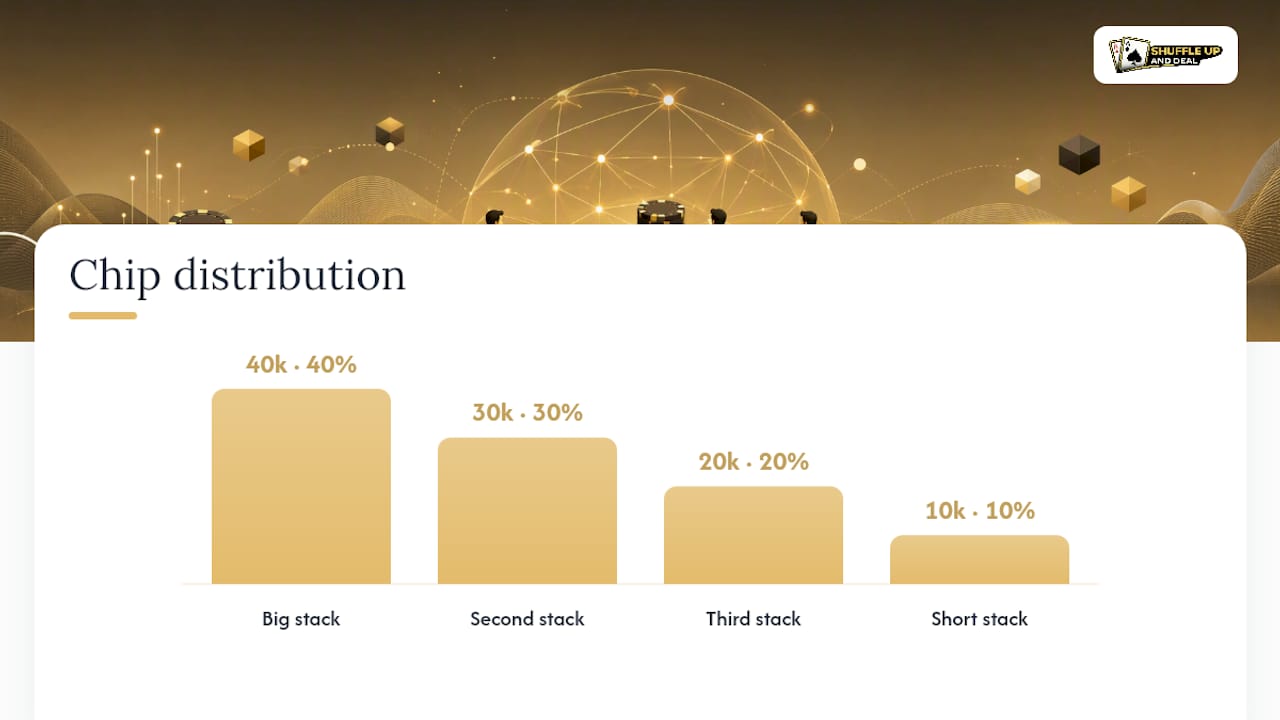
A four-player example makes the gap concrete. Say the payouts are £4,000, £2,500, £1,500, and £1,000, and the four remaining stacks are 40,000, 30,000, 20,000, and 10,000 chips.
- Chip chop would give the big stack roughly a proportional share of the remaining prize pool, sliding down proportionally to a smaller amount for the short stack.
- ICM, by contrast, tends to compress that spread, typically giving the big stack less and the short stack more than chip chop, because ICM accounts for the real chance that any player could finish in various positions.
That compression is the whole story of who wins and loses at the negotiating table. Chip leaders generally prefer chip chops because raw stack size gets rewarded directly. Mid stacks tend to see similar numbers under either model, which is why they’re often the ones pushing hardest for a quick resolution. Short stacks should almost always push for ICM, since it recognises that a small stack still has live outs to every remaining prize, not just a token consolation. Our own Independent Chip Model guide walks through the recursive maths behind these numbers if you want the full mechanics.
When to consider a deal: stack depth, pay jumps and risk tolerance
Not every final table calls for a conversation about splitting money, especially when considering the impact of fantasy tennis payout structures on prize distribution and strategy. The decision hinges on three variables working together: how many players remain, how steep the pay jumps are, and how much variance you can personally stomach.
- Wait until four or fewer players in most standard structures before opening deal talk. Earlier than that, ICM equities shift too fast hand to hand to negotiate anything durable.
- Move earlier if the ladder is unusually steep, or if you’re desperately short and facing a jump that roughly doubles or triples your min-cash. A pay jump from £1,000 to £2,500 for one elimination is a different animal to one from £1,000 to £1,100.
- Calculate your bubble factor before deciding whether to talk. The bubble factor measures how much more a chip is worth to you in survival terms than in accumulation terms; the steeper the jump ahead of you, the higher that factor climbs, and the more a deal should appeal even to a mid stack.
- Weigh your bankroll and utility, not just EV. A guaranteed £3,000 might change your month in a way that a marginally higher ICM-adjusted equity of £3,400 never will if it means gambling your whole stack on one flip.
- Only decline on a genuine skill edge. Requiring a demonstrable 10 to 15% edge over the remaining field before turning down a fair ICM offer is a sound heuristic used by strong professionals, and it stops overconfidence from costing you real money.
Someone grinding a rent-paying score reacts to the same numbers very differently to a well-rolled regular chasing a title. Both reactions can be perfectly rational, provided the maths on the table is accurate first.
Calculating your baseline: how to produce accurate ICM numbers quickly
You cannot negotiate fairly from numbers you’re guessing at. Producing an accurate ICM baseline needs three inputs, and missing any one of them skews the whole conversation.
- The complete remaining payout ladder, down to the last paid place.
- Every player’s exact chip stack, not a rounded estimate.
- Any bounties, set-asides, or previously agreed carve-outs that reduce the pool being negotiated.
Once you have those, the process is short: record the raw stacks exactly as announced, enter the full payout structure into an ICM calculator, run it, and write down your own equity figure somewhere private before anyone starts talking numbers out loud.
ICM calculations matter most at the money bubble, at major pay jumps, and during final-table negotiations, and calculators exist precisely because doing this in your head under pressure is unreliable. That’s the crux of most bad deals: someone does mental arithmetic at the table, gets it wrong under fatigue, and quietly gives away equity they didn’t need to.
Pro Tip: Never accept a player’s verbal estimate of “roughly what ICM says.” Ask the tournament director to produce the actual figures, or run them yourself on a calculator built for the job.
The most common pitfalls are avoidable. Forgetting a bounty pool that sits outside the main prize structure will distort every player’s true equity. Misreading a blinded-off stack, or working from a count that’s ten minutes stale, does the same. Requesting raw, unadjusted numbers directly from the tournament director or floor staff before talks begin removes almost all of this risk, because TD software pulls stacks and payouts directly rather than relying on memory. Our guide to calculating tournament payouts correctly covers the ladder side of this in more depth.
Negotiation techniques: anchoring, cooperative phrasing and escalation path
Treat your ICM figure as the floor of the conversation, not the opening bid. If you believe you deserve a markup above ICM equity for a genuine skill edge, say so explicitly and back it with something concrete, such as your recent results in similar fields or a specific read on how the table is playing. Vague confidence isn’t a negotiating position.
Language matters more than most players expect. Anchoring high and framing the conversation cooperatively rather than competitively both measurably improve outcomes. Try phrases like “let’s find a number that’s fair to everyone here” instead of “I want at least X.” The first invites collaboration; the second invites resistance.
- Open slightly above your real target figure, since the final number typically drifts toward wherever the anchor was set.
- Never reveal your true minimum acceptable payout early in the conversation.
- If two players dispute the ICM numbers, stop and call the floor rather than arguing from memory.
- If the deal falls through, stay composed. Weak, over-qualified language tends to signal flexibility you don’t want to reveal, and how you handle a refused deal follows you to the next final table.
A refused deal isn’t a personal insult, even when it feels that way after twenty minutes of back and forth. Some players simply prefer to gamble, and forcing the issue rarely improves your position. Table the conversation, play the hand in front of you, and revisit it if the situation changes.
Three-phase deal process: prepare, negotiate, review
Structuring deal talk as three distinct phases, preparation, negotiation, and review, consistently outperforms improvising on the spot, and skipping the first or last phase is where most disputes originate.
- Prepare. Run your ICM numbers before anyone suggests a deal, decide your minimum acceptable payout in advance, and confirm the venue’s house policy on chops.
- Negotiate. Present the raw numbers openly, note every concession offered on either side, and ask the tournament director to verify the maths if any player questions it.
- Review. Get the agreement written down or logged by the TD, confirm exactly how and when payouts will be made, and clarify who is responsible for any tax or reporting obligations tied to the final result.
Players who treat the review phase as optional are the ones who end up arguing about what was actually agreed twenty minutes after the fact. A two-line written note, signed or logged, prevents almost all of that friction.
Using the app in practice: ICM calculators and live tracking that secure deals
Most deal disputes trace back to one thing: someone’s numbers didn’t match the room’s actual stacks and payouts. Shuffle Up and Deal! removes that gap by keeping the tournament’s live data and the deal-making tools in the same place.
- The in-app ICM calculator lets you compute a private equity baseline from the current payout ladder and stack sizes, without doing mental maths under pressure.
- Live stack and payout tracking means the numbers on your screen match what the tournament director is seeing in real time, cutting out transcription errors entirely.
- Share links give every player at the table access to the same live data, so nobody’s negotiating from a stale chip count.
- TD logging creates a timestamped, verifiable record of whatever agreement gets reached, which matters far more than a handshake once the tournament ends.
For tournament directors running the room, this is the difference between refereeing a dispute from memory and pointing to a number everyone already agreed was correct.
Common deal structures and sensible variants
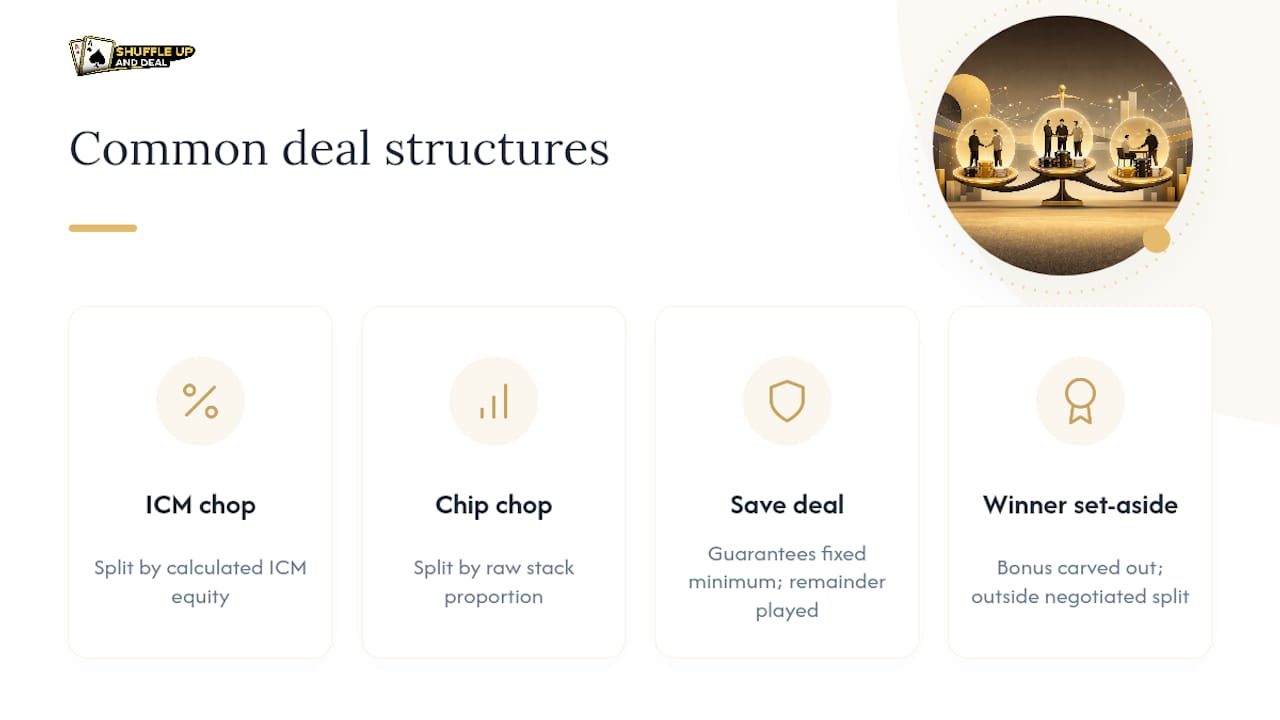
Beyond the straight ICM-versus-chip-chop choice, most rooms see a handful of recurring variants. An ICM chop splits the remaining pool according to calculated equity. A chip chop splits it by raw stack proportion. A save deal guarantees each player a fixed minimum, often close to the current min-cash, while leaving a smaller portion of the prize pool to be played for outright, which keeps the competitive edge of the tournament alive without full variance exposure. A winner set-aside carves out a bonus, often tied to a trophy or title, that stays outside the negotiated split entirely.
Skill markups above ICM equity are reasonable only when backed by something concrete, not table talk. A player might reasonably propose one after cashing three of the last five similar-sized fields; that’s a specific, checkable claim rather than an assertion of general strength.
Table and TD checklist to lock a deal safely
Before any figures change hands, confirm the venue’s house policy on deals and how the operator physically pays out winners once an agreement is reached. Ask the tournament director to produce or independently confirm the ICM numbers rather than relying on player-supplied figures, and have that same TD log the finalised agreement.
- Confirm house policy on chops before negotiations start.
- Get TD-verified numbers, not player estimates.
- Record the agreement in writing or via TD log, with all parties’ initials or digital confirmation.
- Agree in advance who handles final payment processing if the deal alters the standard payout order.
Skipping any one of these steps is how a perfectly fair deal turns into a dispute nobody can resolve after the fact.
Legal and ethical considerations in deal making during poker tournaments
Deal legality depends entirely on the venue and jurisdiction running the event, and rules differ meaningfully between a casino card room, a licensed cardroom operator, and a private home game. Reputable venues typically publish an explicit house policy on whether deals are permitted, how they must be recorded, and whether the operator’s own staff need to witness or approve the final numbers. Always check that policy with the floor before assuming a chop is allowed, rather than relying on what’s customary elsewhere.
Ethically, the core obligation is transparency toward every player still in the hand, not just the two or three loudest voices at the table. A deal negotiated quietly between the chip leaders while a short stack is away from the table, then presented as a fait accompli, is a breach of trust even where it isn’t technically against house rules. Every remaining player has a right to see the same raw numbers and participate in the same conversation.
There’s also a tax and reporting dimension in many jurisdictions, where an official payout structure differs from the negotiated split and can create reporting complications for the operator or the players. This varies significantly by country and by venue, so it’s worth asking the TD directly how payouts will be recorded before assuming the negotiated figures are what gets reported. None of this should feel like a deterrent to fair deal making. It’s simply why the review and recording phase of any deal matters as much as the maths that produced the numbers in the first place.
Psychological factors influencing player decisions in deal negotiations
Fatigue is the single biggest distorting factor at a late final table, and it affects both the maths and the temperament of everyone involved. A player who has been grinding for ten hours is more likely to accept a slightly unfair number just to end the day, and more likely to misjudge their own ICM equity doing mental arithmetic under stress.
Loss aversion plays a specific, measurable role here too. Most players feel the pain of a bad beat far more sharply than the pleasure of an equivalent win, which pushes short stacks toward accepting deals that lock in survival even when the pure expected-value case says to keep playing. That’s not irrational so much as a legitimate expression of risk tolerance, provided the player is making the choice with accurate numbers in front of them rather than out of pure anxiety.
Ego and reputation cut the other way. A chip leader who has spent the whole day building a dominant stack sometimes resists a fair chop purely because accepting one feels like conceding the table, even when the ICM numbers say the deal is favourable. Recognising this in yourself, and in the players across from you, is often the difference between a negotiation that closes cleanly and one that drags on for forty minutes over pride rather than pounds.
Social dynamics matter as well. Players who have been friendly all day tend to negotiate more cooperatively, while a table with unresolved tension from earlier hands often sees stalled or failed deal talks regardless of what the maths actually supports.
Impact of blind levels and tournament timing on deal making decisions
Blind level structure changes the calculus of every deal conversation, because it determines how much longer stacks stay meaningfully deep enough to play real poker. A fast structure with blinds doubling every fifteen minutes compresses decision windows sharply, and a short stack facing three more levels before elimination has a genuinely weaker negotiating position than the same stack under a slow, deep structure with an hour between levels.
Late-night final tables introduce a different pressure entirely. If the tournament has run long and players are facing a genuine choice between finishing tonight or returning the following day, the value of a deal that ends the event immediately can rise well beyond its pure ICM equity for players with early flights, work commitments, or simple exhaustion. That’s a legitimate factor in the negotiation, not a weakness to exploit ruthlessly, though it’s worth being aware of when you’re the one holding the stronger stack and the deadline.
Increasing ante structures and shrinking effective stacks as blinds climb also compress ICM equities toward each other, meaning deals proposed later in a fast-structured event often look flatter than deals proposed earlier in a deep one. Timing your deal conversation against the blind schedule, not just the player count, gives you a more accurate read on how urgent the decision actually is.
Author perspective: when personal utility should override strict EV
The maths gives you a fair number, not a moral instruction. Bankroll pressure, a demonstrable skill edge, or simply not wanting to gamble your rent money on one flip are all legitimate reasons to accept or decline a deal that ICM says is neutral. What matters is that you’re choosing with accurate figures in hand, not guessing under fatigue. Negotiate calmly, get the agreement recorded, and your reputation at the next final table stays intact regardless of which way you decided.
- Jason
Deal-making made simpler with Shuffle Up and Deal!
Shuffle Up and Deal! gives you something a scrap of paper and a phone calculator can’t: live, TD-verified numbers you can trust the moment a deal conversation starts. Instead of guessing stack sizes or waiting for someone to shout out the payout ladder, you’re negotiating from figures the tournament software is already tracking in real time.

The in-app ICM calculator produces a private equity baseline from your actual live stacks and payouts, so you walk into the conversation with a number, not a guess. Live stack and payout tracking keeps that baseline accurate to the second, and share links put the same figures in front of every player at the table, cutting out the disputes that come from mismatched chip counts. TD logging then records whatever agreement gets reached, giving you a verifiable note rather than a handshake nobody can quite remember the terms of a week later. Start with the free plan on Shuffle Up and Deal! and see how much faster your next final-table deal comes together.
Sources
For deeper study, our Independent Chip Model guide and ICM trainer and calculator overview both offer hands-on ways to build ICM intuition beyond the table.
- Poker final-table deal making: ICM chops | DeucesCracked
- ICM deal-making: when to chop and when to gamble | ThinkGTO
FAQ
What is the 80/20 rule in poker?
There’s no single universally recognised rule specific to poker deal making; the term is sometimes used loosely to suggest that a small number of decisions (like when and how to negotiate a chop) account for most of your final-table results. In practice, the more reliable rule is to anchor every deal conversation to your ICM baseline rather than any informal percentage shortcut.
Is it legal to make deals in poker tournaments?
It depends on the venue’s own house policy, which varies by operator and jurisdiction; many casinos and licensed cardrooms explicitly permit and even facilitate chops, provided the tournament director verifies and logs the numbers. Always confirm the specific venue’s rules before assuming a deal is permitted.
What’s the difference between ICM and a chip chop?
ICM converts stacks into dollar equity based on the full remaining payout ladder and typically favours short stacks, while a chip chop splits the pool by raw chip proportion and typically favours the chip leader.
How do I calculate my ICM equity quickly at the table?
Use an ICM calculator, such as the one built into Shuffle Up and Deal!, entering the full payout ladder and every remaining player’s exact stack to get a private baseline before you start negotiating.