
Poker Tournament Management App
Run Poker Tournaments Like a Pro!
From First Hand to Final Table
Seat draws, table balancing, the clock, payouts and league standings: Shuffle Up and Deal! runs the whole night from your iPhone or iPad.


TDs: Set Table Minimums to 6–10 Players and Auto Rebalance

Two players can technically play a hand, but that is a fallback rule, not an operating standard. The practical minimum most tournament directors configure is a playable range of 6 to 10 seats, with tables balanced within one player of each other and clear consolidation points set in advance. Build in a dedicated dealer seat where you use one, and let your app enforce the rest automatically.
TL;DR:
- Most tournament directors set the minimum table size between 6 and 10 players, depending on format and event scale, to maintain game quality and structure.
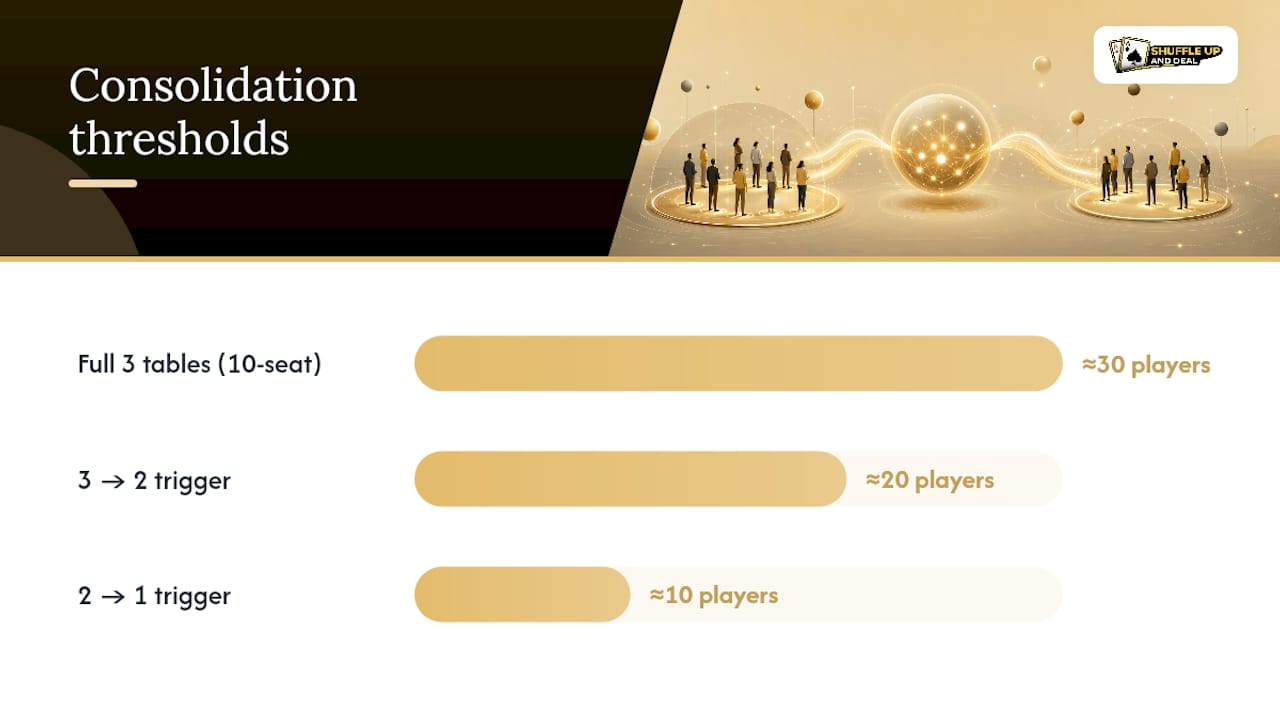
- Consolidation should be planned in advance with fixed trigger points, typically collapsing three tables to two around 20 players remaining and then to one final table at about 10 players.
- Moving players should be done as soon as the seat gap exceeds one, preferably moving the player next to the big blind to minimize positional disruption.
- Running a dedicated dealer seat reduces actual player capacity, so app settings must subtract dealer seats from the total when planning table sizes.
- Automated software, like Shuffle Up and Deal!, reliably manages table balancing and consolidation, providing consistency and saving manual effort during tournaments.
Table of Contents
- What counts as “table minimum players” in a tournament?
- How do you balance and consolidate tables as players bust out?
- How do you set these rules up in your tournament app?
- What about dealer seats, table limits and venue capacity?
- Why consistency in TD decisions matters more than the rule itself
- Set your table minimums once, then let the app run them
- Sources
- FAQ
What counts as “table minimum players” in a tournament?
“Table minimum players” refers to the seat count a tournament director sets as the threshold for opening, keeping open, or collapsing a table during play. It has nothing to do with betting limits or stake minimums at a cash table. In this context, it is purely a seating and structural parameter: the number that tells your software when a table needs topping up, breaking down, or leaving alone.
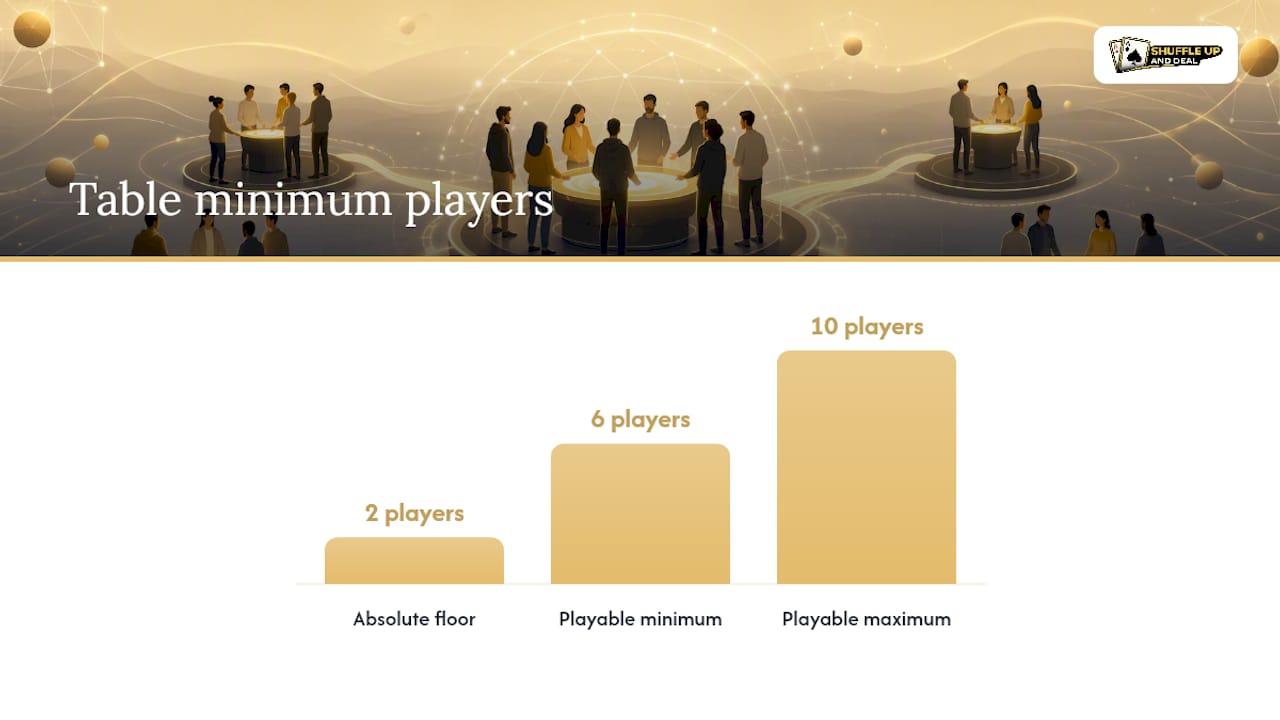
The technical baseline is straightforward. Heads-up play works fine with two players, and no rule prevents a table running that short if it has to. But a table that thin rarely reflects good tournament design. Blind pressure escalates fast, hand quality suffers, and players get restless waiting for a proper game. Two players is the floor a game can survive on, not the floor a well-run event should aim for.
Most tournament directors instead work within a playable range of 6 to 10 seats per table, adjusting the target depending on the format:
- Home games often run comfortably with a moderate number of players per table, since fewer tables mean less need for aggressive consolidation.
- League nights typically use tables with enough players to match standard chip sets and keep structure timing consistent across the room.
- Card rooms running multiple simultaneous events usually opt for larger tables to maximise floor efficiency.
Whichever preset you choose, the number you configure as “minimum” should reflect the point at which a table stops being fun and starts being a liability to the structure.
How do you balance and consolidate tables as players bust out?
Table balancing keeps the game fair as the field shrinks. The widely used target is simple: no table should run more than one player different from any other table on the floor. Once that gap opens to two, it is time to move someone.
For very small home games, some organisers deliberately wait for a two-player gap before moving anyone, accepting slightly more imbalance to avoid disruptive musical chairs every orbit. That trade-off works when you are running two or three tables total. It falls apart fast once you are managing six or more, where uneven tables start skewing blind pressure and average stack comparisons across the field.
Consolidation works best when it is planned, not improvised. A common preset for 10-seat tables combines three tables down to two once the field drops to around 20 players remaining, then collapses to a single final table around 10 players remaining, according to widely used home-tournament seating guidance. Scale those trigger points up or down depending on your table size, but fix them in advance so every consolidation is predictable rather than negotiated on the fly.
When you do move players, three rules keep it fair:
- Move a player as soon as the gap between tables exceeds one seat, not before and not much after.
- Move whichever player is next to post the big blind, since that minimises the positional disruption to their game.
- Never move the same player twice in short succession if you can help it. Repeated moves feel punitive even when they are purely mathematical.
There is also a point where you stop patching a short-handed table and just call it. TDA-style rules and regional tournament policies generally instruct directors to halt play once blinds start materially disadvantaging a table running several players short, rather than forcing it to limp along until the next scheduled break.
Pro Tip: Precompute your consolidation sequence (3 tables to 2, 2 tables to 1) before the event starts. Announcing “we’re now moving to two tables” lands very differently to players than working it out live while they wait.
How do you set these rules up in your tournament app?
Turning all of this into consistent practice means configuring five things properly before your event starts, not adjusting them mid-tournament under pressure.
- Table capacity - the maximum seats per table, minus a dealer seat if you run one.
- Minimum open-seat threshold - the point at which a table is flagged for consolidation.
- Automatic consolidation points - your preset trigger numbers (players remaining at which tables collapse).
- Dedicated-dealer flag - whether a seat is reserved for staff rather than a player.
- Auto-move preferences and move-selection policy - whether the software picks the next blind-payer automatically or leaves the call to you.
How those settings translate into real numbers depends heavily on scale:
Run a short dry run before doors open. Register a handful of test players, force a few busts, and watch how the presets trigger. This catches misconfigured thresholds before real players are sitting at a table that is quietly two seats too full.
This is exactly where automation earns its keep. Shuffle Up and Deal!'s smart seating algorithms rebalance tables the moment a two-seat gap opens, so you are not manually recounting bodies mid-level. The live tournament clock keeps blind timing synced across every table during a consolidation, and the AI rules assistant gives you an instant, consistent answer when a player questions a move decision, rather than you improvising a ruling on the spot.
What about dealer seats, table limits and venue capacity?
A dedicated dealer changes your maths. If you run house dealers rather than player-dealt tables, that seat comes out of usable capacity entirely, not out of the player count you are trying to fill.
Format also shifts your consolidation targets. A 9-handed structure consolidates less often than a 6-handed one simply because there are more bodies per table to lose before a gap opens. Final-table size follows the same logic: a 6-max format might finish 6-handed, while a 9 or 10-handed structure typically plays down to a single full table before shortening further.
Physical and licensing constraints matter too. Regulatory policy in several jurisdictions caps maximum players per table and sets minimum dealer staffing ratios for licensed events.
- Subtract dealer seats from capacity before setting your app’s table-size field.
- Check local licensing rules if you are running a public or paid-entry event.
- Plan one table manager per roughly 4 to 6 tables once you are running a card-room-scale field.
Why consistency in TD decisions matters more than the rule itself
The specific number you pick for a table minimum matters less than whether you apply it the same way every time. Tournament director discretion earns player trust precisely because it is not arbitrary. A TD who consolidates at 20 players remaining one night and 15 the next, with no stated reason, invites disputes that have nothing to do with cards.
The fix is procedural, not personal. State your consolidation points and movement rules before the first hand is dealt, ideally on the same sheet as blind structure and payout splits. Players who know the plan in advance rarely argue with it when it happens.
Software helps because it removes the appearance of favouritism. A logged, timestamped decision, backed by a rules assistant that cites the same standard every time, is far harder to dispute than a verbal call made under pressure with forty players watching.
- Jason
Set your table minimums once, then let the app run them
Working out consolidation points on a napkin between levels is how tournaments fall behind schedule and players start second-guessing your calls. This app is built to take that entire calculation off your plate, whether you are running a kitchen-table game for 12 or a card-room field pushing past 150 entries.
Set your table capacity, dealer flag, and consolidation triggers once inside the app, and the smart seating algorithms handle the rebalancing the moment a two-seat gap opens, no manual recount required. The live tournament clock stays synced across every table through every consolidation, multi-event management lets you run several tournaments from one device, and the AI rules assistant gives you a consistent, citable answer the instant a player questions a move. If you are still deciding how granular to get with your presets, a partner guide on organising card tournaments that run smoothly covers the same discretion-and-consistency ground from a broader events angle.
The app offers a free Home Game plan for smaller nights, with paid tiers unlocking deeper automation as your fields grow. Head to Shuffle Up and Deal! and set up your first event to see the consolidation presets in action before your next session.
Sources
- How often should I balance tables at a home poker tournament?
- How to Move Players in a Poker Tournament, Poker Tournament Seating - Home Poker Tourney
- New Brunswick Texas hold’em poker tournament licensing policy (example)
FAQ
What is the minimum number of players for a poker table?
Two players is the technical minimum needed to play a hand, but that is not a practical operating threshold. Most tournament directors treat 6 to 10 players as the playable range for a table, adjusting up or down based on format and event size.
When should you consolidate tables in a tournament?
Consolidate as soon as the gap between your busiest and quietest table exceeds one player, using preset trigger points fixed before the event starts rather than decided live. A common setup for 10-seat tables collapses three tables to two around 20 players remaining, then down to a final table around 10 remaining.
Who should be moved when balancing tables?
Move the player who is next to post the big blind wherever possible, since this causes the least positional disruption. Avoid moving the same player more than once in short succession, and never move someone purely for convenience if another seat achieves the same balance.
Does a dealer seat change the table minimum?
Yes. If you run a dedicated dealer, that seat comes out of usable capacity entirely, so a “10-handed” table with a house dealer only seats 9 players. Reflect this in your app’s table-capacity setting so automated consolidation logic does not try to overfill the table.
Can a tournament app automate table minimums and consolidation?
Yes, Shuffle Up and Deal! handles this through smart seating algorithms that rebalance tables automatically once a two-seat gap opens, alongside a live tournament clock and an AI rules assistant for consistent decisions. Pricing runs from a free Home Game plan up through paid tiers such as Tournament Director, available at Shuffleup.