Poker Tournament Management App
Run Poker Tournaments Like a Pro!
From First Hand to Final Table
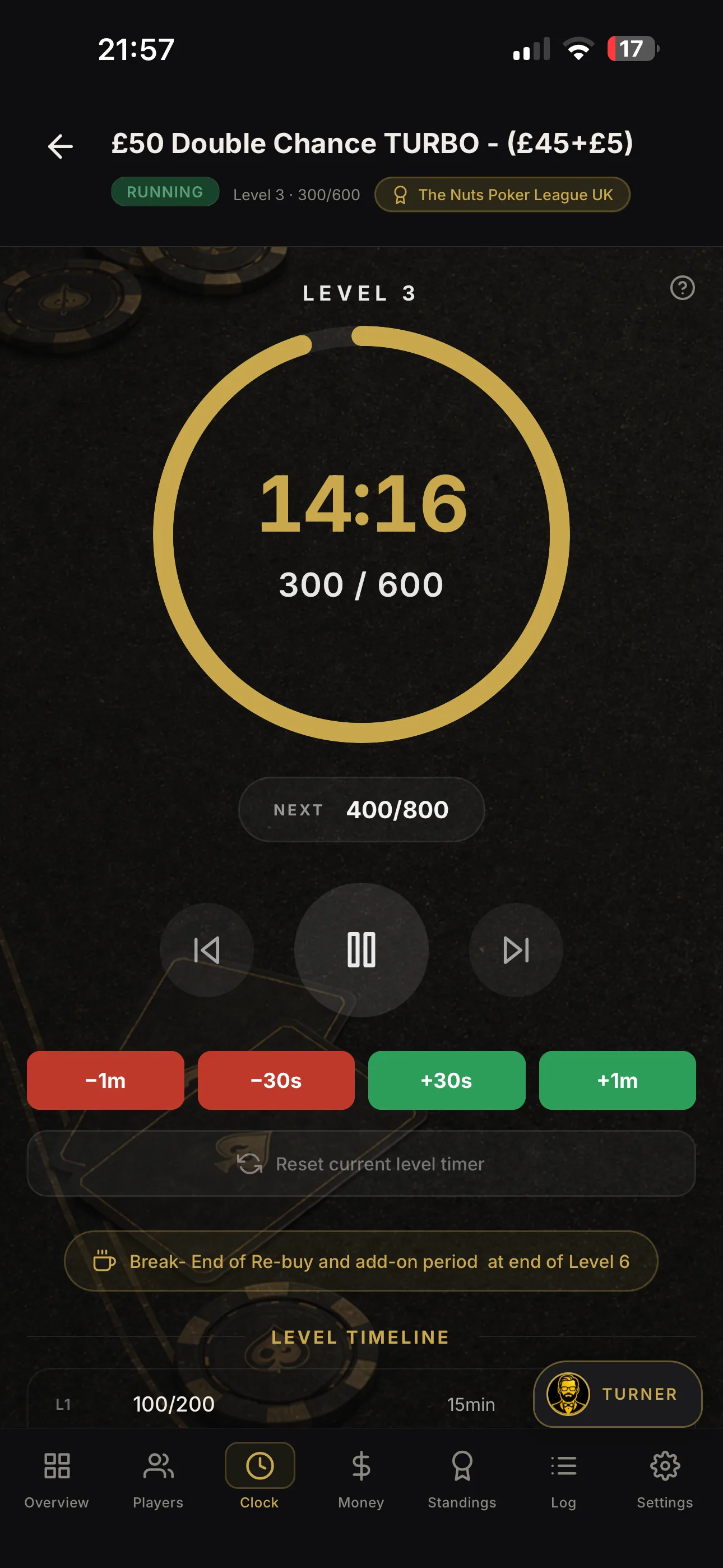
Seat draws, table balancing, the clock, payouts and league standings: Shuffle Up and Deal! runs the whole night from your iPhone or iPad.

TDA rules explained for tournament directors and organisers

The Tournament Directors Association (TDA) rules are a voluntary, widely adopted recommended ruleset for live poker tournaments. Venues adopt them as written or with stated house exceptions. The current published package is the 2024 TDA Rules, Recommended Procedures, and Illustration Addendum. The 2026 TDA Summit XII then added clarifications rather than wholesale changes, with the highest-impact items being stronger table-talk enforcement, explicit zero-tolerance for hate speech, chip penalties recommended as an alternative to orbit penalties, and an extended device ban covering wearables such as Meta smart glasses.
Before your next event, check these five items:
- Rule version posted at registration: confirm you are running the 2024 rules and note any house exceptions in writing.
- Big-blind-ante (RP-11): verify your staff know the big-blind-first calculation and what happens when the big blind cannot cover both the ante and the blind.
- Rule 5 device policy: phones off the felt, no strategy tools at the table, and wearables capable of recording or relaying information now explicitly banned.
- Rule 71 enforcement menu: verbal warning, missed hands, chip penalty, or disqualification. The 2026 Summit recommends chip penalties over orbit penalties where possible.
- Display the rule summary at the TD desk so floor staff can cite rule numbers during rulings without hesitation.
Pro Tip: Print the TDA short-form rules and laminate one copy per TD station. When a player disputes a ruling, pointing to a rule number on a physical card ends most arguments in under thirty seconds.
Key takeaways
The TDA 2024 rules, updated by 2026 Summit clarifications, give tournament directors a clear, enforceable framework: publish your rule version, apply Rule 71 consistently, and use chip penalties over orbit penalties wherever possible.
| Point | Details |
|---|---|
| Post the rule version | Display “TDA 2024 Rules” and any house exceptions at registration before every event. |
| Confirm BBA handling (RP-11) | Brief all dealers on the big-blind-first calculation and short-stack posting order. |
| Update the device policy | The 2026 Summit extended Rule 5 to wearables; update your player briefing and registration notices now. |
| Use chip penalties (Rule 71) | Chip penalties are fairer than orbit penalties because they apply a fixed cost regardless of table position. |
| Shuffle Up and Deal! for compliance | Shuffle Up and Deal!’s smart seating, live clock, external display, and penalty notes map directly to TDA operational requirements. |
Table of Contents
- What the TDA is and how venues actually use its rules
- How the TDA rulebook is organised
- The TDA rules your floor staff will use most
- Common rulings and how to handle them
- Recommended procedures for running a tight operation
- Applying TDA rules in UK venues: what you need to know
- How to make your event TDA-compliant: a practical checklist
- What running these rules actually looks like on the floor
- Shuffle Up and Deal! keeps your event TDA-ready from registration to final table
- Sources
What the TDA is and how venues actually use its rules
The Tournament Directors Association is a voluntary trade association founded to standardise tournament poker rules worldwide. It publishes a ruleset that any venue, tour, or home-game organiser can adopt, free of charge, as their operational baseline. Adoption is entirely voluntary. No regulatory body compels a UK card room to follow TDA rules, but the framework is so widely recognised that most regional festivals, casino tournaments, and independent events use it because players already know it.
How that adoption works in practice matters. A venue that adopts the TDA rules “as written” is bound by every rule and recommended procedure in the published package. A venue that adopts “with house exceptions” must publish those exceptions clearly, ideally at registration and on any posted rule summary. The TDA itself is explicit: deviations are permitted, but they must be communicated. Players who arrive expecting standard TDA rules and encounter an undisclosed exception have a legitimate grievance.
Some major international tours publish their own supplemental rulebooks that sit on top of the TDA baseline, adding tour-specific procedures for things like hand-for-hand play, bubble protection, or media obligations. UK venues operating under a Gambling Commission licence may also face regulatory conditions that affect specific procedures, such as how disputes are escalated or how player identification is handled. In those cases, the regulatory condition always takes precedence over the TDA recommendation.
Pro Tip: At registration, post a single A4 sheet that reads: “This event is run under TDA 2024 Rules with the following house exceptions:” and then list them. If there are none, say so. That one sheet prevents a significant proportion of disputes before they start.
How the TDA rulebook is organised
The TDA publishes its rules in three interconnected documents, and knowing which one to reach for during a ruling saves time under pressure.
| Document | What it contains | When to use it |
|---|---|---|
| Short-form Rules | Concise rule statements, numbered sequentially | Quick reference at the TD desk during play |
| Longform Rules with Recommended Procedures (RPs) | Full rule text plus operational guidance for each rule | Pre-event training, dealer briefings, and complex rulings |
| Illustration Addendum | Diagrams and worked examples for chip movements, betting sequences, and seating | Dealer training and resolving ambiguous physical situations |
The distinction between a Rule and a Recommended Procedure is operationally important. A Rule (e.g. Rule 5, Rule 71) states what must or must not happen. A Recommended Procedure (e.g. RP-11) states how the TDA suggests you implement a rule or handle a common situation. Venues have more flexibility to deviate from an RP than from a Rule, but any deviation should still be published. When you cite a ruling to a player, be precise: “Under Rule 71, I am issuing a chip penalty” carries more authority than a vague reference to “the rules.”
The 2024 TDA rules package is the current authoritative document. The 2026 Summit produced clarifications and guidance notes rather than a new numbered version, so the 2024 package remains the base text. Venues that adopted an earlier version should check their effective date: historical TDA rule changes have gone into effect on specific announced dates, and staggered adoption across venues means a player travelling between rooms may encounter different effective versions.
Pro Tip: Download the official PDF and save it to a shared folder your entire floor staff can access from their phones. During a ruling, pulling up the exact rule text on screen is faster and more credible than paraphrasing from memory.
The TDA rules your floor staff will use most
Button and blinds
The dead-button procedure applies when a player is eliminated or absent. The button advances as normal even if the seat is empty, and the blinds are posted by the players in the blind positions relative to that button. This keeps the dealing rotation fair and prevents any player from skipping a blind obligation. After a table break, the incoming player takes the seat and inherits whatever position that seat holds in the current rotation. They may be dealt in immediately unless they are in a position where they would gain an advantage by skipping a blind.
Big-blind ante (RP-11)
RP-11 recommends the big-blind-first calculation for big-blind-ante formats. The big blind posts the ante first, then the blind. When the big blind is short-stacked and cannot cover both, the ante takes priority and the blind is whatever remains. This order matters for side-pot calculations and must be announced clearly at the start of each level. For a deeper breakdown of BBA calculation methods and how tournament software can automate the announcement, the big blind ante guide on Shuffle Up and Deal! walks through the maths and the display options in detail.
Electronic devices (Rule 5)
Rule 5 prohibits the use of strategy tools at the table. Phones must not rest on the felt. Players may use phones away from the table for non-strategy purposes, but any device capable of running poker solver software, equity calculators, or hand-history analysis is banned during play. The 2026 Summit extended this ban explicitly to wearables, naming devices such as Meta smart glasses as prohibited because they can record or relay strategic information. Train your staff to identify these devices before play begins and to request their removal politely but firmly.
Player identity (Rule 4)
Rule 4 requires that players be identifiable. A TD may request removal of any face covering, hood, or accessory that impedes identification. This is not a blanket ban on headwear; it is a specific requirement that the TD can identify who is seated at the table. In practice, apply this consistently and document any request made.
Enforcement (Rule 71)
Rule 71 gives TDs a graduated menu of sanctions: verbal warning, missed hand(s), missed round(s), chip penalty, or disqualification. The 2026 Summit clarified that chip penalties are often preferable to orbit penalties because orbit penalties can disproportionately punish a player depending on their position in the blind rotation. A chip penalty removes a fixed amount from the offending player’s stack and places it in the pot, creating a consistent deterrent regardless of table position. Disqualification remains available for severe or repeated violations.
The Summit also introduced explicit zero-tolerance language for hate speech. This is not a new concept in most UK venues, but the TDA now states it clearly, giving TDs a direct rule citation when removing a player for abusive language.
All-in declarations and one-chip-behind
A verbal declaration of “all-in” is binding. An ambiguous gesture, such as pushing forward most but not all of a stack, is not automatically an all-in. The 2026 Summit clarified expectations: if a player pushes all their chips forward, that is an all-in regardless of whether they say the words. If chips remain behind, the action is not an all-in unless declared verbally. Dealers should be trained to ask “Is that all-in?” when the situation is ambiguous, rather than assuming.
The one-chip-behind scenario occurs when a player calls with a single chip that is larger than the bet. Unless they verbally declare a raise, the action is a call and change is returned. This is a common source of disputes and worth covering explicitly in dealer briefings.
Chip stacks and presentation
Mandatory stacks of 20 chips of the same denomination are the TDA standard where chip supply allows. Stacks must be visible and not concealed in hand. Players who obscure their stack create an unfair informational disadvantage. The 2026 Summit reinforced this requirement. Dealers should correct non-compliant stacks at the start of each hand.
Out-of-turn action
Acting out of turn in a heads-up pot carries specific consequences. A premature check is binding if no action changes behind the player. A premature call or raise may be binding or may be returned depending on subsequent action. Document and announce any out-of-turn ruling clearly so the table understands the outcome.
Pro Tip: Run a ten-minute dealer briefing before every event covering all-in declarations, one-chip-behind, and out-of-turn action. These three situations generate the majority of floor calls. A dealer who handles them correctly at the table prevents most disputes from reaching you.
Common rulings and how to handle them
Premature all-in
A player pushes all chips forward before the action reaches them. The correct ruling: the action is binding as an all-in if it is their turn when the action arrives, or it is treated as a premature action if it is not. If premature, the chips are returned and the player is bound to the all-in declaration when their turn comes, unless a player behind them raises, in which case the premature actor may reconsider. Announce the ruling to the table before continuing.
Card exposure with action pending
If a player’s hole card is exposed before the action is complete, the card is shown to all players and play continues. The exposed card does not constitute a misdeal unless two or more cards are exposed on the initial deal. Under Rule 71, if the exposure was deliberate, a penalty is appropriate.
Device misuse
A player is observed using what appears to be a poker solver on their phone at the table. The escalation path: first, ask the player to put the device away and issue a verbal warning, citing Rule 5. If the behaviour continues, issue a missed-hand penalty. Repeated or egregious misuse warrants a chip penalty or disqualification. Staff wording that works well: “Under Rule 5, electronic strategy tools are not permitted at the table. I need you to put that away now. This is a verbal warning.” Keep the language calm, specific, and rule-referenced.
For wearables, the approach is the same but the request comes before play begins: “We’ve noticed you’re wearing [device]. Under the updated TDA device rules, wearables capable of recording or relaying information aren’t permitted at the table. Could you remove it or leave it with your belongings?”
Moving the button after a table break
When a table breaks and players move to new seats, the button at the receiving table stays where it is. Incoming players take their assigned seats and inherit the position in the rotation. A player who would receive the button immediately upon sitting may be dealt in; a player who would sit in the big blind posts as normal. The goal is to keep the rotation fair without giving any incoming player a free pass on their blind obligation.
Pro Tip: Post a one-page “common rulings” reference at each TD station. Include the device warning script, the all-in declaration guidance, and the chip penalty amounts for your event. Floor staff who can read from a card sound authoritative and consistent, which matters enormously to players.
Recommended procedures for running a tight operation
Seating and breaking tables
Fair table breaks follow a random or systematic seat-draw process rather than a TD’s discretion. The TDA recommends against posting break orders in a way that incentivises late entry, because players who know which table breaks last may time their registration to avoid early elimination. Use a random draw or a pre-published break order that is not influenced by stack sizes.
When balancing tables, move players from the table with the most players, taking the player in the seat that has been the big blind most recently. This keeps the blind rotation fair across tables. Move players promptly, with their chips in hand, to minimise disruption.
Smart seating and alternates
Alternates and re-entry players should be seated using the same random draw process as original entrants. Placing them in specific seats to balance tables is fine, but the process must be consistent and transparent. Players who re-enter should not receive a positional advantage over players who have been at the table.
Chip handling and clean stacks
| Chip procedure | TDA recommendation |
|---|---|
| Stack size | Stacks of 20 chips of the same denomination where supply allows |
| Visibility | All chips must be visible; highest-denomination chips at the front |
| Counting | Players may request a count of an opponent’s stack at any time |
| Handling | Chips must not be concealed in hand during play |

Clean stacks make counting faster, reduce disputes about bet sizes, and help dealers manage the pot accurately. When a player receives chips from a rebuy or add-on, the dealer should verify the stack before play resumes.
Clock and display
A live, visible tournament clock is the single most effective tool for reducing “how long is the level?” disputes. The TDA recommends that blind levels and upcoming changes be announced before each new level begins. An external display visible to all players removes any ambiguity about the current blind level, ante, and time remaining.
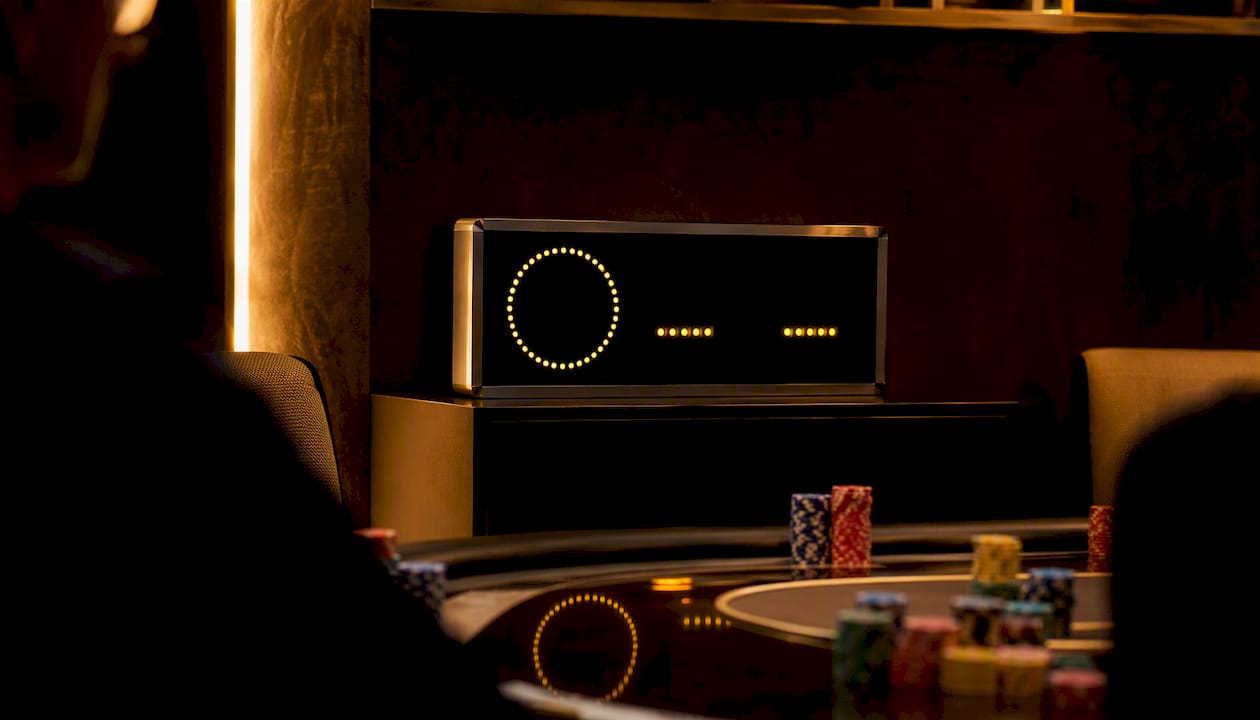
Transparency here pays off in player experience. Players who can see the clock make better decisions about when to take breaks, when to push, and when to request a count. That reduces the number of interruptions to the TD.
Applying TDA rules in UK venues: what you need to know
TDA rules do not override UK gambling licensing conditions. If your venue operates under a Gambling Commission licence, your licence conditions and codes of practice take precedence over any TDA recommendation. Before publishing your rule set, check with your venue manager or compliance officer that no TDA procedure conflicts with your licence conditions. Common areas of potential conflict include player identification requirements, dispute escalation procedures, and cash-handling rules.
Streaming and showcards require specific attention in the UK. If you plan to stream hole cards on a live delay, players must consent before the event. A simple opt-in form at registration, stating clearly that hole cards will be shown on a timed delay, is standard practice. Players who decline must not be disadvantaged in seating or treatment. Never show a player’s hole cards on stream without their prior written consent, even on a delay.
Security escalation follows a clear path. If a player’s behaviour creates a safety concern, involve venue security rather than attempting to manage the situation with floor staff alone. The TDA’s zero-tolerance language on hate speech, reinforced at the 2026 Summit, gives you a clear rule citation when asking security to remove a player. Document the incident, the rule cited, and the outcome.
Pro Tip: Use this standard wording at registration: “This event is run under TDA 2024 Rules, adopted with the following house exceptions: [list exceptions]. A copy of the full TDA rules is available at the TD desk and at pokertda.com.” That single statement satisfies your disclosure obligation and signals professionalism to experienced players.
How to make your event TDA-compliant: a practical checklist
Getting TDA compliance right is less about memorising every rule and more about building the right habits before, during, and after each event. Here is what that looks like in practice, with notes on where Shuffle Up and Deal!’s features do the heavy lifting.
Pre-event tasks
- Publish the rule version: post “TDA 2024 Rules” at registration and list any house exceptions in writing.
- Confirm BBA handling: brief all dealers on RP-11, the big-blind-first calculation, and what happens when the big blind is short.
- Update the device policy: include the wearables ban in your pre-event player briefing and at the registration desk.
- Train dealers on all-in and out-of-turn: run a ten-minute briefing covering all-in declarations, one-chip-behind, and premature action.
- Prepare penalty templates: create a reference card for floor staff listing the Rule 71 escalation path and the chip penalty amounts for your event.
How Shuffle Up and Deal! supports TDA-aligned operations
Shuffle Up and Deal!’s smart seating algorithms handle table balancing automatically, moving players from the largest table and keeping the blind rotation fair without manual calculation. The live tournament clock and external display features mean every player in the room can see the current blind level, ante, and time remaining, which directly supports the TDA’s transparency recommendations on clock management.
For BBA specifically, Shuffle Up and Deal! can display the current ante and blind amounts on the external screen and announce level changes, reducing the chance of a dealer miscalculating the posting order. The big blind ante guide on Shuffle Up and Deal!’s site explains exactly how to configure this.
Player registration and late-entry management are handled within the app, so alternates and re-entries are seated through the same process as original entrants. That consistency is exactly what the TDA recommends.
For incident tracking, use the app’s event notes to log any Rule 71 penalty: the player’s name, the rule cited, the penalty applied, and the time. If a player appeals a ruling later, that log is your audit trail. Shuffle Up and Deal!’s live share links mean a remote supervisor or venue manager can review the tournament state in real time, adding another layer of accountability.
Pro Tip: Use Shuffle Up and Deal!’s smart seating and live display together to enforce stack-20 expectations and BBA announcements without relying on dealer memory. When the display shows the correct blind and ante at the start of every level, dealers have one less thing to track and players have one less thing to dispute.
What running these rules actually looks like on the floor
The gap between reading the TDA rules and enforcing them confidently is wider than most new TDs expect. Two situations come up repeatedly and are worth addressing directly.
Device enforcement is the one that makes floor staff most uncomfortable, because it feels confrontational. The instinct is to wait for clearer evidence before acting. That instinct is wrong. Rule 5 does not require you to prove a player is cheating; it requires you to ensure no strategy tool is in use at the table. If you see a phone on the felt or a player with a wearable device, you act immediately, politely, and with a rule citation. The discomfort of the conversation is far smaller than the damage to your event’s integrity if you wait.
Chip penalties versus orbit penalties is the other recurring challenge. Orbit penalties sound intuitive: miss a round of blinds, pay the price. But the actual cost of an orbit penalty varies enormously depending on where a player sits in the rotation when the penalty is applied. A player who just posted the big blind faces a much lighter penalty than one who is about to post it. Chip penalties remove a fixed amount regardless of position, which is fairer and more predictable. The 2026 Summit’s recommendation to prefer chip penalties reflects real operational experience, not just theory.
The practical takeaway: build a penalty schedule before your event. Decide the chip penalty amounts for a first offence, a second offence, and a third offence. Write them on the reference card at your TD station. When you apply a penalty, you read from the card, cite Rule 71, and move on. Players respect consistency. What they do not respect is a TD who hesitates, negotiates, or applies different penalties to different players for the same infraction.
Shuffle Up and Deal! keeps your event TDA-ready from registration to final table
Running a TDA-compliant event means managing a lot of moving parts at once: seating, blinds, penalties, displays, and player records. Shuffle Up and Deal! handles the operational layer so you can focus on the rulings.
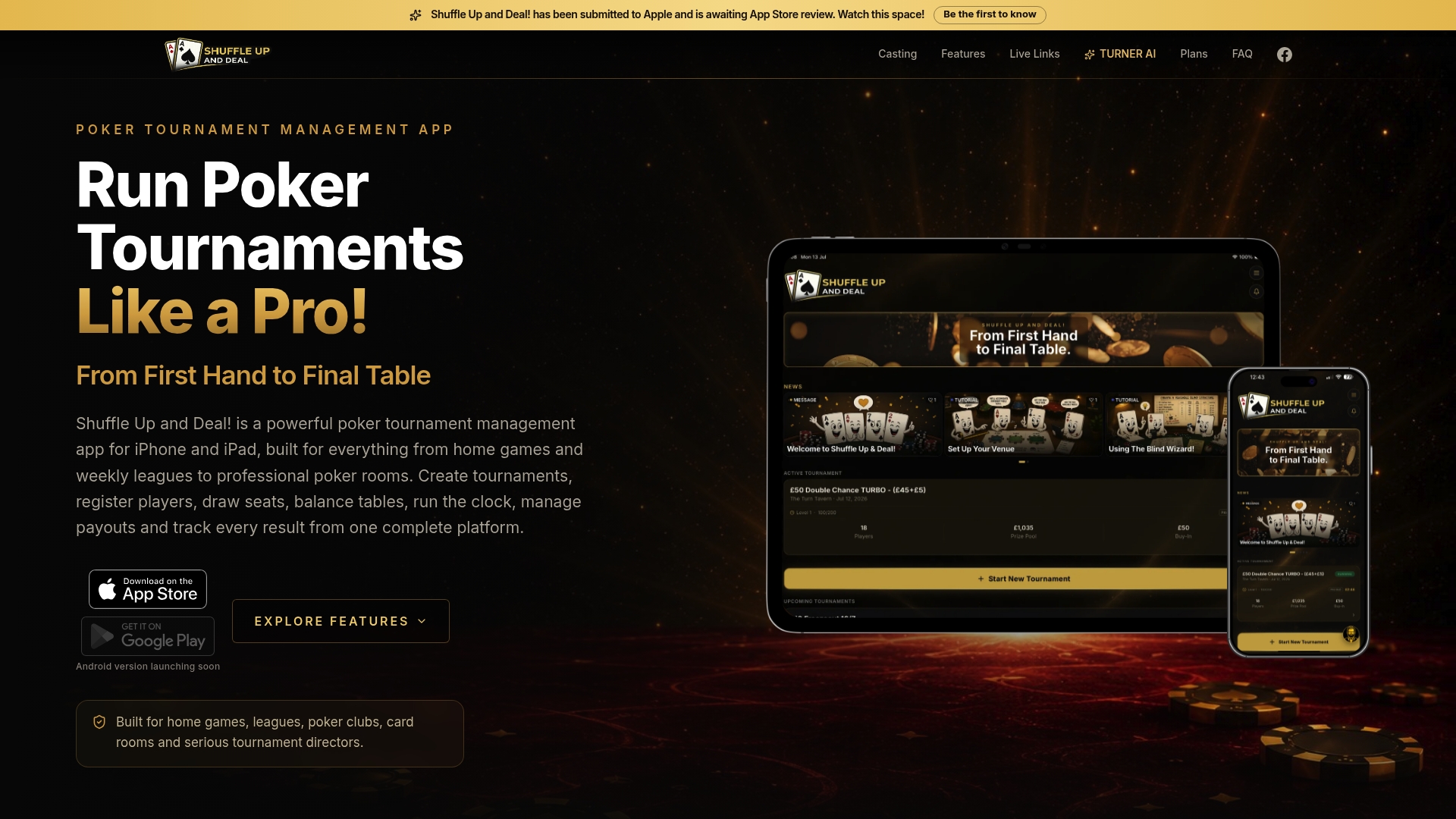
The Shuffle Up and Deal! app gives tournament directors a single platform covering smart table balancing, live blind clock and level management, external display casting, player registration and late-entry controls, and in-app ICM deal calculators. The app’s event notes function doubles as a penalty log, giving you a timestamped audit trail for every Rule 71 decision. Live share links let players and spectators follow the tournament in real time, and multi-device syncing means your floor staff are always looking at the same data.
For BBA management specifically, the app displays the current ante and blind on the external screen at every level change, removing the most common source of posting errors. Check out the best TDA rules app guide to see how the features map to TDA compliance tasks, then start a free plan at shuffleup.co.uk to run your next event with confidence.
Sources
The documents and summaries below are the primary references for everything covered in this guide.
- TDA Poker Rules - Poker Tournament Directors AssociationPoker Tournament Directors Association
- Here’s All the Big Changes & Topics from this Year’s TDA Summit XII | PokerNews
- TDA Summit XII: 2026 Poker Rule Changes Explained