
Poker Tournament Management App
Run Poker Tournaments Like a Pro!
From First Hand to Final Table
Seat draws, table balancing, the clock, payouts and league standings: Shuffle Up and Deal! runs the whole night from your iPhone or iPad.


Clock Synced TDA Tournament Announcement Scripts for Poker TDs & Home Games

A good tournament announcement script is short, consistent, and tied to the tournament clock as the single source of truth. Professional TD guidance from the Poker Tournament Directors Association backs a simple approach: scripted phrasing, delivered the same way every level, with the clock and audio signal doing the heavy lifting. Tools like Shuffle Up and Deal! keep the clock and display in sync automatically, so your words never contradict what players see on screen.
TL;DR:
- Consistent timing relies on the official tournament clock and audio signals, not personal watches or intuition, to prevent disputes about level and break start times.
- Using automated tools like Shuffle Up and Deal! ensures real-time synchronization of the clock, display, and seating, reducing the risk of announcement errors.
- Announcements should be short, clear, and delivered at a slow pace with pauses, always paired with the clock’s audio signal to maximize room understanding.
- Pre-made phrasing fragments, written on an index card, help maintain a professional, uniform tone across all announcements and reduce improvisation mistakes.
- Proper timing and phrasing are crucial during sensitive moments like reseating, payouts, and hand-for-hand play to prevent confusion and maintain fairness.
Table of Contents
- What every announcement needs to include
- When to make the call: timing rules that prevent disputes
- Ready-to-read scripts for the moments that matter most
- How to deliver announcements so the whole room hears them
- How automation keeps your announcements accurate
- Keeping the room calm when the pressure is on
- Let Shuffle Up and Deal! run the announcements with you
- Where these guidelines come from
- Sources
- FAQ
What every announcement needs to include
Every announcement, whether it is a level change, a break, or a late registration cutoff, works from the same four building blocks: the trigger, the instruction, who it affects, and the action players take right now. Skip any of these and you invite questions from the floor, which is exactly what a script is meant to prevent.
Keep spoken announcements short enough to be clear in the room, aiming for a balance that ensures players at the back tables can hear and understand clearly. The goal is authority, not chattiness.
Build a small library of reusable phrasing fragments so your voice stays consistent across a long event:
- Level change: “Blinds are now [amount]. New level starts on the next hand.”
- Break: “We are now on a [duration]-minute break. Please be back at your seats by [time].”
- Late registration: “Late registration is now closed. No further entries or re-entries will be accepted.”
Consistency matters more than elegance here. Players remember phrasing, and when it changes every level, they start listening harder to catch the difference instead of trusting the routine.
Pro Tip: Write your fragments on an index card taped to the podium. Reading from a fixed script beats improvising, even for TDs who have run hundreds of events.
When to make the call: timing rules that prevent disputes
Timing is where most disputes start, and it is also where a script earns its keep. The clock, not your watch or your gut feeling, is the authority for every level and break trigger.
- Treat the clock’s audio signal or your own floor announcement as the official start of a new level. Under TDA-aligned practice, the new level applies to the next hand once that signal sounds.
- Have dealers hold up the push before a scheduled break or level change rather than dealing into it blind.
- Start hand-for-hand play with the phrase: “Finish the hand you are on, then hold up. We are going hand for hand.” Payoff eligibility is judged from that announcement onward.
- Announce table breaks by naming the table number and the destination seats before players move, not after.
Dealers should hold up the push shortly before a scheduled level change or break to give the room time to finish hands cleanly instead of racing the clock (Poker Tournament Directors Association). That margin is small, but it prevents the scramble that causes missed blinds and arguments about which level actually applied.
For reseating, always pair the verbal announcement with an updated seating display. A synced app display removes the guesswork entirely, since the seating chart updates the moment the break is confirmed.
Ready-to-read scripts for the moments that matter most
These are short enough to read cold and flexible enough to adapt to house rules. Use the short version for PA announcements and the extended version when you are talking to a stream or a room with less familiarity with your format.
- New level start: “Attention, players. New blind level: [small blind]/[big blind], ante [amount]. This applies to the next hand.”
- One-minute warning: “One minute remaining in this level.”
- Break start: “We’re on a [duration]-minute break. Back in your seats by [time], please.”
- Break end: “Break is over. Please return to your seats, we’re starting the next hand shortly.”
- Late registration closed: “Late registration is now closed. The prize pool is now final.”
- Rebuy and add-on close: “This is the final call for rebuys and add-ons. The add-on period closes at the end of this break.”
- Payout announcement: “We have now reached the money. Payouts are posted on the display and will be paid according to the final prize structure.”
- Hand-for-hand start: “We are now hand for hand. Finish the current hand, then hold up until the floor confirms.”
- Table break or reseat: “Table nine is breaking. Players, please check the seating display for your new seat.”
- Colour-up: “We are colouring up [denomination] chips. Please pass them to the dealer for exchange.”
For streamed or larger events, extend each script with one line of context: why the break is happening, how long players have, or what the payout jump means for the field. That extra sentence costs you five seconds and saves the chat or the rail from asking the same question twice.
Pro Tip: Adjust vocabulary and house-policy statements for your venue, some rooms require English-only announcements or a specific late-registration wording, so check local rules before locking your script.
If you run destination or holiday poker events, phrasing tends to need a lighter touch for a mixed-experience crowd, something the Poker Holidays format handles well with clear, welcoming language.
How to deliver announcements so the whole room hears them
Reading the script well matters as much as writing it. Slow your pace slightly below normal conversation speed, project from the diaphragm rather than the throat, and pause briefly between naming different tables or seat numbers so listeners can process each detail before the next one arrives.
Always pair your voice with the clock’s audio signal rather than relying on either alone. The signal reaches players wearing headphones or seated far from the podium; your voice confirms the detail they might have missed.
- Update the live display or share link immediately before or after speaking, never long after, so the room and the announcement always match.
- Avoid scripts that run past 20 seconds, players tune out the second half.
- Never leave an instruction ambiguous, “shortly” is not a time, “soon” is not a seat number.
- Confirm the prize structure is finalised before announcing payouts, not while registration is still technically open.
How automation keeps your announcements accurate
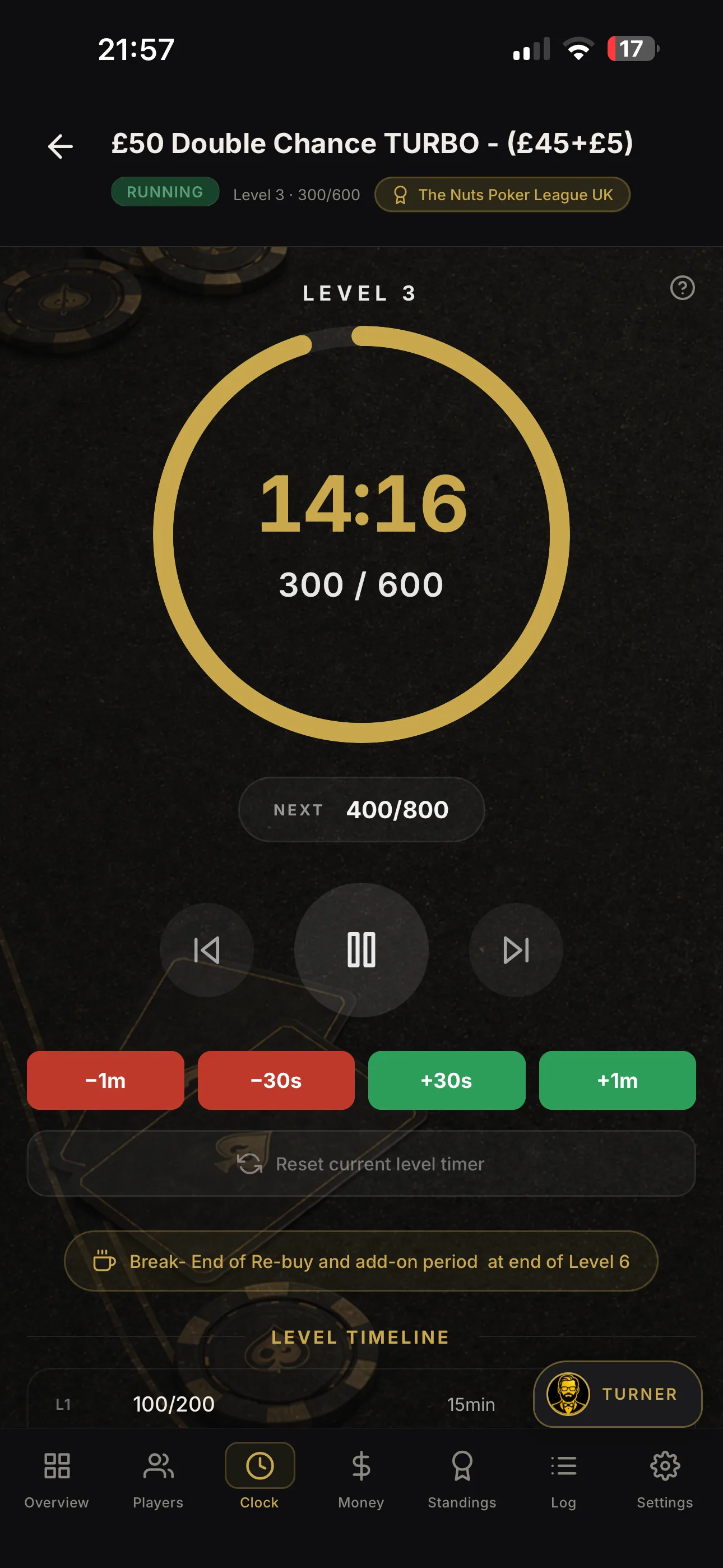
A live tournament clock that runs on autopilot removes the single biggest source of announcement error: mismatched timing between what you say and what the room sees. The app syncs its clock across every connected device, so a level change pushed on your phone updates the display, the share link, and the seating chart at the same moment.
That consistency matters most during rebuys, payouts, and reseating, where manual tracking invites mistakes under pressure. Smart seating tools in the app rebalance tables automatically when one breaks, cutting the repetitive “where do I sit now” questions that eat into your announcement time. A typical flow looks like this: push the level change in the app, confirm the display updates, then read your short PA script exactly as written.

Keeping the room calm when the pressure is on
Consistency is what keeps a room calm, not volume or charisma. When the stakes rise near the bubble, I favour clarity over speed every time, a slightly slower, more deliberate announcement beats a fast one that gets misheard and has to be repeated.
Rehearse your scripts with dealers and floor staff before the event starts. A five-minute run-through catches awkward phrasing long before it reaches a room full of players watching the clock.
- Jason
Let Shuffle Up and Deal! run the announcements with you
This app turns every guideline in this article into something you can tap instead of calculate. The live clock, seating engine, and share links work together so your script always matches what players see, whether you’re running a kitchen-table game or a multi-table card room event.
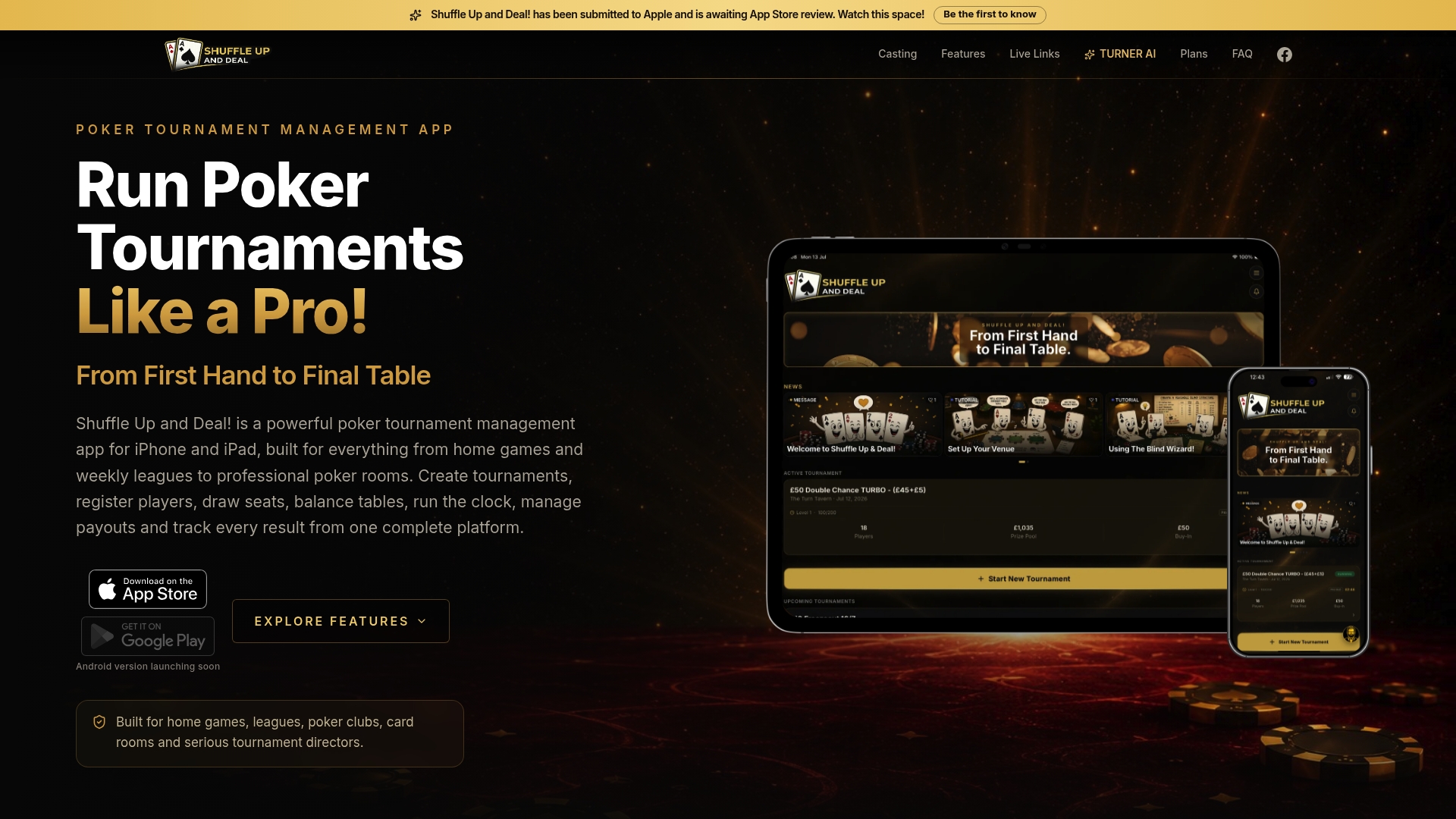
- Home game organisers get a synced clock and display without juggling spreadsheets.
- Card rooms and advanced users add automated payouts, multi-device sync, and league tracking for repeat events.
- Everyone gets a live share link so players can check levels and seating without interrupting you mid-announcement.
Visit the Shuffle Up and Deal! landing page to see which plan fits your next event and start running announcements that match your display every single time.
Where these guidelines come from
The timing and procedural detail in this article draws on professional guidance from the Poker Tournament Directors Association, whose recommended procedures cover dealer pushes, hand-for-hand play, and level timing. Prize and break examples reference PokerStars tournament rules, which set out when a prize pool becomes final and how breaks wait for hands to finish. For further reading on rules-aligned clocking, see our guide on the best TDA rules app.
Sources
FAQ
What should a poker tournament announcement include?
A poker tournament announcement should state the trigger, the instruction, who it affects, and the action players need to take immediately. Keeping it under 20 seconds and pairing it with the clock’s audio signal, as recommended by the Poker Tournament Directors Association, avoids confusion.
When does a new blind level officially start?
A new blind level starts once the clock’s audio signal sounds or the floor makes the announcement, and it applies from the next hand onward. Dealers are advised to hold the push roughly 90 seconds before the scheduled change to avoid dealing into a level that is about to expire.
How do you announce hand-for-hand play?
Announce hand-for-hand play by saying: “Finish the current hand, then hold up. We are going hand for hand.” Payoff eligibility is judged from the moment that announcement is made, so timing and clarity both matter.
When should payout information be announced?
Payout information should be announced only after late registration and any rebuy or add-on period has closed, since operator rules such as PokerStars tournament rules confirm prize structures are not final until then. Posting the finalised payouts on a display alongside the verbal announcement reduces disputes.
Can an app automate tournament announcements?
An app cannot replace your voice, but it can keep the clock, display, and seating chart perfectly in sync so your script never contradicts what players see. This app handles that synchronisation automatically across connected devices during live events.