
Poker Tournament Management App
Run Poker Tournaments Like a Pro!
From First Hand to Final Table
Seat draws, table balancing, the clock, payouts and league standings: Shuffle Up and Deal! runs the whole night from your iPhone or iPad.


25 Second Baseline Tournament Shot Clock Rules: TD Playbook

Tournament shot clock rules set a firm decision window for every player: act within the time or face a consequence. The common baseline, drawn from the Poker Tournament Directors Association, is 25 seconds plus a 5 second countdown, though many rooms tighten this to 15 seconds with time banks in reserve. If the clock runs out while a player faces a bet, the hand is dead. If it isn’t facing a bet, it is checked. Announce your rule before you deal a single card, and log every call.
TL;DR:
- Most tournament shot clocks are set at 25 seconds plus a five-second countdown, but some operators tighten this to 15 seconds with maintained time banks.
- Operators typically introduce the shot clock before the bubble or final table stages to prevent deliberate stalling and to maintain fairness.
- When the clock runs out facing a bet, the hand is declared dead, while if no bet is facing, the hand is automatically checked.
- Proper setup includes selecting equipment, announcing rules, assigning enforcement staff, and testing displays before play begins.
- Disputes should be handled calmly with clear communication and documented logs to protect decision-making consistency.
Table of Contents
- What official guidance says about shot clock rules
- When to introduce a shot clock during your event
- Penalties and enforcement when the clock runs out
- Step by step setup for a tournament shot clock
- Handling disputes and etiquette around clock calls
- Alternatives and complementary methods to reduce stalling
- Rules variations across different tournament formats
- How shot clock rules change player strategy
- Official rulings and exception scenarios to plan for
- What running a shot clock actually taught me
- Running your shot clock rules without the chaos
- Primary sources and official guidance
- Sources
- FAQ
What official guidance says about shot clock rules
The clearest starting point is the Poker Tournament Directors Association, whose rules underpin most tournament formats worldwide. Under TDA guidance, a player must be seated to call the clock on an opponent, and once the clock is called, the acting player typically gets about 25 seconds plus a short countdown before a ruling is made. Tournament Directors retain discretion to adjust these timings, and the TDA explicitly encourages houses to take steps that reduce stalling rather than leaving it unchecked.
Time banks work alongside this baseline: a player can draw on banked seconds for a genuinely tough spot, then return to the standard allowance once they’re used. Some operators have moved further, trimming the active decision window to 15 seconds while keeping the time bank intact, according to reporting on PokerStars’ rule changes at EPT Barcelona. The logic is simple: shorter active windows discourage habitual stalling, while the time bank still protects a player facing a genuine decision.
- Who can call it: a seated player or a floor official, per TDA convention.
- Standard allowance: 25 seconds plus a 5 second countdown, adjustable by the TD.
- Time banks: extra seconds a player can draw on for harder decisions, then rebuilt or capped per event rules.
When to introduce a shot clock during your event
Timing matters as much as the rule itself. Most Tournament Directors hold off on a shot clock through early levels, when stack depth naturally slows play, then introduce it as the bubble approaches, when stalling becomes a deliberate tactic rather than a genuine tough spot. Pay jumps and final table restructures are the other classic trigger points, since that’s exactly when a player has the most incentive to burn the clock.
Predictability beats surprise here. Tell players in advance, ideally in your written rules and again verbally, when the shot clock switches on and what changes. According to reporting on operator rule changes, introducing the clock precisely before the bubble, rather than mid-level, gives players fair notice and avoids the perception that you’re targeting a specific player.
- Home games: a shot clock is rarely needed before the final table, if at all.
- Larger card rooms: introduce it at a fixed level or once the field reaches the money bubble.
- Final tables: many operators keep the clock running throughout, given the stakes involved.
Penalties and enforcement when the clock runs out
Consistency is what makes a shot clock fair, so the outcomes need to be automatic rather than negotiated table by table. There are two standard results, and both flow directly from TDA convention.
- Facing a bet: if time expires before the player acts, the hand is dead.
- Not facing a bet: if time expires with no bet to call, the hand is checked automatically.
- Ties or borderline calls: where the ruling is genuinely unclear, the benefit typically goes to the player, with the TD’s decision standing as final.
- Repeated delays: escalate through a simple ladder, a verbal warning first, then loss of remaining time bank seconds, then a formal penalty such as a missed hand or orbit under your house rules.
Document every incident: hand number, seat, what happened, and the ruling given. A short written log protects your decision if a player questions it later and gives you something concrete to point to during a review.
Step by step setup for a tournament shot clock
Getting the hardware and the rules aligned before Level 1 saves you a dozen small arguments later. Here’s a practical sequence.
- Choose your equipment. Options range from dedicated physical shot clocks to a tablet running your tournament software, or a shared room display everyone can see.
- Set your base time. Decide between the TDA-style 25 seconds plus 5 second countdown or a tighter 15 second active window, keeping time banks available for harder spots.
- Configure time banks. Fix the number of banked seconds per player, whether they replenish at set intervals, and whether unused time carries over.
- Announce the rule. Read it into the microphone, post it on your rule sheet, and repeat it as blind levels and shot clock triggers change.
- Assign a monitor. One staff member (or the dealer) should own clock calls at each table so enforcement doesn’t depend on who happens to notice.
- Test your displays. Run through your casting or multi-device setup before players sit down, not after the first dispute.
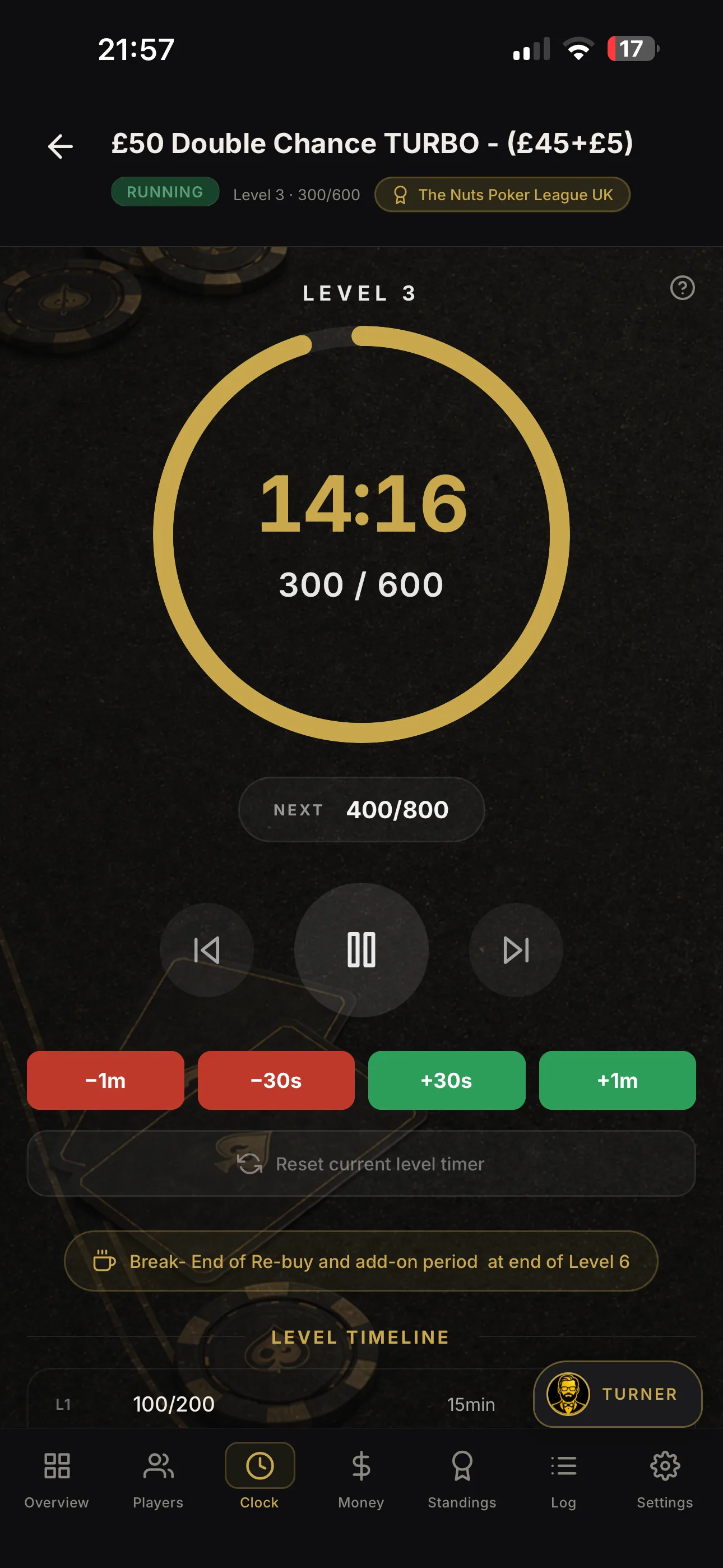
Some poker tournament management apps handle most of this from a single screen: a live tournament clock and multi-device syncing mean every table display updates the moment settings change, so switching timing during an event doesn’t require manual adjustments at each table.
Pro Tip: Test your shot clock display on the actual screens players will see, house monitors, tablets, or a cast setup, at least thirty minutes before doors open.
Handling disputes and etiquette around clock calls
A clock call can rattle a table if it’s handled clumsily, so a calm, repeatable procedure matters more than the rule itself. When a player calls the clock, confirm they’re seated and eligible to call it, announce it clearly to the table, and start the countdown out loud so nobody can claim they didn’t hear it.
Neutral phrasing helps: “The clock has been called on you. You have 25 seconds, then a 5 second count.” State the consequence plainly, dead hand if facing a bet, checked if not, so there’s no ambiguity when time runs out.
- Confirm the calling player is seated before starting the clock.
- Announce the countdown audibly, don’t let it run silently.
- Log the hand number and outcome immediately, not after the next hand.
- If a player disputes the ruling, review your log calmly and uphold or rescind based on what actually happened, not table pressure.
For a fuller walkthrough of tone and wording, our guide on handling call-the-clock disputes covers common flashpoints in more depth.
Alternatives and complementary methods to reduce stalling
A shot clock isn’t the only lever against slow play. The TDA’s 2022 rules list several house-level options: random table breaks, fixed hand counts before a break, going orbit for orbit, or rotating soft hands to keep pace steady without formal timing hardware.
These work well for smaller fields or home games where a dedicated clock feels like overkill. A fixed hand count before breaks, for instance, gives players a natural rhythm without anyone watching a countdown.
- Random table breaks: unpredictable timing discourages players from pacing their stalling around a known break.
- Fixed hand counts: simple to run, no equipment needed, works well in home games.
- Orbit or hand-for-hand play: keeps tables synchronised near the bubble without a clock at all.
Mixing methods often works best: run hand counts through the middle levels, then bring in the shot clock once the bubble approaches and the stakes for stalling rise.
Rules variations across different tournament formats
Not every event runs the same version of the shot clock, and knowing where the variation sits helps you avoid importing the wrong rule set. Home games rarely use one at all, relying instead on peer pressure and the TD’s informal reminder to “speed it up.” Casual card rooms tend to follow TDA convention closely: 25 seconds plus a 5 second countdown, called by a seated player, adjustable at the TD’s discretion.
Larger operators sometimes diverge. Some have trialled a tighter 15 second active window while keeping time banks intact, a change reported around PokerStars’ rule adjustments at EPT Barcelona, aimed at curbing tactical stalling without removing a player’s ability to think through a genuinely hard spot. Major series have gone further still, testing shot clocks at marquee final tables and then reversing course. The 2026 WSOP Main Event trialled a shot clock but ultimately removed it for the final table after debate over preserving natural decision time in the biggest hands of the year.
The takeaway for any organiser is that there’s no single universal standard. TDA rules give you a defensible baseline, but the active time, the countdown length, and whether the clock applies at all through the late stages are all decisions your event gets to make, provided you set them clearly and communicate them well in advance.

How shot clock rules change player strategy
Once players know a clock is running, their decision-making shifts in predictable ways. Tanking as a deliberate tactic, taking extra time specifically to pressure an opponent near a pay jump, becomes far riskier, since the dead-hand penalty removes the payoff entirely. That’s precisely why operators lean on the clock most heavily around the bubble and final table restructures.
The flip side is real: a tighter window, especially the 15 second active decisions some operators have trialled, can compress genuinely difficult spots. Debate around the 2026 WSOP Main Event trial centred on exactly this tension, whether a clock speeds up the field fairly or shortchanges players facing a legitimately complex all-in decision worth their whole tournament.
Time banks are the pressure valve. A well-calibrated bank lets players preserve their ability to think through the hands that matter while still removing the incentive to stall on routine folds. Game flow generally speeds up across the board, fewer dead minutes between hands, more hands per level, and a tighter overall schedule, but the benefit only holds if the bank sizing matches the stakes of your event. A card room running modest buy-ins can run a tighter clock than a marquee final table where every decision carries outsized consequences.
Official rulings and exception scenarios to plan for
Even a well-drafted shot clock rule runs into edge cases, and having a plan for them before they happen keeps your rulings consistent. A player who’s mid-sentence explaining a decision when time expires still faces the standard outcome, dead if facing a bet, checked otherwise, unless your house rules explicitly carve out an exception.
Disconnections, physical emergencies, or a genuine equipment failure (a display freezing mid-countdown) call for TD discretion rather than a rigid application of the penalty. The TDA’s own guidance leaves room for Tournament Directors to adjust timing to fit the circumstances of their event, and that discretion exists precisely for moments like these.
Multi-way pots occasionally raise the question of whether the clock should run simultaneously or sequentially for each player facing a decision. Running it sequentially, one player at a time, is the more defensible standard, since it avoids penalising a player for another’s slow play.
Keep a short written exception list alongside your main rule sheet: connection issues, display failures, and medical situations are the three most common scenarios worth pre-empting. When in doubt, rule in favour of preserving a fair outcome over a mechanical one, and log the reasoning so the next TD on shift can see why the call was made.

What running a shot clock actually taught me
Bringing a shot clock in right at the bubble, rather than earlier, made the biggest difference I’ve seen in pace. Hands that used to take ninety seconds dropped to something closer to the countdown itself, and the field moved through the money bubble noticeably faster.
The pushback came from players used to taking their time on marginal spots, and a couple of dealers needed a run-through before they called it confidently. The lesson: train your staff before the clock ever gets used live, and never clock a player who’s clearly weighing a genuine tournament-defining decision. Write the rule down, post it, and repeat it out loud.
- Jason
Running your shot clock rules without the chaos
Switching a room from a 25 second baseline to a tighter clock at the bubble is exactly the moment mistakes happen, someone forgets to update a table display, another dealer is still running the old timing. Shuffle Up and Deal! keeps every table synced from one screen: change the setting once, and the live tournament clock updates across every connected device instantly.

- Live tournament clock: runs your shot clock, blind levels, and time banks in one synced view.
- Multi-device syncing: every table display, iPad, or cast screen updates the moment you change a setting.
- Smart seating: keeps tables balanced automatically, so your clock rules apply to a fair, evenly stacked field.
For the full walkthrough, our guide on setting a TDA poker tournament clock covers the exact configuration steps. Plans start with a free Home Game tier, and Tournament Director unlocks the full clock and syncing toolkit for £13.99 a month. Visit Shuffle Up and Deal! to see which plan fits your event.
Primary sources and official guidance
For the official wording behind everything above, the Poker Tournament Directors Association rules remain the authoritative reference on calling the clock and standard timing. Reporting on the 2026 WSOP Main Event’s shot clock reversal shows how even major series adjust their approach. Rules vary by event and country, so always check the specific tournament’s published regulations before you run your own.
Sources
- POKER TOURNAMENT DIRECTORS ASSN. 2024 Rules Version 1.0
- PokerStars announces game integrity rule changes at EPT Barcelona | PokerNews
FAQ
What is the standard shot clock timing in poker tournaments?
The common baseline, per TDA rules, is 25 seconds plus a 5 second countdown once the clock is called. Some operators tighten the active decision window to 15 seconds while keeping time banks available, as seen in reported changes at EPT Barcelona.
What happens if a player’s time runs out?
The outcome depends on whether they’re facing a bet: if they are, the hand is dead, and if they aren’t, it’s checked automatically. Tournament Directors retain discretion over borderline calls and repeated delays.
Who is allowed to call the clock on a player?
Under TDA convention, a seated player or a floor official can call the clock on an opponent taking an unusually long time to act. The Tournament Director then confirms the call and starts the standard countdown.
Should home games use a shot clock?
Most home games can manage stalling through fixed hand counts or informal reminders rather than a formal clock. A shot clock becomes more useful once a field grows or reaches a structured bubble, as outlined in the TDA’s guidance on reducing stalling.
Does a shot clock change how players make decisions?
Yes, it discourages deliberate tanking near pay jumps since a dead hand removes any strategic benefit from stalling. Debate around the 2026 WSOP trial shows the balance organisers weigh between faster play and preserving time for genuinely hard decisions.