
Poker Tournament Management App
Run Poker Tournaments Like a Pro!
From First Hand to Final Table
Seat draws, table balancing, the clock, payouts and league standings: Shuffle Up and Deal! runs the whole night from your phone or tablet.



Organizers: Stop Collusion in Tournaments with Strategy Proof Rules
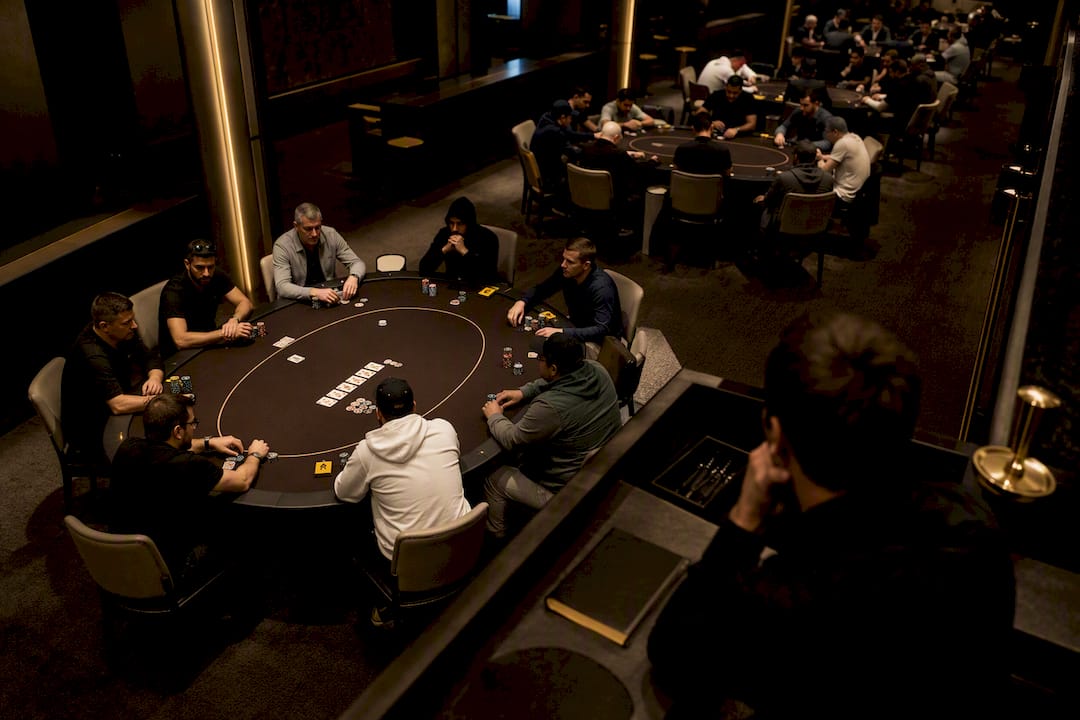
Collusion in tournaments happens when two or more competitors secretly coordinate their play to gain an advantage neither could achieve alone, whether that’s soft-playing each other in a poker event or swapping information mid-hand. It creates an uneven playing field for everyone else at the table, and it typically ends in disqualification, forfeited winnings, or worse once organisers catch on. Proving it usually means reading behaviour first and confirming it with forensic evidence second.
TL;DR:
- Colluders tend to avoid betting or raising against each other, share information informally, and frequently land at the same tables more often than chance suggests.
- Tournament formats like randomised single-elimination brackets can limit how much a pair of colluders can inflate their chances of winning.
- Detection relies on layered evidence such as betting patterns, IP overlaps, device data, and hand history analysis, often requiring forensic investigation.
- Prevention combines clear policies, random seating, live logs, behavior monitoring, and technical tools like screen-share detection and AI enforcement assistants.
- Transparent handling of suspected cases, with publicly shared evidence and sanctions, helps maintain tournament trust and discourage future collusion.
Table of Contents
- What collusion in tournaments looks like: common tactics and warning signs
- Why tournaments are vulnerable: theory and practical effects on outcomes
- How organisers and platforms detect collusion
- How to prevent and mitigate collusion: policy, operational and technical controls
- Case studies and enforcement: notable incidents and typical sanctions
- The psychology behind why players collude
- What collusion does to player trust and tournament reputation
- How players can protect themselves from collusion
- How tournament tools help prevent collusion before it starts
- Author perspective: balancing deterrence and player experience
- Run your next event with fewer blind spots
- Sources
What collusion in tournaments looks like: common tactics and warning signs
Collusion rarely announces itself. It shows up as small, repeated deviations from how a rational, self-interested player would act, and most tournament directors learn to spot the pattern before they can prove it.
The most common tactics include:
- Soft play - colluders avoid betting or raising against each other, effectively giving each other free passes through pots.
- Chip dumping - one player deliberately loses chips to a partner to build their stack for a deeper run.
- Information sharing - hole cards, table dynamics, or strategy passed via chat, voice calls, or a second screen.
- Account swapping - one person plays under another’s identity, often to dodge a ban or skew a payout.
- Signalling - physical tells or verbal cues at live tables, or timed bet-sizing patterns online.
Beyond the table, non-game data tells its own story. Repeated IP or device overlaps between two “unrelated” players, oddly synchronised session times, and the same two or three names landing at the same table far more often than shuffling odds allow are all red flags worth logging.
Pro Tip: If two players consistently avoid confrontation in pots where a normal opponent would apply pressure, note the hand numbers immediately. Patterns matter far more than any single hand.
Why tournaments are vulnerable: theory and practical effects on outcomes
Tournaments reward relative performance, not absolute skill, and that structural quirk is exactly what makes collusion attractive. When your payout depends on beating specific rivals rather than posting the best possible result, two players who agree to help each other can out-earn two players who compete honestly. Academic work on tournament design has spent years mapping how big that vulnerability actually is.
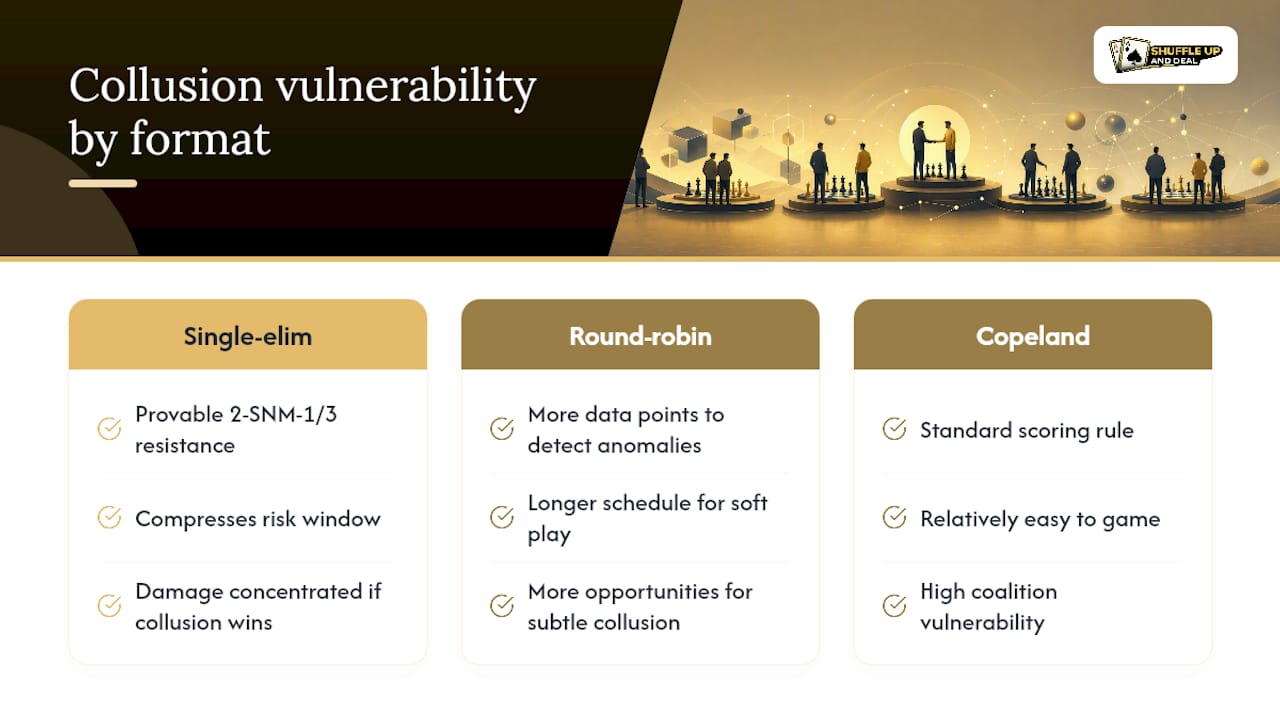
Researchers use the term 2-SNM, standing for two-player strategy-proofness against manipulation, to describe a tournament rule’s resistance to a pair of colluding competitors. The broader concept, k-SNM, extends that resistance to coalitions of any size. Recent formal analysis of these bounds shows randomised single-elimination brackets can achieve provable resistance to two-player collusion, described as 2-SNM-1/3, while standard rules like Copeland scoring remain comparatively easy to game when a coalition forms.
Format choice is not neutral. Some tournament structures mathematically limit how much a colluding pair can inflate their combined win probability, while others leave that door wide open.
Round-robin formats sit somewhere in between: they generate more data points to catch anomalies but also more opportunities for soft play across a longer schedule. Single-elimination brackets compress the risk window but concentrate the damage of a single successful collusive run. The practical fallout is the same regardless of format. Distorted payouts, unfair advancement of a colluding pair, and lasting reputational damage to the event itself once word gets out.
How organisers and platforms detect collusion
Detection works best as layered evidence rather than a single smoking gun. Behavioural analytics flag the pattern; forensic traces confirm it; operational records tie it to specific people.
Start with the numbers. Suspiciously high head-to-head win rates between two specific players, betting patterns that mirror each other too closely, and fold or raise decisions that make no sense against a random opponent but perfect sense against a partner all belong on a watch list. Cross-reference these against seating history: if the same pair keeps landing at the same table more often than shuffling probability allows, that’s worth a second look.
A practical investigation workflow typically runs like this:
- Flag the anomaly using automated win-rate and betting-pattern monitoring.
- Pull the metadata - IP addresses, device fingerprints, login timestamps, and payment methods tied to both accounts.
- Check for shared infrastructure such as identical IPs, overlapping device IDs, or evidence of screen-sharing software running during live hands.
- Preserve everything - raw hand histories, chat logs, and session data, before confronting either player.
- Escalate to a human reviewer who can weigh context an algorithm will miss, such as a legitimate reason two players share a household network.
Sophisticated collusion rarely leaves a trace in the hand history alone. A widely reported esports match-fixing case in Southeast Asia only unravelled once investigators examined screen-share logs and device data alongside the match footage. The gameplay looked plausible in isolation; the digital footprint did not.
Pro Tip: Preserve evidence before you confront anyone. Once players suspect they’re under investigation, they stop the behaviour immediately and you lose your clearest data.
How to prevent and mitigate collusion: policy, operational and technical controls
Prevention works in layers, and no single control does the whole job. The strongest anti-collusion setup combines written policy, table-level operations, and backend technology.
On the policy side, a written, unambiguous rule set is non-negotiable. Effective policy language borrows from how established organisations define collusion in competitive contexts: any agreement, written, spoken, or implied, that restricts fair competition qualifies. Strict liability clauses, where intent doesn’t need proving and mere participation is enough for a penalty, make enforcement far less messy.
Operational controls do the daily heavy lifting:
- Randomised, unannounced table draws that break up repeated pairings before they become a pattern.
- Anonymised seating charts until the last possible moment, so colluders can’t plan ahead.
- Audit-ready logs of every seating change, chip count, and payout decision.
- Delayed payout confirmation where local rules allow, giving investigators a window to act before money moves.
Technical controls close the remaining gaps: IP and device checks at registration, session monitoring for unusual multi-account activity, screen-share detection software, and two-factor authentication to stop account swapping outright.
Design choices matter too. Randomised or lightly biased formats, the kind explored in strategy-proof tournament rule research, demonstrably reduce how much a colluding pair or coalition can inflate their odds compared with straightforward rules like Copeland scoring. A small club running one table a week doesn’t need the same infrastructure as a platform running thousands of concurrent events, but the underlying principles, unpredictability, logging, and clear consequences, scale in both directions.
Pro Tip: Random seating alone won’t stop determined colluders, but combined with audit logs it turns a hard-to-prove suspicion into a documented pattern.
Case studies and enforcement: notable incidents and typical sanctions
Formal proceedings almost always hinge on the same thing: evidence that exists outside the game itself. Chat transcripts, device metadata, and financial trails tend to matter more than the hands or matches in question.
A few patterns recur across sports and games:
- Chess has seen governing bodies treat mere possession of unauthorised tools as grounds for severe punishment. FIDE stripped a Grandmaster title and issued bans once unauthorised device access came to light, without needing to prove every move was assisted.
- Esports match-fixing cases frequently collapse once screen-share and device logs contradict the official broadcast footage, as seen in the Southeast Asian case referenced above.
- Non-gaming tournaments aren’t exempt from criminal exposure either. A fishing tournament scandal involving weight-tampering led to felony charges in the United States once prize values crossed a legal threshold.
The psychology behind why players collude
Collusion rarely starts as a calculated crime. It usually begins as a favour between friends, a shared table where two familiar faces decide, almost casually, to “look after” each other. That informal trust is precisely what makes it dangerous. Social bonds lower the psychological barrier to cheating far more effectively than any financial incentive alone.
Group dynamics reinforce the behaviour once it starts. A pair that gets away with soft play once tends to repeat it, because the perceived risk drops with each unpunished instance while the perceived reward, extra chips, a deeper run, a bigger cash, stays constant or grows. Diffusion of responsibility plays a role too: when two people share a scheme, each can rationalise their part as the smaller half of the wrongdoing, making the decision feel less like a solitary act of cheating.
Financial pressure and status anxiety often sit underneath the surface motive. Regular players in the same local circuit, home game, or online community frequently know each other’s bankroll situations, and that familiarity can tip into quiet arrangements neither party would attempt with a stranger. Anonymity cuts the other way online: players who’ll never meet face-to-face sometimes collude precisely because they assume distance protects them from social consequences even if they’re caught.
Understanding this matters for organisers because punitive deterrence only addresses half the equation. Rules that reduce the social opportunity for collusion, unpredictable seating, limited repeated pairings, private betting information, remove the conditions that let quiet arrangements form in the first place.

What collusion does to player trust and tournament reputation
Nothing erodes a tournament’s reputation faster than the perception that some players had a hidden edge. Trust in poker is fragile precisely because so much of the game depends on players believing the deck is fair, the seating is random, and their opponents are playing their own hand.
Once a collusion scandal breaks, the damage rarely stays contained to the players involved. Field sizes shrink in subsequent events as word spreads through local and online communities. Regular players start scrutinising seating draws and pairing patterns that they’d never have questioned before, and some of that suspicion lands on organisers who had nothing to do with the original incident. Sponsors and satellite partners, particularly in larger series, tend to distance themselves quickly from any event associated with an unresolved integrity issue.
The reverse is also true, and it’s worth organisers remembering: a tournament that handles a collusion case transparently, publishing what was found, what rule was broken, and what sanction followed, often comes out with its reputation intact or even strengthened. Players respect visible enforcement far more than they respect the absence of scandal. Silence around a known problem breeds far more suspicion than a public, well-documented penalty ever does. The operational best practices that keep a clear audit trail aren’t just for catching cheats; they’re what let you demonstrate fairness after the fact.
How players can protect themselves from collusion
Individual players aren’t powerless against collusion, even though most of the heavy lifting sits with organisers. A handful of habits genuinely improve your odds of spotting it early.
Watch for players who consistently avoid confrontation with one specific opponent across multiple sessions, especially when the fold or check patterns make no strategic sense given stack sizes and position. Keep informal notes on repeated table pairings; if you keep landing with the same two players across supposedly random draws, that’s worth flagging to the tournament director rather than assuming coincidence.
Report suspicious behaviour promptly and specifically. Vague complaints (“something feels off”) rarely trigger action, but a note with hand numbers, timestamps, and a description of the pattern gives a director something they can actually investigate. Most reputable organisers, including those following published rulebooks and tournament director best practices, take documented reports seriously precisely because vague ones are so common and hard to act on.
Beyond reporting, protect your own game. Avoid sharing your table draw, stack size, or hand details in public chat or on social media during live events, since that information can inadvertently help a colluding pair calibrate their play against you. If you’re playing online, stick to platforms that publish clear anti-collusion policies and player statistics you can actually review. Transparency from the organiser is itself a signal worth weighing before you register.
How tournament tools help prevent collusion before it starts
Good policy needs good infrastructure behind it, and this is where the right software does genuine work rather than just paperwork. The controls described earlier, unpredictable seating, audit trails, behavioural monitoring, only function if a tournament management system actually implements them consistently across every event.
Features that materially reduce collusion risk include:
- Smart seating algorithms that randomise and rebalance tables automatically, breaking up the repeated pairings colluders rely on.
- Live audit logs that timestamp every seating change, chip count, and elimination, giving directors a defensible record if a dispute arises.
- Player statistics tracking that surfaces head-to-head patterns across events, not just within a single tournament.
- Live tournament share links that keep results transparent to the whole field in real time, reducing the information asymmetry colluders exploit.
- An AI rules assistant that gives directors instant, consistent rulings on disputed situations, so enforcement doesn’t vary from one event to the next.
Shuffle Up and Deal! builds each of these directly into its tournament management platform, alongside ICM calculators and payout tracking that make the numbers behind any suspicious pattern easy to verify.
Author perspective: balancing deterrence and player experience
If you’re running a tournament with limited resources, sequence your defences rather than trying to build all of them at once. Write your anti-collusion policy first, since enforcement without a published rule invites disputes. Fix your seating and format rules second, because unpredictability closes off the easiest collusion pathways for free. Layer forensic monitoring on top once volume justifies it. Apply sanctions consistently, every time, regardless of who’s involved. Players forgive a strict rule. They rarely forgive a rule enforced selectively.
- Jason
Run your next event with fewer blind spots
Every control described above - randomised seating, audit-ready logs, transparent player stats - only earns its keep if it runs consistently across every event you host, not just the ones where you remember to switch it on. Shuffle Up and Deal! builds those safeguards directly into how you run a tournament, so unpredictable table draws and timestamped records happen automatically rather than depending on a busy director’s memory.

The app’s smart seating algorithm handles the rebalancing that breaks up repeated pairings, its live tournament clock and audit trail give you a defensible record if a dispute ever lands on your desk, and its player statistics surface head-to-head patterns you’d otherwise have to spot manually. Pair that with in-app ICM calculators for clean payout decisions and an AI rules assistant for consistent rulings under pressure, and you’ve got the operational backbone this article has been describing, built for both weekly home games and full-scale card room series. If integrity controls are on your list for the next event, visit Shuffle Up and Deal! to see the features in action and start running tighter tournaments today.
Sources
- Collusion and biased tournaments (European Economic Review)
- On approximately strategy-proof tournament rules for collusions of size at least three (arXiv, 2024)
- Johnson Controls - Global antitrust & fair competition policy
- Disgraced Thai esports players reveal how they cheated (VnExpress, 2026)
- Chess