
Poker Tournament Management App
Run Poker Tournaments Like a Pro!
From First Hand to Final Table
Seat draws, table balancing, the clock, payouts and league standings: Shuffle Up and Deal! runs the whole night from your iPhone or iPad.


Copy Paste Late Entry Policy, Checklist, and App Workflow for Poker TDs

The recommended default is simple: publish a clear late-registration window, sell full starting stacks to everyone who arrives within it, and seat them randomly, following Poker Tournament Directors Association (TDA) rules. Organisers who prefer a different feel can use blinded empty-seat stacks or an on-time bonus instead, but the TDA model remains the fairest starting point, and the app makes it easy to enforce consistently.
TL;DR:
- The full-stack, random-seating model from the TDA remains the fairest and simplest approach for late registration, reducing disputes and ensuring transparency.
- Implementing a precise late-registration window, whether by clock time or level-based cut-off, is essential to prevent ambiguities and arguments during events.
- Using tournament software like Shuffle Up and Deal! automates enforcement, automatically closing registration and seating late entrants consistently across all tables.
- Offering early bonuses or prepay options encourages punctuality and minimizes last-minute rushes, especially in recurring or home-game settings.
- Clear communication and published policies on registration timing, re-entries, no-shows, and seating mechanics are critical for smooth operation and fairness.
Table of Contents
- Standard models used for late entries
- Setting and publishing your late-registration window
- A copy-paste policy template and event-day checklist
- Alternates, re-entries and no-shows without the arguments
- How blinds and dealing work when a player sits mid-level
- Which house-rule variant suits your event
- Enforcing your policy with tournament software
- A tournament director’s honest take
- Try Shuffle Up and Deal! for consistent late-registration enforcement
- Where to check the rules and structure examples
- Sources
- FAQ
Standard models used for late entries
Three approaches dominate live and online poker, and each one solves a different problem. Understanding what each model actually does helps you pick the right fit for your event rather than copying whatever the last venue did.
The TDA and major-event approach is the one most casinos and serious home games use. A player who registers within the published window buys a full starting stack, gets seated at random by the software or the floor, and gets dealt into every hand except when they would sit between the small blind and the button. That last exception matters: it stops a late arrival from dodging a blind simply because of where they landed. According to the TDA rules, this random-seating requirement exists specifically to prevent players gaming their arrival time.
Blinded empty-seat stacks work differently. Instead of waiting for the seat to fill, the house treats the empty chair as if it were occupied, posting blinds from a stack that sits there until a player claims it. When the late entrant finally sits down, their stack is whatever remains after those forced blinds. This model appeals to hosts who want strict parity: nobody gets a “free ride” of extra hands before their blind comes round. The pitfall is administrative. Someone has to track which seats are blinded, remove the correct number of chips at the right moments, and explain the maths to a confused new arrival, and that is where home games and smaller casino events run into trouble, as practitioner discussion on the Poker Chip Forum makes clear.
On-time incentives take a behavioural route rather than a mechanical one. Instead of penalising latecomers, you reward punctuality directly.
- Early-bird or on-time bonus: players who register before a set time or level receive extra starting chips, often 5 to 10% more than the standard stack.
- Prepay-for-seat: players pay in advance to guarantee a seat and avoid the waitlist, which smooths the registration desk and reduces late scrambling.
- Combined approach: many organisers layer a modest bonus on top of the standard TDA full-stack model rather than treating it as a replacement.
The same forum discussion of house-rule practices notes that players tend to respond better to a bonus for showing up on time than to a penalty for arriving late, and that standardising the window and publishing the exact wording removes most disputes before they start.
Pick the model that matches your crowd. A casino-style multi-table event with strangers benefits from the TDA standard because it is transparent and hard to argue with. A regular home game where everyone knows the house rules can experiment with blinded stacks or bonuses without much friction.
Setting and publishing your late-registration window
Ambiguity is where most late-arrival disputes start, so the window itself needs a precise definition before you worry about seating mechanics. You have two broad choices: clock time or level cut-off, and each suits different formats.
- Clock-time windows measure from the tournament’s advertised start, not from when the player actually sits. A common example is closing registration 90 minutes after the first cards are dealt, a format online rooms use because it displays cleanly in a lobby countdown, as shown in PokerStars’ tournament rules.
- Level-based cut-offs tie registration to the blind schedule instead of the clock, for example “registration closes at the end of level 6” or “through the first break”. This suits events where blind levels vary in length or where a delayed start would otherwise shift a clock-time deadline unfairly.
- Early closure for field integrity lets you shut registration before the published deadline if enough players have already been eliminated that starting the payout structure makes sense. Online rooms reserve this right explicitly, and live events should state the same thing in writing rather than leaving it to floor discretion on the day.
Whichever method you choose, state it in three places: the online listing, the printed structure sheet, and signage at the registration desk. Vague wording such as “late registration closes early in the event” invites arguments. Precise wording such as “late registration closes at the start of level 8 (approximately 3 hours after start) or when the field is reduced to two tables, whichever comes first” leaves nothing to interpret.
Casino structure sheets are a useful model to borrow from directly. The Wynn Signature Series structures publish registration opening times and action-clock rules alongside the blind schedule, so players see the whole timetable in one document rather than hunting for the late-entry rule separately. Copying that habit, one sheet, every rule visible together, saves your registration desk a lot of repeated explaining. If you run your event through an app, tools like the late-registration cutoff settings in Shuffle Up and Deal! let you set the window once and have it display automatically on every connected screen, so the printed sheet and the live display never drift out of sync.
A copy-paste policy template and event-day checklist
You do not need to write your late-arrival policy from scratch. Below is wording you can adapt directly for a registration page, a printed structure sheet, or tabletop signage, followed by the operational steps that make the policy stick on the day.

Sample registration-page wording: “Late registration closes at the start of level 8 (approximately 90 minutes after the scheduled start) or when the remaining field reaches two tables, whichever occurs first. All late entrants receive a full starting stack and are seated randomly per standard tournament rules.”
Sample structure-sheet line: “Registration: opens 60 minutes before start, closes end of level 8. On-time bonus applies to entries before level 3.”
Sample tabletop signage: “Ask the floor about seat availability. Late entries welcome until the announced cut-off, full stack guaranteed.”
With the wording settled, the checklist below keeps the desk consistent when the room is busy and players are queuing.
- Registration desk procedure: confirm the player’s name against the prepaid list or take payment, log the exact entry time, and issue the stack before the player sits, never after.
- Waitlist rules: state up front whether a waitlisted player forfeits their spot if a seat opens and they are not present, and give a specific response window, such as two minutes when called.
- Seating draw: use a randomiser, whether a card draw, a digital shuffle or an app-based seating algorithm, so no one can accuse the floor of favouritism.
- Paid-but-not-present players: decide in advance whether their stack blinds off from the moment registration opened for that table or only from when the seat was assigned, and publish whichever rule you pick.
- Removing blinded chips: name the specific role, dealer or floor, responsible for pulling forced blinds from an empty seat, so it happens on schedule rather than being forgotten until someone complains.
A sensible default is a late-registration window of roughly an hour and a half or eight levels, with a stack bonus for entries that arrive early in the window. That combination rewards punctuality without shutting out players stuck in traffic or finishing a work call.
Pro Tip: Print the exact cut-off time on every table’s structure card, not just at the registration desk, so players stop asking the dealer and start checking the card themselves.
Running this checklist manually across several tables gets error-prone fast, which is exactly the gap the Shuffle Up and Deal! player registration tools are built to close, since the app timestamps entries and applies your bonus rule automatically rather than relying on a clipboard.
Alternates, re-entries and no-shows without the arguments
Late arrivals are not the only source of seating disputes. Alternates, re-entries and no-shows each need their own clearly stated rule, and conflating them with ordinary late registration is where confusion creeps in.
An alternate is a player who registered before the event filled but was placed on a waiting list because every seat was taken. A re-entry, by contrast, is a player who busted out of the same event and is paying again to come back in, something only permitted in tournaments explicitly marked as re-entry or rebuy formats. Both are different from a simple late arrival, who has never played a hand yet.
- Alternates get full stacks and a random seat, exactly as a standard late entrant would, the moment a seat opens during the registration window.
- Re-entries follow the same full-stack, random-seat rule, but only within events that permit re-entry, and only inside the same late-registration window that applies to everyone else.
- No-shows on a paid alternate list forfeit their place once the response window passes, and the seat goes to the next name down rather than staying held.
Seating an alternate mid-level raises the same blind question as any late entry: do they owe the blinds they missed while waiting? Most rooms say no, since the alternate never had chips in play, and the PokerTDA forum discussion on alternates describes TDs using small workarounds, such as opening an extra short table in anticipation of a rush of alternates, rather than forcing a missed-blind charge on someone who was never dealt in.
No-show policy deserves its own line in your published rules, separate from the late-entry window. State clearly whether a prepaid, no-show player forfeits their entry fee outright or receives a partial refund if they cancel before a set deadline, and communicate that deadline the same way you communicate the registration window, in the listing, on the sheet, and at the desk. Vague refund policies invite the kind of last-minute disputes that late-registration rules are supposed to prevent in the first place.
How blinds and dealing work when a player sits mid-level
The mechanics of seating a late arrival matter as much as the window itself, because a badly handled seating decision can hand a player a strategic edge or an unfair penalty within seconds of sitting down.
The TDA’s guidance is specific on one point: a late entrant should never be dealt a hand from a seat that would place them between the small blind and the button, since that position would let them skip a blind they should owe. Seating is otherwise random, drawn the same way as any other new player, which the TDA rules note exists precisely to stop players timing their arrival to land in a favourable spot.
Once a seat is assigned, organisers have a few options for how blinds get handled:
- Full stack, no deduction: the entrant sits with the complete starting stack and simply waits for their turn to post blinds naturally, which is the simplest option and the one most casino events use.
- Dead-chip adjustment: some rooms take a small, published amount from a returning alternate’s or re-entry’s stack to cover a blind they would otherwise dodge, though this is far less common than the full-stack approach.
- Blinded empty-seat deduction: as covered earlier, this applies before the player ever sits, so by the time they arrive their stack already reflects any blinds posted on their behalf.
Each option has a knock-on effect on stack depth and pacing. Full stacks with no deduction keep the field’s average stack size predictable and easy to track, which matters for anyone running blind-level timing and payout projections. Blinded stacks create smaller, uneven starting stacks across the room, which can distort early aggression if players sense some seats are already short. If you want a fuller picture of how blind schedules interact with stack depth generally, the Shuffle Up and Deal! guide to poker blinds breaks down how level length and starting stack size combine to set the pace of a tournament.
Whichever mechanic you choose, apply it identically to every late entrant, every time. Consistency is what actually prevents complaints, far more than the specific rule you land on.
Which house-rule variant suits your event
Not every event needs the same late-arrival policy, and matching the variant to the room usually matters more than picking the theoretically “correct” one.
- Full-stack on arrival suits casino events, charity tournaments and anything with strangers in the field, because it is transparent, matches the TDA standard, and needs almost no explanation at the desk. The trade-off is that a player arriving near the end of the window gets a stack identical to someone who has played for two hours, which some regulars find generous.
- Blinded empty-seat stacks suit tight-knit home games where the host wants strict parity and players already understand the house rules. The trade-off is administrative: someone must track every empty seat and remove the right chips at the right time, and a single mistake here causes exactly the kind of dispute the rule was meant to prevent.
- On-time bonus or prepay suits regular leagues and recurring games where punctuality is a habit worth building. The trade-off is a possible objection from a bonus-less late entrant who feels penalised, even though, strictly speaking, they are only missing an incentive rather than losing chips.
Most organisers land on a hybrid: TDA-style full stacks and random seating as the baseline, with a modest on-time bonus layered on top to reward the players who show up early. That combination keeps the fairness case simple to explain while still nudging behaviour in the direction you want.
Enforcing your policy with tournament software
Publishing a policy is one thing; enforcing it identically across every table, every week, is another. This is the gap that tournament management software closes, and it is where the Shuffle Up and Deal! app earns its keep for organisers running anything beyond a two-table home game.
- Registration cut-offs: set your clock-time or level-based window once, and the app closes registration automatically rather than relying on the floor to remember.
- Smart seating algorithm: late entrants and alternates get placed randomly the moment a seat opens, matching TDA practice without a manual card draw at a busy desk.
- Live tournament clock: the same clock that tracks blind levels also drives the registration cut-off, so the two never fall out of sync.
- Waitlist and seat-hold handling: the app tracks who is next in line and how long a called player has to respond, removing the guesswork from a busy alternates list.
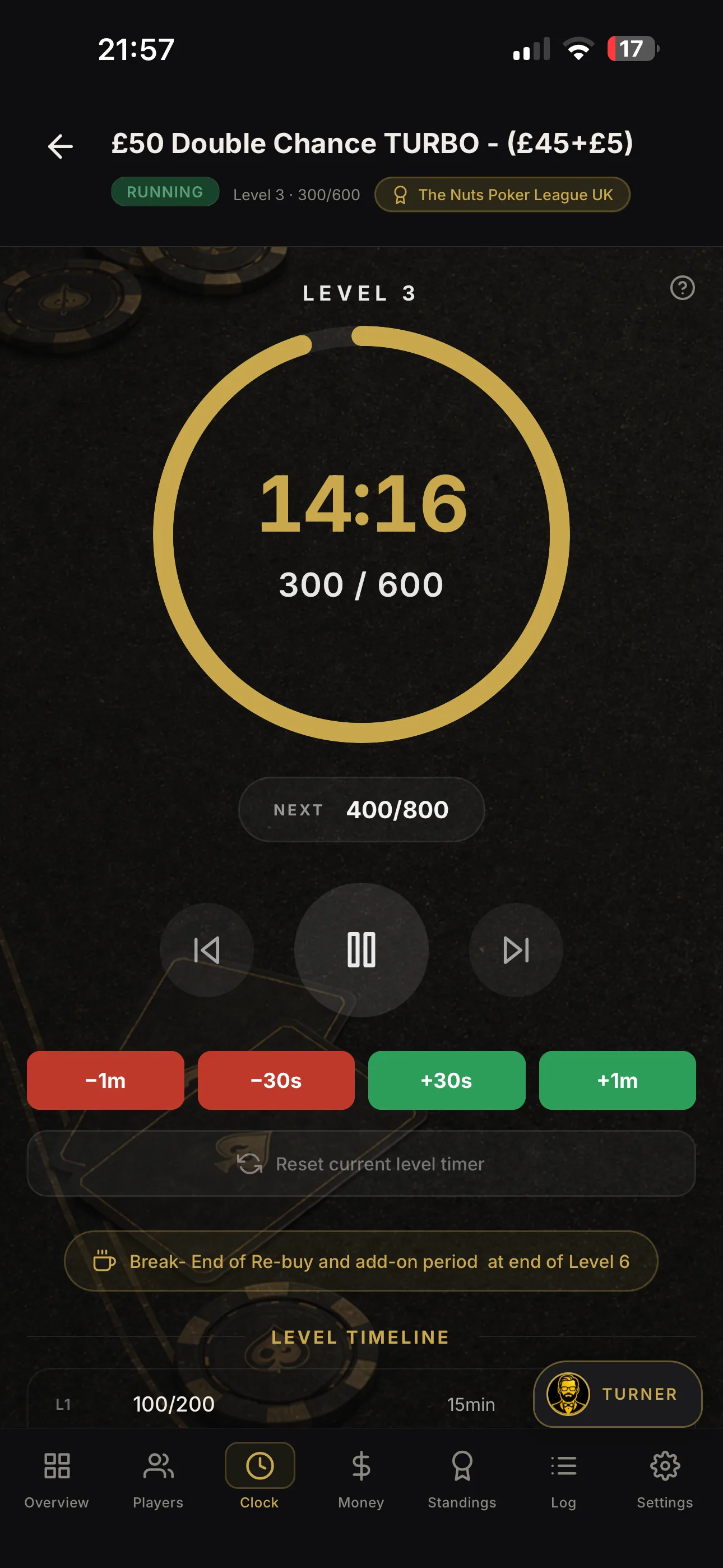
A typical workflow looks like this: create the event, set the late-registration window against the level schedule, enable a prepay or on-time bonus if you are using one, then let the seating engine and clock handle the rest as players arrive. The result is consistent enforcement, a public display that shows the exact cut-off in real time, and faster table balancing once the room fills.
Pro Tip: Turn on the live display before doors open, so players can see the registration countdown for themselves instead of asking the desk every ten minutes.
A tournament director’s honest take
Every organiser eventually has to pick one late-arrival policy and stick with it, and after running plenty of events with players who arrive at every point on the clock, the full-stack, random-seat model is the one that causes the fewest arguments. It matches what most players have already experienced elsewhere, so nobody at the table needs a lecture on why they got a full stack twenty minutes before the window closed.
The trade-off is real. A player who has ground for two hours sometimes resents watching a late arrival sit down with the same chip count they started with. That resentment is manageable, though, and a modest on-time bonus takes most of the sting out of it without adding the bookkeeping headache of blinded stacks. Blinded seats look fairer on paper, but the amount of floor attention they demand rarely pays for itself outside a small, familiar home game where everyone already trusts the host to get the maths right.
The single habit that matters more than the rule itself is publishing it early and applying it the same way every time. Players forgive a policy they disagree with far more easily than one that seems to change depending on who is asking.
- Jason
Try Shuffle Up and Deal! for consistent late-registration enforcement
Once you have settled on a policy, the harder part is applying it the same way at every table, every week, without a desk manager who has to remember three different rules for three different events. Shuffle Up and Deal! handles that consistency for you: set your registration cut-off once, let the seating engine place late entrants and alternates randomly, and run the live tournament clock so the countdown on screen always matches the countdown at the desk.

Some apps also manage waitlists, table balancing and payouts from the same screen, so your registration policy sits alongside the rest of the tournament rather than living on a separate printed sheet. Plans range from the free Home Game tier through to the Tournament Director plan at £13.99 per month, with TD Pro, TD Elite and Card Room tiers available for larger operations. Head to Shuffle Up and Deal! to set up your first event and publish a late-arrival policy that runs itself.
Where to check the rules and structure examples
For organisers who want to verify wording or fine-tune their own policy, a handful of sources are worth bookmarking. The TDA rules remain the reference point most casinos and serious home games build their late-entry language from, covering full stacks, random seating and the small-blind-to-button exception in one document. PokerStars’ published tournament rules show how a major online room states its clock-time cut-off and early-closure right in plain language suitable for a listing page. The Wynn Signature Series structure sheets give a real example of registration times and action-clock rules printed alongside a blind schedule, worth copying for format alone. Practitioner threads on the Poker Chip Forum and the PokerTDA alternates forum show how smaller games actually apply these rules day to day, warts and all. Organisers sourcing physical tournament equipment alongside their software setup can also compare options such as the Texas Hold It table range for live events.
Sources
- Poker Tournament Directors Association (TDA) rules
- PokerStars tournament rules - late registration
- Wynn Signature Series tournament structures (example)
- Tourney - Blinds for late arrivals? | Poker Chip Forum
FAQ
What is the 42 rule in poker?
The “42 rule” is not a recognised TDA or major-event rule; the number varies by house, and no standard body publishes a fixed guideline. Definitions circulating online tend to be informal home-game shorthand rather than an official standard, so check your specific event’s structure sheet instead of assuming a universal rule.
What is the 7-2 rule in poker?
The “7-2 rule” is a casual home-game side bet where a player who wins a hand holding one of the weakest starting hands earns a bonus from the pot or other players. It has no bearing on official tournament structure and is not part of TDA guidance.
What is the 80/20 rule in poker?
There is no official rule published by the TDA or major tournament series corresponding to an “80/20 rule”; the phrase is used informally in different contexts without a single agreed definition. Treat any claimed “80/20 rule” as a personal heuristic rather than an established standard.
Is there a time limit for poker?
Individual tournaments set their own time limits through the blind-level schedule and the late-registration cut-off, whether measured in clock time or by level, as shown in PokerStars’ tournament rules. There is no universal time limit across all poker; each event’s structure sheet states its own registration window and level durations.
What is late arrival in poker and how is it handled?
Late arrival refers to a player registering or sitting down after a tournament has already started but before the late-registration window closes. Under TDA rules, a late arrival receives a full starting stack and is seated randomly, except they are not dealt in when that seat would fall between the small blind and the button.