
Poker Tournament Management App
Run Poker Tournaments Like a Pro!
From First Hand to Final Table
Seat draws, table balancing, the clock, payouts and league standings: Shuffle Up and Deal! runs the whole night from your iPhone or iPad.

Poker blinds explained: rules, structures, and strategy

Blinds are the forced small and big bets two players post before cards are dealt, and they exist to create an opening pot that forces action. Without them, every player could fold for free until someone finally chose to play, so the game would stall.
- Small blind: posted first, usually half the big blind
- Big blind: posted second, sets the minimum bet size for the hand
- Cash games: blinds stay fixed for the whole session
- Tournaments: blinds rise on a schedule, squeezing your SPR (stack-to-pot ratio) as levels climb, which is exactly why tournament directors lean on tools like Shuffle Up and Deal! to keep the clock and the increases running correctly.
Key Takeaways
Poker blinds create the pot that forces action, and how you play each blind seat, and how a tournament’s schedule is built, determines far more of your results than most players assume.
| Point | Details |
|---|---|
| Blinds force the action | Small and big blinds create an opening pot so hands don’t stall before anyone acts. |
| Big blind seat gets a discount | Pot odds mean the big blind should defend far wider than most players instinctively do. |
| Small blind plays for position | Steal or fold from the small blind rather than flatting into positional disadvantage. |
| Structure design shapes strategy | A 25 to 50% increase rate per level balances tournament length against playable stack depth. |
| Tools reduce enforcement errors | Apps like Shuffle Up and Deal! automate blind increases and keep displays synced during rebuys. |
Table of Contents
- How poker blinds work at the table
- Small blind vs big blind: why the two seats play so differently
- Cash game blinds vs tournament blinds
- Designing a blind structure that actually works
- Small blind strategy: stealing without bleeding chips
- Big blind defence: pot odds, MDF, and knowing when to fold
- What happens if you miss the blinds?
- How Shuffle Up and Deal! keeps blind schedules accurate
- Why most blind advice misses the point
- Frequently asked questions about poker blinds
- Sources
How poker blinds work at the table
Blinds rotate clockwise with the dealer button, so every player takes a turn in each seat over the course of a session. The player immediately left of the button posts the small blind; the next player posts the big blind. This structure is what makes blinds distinct from antes), which every player at the table posts rather than just two.
- Small blind amount. Usually half the big blind, though live rooms round awkward figures up or down when chips don’t split cleanly.
- Big blind amount. Sets the minimum opening bet for the hand.
- Live blind rule. The big blind is “live,” meaning that player retains the right to raise even after calls from other players, because they’ve already committed money before seeing their cards.
- Heads-up exception. With only two players, the button posts the small blind and acts first before the flop, reversing the usual order.
A quick example: at 25/50, the small blind posts 25 chips, the big blind posts 50, and any player who wants to enter the pot before the flop must put in at least 50 to call, or more to raise.
Small blind vs big blind: why the two seats play so differently
The two blind seats share a name but almost nothing else strategically. From the small blind, you’re out of position for the rest of the hand against every other player who acts after you, so most winning strategies from here lean towards either stealing when folded to or folding to real aggression rather than calling into bad spots.
The big blind works in reverse. You’re getting a discount on your call because you’ve already invested chips, so a wider defending range is correct, mixing calls and 3-bets depending on who opened and from where.
- Blind vs blind, heads-up: the small blind can open far wider than from any other seat, because only one opponent needs to fold.
- Folded to you in the small blind: raise or fold, rarely call a limp.
- Multiway pots: both blinds need tighter ranges, since more players means more chances someone wakes up with a strong hand.
Pro Tip: When stealing from the small blind against a tight big blind, a raise to around 3x the big blind applies pressure without overcommitting; when defending the big blind against a min-raise, you can flat far wider than instinct suggests because the pot odds are simply too good to fold.
Cash game blinds vs tournament blinds
Cash game blinds never move. If you sit down at a $1/$2 table, they stay $1/$2 whether you play for twenty minutes or ten hours, and buy-ins in live cash games commonly run 50 to 250 big blinds, letting players rebuy instantly if they bust a hand.
Tournament blinds behave completely differently.
- Scheduled increases push blinds higher every level, regardless of how the table is running.
- Antes often join the structure later in a tournament, adding extra pressure beyond the two blinds.
- Being “blinded off” describes a player who folds too passively and watches their stack shrink purely from posting blinds each orbit, a real risk once levels accelerate.
- ICM considerations mean tournament players must weigh survival against chip accumulation, especially near the money bubble, in a way cash players never have to.
Rising blinds are also why late-stage tournament ranges tighten. When your stack shrinks relative to the blinds, marginal decisions that were fine at 100 big blinds become shoves or folds at 20.
Designing a blind structure that actually works
A good blind structure balances two competing goals: finishing within your target time and keeping stacks deep enough for real poker to happen. Get the balance wrong and you either run hours past your venue’s closing time or force players into all-in coin flips within the first hour.
- Pick your increase rate. Most well-designed structures raise blinds by roughly 25 to 50% per level, smooth enough that no single jump feels punishing.
- Set level length. Home games and fast tournaments often use 10 to 15 minute levels; deeper-stacked events run 20 to 30 minutes to let post-flop skill matter more.
- Model a sample schedule. A 10,000 chip starting stack against a 25/50 opening level, rising through ten levels to something like 300/600, gives players a genuine arc rather than an immediate scramble.
- Decide when antes join. Many structures introduce a big blind ante around the midpoint, once stacks have thinned enough that extra pressure sharpens decisions without gutting them outright.
Rebuys and add-ons complicate this further, since a wave of rebuys can suddenly inflate the average stack size, and a structure built around that needs built-in flexibility rather than a fixed script.
Small blind strategy: stealing without bleeding chips
Playing well from the small blind starts with accepting a simple fact: you’re going to be out of position for the entire hand if you don’t win it before the flop. That shapes almost every decision from here.
- Raise sizing when stealing. Somewhere between 2.2x and 3x the big blind tends to work, tightening towards the smaller end against multiple players still to act.
- Avoid flatting marginal hands. Calling from the small blind leaves the big blind acting last with a positional and numerical advantage, so most solvers favour raising or folding over limping.
- Play for pot control postflop. In tournaments especially, small blind steals should aim to win the pot preflop or on the flop rather than building large multi-street pots out of position.
- Tighten near the bubble. ICM pressure means a small blind steal that’s profitable in a cash game can be a costly mistake two spots from the money.
Pro Tip: Track how often your table’s big blind folds to a small blind raise over a full session; if that number sits above roughly 70%, you can widen your stealing range considerably before opponents adjust.
Big blind defence: pot odds, MDF, and knowing when to fold
Defending the big blind is really a maths problem dressed up as a poker decision. If the pot is 150 chips and it costs you 50 to call, you’re getting 3 to 1, meaning you need to win roughly 25% of the time for the call to break even before any postflop equity at all.
Minimum defence frequency tells you how often you need to defend against a given raise size to stop an opponent from profiting by opening any two cards. Against small raises, that number climbs high, which is why over-folding the big blind ranks among the most common leaks in the game.
- Split calling from 3-betting based on hand type: suited connectors and small pairs often prefer calling, while strong broadways and pocket pairs can profitably 3-bet.
- At 100 big blinds, defend a wide mix of calls and 3-bets against most opens.
- At 40 big blinds, ranges compress; flatting loses appeal as stack-to-pot ratios shrink.
- At 15 big blinds, shove/fold dynamics dominate, and calling ranges shrink sharply in favour of 3-bet shoves.
- Postflop, check-raising and blocker bluffs become more useful the deeper the stacks, while check-calling suits hands with genuine showdown value.
Coaches consistently warn against “autopilot” defending: the chips you already posted are gone regardless of your decision now, so the call needs to stand on its own merits against the current raise size and your remaining stack.
What happens if you miss the blinds?
Step away from a live table and the rules don’t pause for you. In cash games, most rooms require a “super-post,” meaning you post both blinds (or an equivalent) when you return before you can act, since your seat missed its turn in the rotation.
- Live blind vs dead blind: a live blind counts towards your call and gives raising rights; a dead blind sits in the pot but grants nothing back.
- In tournaments, blinds are deducted from your stack whether you’re at the table or not, so stepping away for even one level risks being blinded off entirely.
- Speak to the tournament director before leaving your seat for any length of time, since most rooms have specific windows before a stack is forfeited.
How Shuffle Up and Deal! keeps blind schedules accurate
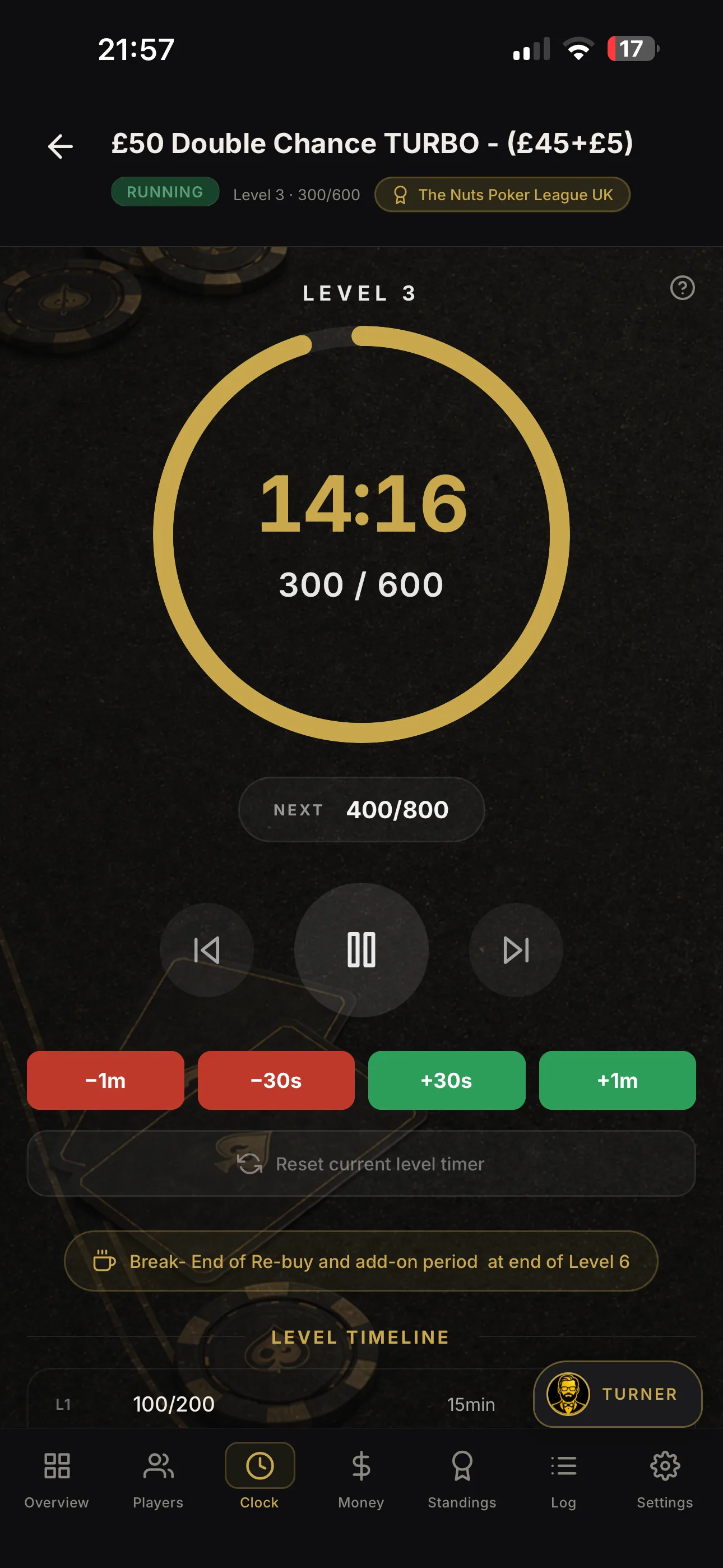
Manually tracking blind levels across a room full of tables is where most tournament chaos actually starts. Shuffle Up and Deal! runs a live tournament clock with automatic blind increases, so every table sees the same level at the same second, no shouting across the room required.
- Automatic level advances remove the need for a TD to manually push blinds up on schedule.
- Rebuy and add-on handling lets you adjust the structure mid-event without breaking the clock.
- Table balancing keeps player counts even as the field shrinks and blinds climb.
- Live display sharing puts current blinds, time remaining, and average stack on any screen in the room.
Update the entry count in the app and the shared display, seating, and payout structure adjust immediately, so the blind schedule you built still fits the tournament you actually got.
Why most blind advice misses the point
Most articles on this subject treat blinds as a rules footnote before rushing to preflop charts, and that ordering gets it backwards. The single biggest leak this research points to isn’t a sizing error at all; it’s structural. Players lose more equity to badly designed blind schedules and sloppy big blind defence than to any preflop chart mistake.
The conventional wisdom of “just call more from the big blind” is only half right. Pot odds justify a wide calling range, but coaches are correct that calls still need to be judged against opener size and stack depth, not treated as an automatic reflex because the money’s already in.
If you take one thing from this, prioritise understanding structure before memorising ranges.
Frequently asked questions about poker blinds
What is the difference between small blind and big blind? The small blind posts first and is usually half the big blind; the big blind posts second, sets the minimum bet, and retains live raising rights preflop.
Do all poker variants use blinds? No. Some variants use antes instead of blinds, where every player contributes rather than just two seats.
How often do tournament blinds increase?
What does it mean to be blinded off? It describes a player whose stack shrinks purely from posting blinds each orbit without playing hands, a real risk for short stacks in late tournament levels.
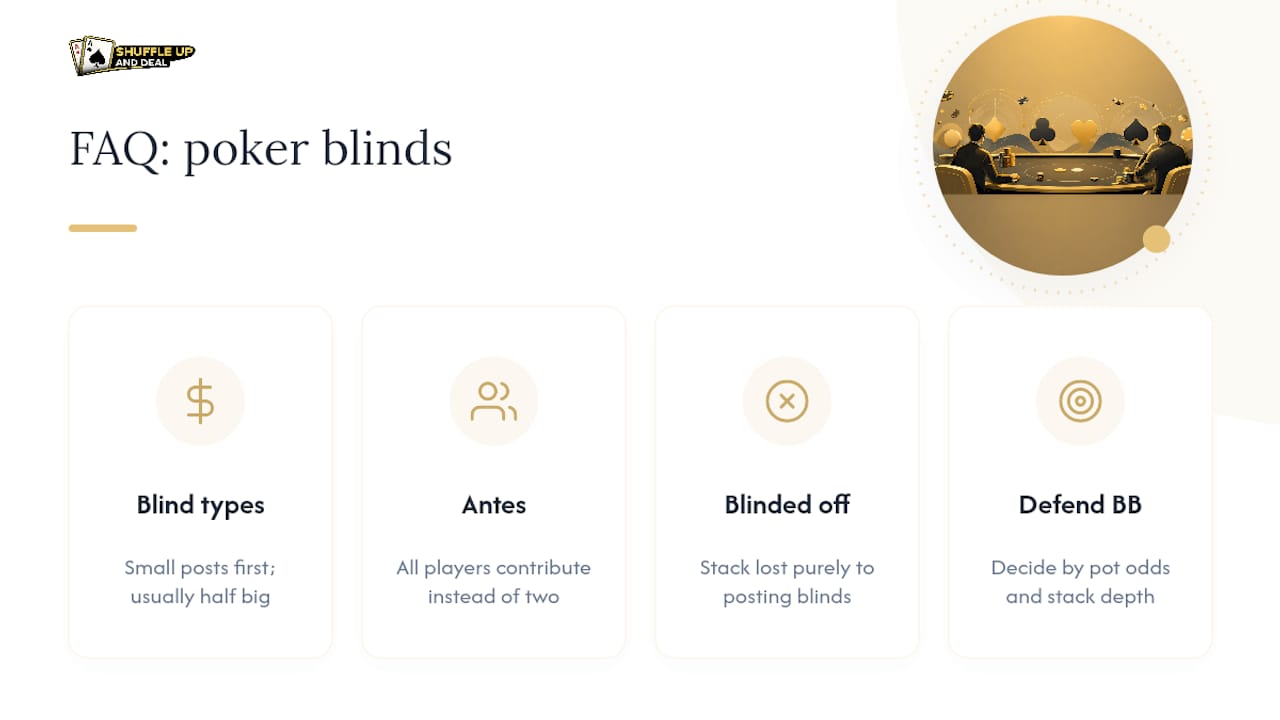
Should I always defend my big blind? No. Defend based on pot odds and stack depth against the specific raise size you’re facing, not as a reflex just because chips are already committed.
Sources
- Blind Structure Calculator - PokerSoup
- Defending the big blind: Poker strategy guide for 2026 - DeucesCracked
- Big blind defence - Preflop Wizard blog