
Poker Tournament Management App
Run Poker Tournaments Like a Pro!
From First Hand to Final Table
Seat draws, table balancing, the clock, payouts and league standings: Shuffle Up and Deal! runs the whole night from your iPhone or iPad.


In Under a Minute, TDs Can Prove Poker Seat Draws Are Fair

Random seat assignment, run transparently, is the accepted standard for fair seating in tournaments and the sensible default for formal cash games too. Organisers can meet that standard with a documented manual draw (cards, numbered slips, witnesses) or a verifiable digital draw using commitment-reveal cryptography. This article walks through both, shows how they align with Tournament Directors Association guidance, and gives you a checklist to run every time.
TL;DR:
- Manual seat draws should be transparent, involve independent witnesses, and be photographed or logged immediately after completion.
- Digital systems must generate and publish a seed hash before the draw, then reveal the seed afterward for verification.
- Late entries and re-entries must be assigned seats randomly from the same pool as regular players, regardless of registration time.
- Following the Tournament Directors Association guidelines ensures seatings are truly random and disputes are minimized.
- Automated tools like Shuffle Up and Deal! streamline fair seat assignment and maintain an auditable process for large or online tournaments.
Table of Contents
- What is a seat draw and when do you need one?
- Manual draw methods that hold up under scrutiny
- Digital and provably fair draws explained simply
- TDA-style rules every organiser should know
- A practical checklist for running a fair draw
- Handling disputes without losing player trust
- How Shuffle Up and Deal! supports fair, auditable seating
- Why documented process matters more than the method itself
- Run your seating draws with less guesswork
- Sources
- FAQ
What is a seat draw and when do you need one?
A “draw for seats” is simply the process of assigning players to specific seats using a random method, rather than letting people choose or an organiser hand-pick placements. Most rooms use a shuffled deck, numbered slips pulled from a container, or a random number generator tied to registration numbers. The alternative, informal house rules like “first come, first served” or friends sitting together, works fine for a casual home game but creates real problems once money and reputation are on the line.
Tournaments need random seating because structure changes everything: stack sizes swing, position matters more as blinds rise, and any perception that an organiser seated a friend on a short-stacked table can end a tournament series’ reputation overnight. Formal cash games benefit from the same discipline, particularly when a list of waiting players exists and seat choice could favour regulars over newcomers.
Late entries and re-entries need special handling:
- They are typically sold a full starting stack, not a discounted one, regardless of when they join.
- They get randomly assigned from the same available seat pool as everyone else, not placed wherever is convenient.
- The TDA rules explicitly extend the random-seating requirement to late entries and re-entries, closing a loophole that some smaller events still get wrong.
Manual draw methods that hold up under scrutiny
Live events still rely on manual draws constantly, and there is nothing wrong with that, provided the method is defensible; using tools like Whiskey Poker Playing Cards can add quality and authenticity to the process. Three approaches cover almost every situation.
- The double-blind two-step method. Shuffle a deck, deal one card face down per seat, then have a second person independently deal a matching card to each player. Nobody, including the dealer, controls both halves of the pairing.
- The numbered-ticket method. Print or write seat numbers on identical slips, fold them, and have players draw blind from a container. Works well for smaller fields and satellites where a full deck feels excessive.
- The hat draw. A traditional favourite for home games: names or registration numbers go into a hat or bowl, drawn one at a time against a pre-shuffled seating order.
Whichever method you pick, announce it before the draw starts. Players trust a process they were told about in advance far more than one explained after the fact. Use at least one independent witness, ideally two, and photograph or log the final assignments the moment the draw finishes.
Pro Tip: Never make a mid-draw exception, even a small one. Swapping a single seat “just this once” because a player asks nicely is the single most common way a clean draw turns into a dispute six months later.
Partial tables and alternates need the same rigour as a full field. Treat the last incomplete table exactly like a table break: randomise within the available seats rather than filling gaps in registration order, and assign alternates from the same blind draw pool as everyone else waiting.
Digital and provably fair draws explained simply
Provably fair systems solve a problem manual draws cannot: proving, mathematically, that nobody altered the outcome after seeing who was in the field. The mechanism is called commitment-reveal, and it works in three steps that most players can grasp in under a minute.
- The organiser or app generates a random seed and publishes its SHA-256 hash before the draw runs.
- The draw executes using that seed, assigning every seat.
- The seed itself is revealed afterwards, so any player can independently recompute the hash and confirm it matches what was published, proving the seed wasn’t swapped after seats were assigned.
This proves the deck or seat assignment itself was not tampered with between commitment and reveal. It does not, however, certify that the wider platform is secure or that every other rule was followed correctly. Experts researching blockchain-style provably fair poker are clear that commitment-reveal replaces blind trust with a verifiable proof of one specific claim, nothing broader.
There’s a related but distinct concept worth knowing: RNG audits. These test a random number generator’s statistical output over enormous sample runs. Passing an audit shows the generator’s distribution matches what mathematics predicts on the tested batch, but it says nothing about whether that same generator was actually used, untampered, in tonight’s live draw. Provably fair and RNG audits answer two different questions, and serious organisers need both concepts in their vocabulary even if they only implement one.

Digital draws earn their place once an event grows past what a single witness can reasonably oversee, or once players start asking pointed questions about integrity. Robust implementations lean on cryptographically secure generators and monotonic nonce counters to stop old seeds being replayed, a detail that matters far more for recurring online series than for a one-off Saturday tournament.
TDA-style rules every organiser should know
The Tournament Directors Association rulebook is the closest thing poker has to an industry standard, and its seating provisions are worth internalising rather than merely referencing when a dispute erupts.
- Random correct seating is the baseline rule: initial placement, and every subsequent placement, comes from a random process, never organiser discretion.
- Late entries and re-entries draw from the same pool. As covered above, a player who registers in level four gets the same random treatment as someone who registered before the first hand was dealt.
- Table breaks use a documented, two-step process. The full TDA rulebook sets out a script: identify which table is breaking, determine which surviving tables receive players, and randomise the specific seats those players land in, often using a card comparison method so no single person makes the call alone.
- Table balancing favours the table furthest from balanced, not the table an organiser finds easiest to reach. The worst-positioned table gets attention first, every time.
- The button moves according to fixed logic when a table breaks mid-hand, and disputes over its placement go to the floor, not to player negotiation.
- Floor decisions are final. Once a floorperson or tournament director rules on a seating dispute, play continues; the TDA framework treats floor authority as the mechanism that keeps a tournament moving rather than stalling on argument.
Publishing your table balancing playbook before the event starts, rather than improvising it live, removes most of the friction these rules are designed to prevent.
A practical checklist for running a fair draw
Consistency beats cleverness. Run through these three phases every single time and you will rarely face a credible fairness complaint.
Before the draw:
- Publish your seating procedure, late-entry policy, and (for digital draws) the seed-commitment method in advance.
- Verify every registration is confirmed and stacked correctly before the draw begins, not after.
- Decide in writing how alternates and partial tables will be handled if the field doesn’t divide evenly.
During the draw: 4. Use two-person oversight, one running the process, one witnessing it, for every manual draw. 5. Publish the seed hash on screen or on a public sheet before drawing digitally; photograph the physical draw if running one manually. 6. Log a timestamp the moment assignments are finalised, before anyone has a chance to request a change.
After the draw: 7. Publish the full seating chart immediately, ideally somewhere every player can check without asking a dealer. 8. Apply your published late-entry and re-entry rules exactly as written, with no live improvisation. 9. Keep the audit trail (hash, seed, photographs, logs) for the duration of the event and beyond, in case a question surfaces days later.
Pro Tip: Store your seed reveal and hash together in one place players can screenshot. A verification step nobody can find when they ask for it is functionally the same as having no verification at all.
Handling disputes without losing player trust
Players who question a draw usually aren’t accusing you of cheating outright. They’re reacting to variance, a run of short stacks or tough tables, and asking you to prove it wasn’t rigged. Evidence prepared in advance turns that conversation from confrontation into a two-minute lookup.
Keep these on hand at all times:
- The published seed and its hash, for anyone running a digital draw.
- Photographs or a signed log of any manual draw, dated and witnessed.
- The written procedure you published before the event started.
When a complaint comes in, verify the log first, consult the floorperson second, and reproduce the verification steps in front of the player if the method is digital. Recomputing a SHA-256 hash on the spot settles most disputes faster than any explanation could. If the complaint reveals a genuine gap, correct it publicly and treat it as an update to your written procedure rather than a one-off apology; that turns a bad moment into evidence you take fairness seriously.
How Shuffle Up and Deal! supports fair, auditable seating
Running every step above by hand is achievable for a small home game. It gets harder fast once you’re managing re-entries, multiple tables, and a room full of players checking their phones for the seating chart. Shuffle Up and Deal! was built around exactly this gap.
- Smart seating algorithms handle random assignment and table balancing automatically, applying the same logic every time rather than leaving placement to judgement calls under pressure.
- Multi-device sync keeps every director and floorperson looking at the same live data, so nobody is working from an outdated seating chart.
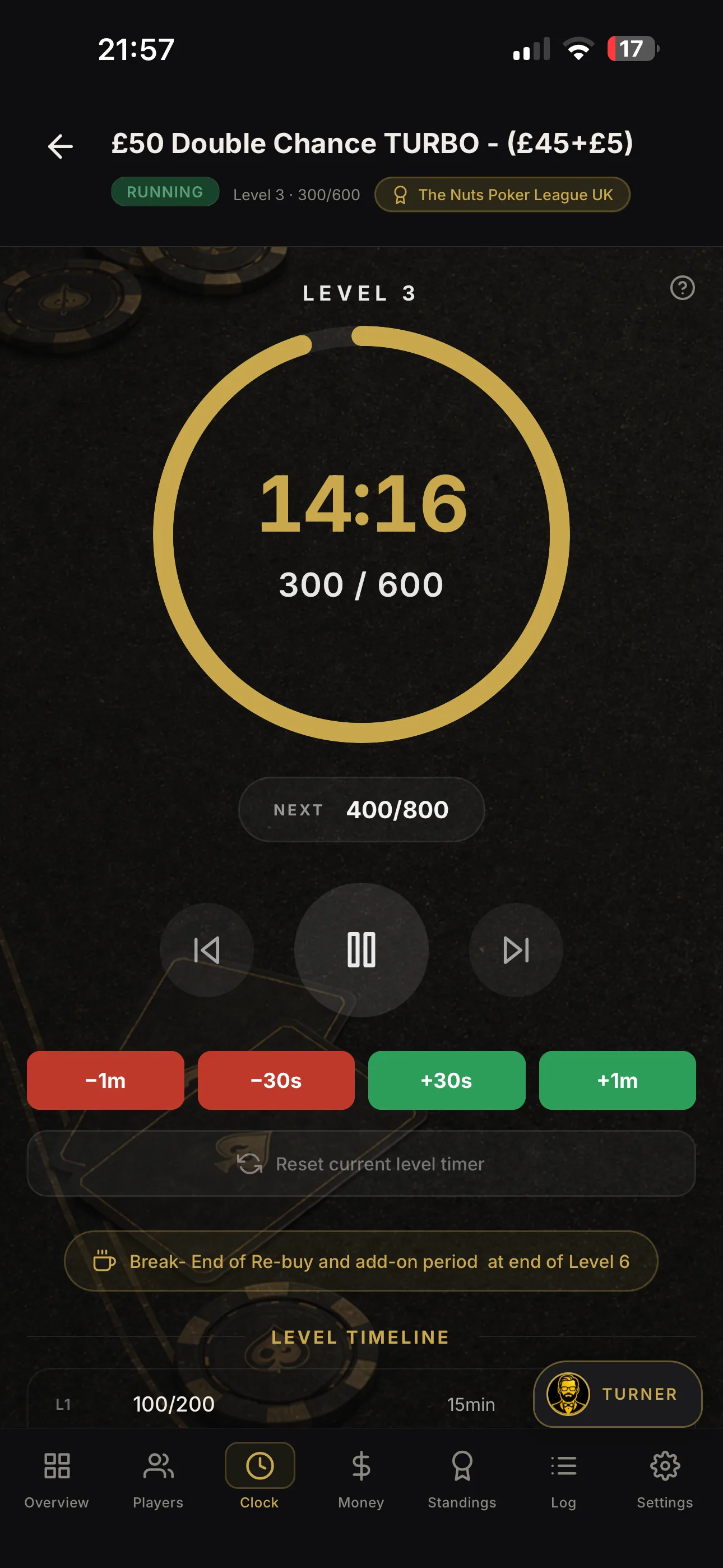
- A live tournament clock and shareable seating displays let players check their own table and seat without approaching the desk, which cuts down the perception that information is being managed selectively.
- Session data and player records build a natural audit trail, giving you the documentation this article recommends keeping without a separate spreadsheet.
Automation doesn’t replace a documented procedure; it enforces one consistently, which is precisely what reduces perceived bias across a long tournament day.
Why documented process matters more than the method itself
Most seating disputes I’ve seen written about have nothing to do with whether a draw was actually random. They happen because the organiser never explained the method beforehand, or explained it once and then quietly deviated when a friend asked for a favour. That inconsistency is what erodes trust, far more than the choice between cards and cryptography ever does.
The organisers who avoid these headaches aren’t necessarily running the most sophisticated draw. They’re the ones who write the procedure down, follow it identically every single time, and can produce evidence in under a minute when someone asks a pointed question. A hash you can’t find fast is barely better than no hash at all.
- Jason
Run your seating draws with less guesswork
There are other routes to fair seating: a shuffled deck and a witness, a spreadsheet you build yourself, or a numbered-ticket draw run by hand every level. Each works, but each also asks you to rebuild the audit trail from scratch every event. Shuffle Up and Deal! gives organisers a single native iOS platform that handles the whole run, from random seat assignment and table balancing through to the live clock and shareable displays that let players check their own seat without a queue at the desk.

That’s the practical advantage over a manual process: the fairness discipline this article describes gets applied automatically, every level, without you having to remember the procedure under pressure. Plans range from a free tier to paid subscription plans with prices that vary according to the features and scale intended for different sizes of tournaments. Head to Shuffle Up and Deal! to see which plan matches the size of tournament you’re running.
Sources
For procedural rules on random seating, table breaks, and floor authority, the TDA rulebook remains the reference organisers cite most. For the mechanics of verifiable digital draws, the provably fair cryptography primer explains commitment-reveal clearly, while the RNG audit explainer clarifies what a passed audit does and doesn’t prove.
- How poker tournament seat draws stay fair using cryptography
- Poker RNG shuffles and audits explained
- Provably fair system: seed lifecycle and nonce monotonicity
FAQ
What is the 15-25-35 rule in poker?
This isn’t a recognised seating or fairness standard; usages vary depending on context, and no consistent definition appears across tournament rulebooks. If you’ve encountered it in a specific room’s house rules, check that venue’s published procedure directly rather than assuming a universal meaning.
What is the 42 rule in poker?
There’s no standard rule with a specific number in tournament poker governance or seating procedure. It may refer to a specific home game’s private convention, but it isn’t part of TDA guidance or any widely recognised fairness framework.
Is it rude to leave a poker table after winning?
It’s not against the rules to leave after a big win, though etiquette varies by room and game type. Cash games generally allow players to rack up and go at any time, while some private games expect a reasonable session length as an unwritten courtesy.
Is poker 100% luck?
No. Poker combines chance in card distribution with skill in decision-making, betting strategy, and reading opponents over the long run. What good seat draw fairness ensures is that the luck component, who gets which cards and table, is distributed randomly rather than manipulated, so skill differences can show through over time.
How do I verify a digital seat draw was fair?
Take the seed revealed after the draw and independently recompute its SHA-256 hash, then compare it to the hash published before the draw ran. If the two match, the seed wasn’t altered after assignments were made, which is the core proof provably fair systems are designed to offer.