Poker Tournament Management App
Run Poker Tournaments Like a Pro!
From First Hand to Final Table
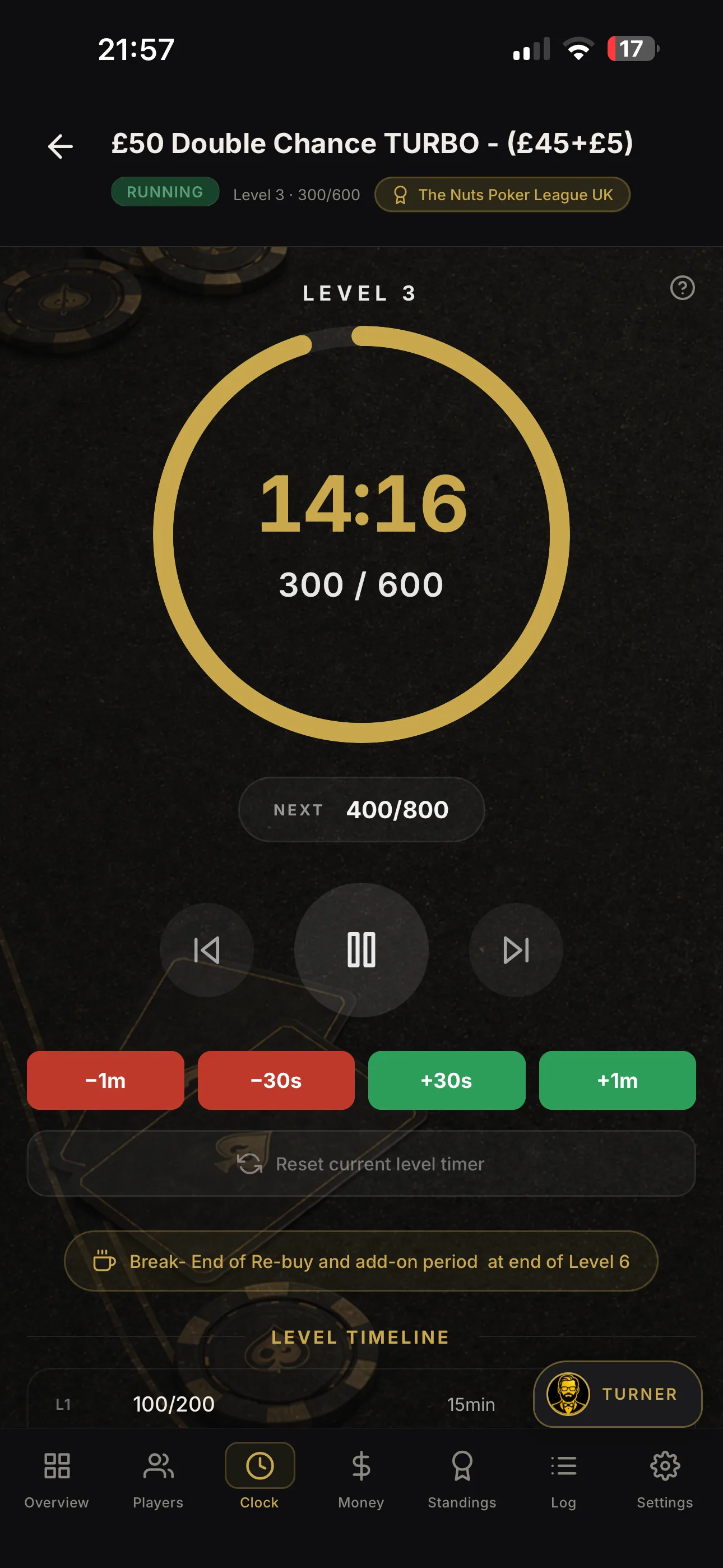
Seat draws, table balancing, the clock, payouts and league standings: Shuffle Up and Deal! runs the whole night from your iPhone or iPad.

Bubble protection poker: the UK TD's complete guide
Bubble protection is a tournament rule that refunds or compensates entrants eliminated on the money bubble, and it must be published before play begins. Three actions get you operational today:
- Publish your eligibility criteria and refund model in the tournament lobby or on your event page before registration opens.
- Assign a named staff member to confirm the bubble elimination at the table and issue the refund immediately.
- Enable the in-app refund workflow in Shuffle Up and Deal! so the record, timestamp and receipt are created in one step.
Every bubble-protection policy needs four elements:
- Who qualifies: paid cash entries only; specify whether rebuys and late registrations are included.
- What is refunded: full buy-in including fee, buy-in excluding fee, or a free re-entry ticket.
- How it is issued: cash at the cage, bank transfer, or in-app credit, processed the same day.
- How it is logged: timestamped receipt tied to the player’s registration record and table seat.
Key takeaways
Bubble protection works reliably only when eligibility is published before play begins, a named staff member confirms the bust, and the refund is logged with a timestamp the moment it is issued.
| Point | Details |
|---|---|
| Publish rules before play | State eligibility, refund model, and exclusions in the lobby before registration opens. |
| Freeze entries at the bubble | Lock the entry list the moment you announce hand-for-hand to fix eligibility. |
| Log every refund immediately | Record table ID, seat, player ID, entry method, amount, and timestamp at the point of issue. |
| Retain records for two years | Keep exported CSV receipts per event for Gambling Commission inspections or player disputes. |
| Use Shuffle Up and Deal! for one-tap refunds | Pre-configure the refund model in Shuffle Up and Deal! so issuing and logging the refund takes a single tap on the day. |
Table of Contents
- When does bubble protection make sense for your event?
- How to set clear, publishable bubble-protection rules
- Day-of workflow: running the bubble in real time
- Calculating refund amounts and UK accounting notes
- How Shuffle Up and Deal! records and exports bubble-protection refunds
- Pre-event wording and at-table announcement scripts
- Edge cases: rebuys, satellites, bounties and technical problems
- Post-event reconciliation and record-keeping
- What most TDs get wrong at the bubble (and how to fix it fast)
- Shuffle Up and Deal! makes bubble protection reliable and auditable
- Sources
When does bubble protection make sense for your event?
The core logic is ICM pressure. When a single elimination converts a near-miss into a min-cash, the chip-equity value of survival spikes far above the mathematical chip value. Research on bubble ICM strategy shows callers in high-ICM bubble spots often need a majority equity to justify a call, meaning players tighten dramatically and the game slows. Offering protection at that moment rewards the player who ran into bad luck rather than bad play.
Target protection where a single elimination triggers a meaningful pay jump, typically within roughly a fifth of the paid field. A 100-player event paying 15 spots has its sharpest ICM pressure from roughly 18 players remaining. A 30-player home game paying 3 spots feels it from 4 players out.
Formats that suit protection: single-flight live events, charity tournaments, large-field guarantees, and league finals where player goodwill matters.
Formats that generally do not: satellites (the prize is a seat, not cash), freerolls, and most bounty formats where the knockout prize already compensates short-stack aggression.
How to set clear, publishable bubble-protection rules
Copy-ready rule text saves disputes before they start. Here is a sample block you can adapt:
Eligibility checklist:
- Paid cash entry confirmed before late registration closes.
- Player seated and active at the time of the bubble elimination.
- Entry method is a direct cash purchase (not a promotional ticket or comp seat).
- Rebuys: include or exclude explicitly - do not leave it ambiguous.
Refund model options:
| Model | Pros | Cons |
|---|---|---|
| Full buy-in including fee | Maximum goodwill; simple to communicate | Operator absorbs the rake |
| Buy-in excluding fee | Operator recovers rake cost | Slightly less generous; needs clear wording |
| Free re-entry | No cash leaves the room; builds loyalty | Only works if a future event exists |
Bubble protection research confirms that offering protection can increase participation and reduce player distress, though operators may need to adjust entry fees slightly to offset the cost.
Pro Tip: If you are running a league series, the free re-entry model is often the strongest option. It costs you nothing upfront, keeps the player in your ecosystem, and gives you a marketing moment when they use it.
Day-of workflow: running the bubble in real time
A clear numbered process prevents chaos at the most tense moment of your event.
- Confirm paid places with your payout calculator before the bubble phase begins.
- Freeze late registration and lock the entry list so eligibility is fixed.
- Identify qualifying entries from the registration log; flag any promotional or satellite seats as ineligible.
- Announce the bubble at all tables: “We are now on the money bubble. Bubble protection is in effect.”
- Watch the final hand. The dealer confirms the elimination; the floor verifies the player’s seat and entry type.
- Confirm eligibility against the locked entry list before issuing anything.
- Issue the refund at the desk or via the app; hand the player a signed receipt.
- Log the timestamp immediately: table ID, seat number, player ID, entry method, refund amount, and operator name.
- Announce the bubble has burst and resume normal play.
Stack dynamics on the bubble mean short stacks shove wide and medium stacks fold tight, so eliminations can happen quickly. Freeze entries and confirm eligibility before the bubble hand, not after.
Calculating refund amounts and UK accounting notes
Three quick examples cover most scenarios:
- Full buy-in including fee: £50 buy-in + £5 fee = £55 refund.
- Buy-in excluding fee: £50 buy-in only = £50 refund; the £5 fee is retained.
- Prorated refund (multi-flight): Player paid £50 for two flights at £25 each; only one flight was active at bust = £25 refund.
A simple spreadsheet formula for the full-refund model: =BuyIn+Fee. For the fee-excluded model: =BuyIn. For prorated: =BuyIn/NumberOfFlights.
For UK card-room operators, record each refund as a negative line in your cashbox report on the day of the event. If you collect rake, the refunded portion of the rake reduces your gross rake figure for that session. Home-game organisers running non-commercial events have no VAT obligation on player refunds, but should retain receipts for at least two years in case of a Gambling Commission inspection. This guide provides general information; confirm your specific obligations with a qualified accountant or legal adviser.
How Shuffle Up and Deal! records and exports bubble-protection refunds
Bubble protection should be automated and logged immediately to avoid disputes and create a defensible audit trail. Shuffle Up and Deal! handles this end to end.
In-app steps:
- Open the active tournament and navigate to the player’s registration record.
- Mark the elimination as a bubble bust using the entry-status flag.
- Select the pre-configured refund model (full, fee-excluded, or free re-entry) from event settings.
- Tap Issue Refund; the app records the timestamp, operator ID, player ID, seat, entry type, and refund amount automatically.
- Export the refund receipt as a CSV or PDF from the audit log screen and attach it to your event reconciliation file.
The exported receipt includes: player name, player ID, entry method, table and seat at elimination, refund type, refund amount, timestamp, and the operator who processed it. Every field you need for a Gambling Commission inspection or a player dispute is there.
Pro Tip: Pre-configure your bubble-protection rule template in Shuffle Up and Deal! before the event. Set the refund model, eligibility flags, and entry-type exclusions in advance so that on the day, issuing the refund is a single tap. It takes two minutes to set up and saves ten minutes of frantic searching at the bubble moment.
Pre-event wording and at-table announcement scripts
Lobby / registration page template:
At-table announcement (bubble imminent):
Immediately after the bust:
Dispute-handling steps:
- Player raises a dispute: pause, do not deal the next hand.
- Retrieve the registration record and entry-type flag from the app.
- Confirm eligibility against the locked entry list.
- If eligibility is confirmed, issue the refund and log it.
- If disputed further, escalate to the senior TD; document the player’s claim and your ruling in writing before play continues.
- Expected resolution time: within 10 minutes at the table; written response within 24 hours for post-event claims.
Edge cases: rebuys, satellites, bounties and technical problems
- Rebuys: each rebuy is a separate entry. Specify in your rules whether the protection covers the original entry, the final rebuy, or any active entry at bust time.
- Late registrations: eligible if they registered before the freeze point and paid in cash. Never eligible if they registered after you announced the bubble.
- Satellite tickets: excluded by default unless your rules explicitly include them. State this clearly in the lobby wording.
- Bounty formats: protection typically does not apply to the bounty component; it may apply to the base buy-in. Publish this distinction before the event. See mystery bounty handling for specialist formats.
- Collusion suspicion: do not issue the refund until the hand is reviewed. Document the concern, retrieve the hand history from the app log, and escalate to the senior TD.
- Clock failure or app sync issue: revert to a manual paper log immediately. Record table ID, seat, player name, time, and entry method by hand, then reconcile with the app once connectivity is restored.
- Mistaken seat record: cross-check the seating chart display against the registration record before issuing. Correct the record in the app and note the amendment with a reason and timestamp.
Escalation path: floor staff confirm bust → TD verifies eligibility → senior TD rules on disputes → written appeal within 24 hours for unresolved claims.
Post-event reconciliation and record-keeping
- Cross-check every refunded buy-in against the exported app receipts and the cashbox report before closing the books.
- Keep the following CSV fields: player ID, entry method, refund type, refund amount, timestamp, and operator ID.
- Retain all refund records for a minimum of two years; store export files in a named folder per event date for easy retrieval during a licence inspection.
- For late claims received after the event, check the audit log for the player’s entry record and the bubble timestamp. If the claim is valid, process the refund and amend the reconciliation report with a dated note.
- If an error is found in the log, correct it in the app, export a revised receipt, and attach a brief written explanation to the event file.
What most TDs get wrong at the bubble (and how to fix it fast)
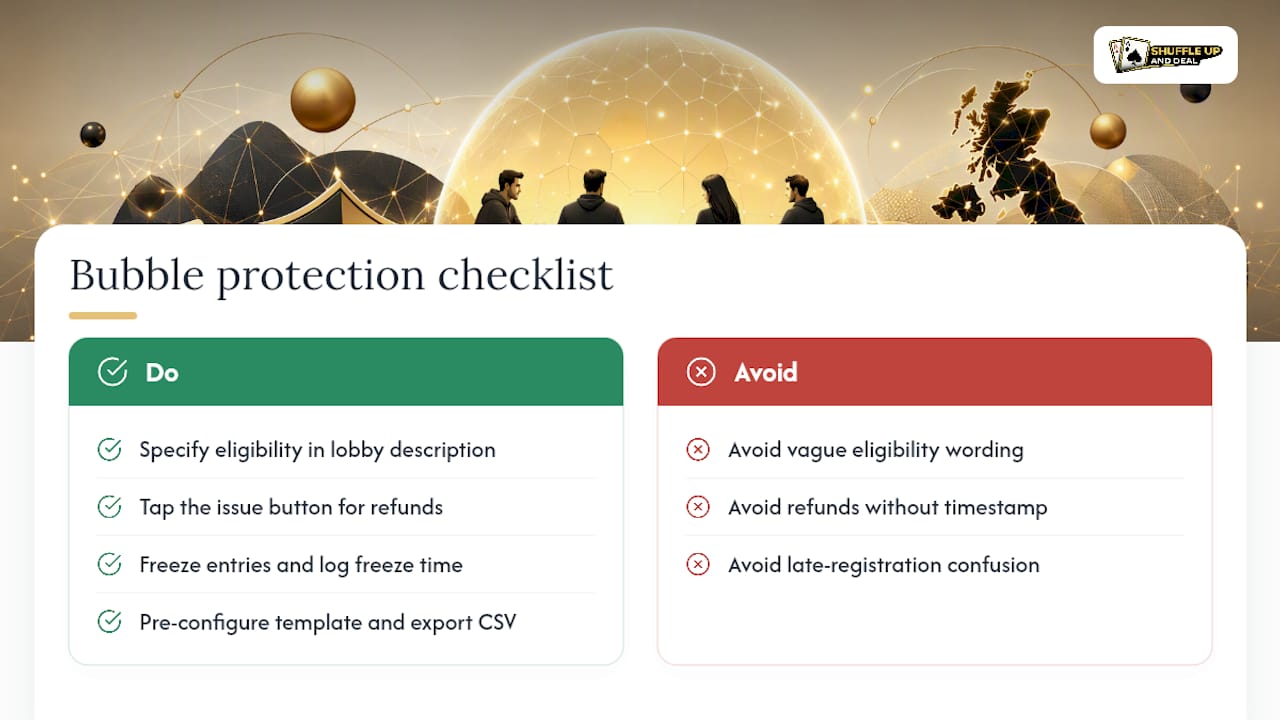
Three mistakes account for the vast majority of bubble-protection disputes, and all three are avoidable with a small amount of preparation.
The first is vague eligibility wording. When the rules say “all players” without specifying entry method, someone with a promotional ticket will expect a refund. One sentence in the lobby description eliminates that argument entirely.
The second is no timestamp. A refund issued without a logged time and operator name is almost impossible to defend if a player claims it was never processed. The audit log in Shuffle Up and Deal! solves this automatically, but only if you tap the issue button rather than handing cash informally and noting it later.
The third is late-registration confusion. TDs who forget to freeze the entry list before the bubble hand sometimes face a player who registered mid-hand claiming eligibility. Freeze entries the moment you announce hand-for-hand play, and log the freeze time in the app.
Pre-configuring a bubble-protection template before the event, then exporting a single CSV at close of play, has prevented more repeat disputes than any other single change. It takes two minutes to set up and produces a clean, timestamped record that answers almost every question a player or inspector could raise.
Shuffle Up and Deal! makes bubble protection reliable and auditable
Running bubble protection without a system is where things go wrong. Shuffle Up and Deal! gives you pre-configured bubble-protection templates, in-app refund issuing, timestamped audit logs, CSV export, entry-type flags, and an AI rules assistant for dispute guidance, all in one place on your iPhone or iPad.
For UK organisers, that means speed at the bubble moment, a clean compliance record for Gambling Commission purposes, and a receipt every player can trust. You set the refund model once in event settings, and the app does the rest: one tap issues the refund, logs the timestamp, and queues the export.
Visit Shuffle Up and Deal! to set up your first bubble-protection template and run your next event with complete confidence.
Sources
- Poker Tournament Bubble Strategy: How to Play When the Money Is Close
- Bubble Protection in Poker: An Overview - PokerHopper
This article is general information, not a substitute for advice from a qualified lawyer. Consult a qualified legal professional about your own circumstances before acting on anything here.
Recommended
- Poker chip breakdown: the UK tournament director’s guide | Shuffle Up and Deal!
- Best TDA rules app for TDs: TURNER in Shuffle Up and Deal! | Shuffle Up and Deal!
- Freezeout tournament rules: the complete guide for players and TDs | Shuffle Up and Deal!
- Best poker tournament app for UK tournament directors | Shuffle Up and Deal!