
Poker Tournament Management App
Run Poker Tournaments Like a Pro!
From First Hand to Final Table
Seat draws, table balancing, the clock, payouts and league standings: Shuffle Up and Deal! runs the whole night from your iPhone or iPad.


Start Tournaments on Time: TDA Playbook for TDs With 7 Step Checklist

Start tournaments on time by enforcing your registration cutoff, running a visible tournament clock, and working through a standard pre-start checklist before the announced hour. The Poker TDA rules give you the timing framework; an app like Shuffle Up and Deal! gives you the tool to execute it. The rest of this guide gives you the scripts and checklists to make that verdict routine.
TL;DR:
- Enforcing a strict registration cutoff and seating process reduces start delays caused by late entries and uneven table readiness.
- Pre-counted stacks, prepared supplies, and tested displays ensure tables are ready to begin precisely at the scheduled time.
- Using a consistent trigger to start the clock and maintaining clear visible timing helps prevent staggered starts caused by ambiguity or slow dealer preparation.
- A well-rehearsed verbal checklist with the floor team ensures all preparatory steps are completed in under three minutes, avoiding cumulative delays.
- Automation tools like Shuffle Up and Deal! streamline seat assignment, tournament clock display, and real-time sync, minimizing manual bottlenecks and human error.
Table of Contents
- How do you build a pre-start checklist for on-time tournaments?
- What should you prepare before players even arrive?
- What happens at the scheduled start time itself?
- How do you call the clock without killing the pace?
- How does Shuffle Up and Deal! remove start-time friction?
- Why preparation beats good intentions
- Get your next event running on schedule
- Sources
- FAQ
How do you build a pre-start checklist for on-time tournaments?
Thirty minutes before the clock starts, you should already know exactly where every problem is likely to come from. A checklist works because it removes decisions under pressure, and pressure is exactly what builds at T-minus-30.
Run through this sequence, in order, every single event:
- Close registration on schedule. Confirm the cutoff window and stop taking new sign-ups the moment it passes, no exceptions for “just one more”.
- Seat everyone registered. Full stacks go out first, and any late entries get seated as complete stacks rather than trickled in mid level.
- Confirm chip counts and colour-ups. Every starting stack should already be counted, bagged or racked, and ready to hand across without a dealer stopping to make change.
- Bring racks to breaking stations. If a table is due to break in the first level, the racks need to already be there, not fetched afterwards.
- Switch on and test the tournament clock display. Check the blind schedule loads correctly and confirm the time to the first break.
- Brief dealers on timing rules. Cover TDA action phrases, calling the clock, and deck preparation, so nobody improvises mid hand.
- Assign floor coverage. Name who is refereeing, who is running the PA or announcements, and who covers the door.
Pro Tip: Run this checklist out loud with your floor team, not silently on a clipboard. Verbal confirmation catches gaps that a tick box hides, and it takes less than three minutes for a ten-table room.
Skip any one of these seven steps and you are not risking a small delay. You are risking a staggered start where three tables begin on time and four are still shuffling five minutes later.
What should you prepare before players even arrive?
The start time is decided long before the first card hits the felt. Most delays trace back to something that should have been sorted the night before, or that morning, not scrambled together at the registration desk.
Set up online pre-registration wherever you can, and staff a dedicated fast-sign-in desk for walk-ins so payment handling never blocks the seating queue. Give one person sole responsibility for taking money and issuing receipts. That single ownership point stops the awkward moment where three staff are all assuming someone else has it covered.
Beyond the front desk, a handful of physical preparations matter more than they get credit for:
- Pre-count and bag starting stacks so dealers never stop play to make change.
- Plan colour-up denominations in advance rather than improvising them at the first break.
- Lay out seat cards, all-in buttons, and spare supplies at every table before doors open.
- Stage backup decks and shufflers within reach of each dealer, not in a store room.
- Fix your staffing chain of command, TD, floor referees, and table leads, so a decision never waits on someone finding the right person.
- Test your public displays, clock software, and any push notifications or share links before a single player checks in.
Organiser guides consistently point to the same fundamentals here: visible clocks, online registration, and proper chip and supply planning are what separate a smooth room from a chaotic one. One more thing worth flagging early: if your event charges an entry and draws the public, check whether your jurisdiction requires local approval or notification, since larger recurring events often do.
What happens at the scheduled start time itself?
The moment on the clock is where good preparation either pays off or falls apart in front of a room full of players. Seating comes first. Use a random, correct seat-draw process for both your main field and any alternates, and get full stacks dealt to every seat with no gaps.
Then start the clock, not whenever the room feels ready, but on the trigger your house rules define: the first riffle, the first dealer push, or the shuffler button, exactly as TDA recommended procedures describe. Pick one trigger and use it every time, because ambiguity here is where staggered starts begin.
From there, dealer synchronisation decides whether your tables begin together or in a slow cascade:
- Dealers prepare their decks within one minute of the start signal, per RP-20, so every table is genuinely ready at once.
- Players must be in their seat to be dealt in. Decide your house rule for absent players in advance, whether that means a sit-out or a forfeited hand, and apply it consistently.
- Announce the essentials clearly: last hand before a break, upcoming blind changes, and the late-registration cutoff, so nobody can claim they missed it.
- Keep the clock visible at all times, on a screen, projector, or shared display, so players are managing their own expectations instead of asking staff.
One number is worth building your whole dealer routine around: 60 seconds. That is the deck-prep window TDA guidance recommends between hands or after a break, and it is the difference between four tables starting together and four tables starting in a ragged sequence over several minutes. A room that treats that minute as a hard target rarely drifts far off schedule.
How do you call the clock without killing the pace?
Slow play is the single most corrosive habit in a tournament room, because one stalling player at one table quietly resets the pace for everyone else waiting on that table to act. The fix is not a debate. It is a script you already know by heart.
Once a player at the table calls for the clock, and it is seconded, you apply the standard allowance: 25 seconds, plus a 5-second countdown, and if the player is facing a bet when time expires, the hand is dead. Say it plainly, start the count out loud, and move on.
- Approve the clock request immediately once it is properly seconded, don’t hesitate or negotiate.
- Announce the countdown audibly so both players and the table hear it together.
- Rule under Rule 1 (best interest of the game) for anything genuinely ambiguous, rather than opening a floor debate mid hand.
- Move chip racks and staff to breaking tables early so seating moves the moment a table is called dead.
- Shorten the allowance for repeat offenders or for formats that need a faster pace, and publish that adjustment in your structure sheet beforehand.
Pro Tip: Publish your house time policy on the structure sheet before day one. Players who know the rule in advance rarely test it, and floor staff who know it could enforce it in seconds instead of minutes.
How does Shuffle Up and Deal! remove start-time friction?
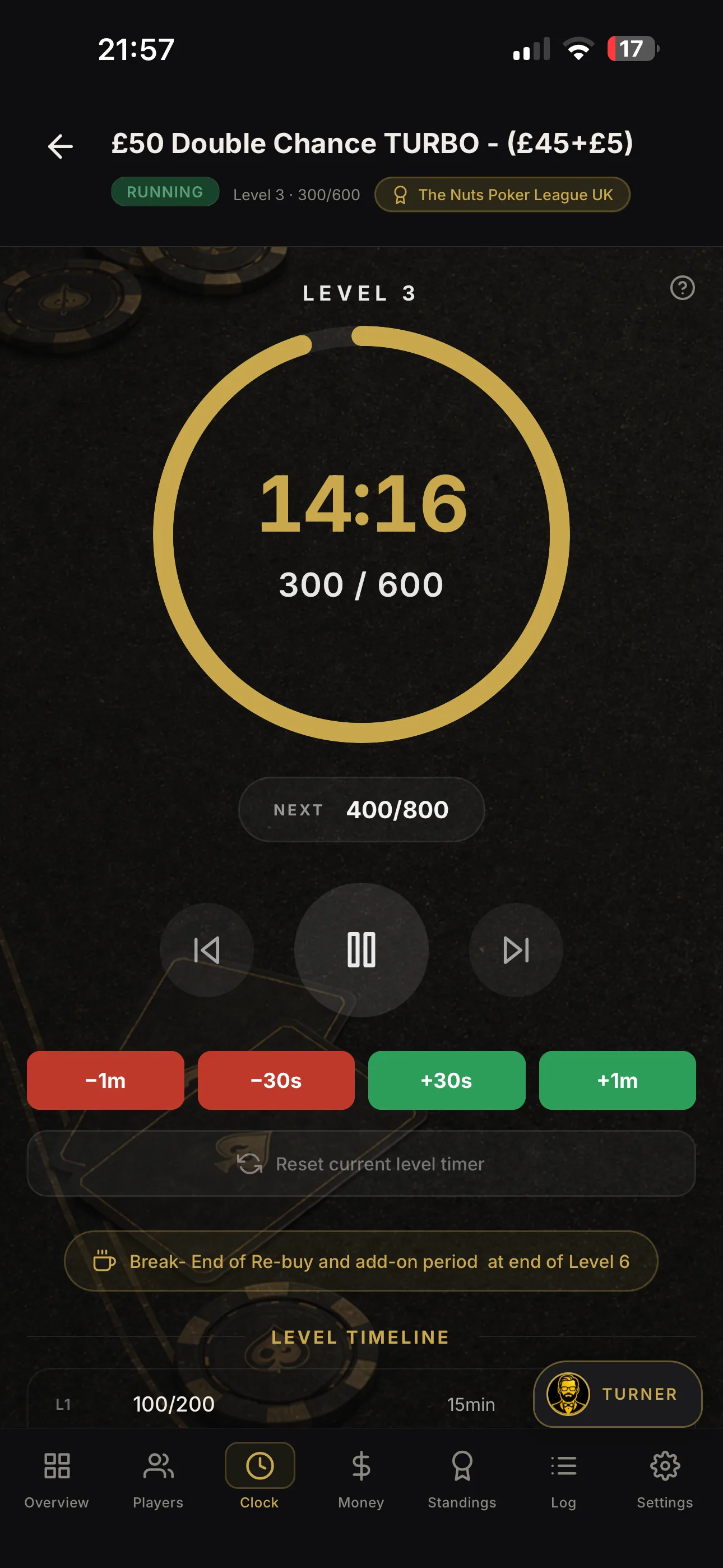
Every checklist item above is a manual task until you put software behind it. Shuffle Up and Deal! was built around exactly that gap, running the mechanics of a tournament so your floor team can focus on players instead of paperwork.
- A live tournament clock displays blind levels and break timings automatically, and advances them without a staff member watching a stopwatch.
- Smart seating assigns and pushes seats the moment registration closes, cutting the seating window that usually eats into your start time.
- Multi-device sync keeps every table lead, dealer, and floor referee looking at the same live data, so nobody is working from a stale printout.
- Public share links and casting put the clock and standings on a screen or a player’s phone, which cuts the “what level are we on” interruptions that slow a room down.
- Quick registration entry processes walk-ins and late entries as full stacks in seconds rather than minutes.
For the setup itself, Shuffle Up and Deal!'s guide to setting a TDA-aligned tournament clock and its walkthrough on rebalancing tables both cover the exact operational steps this article has laid out.
Why preparation beats good intentions
Most late starts aren’t caused by one big failure. They come from three or four small gaps, an uncounted stack, a dealer unsure of the push time, a floor staffer who assumed someone else was watching the clock, stacking up until the room is fifteen minutes behind before anyone notices. The fix is never a heroic recovery. It’s a checklist rehearsed enough times that nobody has to think under pressure.
Rooms that publish their timing rules and enforce them the same way every level rarely fight the same dispute twice. Consistency, not charisma, is what actually keeps a schedule intact.
- Jason
Get your next event running on schedule
Shuffle Up and Deal! gives you the live clock, smart seating, and multi-device sync this whole playbook depends on, in one native iOS app instead of a stack of spreadsheets, printed seat cards, and a stopwatch on someone’s phone.

Home games can start on the Home Game plan, and clubs running regular events can step up to a paid plan for the clock, seating, and registration tools covered above. Card rooms managing multiple simultaneous tables can choose from higher-tier plans that include league management and multi-event handling. Pair the app with Shuffle Up and Deal!'s guide to setting up late-registration cutoffs and its tournament clock setup walkthrough to get a room started on time this week. Head to Shuffle Up and Deal! to pick a plan and start your first tournament.
Sources
- Poker TDA rules and recommended procedures (2024)
- How to run a poker tournament: the basics and legalities
FAQ
What is the standard action time under TDA rules?
A player facing a decision gets 25 seconds plus a 5-second countdown once the clock is called, and if time runs out while facing a bet, the hand is ruled dead. TDs can shorten this allowance for faster formats or repeat slow players, as long as the change is published in advance.
How early should registration close before start time?
There’s no single universal cutoff, it depends on your format and field size, but the key rule is consistency: whatever window you set, enforce it the same way every event. Late entries should always be seated as full stacks rather than trickled into an already-running level.
Can an app really prevent staggered table starts?
Yes, largely by removing the manual bottlenecks that cause staggering in the first place. Shuffle Up and Deal! pushes seat assignments the moment registration closes and syncs the tournament clock across every device, so tables aren’t waiting on a staff member to relay information by hand.
What is the single biggest cause of late tournament starts?
Uncounted or untagged starting stacks are one of the most common culprits, since dealers end up making change instead of dealing cards. Pre-counting chips and pre-planning colour-ups, as recommended in TDA procedures, removes that bottleneck entirely.
Does Shuffle Up and Deal! work for home games as well as card rooms?
Yes, the Home Game plan covers casual events at no published cost, while card rooms running multiple simultaneous tables typically move up to a paid plan for the added league and multi-event features. Full plan details are available at Shuffleup. Full plan details are available at Shuffleup.